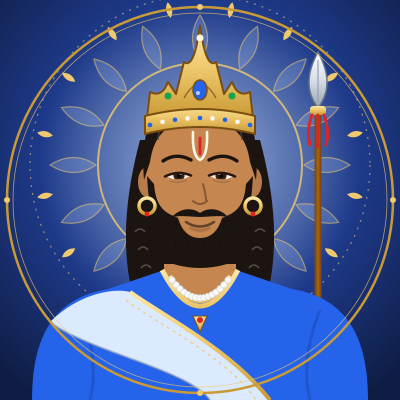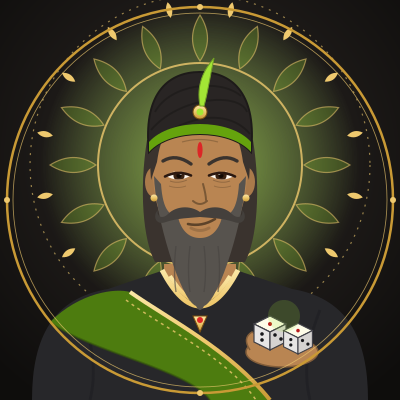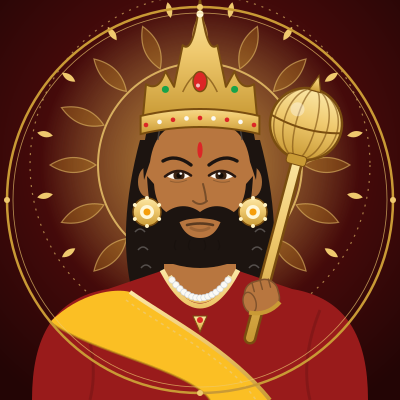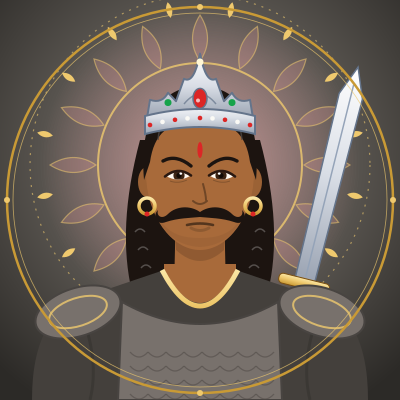
Key moments
- Maya builds a wonderful hall of illusions for Yudhishthira
- Bhima defeats Jarasandha after fourteen days of wrestling
- Bhishma gives the first honour at the Rajasuya to Krishna
- Shishupala's hundred offences end with the Sudarshana discus
- Yudhishthira loses everything, even Draupadi, in Shakuni's game of dice
- Draupadi asks: did he stake himself first, or me?
- Draupadi prays to Govinda and her garment becomes endless
- The Pandavas lose again and go to the forest for thirteen years
The Wonderful Hall of Maya
Maya kept his promise. He fetched rare materials from a lake called Bindusaras in the mountains, and from there he also brought a mighty mace for Bhima and a great conch, Devadatta, for Arjuna. In fourteen months he built a hall for Yudhishthira that had no equal on earth. It sparkled with gold and jewels, it had pools with lotuses and crystal floors, and it was full of clever illusions.
Not long after, the sage Narada visited the hall. He asked Yudhishthira many questions about how he ruled: did he care for farmers, honour the wise, pay his soldiers on time and protect the weak? Yudhishthira listened humbly and promised to follow this advice. Then Narada described the heavenly halls of the gods Indra, Yama, Varuna and Kubera, and of Brahma himself.
Narada said that he had seen Yudhishthira's father, King Pandu, in the hall of Yama. Pandu had sent a message: “Tell my son to perform the Rajasuya.” The Rajasuya is a great sacrifice in which all the kings of the land accept one king as their emperor. Narada added a warning: such a sacrifice can sometimes lead to a great war in which many warriors perish.
Yudhishthira's ministers and brothers encouraged him, but he wanted to hear from the one person whose advice he trusted most. He sent for Krishna.
Jarasandha of Magadha
Krishna came quickly from Dwarka. He told Yudhishthira that he was worthy of the Rajasuya, but one king stood in the way: Jarasandha of Magadha. Jarasandha was so powerful that the Yadavas themselves had left Mathura and built Dwarka to escape his attacks. He had captured many kings and kept them in his prison, planning to offer them in a sacrifice. “As long as Jarasandha lives,” said Krishna, “no one can perform the Rajasuya.”
Krishna told the story of Jarasandha's birth. His father, King Brihadratha, had two queens but no son. A sage gave the king a blessed mango, and the king gave half to each queen. Each queen gave birth to half a child. In horror the halves were thrown outside, and a rakshasi named Jara joined them together. The child came to life and was named Jarasandha, “joined by Jara.”
Krishna said, “Jarasandha cannot be defeated by an army, but he can be defeated in single combat.” So Krishna, Bhima and Arjuna went to Magadha dressed as learned Brahmins. They did not enter by the main gate but broke through a hill at the edge of the city. Jarasandha received them with respect, but he soon saw from the marks of the bowstring on their arms that they were warriors. Krishna then told him who they were and challenged him to fight one of them.
Jarasandha chose Bhima, for he would not fight Krishna, whom he called a cowherd, or Arjuna, whom he called a boy. The wrestling began on the first day of the month of Kartika. Day and night the two giants fought, without food or rest, for thirteen days. On the fourteenth night Jarasandha grew tired. Krishna gave Bhima a sign that the moment had come to use his full strength.
Bhima understood. He lifted Jarasandha high above his head, whirled him round many times, and split him into two. The terrible king of Magadha fell. Krishna, Bhima and Arjuna went to the prison and set all the captured kings free. The grateful kings promised to help Yudhishthira's Rajasuya.
Krishna did not take Jarasandha's kingdom. He crowned Jarasandha's son Sahadeva as king of Magadha, and the new king became a friend of the Pandavas. This shows that the purpose of the battle was to free the prisoners and protect dharma, not to grab land.
The Rajasuya and Shishupala
Now the four younger brothers set out in four directions. Arjuna went north, Bhima east, Sahadeva south and Nakula west. Some kings welcomed them as friends, others fought and were defeated, and all accepted Yudhishthira as emperor and sent tribute. Indraprastha overflowed with treasure.
The Rajasuya began with great splendour. Kings, sages and Brahmins came from all over the land. Bhishma, Drona, Dhritarashtra, Duryodhana and the other Kauravas came too, and each was given a duty. Duryodhana was put in charge of receiving the gifts, and he watched with growing envy as mountains of treasure poured in for Yudhishthira.
At the end of a Rajasuya, the first honour, called agra-puja, is offered to the most worthy guest. Yudhishthira asked Bhishma whom to honour. Bhishma said, “Among all here, Krishna shines as the sun shines among the stars. Honour him first.” Sahadeva brought water and offerings and honoured Krishna, and Krishna accepted.
Then Shishupala, the king of Chedi, stood up in rage. He said that Krishna was neither a king, nor the eldest, nor a priest, and that honouring him was an insult to all the kings present. He insulted Bhishma and the Pandavas too, and he tried to lead the kings to break up the sacrifice. Sahadeva declared that he would put his foot on the head of anyone who objected to the honour of Krishna.
Bhishma then told the story of Shishupala. Shishupala was the son of Krishna's father's sister. He was born with three eyes and four arms, and a voice from the sky said that the extra eye and arms would vanish when he sat on the lap of the person who would one day end his life. When little Krishna visited and took the baby on his lap, the extra arms and eye disappeared. His mother begged Krishna to forgive her son. Krishna promised, “I will forgive him a hundred offences.”
Shishupala went on insulting Krishna, and Krishna stayed calm. Then Krishna told the assembly of Shishupala's many crimes and said that his patience had reached its limit. When Shishupala insulted him once more, Krishna released the Sudarshana discus, and Shishupala's life ended. Everyone saw a radiant light rise from his body and merge into Krishna. Then the Rajasuya was completed peacefully, and Yudhishthira was honoured as emperor.
Duryodhana's Envy and Shakuni's Plan
After the sacrifice Duryodhana stayed on at Indraprastha with his uncle Shakuni, the brother of his mother Gandhari, to see Maya's hall. The hall was full of illusions. In one place Duryodhana saw a crystal floor and thought it was water, so he lifted his clothes to step in. In another he thought a pool was a floor, walked forward and fell into the water.
Bhima laughed loudly, and so did Arjuna, Nakula, Sahadeva and the servants. Yudhishthira kindly ordered dry clothes for him. Then Duryodhana tried to walk through a wall that looked like an open door and bumped his head, and he went round a real door thinking it was closed. Every mistake made him burn with more shame.
He returned to Hastinapur sad and silent. He told Shakuni, “When I saw the wealth and glory of the Pandavas, I could not bear it. I would rather die.” Shakuni replied, “The Pandavas cannot be defeated in war, not even by the gods. But Yudhishthira loves the game of dice and does not know its tricks. I am a master of dice. Invite him to a game, and I will win everything for you.”
Together they went to King Dhritarashtra. The king loved his son too much to refuse him. He asked Vidura, who warned him firmly, “This game will cause a quarrel that will destroy our whole family. Do not allow it.” Dhritarashtra admitted that Vidura was right, but he said that fate was stronger than man.
Dhritarashtra had a new hall built, with a thousand pillars and a hundred doors, and he sent Vidura to Indraprastha to invite Yudhishthira for a friendly game. Vidura went unwillingly. He told Yudhishthira honestly, “I know this game will bring harm. Still, the king has ordered me to invite you.”
Yudhishthira said, “A game of dice causes quarrels. But I have vowed never to refuse a challenge, and I cannot disobey my uncle's call.” So he went to Hastinapur with his brothers, Draupadi and his family.
The Game of Dice
The game began in the new hall before all the elders. Duryodhana said, “I will provide the wealth to be staked, and my uncle Shakuni will throw the dice for me.” Yudhishthira said that one person playing for another was not proper, but in the end he agreed. Shakuni threw the dice, and they always fell his way.
Yudhishthira staked a necklace of rare pearls and lost. He staked jars of gold, his royal chariot, his elephants, his servants, his armies and his treasures, and lost them all one by one. Vidura stood up and begged Dhritarashtra to stop the game, saying that Duryodhana would lead the family to ruin. Duryodhana answered him rudely, and the game went on.
Yudhishthira lost his cattle, his lands, his cities and his whole kingdom. Then he began to stake his brothers. He staked Nakula and lost him, then Sahadeva. Shakuni said slyly, “Perhaps the sons of Madri are less dear to you than Bhima and Arjuna.” Stung, Yudhishthira staked Arjuna and lost him, and then Bhima, and lost him too.
At last he staked himself and lost. The hall fell silent. Then Shakuni said, “You still have one treasure left: Draupadi. Stake her and win yourself back.” Yudhishthira staked Draupadi.
Cries of “Shame!” rose from the elders. Bhishma, Drona and Kripacharya sat pale and troubled, and Vidura held his head in his hands. But the dice fell again for Shakuni. Duryodhana, Karna and Dushasana rejoiced, while the Pandavas sat with lowered heads.
Draupadi in the Assembly
Duryodhana sent his servant Pratikami to bring Draupadi as a servant of the Kauravas. Draupadi asked him, “Go and ask in the assembly: did my husband lose himself first, or me?” Pratikami brought back her question, but no one answered, and Pratikami was too afraid to go again. Then Duryodhana sent his younger brother Dushasana. Draupadi ran towards the women's rooms, but Dushasana seized her by her long hair and dragged her into the hall.
Standing before the elders, Draupadi asked her question again: “If he had already lost himself, what right did he have to stake me?” Bhishma answered sadly, “Dharma is very subtle. A man who has lost himself cannot stake what is not his own, yet a wife is said to be in her husband's keeping. I cannot decide this question.” The other elders lowered their heads in silence.
Only one voice rose for justice. Vikarna, a younger brother of Duryodhana, stood up and said, “Yudhishthira staked her after losing himself, and only because Shakuni urged him. Draupadi has not been won.” Many people in the hall praised him. But Karna, Duryodhana's close friend, scolded Vikarna harshly, spoke cruel and insulting words about Draupadi, and told Dushasana to take away the garments of the Pandavas and of Draupadi.
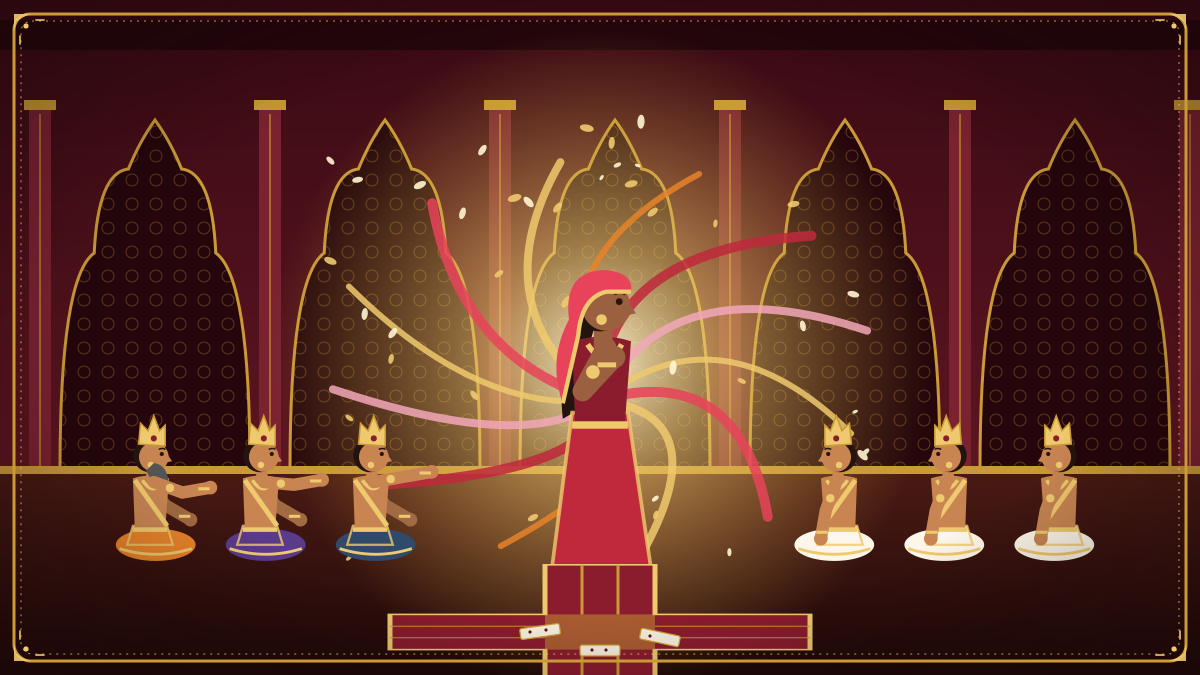
The Pandavas silently put down their upper garments. Dushasana began to pull at Draupadi's garment. Seeing that no one in the hall would help her, Draupadi called with all her heart to the Lord: “O Govinda, who lives in Dwarka! O Krishna, dear to the gopis! O Keshava! Do you not see me drowning in this sea of the Kauravas? Save me!”
By the Lord's grace a wonder happened. Each time Dushasana pulled away a garment, another of the same kind appeared, in many colours. The cloth piled up in a great heap, and still the garment had no end. At last Dushasana sat down, tired and ashamed. The people in the hall praised Draupadi and condemned Dushasana.
Bhima rose, shaking with anger, and made a terrible vow: “If I do not break the chest of this Dushasana in battle, may I never reach the world of my ancestors.” Later, when Duryodhana insultingly showed his thigh to Draupadi, Bhima made a second vow: that he would break that thigh with his mace in battle.
The Boons, the Second Game and the Exile
At that moment a jackal howled loudly in Dhritarashtra's room of sacred fire. Donkeys brayed and birds cried out on every side. Gandhari and Vidura recognised these evil omens and told the king. Frightened, Dhritarashtra scolded Duryodhana and said to Draupadi, “You are the most virtuous of my daughters-in-law. Ask me for a boon.”
Draupadi asked first that Yudhishthira be set free, so that her son Prativindhya would never be called a slave's son. Then she asked that Bhima, Arjuna, Nakula and Sahadeva be freed with their chariots and weapons. When the king offered a third boon, she declined, saying that a Kshatriya woman should ask for only two, and that greed destroys dharma. Dhritarashtra returned everything the Pandavas had lost and told Yudhishthira to forget what had happened and go home in peace.
But Duryodhana, Shakuni and Karna persuaded the king to call the Pandavas back for one more game. Gandhari begged her husband to give up their son's wishes, but he would not listen. A messenger caught up with the Pandavas on the road, and Yudhishthira returned, saying that he could not refuse his uncle's call. This time the stake was that the losers would live twelve years in the forest and a thirteenth year in hiding. If they were discovered in the thirteenth year, they would have to go to the forest for another twelve years. Again Shakuni's dice won.
The Pandavas put on clothes of deerskin. Dushasana mocked them, and the brothers made vows in return: Bhima repeated his vows, Arjuna vowed to defeat Karna in battle, and Sahadeva vowed to defeat Shakuni. Vidura said, “Kunti is old and delicate. Let her stay in my house.” The Pandavas agreed and took leave of the elders with folded hands.
Draupadi left the hall weeping, in a single garment, with her hair loose over her face. Vidura explained to Dhritarashtra what this meant: that in the fourteenth year the wives of those who had wronged her would also walk weeping with loose hair. Her untied hair became a sign she would never forget. Their priest Dhaumya walked ahead chanting sacred hymns, and the Pandavas set out for the forest, where many years of hardship and learning awaited them.
Did you know?
- The name Jarasandha means “joined by Jara”, after the rakshasi Jara, who joined the two halves of the baby.
- Shishupala and Krishna were cousins: Shishupala’s mother was the sister of Krishna’s father Vasudeva.
- The second book of the Mahabharata is called the Sabha Parva, “the Book of the Assembly Hall,” because so much of it happens in great halls.
- When King Dhritarashtra offered Draupadi a third boon, she refused it, saying that a noble woman should ask for no more than two.
What this chapter teaches us
Jealousy and greed can lead even a royal family to shameful deeds, and staying silent in the face of injustice is itself a wrong. Vikarna showed that one honest voice matters even when everyone else is quiet. When Draupadi turned to God with her whole heart, she was protected. Whoever calls to the Lord with a true heart is never alone.