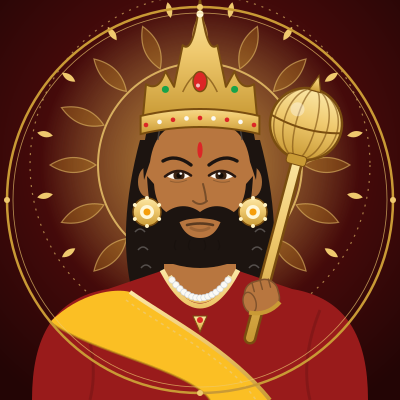
Duryodhana was the eldest of the hundred sons of the blind King Dhritarashtra and Queen Gandhari of Hastinapur. His father’s younger brother, King Pandu, was the father of the five Pandavas, so the Pandavas were his first cousins. Shakuni, Gandhari’s brother, was his maternal uncle; Dushasana was the brother closest to him; and Karna was his dearest friend. Duryodhana was brave, proud, generous to his friends and one of the greatest mace-fighters of his age. But from childhood he could not bear the success of his cousins, and he believed the throne belonged to him alone. Again and again the elders, his own parents and even Shri Krishna begged him to make peace. He would not listen, and his stubbornness led to the war at Kurukshetra and the fall of his whole family.
Born amid evil omens
Gandhari had once served the sage Vyasa with great care, and he blessed her with a hundred sons. She became pregnant, but two long years passed and no child was born. Then news came that Kunti, Pandu’s wife, had already given birth to Yudhishthira. In grief Gandhari struck her own womb, and what came out was a hard lump of flesh.
Vyasa came at once. He had the lump sprinkled with cool water, and it divided into a hundred and one pieces. These were kept in pots of ghee and carefully guarded. In time the first pot opened and Duryodhana came out; from the others came his ninety-nine brothers and one sister, Duhshala. The epic says Bhima was born on the very same day as Duryodhana.
As soon as he was born, Duryodhana cried out like a donkey. Donkeys, jackals, vultures and crows answered from all sides, fierce winds blew and fires broke out. Vidura and the Brahmanas told Dhritarashtra plainly that this child would ruin the family and advised him to give the baby up, for one may be given up to save a family. But Dhritarashtra loved his firstborn too much to agree.
The name Duryodhana means “one who is hard to fight against”; in some places the epic also calls him Suyodhana, “the good fighter”. Dhritarashtra had one more son, Yuyutsu, born of a Vaishya woman who served in the palace, who later joined the Pandavas.
Jealousy of Bhima
After King Pandu died in the forest, Kunti brought her five sons to Hastinapur, and the cousins grew up together. Bhima played roughly with the Kaurava boys: he pulled their hair, held them under water and shook the trees they had climbed until they fell like fruit. The epic says this was childish high spirits, not hatred, but Duryodhana took it as an insult.
He decided to get rid of Bhima. At a water-sports outing on the Ganga at Pramanakoti, he secretly mixed a deadly poison into Bhima’s food. When Bhima fell unconscious, Duryodhana tied him with creepers and pushed him into the river.
Bhima sank to the world of the Nagas. The snakes bit him, and their venom destroyed the poison. The Naga Aryaka, related to Kunti’s family, recognised him, and the Naga king Vasuki gave him a drink of great strength. After eight days Bhima came home stronger than ever. Vidura advised the Pandavas to keep quiet and stay watchful.
The princes learned the arts of war from Kripacharya and Dronacharya. Duryodhana became a master of the mace, equal to Bhima, and Balarama, Krishna’s elder brother, was his teacher in mace-fighting. But the more praise his cousins won, the more bitter he became.
Karna’s friendship and the house of lac
At the great tournament of the princes, an unknown young warrior, Karna, matched every feat of Arjuna and challenged him to a duel. Kripacharya asked him to name his parents and royal family, and Karna lowered his head in silence. Duryodhana sprang up, saying a man may be great by birth, by courage or by leading an army, and had Karna crowned king of Anga on the spot.
Karna asked what he could give in return. “Your friendship forever,” Duryodhana replied. When Bhima mocked Karna as a charioteer’s son, Duryodhana defended him. From that day Karna was his dearest friend. The epic later tells that Karna helped Duryodhana carry off the daughter of King Chitrangada of Kalinga from her swayamvara, defeating all the kings who opposed them; she became Duryodhana’s queen.
As the years passed, the people began to say that Yudhishthira, the eldest prince, should be king. Duryodhana feared the throne would then pass to Yudhishthira’s sons forever. He pressed his father to send the Pandavas to Varanavata, where his minister Purochana built them a house of lac and resin that would burn easily.
But Vidura warned Yudhishthira in a hidden language and sent a miner to dig a tunnel. After a year Bhima set the house on fire himself, and the Pandavas escaped with Kunti. Purochana died in the flames, and everyone believed the Pandavas were dead. Then they reappeared at Draupadi’s swayamvara, where Arjuna won her hand, and on the elders’ advice they were given half the kingdom and built Indraprastha.
The Maya Sabha and the game of dice
At Yudhishthira’s great Rajasuya sacrifice, Duryodhana was given the task of receiving the kings’ gifts. Seeing the endless treasure that flowed into Indraprastha, his heart burned. He stayed on to see the wonderful assembly hall built by Maya.
The hall was full of tricks of the eye. Duryodhana mistook a crystal floor for water and lifted his clothes, then fell into a real pool, thinking it was floor. Bhima laughed, and so did the servants. He also struck his head on a door that only looked open. Yudhishthira kindly sent him dry clothes, but Duryodhana went home deeply wounded in his pride.
In Hastinapur he grew pale and thin. He told Shakuni and his father that he could not bear his rivals’ prosperity and would rather die. Shakuni said Yudhishthira loved dice without being skilled, while he himself had no equal. Vidura warned that the game would destroy the family, but Dhritarashtra gave in and invited the Pandavas.
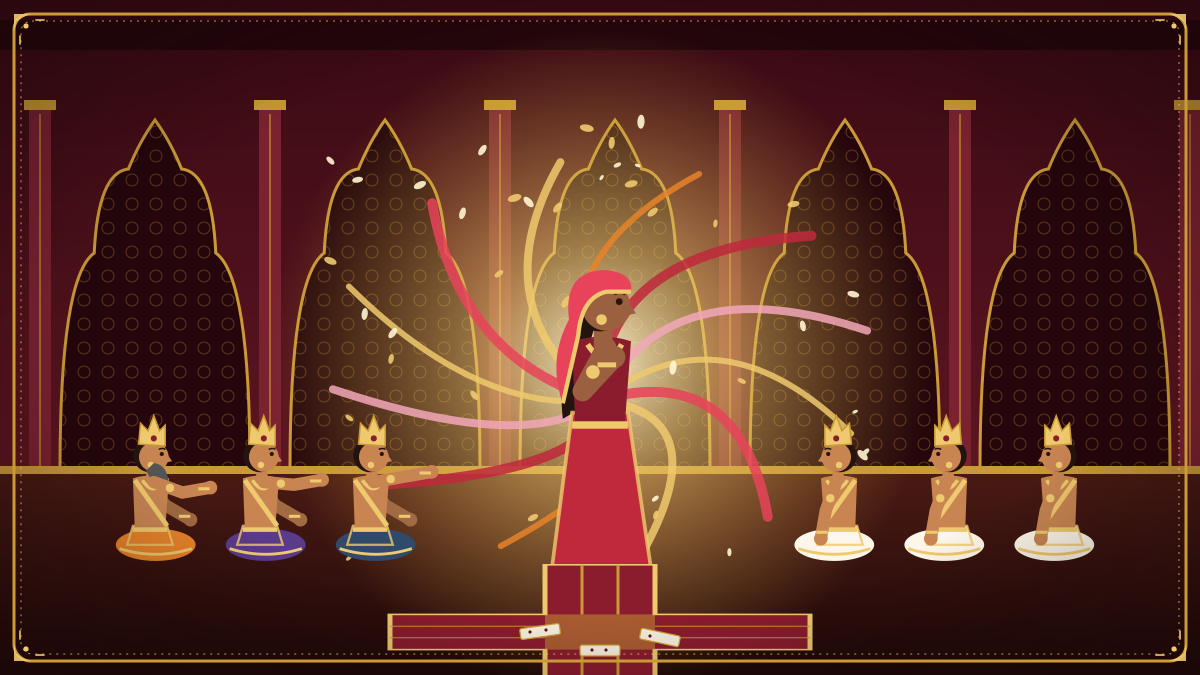
Duryodhana provided the stakes and Shakuni threw the dice for him. Yudhishthira lost his wealth, his kingdom, his brothers, himself and finally Draupadi. Duryodhana had Dushasana drag Draupadi into the assembly, called her a servant, and showed her his thigh in an insulting gesture. Bhima vowed that one day he would break that thigh with his mace.
Frightened by evil omens, Dhritarashtra gave Draupadi boons, and she freed her husbands. But Duryodhana persuaded his father to call them back for one more game: the losers would spend twelve years in the forest and a thirteenth in hiding. Gandhari begged her husband to give up this son, but he would not. The Pandavas lost again and left for the forest.
The forest years: shame and pride
During the exile, the sage Maitreya advised Duryodhana to make peace with his cousins. Duryodhana only slapped his thigh and scratched the ground with his foot. Angered by this disrespect, Maitreya cursed him that Bhima would break that very thigh in battle.
Karna and Shakuni then suggested that Duryodhana visit the Dvaita forest, where the Pandavas lived, in full royal splendour, so the exiles would see his wealth and suffer. On the excuse of inspecting the royal cattle, he set out with a great procession. Near a lake he clashed with the Gandharvas led by Chitrasena. Karna had to flee, and Duryodhana was taken prisoner with his brothers and the royal ladies.
His ministers ran to Yudhishthira for help. Yudhishthira said that among themselves they were five and a hundred, but against outsiders they were a hundred and five. He sent Bhima and Arjuna, and Chitrasena, Arjuna’s friend, released the prisoners. Yudhishthira gently told Duryodhana to go home without sorrow.
That kindness hurt Duryodhana more than defeat, and he resolved to fast unto death. Karna, Dushasana and Shakuni pleaded in vain. Then, the epic says, the Daityas and Danavas of the underworld drew him to them by a magic rite and promised that demonic powers would enter the warriors on his side. Comforted, he gave up his fast, and Karna vowed to kill Arjuna.
The priests told Duryodhana he could not perform a Rajasuya while Yudhishthira and his own father lived, so he performed the grand Vaishnava sacrifice instead. Yudhishthira declined the invitation because of his vow of exile. In the thirteenth year Duryodhana joined the raid on King Virata’s cattle, hoping to expose the hidden Pandavas, but Arjuna alone defeated the whole Kaurava army.
Peace refused and the great war
When the thirteen years were over, Duryodhana refused to return the Pandavas’ kingdom. He and Arjuna both went to Dwaraka to seek Krishna’s help. Duryodhana sat near Krishna’s head as he slept, and Arjuna at his feet. Krishna saw Arjuna first and gave him the first choice: Krishna alone, unarmed, or his huge Narayani army. Arjuna chose Krishna, and Duryodhana went away happy with the army. He also won over King Shalya, the Pandavas’ own uncle, through secret hospitality.
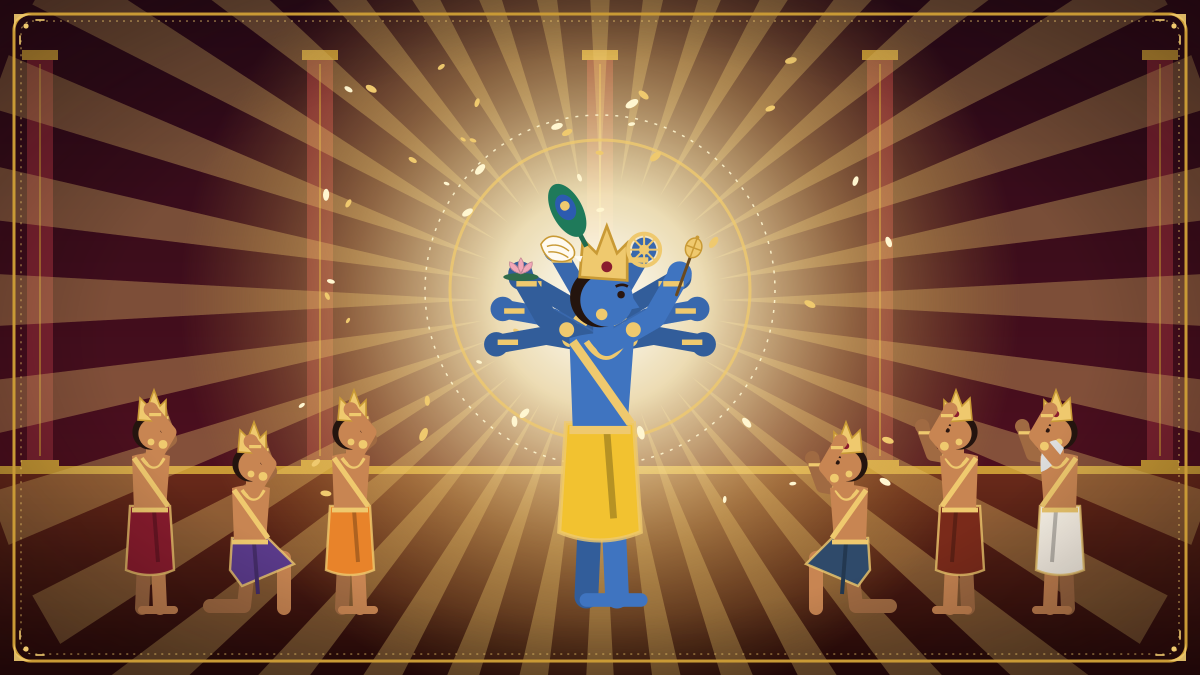
Yudhishthira had said he would accept even five villages. When Krishna came as a messenger of peace, Bhishma, Drona, Vidura and Gandhari all begged Duryodhana to agree. He answered, “Without war I will not give them even as much land as the point of a needle.” He and his companions even planned to capture Krishna, but Krishna showed his divine universal form, and the plan came to nothing. Eleven armies gathered on Duryodhana’s side and seven on the Pandavas’. Each day he asked his mother for her blessing, and Gandhari only said, “Where there is dharma, there is victory.”
Bhishma was his first commander. As losses mounted, Duryodhana kept complaining that the grandsire was sparing the Pandavas out of love. Bhishma, hurt, fought with fresh fury, though he had said from the start that he would not kill the sons of Pandu. Then Drona became commander, and Duryodhana asked him to capture Yudhishthira alive, so he could defeat him at dice again. When this failed, and Arjuna killed Jayadratha in spite of Drona’s guard, Duryodhana blamed Drona for favouring his pupil Arjuna.
On the thirteenth day his son Lakshmana fell to Abhimanyu. Then Karna led the army, but on the seventeenth day he was killed by Arjuna, and Duryodhana wept bitterly for his friend. When Kripacharya urged peace even then, Duryodhana replied that after sending so many friends to their death, he could not live as a king by Yudhishthira’s mercy. He made Shalya commander for the last day.
The lake, the mace duel and the end
On the eighteenth day Shalya was killed by Yudhishthira and Shakuni by Sahadeva, and the Kaurava army was destroyed. Duryodhana, alone and wounded, took his mace and left the field. He entered the Dvaipayana lake and, by a special power, made the waters stand still around him and hid inside. Hunters told Bhima where he was, and the Pandavas came with Krishna.
Yudhishthira mocked him for hiding. Duryodhana said the empty earth was now Yudhishthira’s; he himself would go to the forest. Yudhishthira refused the kingdom as a gift and offered: “Fight any one of us with any weapon you choose. If you win, the kingdom is yours.” Krishna was dismayed at this risky offer. Duryodhana rose from the water and chose to fight Bhima.
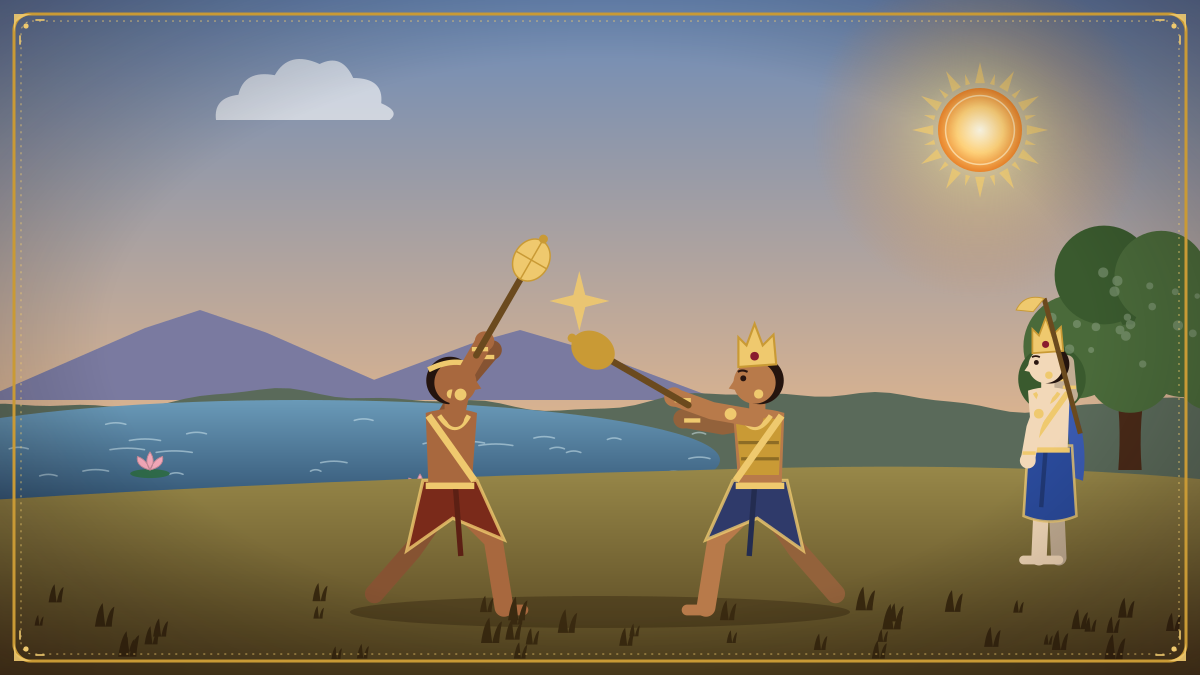
Just then Balarama returned from his pilgrimage to watch his two pupils, and the duel was fought at Samantapanchaka in Kurukshetra. Duryodhana seemed the more skilful. Krishna told Arjuna that Bhima could not win fairly and must keep his vow, and Arjuna struck his own thigh as a sign. Bhima understood, and with a mighty blow broke Duryodhana’s thighs. Balarama was furious that a blow below the navel had been struck against the rules and raised his plough, but Krishna calmed him, reminding him of Bhima’s vow and Maitreya’s curse.
Lying on the ground, Duryodhana blamed Krishna for the unfair fall of Bhishma, Drona and Karna. Krishna replied that every sorrow had come from his own wrongs. Duryodhana answered, “I have studied, given gifts, ruled the earth and stood over my enemies. Who has had a better end? I go to heaven with my friends and brothers, while you stay behind to grieve.” At once a rain of fragrant flowers fell on him from the sky, and the Gandharvas played music in his honour.
That night Ashwatthama, Kripacharya and Kritavarma found him, and at his wish Ashwatthama was anointed as the last commander. After Ashwatthama’s night attack on the Pandava camp, Duryodhana heard his report and then breathed his last. Long afterwards, when Yudhishthira reached heaven, he was amazed to find Duryodhana there, shining in glory. The sage Narada explained that Duryodhana had won the heaven of heroes by fighting without fear and dying on the battlefield facing his foes.
Did you know?
- According to the epic, Duryodhana and Bhima, the two great rivals, were born on the same day.
- Duryodhana learnt mace fighting from Balarama, Krishna’s elder brother, who thought of him as a favourite pupil.
- Vyasa’s text sometimes calls him Suyodhana, “the good fighter”, as well as the more common Duryodhana, “the one who is hard to fight”.
- When Yudhishthira reached heaven, he found Duryodhana already there, because he had died fighting bravely on the battlefield.
What we learn from Duryodhana
Duryodhana had courage, loyalty to his friends and a king’s pride, and even the heavens honoured his bravery at the end. Yet jealousy ruled his heart, and he turned away every chance of peace that his elders, his parents and Shri Krishna himself offered. His story teaches that envy and ego can turn great gifts into great ruin. Listening to good advice in time can save a whole family.
Duryodhana in the story
Read the chapters where Duryodhana plays a part.