Key moments
- Surya gives Yudhishthira the never-emptying Akshaya Patra
- Krishna promises Draupadi that her tears will be avenged
- Arjuna fights Shiva as a hunter and wins the Pashupata
- Urvashi's curse becomes a blessing for the year in disguise
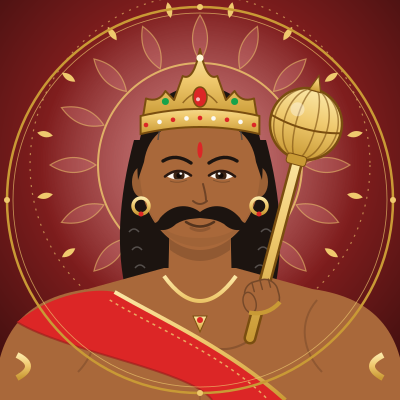
- Bhima cannot lift Hanuman's tail
- Yudhishthira frees Duryodhana from the gandharvas
- Krishna eats one leaf and satisfies Durvasa's disciples
- Yudhishthira answers the Yaksha and chooses Nakula
Leaving Hastinapur
Having lost everything at the game of dice, the Pandavas and Draupadi put on clothes of deer-skin and bark and set out from Hastinapur. Yudhishthira walked with his face covered, Bhima kept looking at his mighty arms, and Draupadi walked with her hair untied, weeping. Their mother Kunti was old, so she stayed behind in Vidura's home.
The people of Hastinapur could not bear it. Crowds followed the brothers, crying, “Where the Pandavas live, that is our city. We will not stay in a kingdom ruled by Duryodhana.” Yudhishthira lovingly folded his hands and asked them to go back and look after Kunti, Vidura and the elders. The citizens returned, but many Brahmins went with the brothers into the forest.
The first night they rested on the bank of the Ganga under a great banyan tree. Yudhishthira was troubled: “I have nothing left. How will I feed these good Brahmins who have followed me?” The wise sage Shaunaka spoke to him about controlling the mind, and the family priest Dhaumya advised him to pray to Surya, the Sun god, who nourishes every living being.
Dhaumya taught him the hundred and eight names of Surya. Yudhishthira stood in the Ganga, fasting and controlling his breath, and prayed with full devotion. Surya appeared, shining like fire, and gave him a copper vessel. “Whatever food is cooked in your kitchen,” said the Sun god, “this vessel will keep it from running out, every day for twelve years, until Draupadi has eaten.” This was the Akshaya Patra, the vessel that never empties.
From then on, Draupadi would first serve the guests, the Brahmins and her husbands, and only then eat herself. As long as she had not eaten, the food never ran out. Even in the forest, no guest of the Pandavas ever went away hungry.
Kirmira, Kamyaka and Krishna's promise
On their way to the Kamyaka forest, in the dark of the night, a fearsome rakshasa named Kirmira blocked their path. He was the brother of Baka and a friend of Hidimba, both of whom Bhima had killed earlier, and he had come for revenge. Draupadi shut her eyes in fear, and Dhaumya chanted protective mantras. Bhima pulled up a tree and fought the demon, and at last he defeated and killed him. The forest became safe for the sages who lived there.
When the news of the exile reached Krishna, he came at once to Kamyaka with warriors of the Vrishni and Bhoja clans. He was so angry with Duryodhana that it seemed he would destroy the wrongdoers that very day. Arjuna calmed him by remembering his glories, and said that Krishna and he were Nara and Narayana, the ancient sages.
Then Draupadi came before Krishna and could no longer hold back her tears. “I am the daughter-in-law of the Kuru house and the wife of five heroes,” she said, “yet I was dragged into the assembly and insulted, and no one stopped it. These mighty husbands of mine sat silent. It feels as if I have no husbands, no sons, no brothers, no father, and not even you, Madhusudana.” She covered her face with her soft hands and wept.
Krishna said to her, “Lady, the wives of those who have made you angry will one day weep just as you are weeping now. I promise you, you will again be a queen among queens. The sky may fall, the Himalaya may break apart, the earth may shatter and the ocean may dry up, but my words will never be false.” Hearing this, Arjuna looked at Draupadi and said, “Do not weep. What Krishna has said will surely come true.”
Krishna also explained why he had not come during the game of dice. He had been away fighting King Shalva, who had attacked Dwarka. “If I had been there,” he said, “I would have come without being called and stopped that game.” Then Krishna took Subhadra and young Abhimanyu with him to Dwarka, and Dhrishtadyumna took Draupadi's sons to the kingdom of Panchala.
Patience or war?
After some time the Pandavas went to live by the beautiful lake of Dvaitavana. But Draupadi's heart had no peace. One evening she said to Yudhishthira, “I see you sleeping on grass, you who once slept on soft beds. How can you stay calm? A Kshatriya who never shows anger is not respected by anyone.”
Yudhishthira answered gently, “Anger destroys the one who holds it. Forgiveness is the strength of the strong. It is truth, it is dharma, and it keeps the whole world standing. I gave my word in the assembly, and I will keep it.” When Draupadi complained that God plays with people like puppets, Yudhishthira told her that doing right is never wasted.
Bhima was even more impatient. “Every day of these thirteen years is like a year to me,” he said. “Let us gather our friends and win back our kingdom now.” Yudhishthira reminded him that Bhishma, Drona and Karna stood with Duryodhana, and that a promise once given cannot be broken. Bhima fell silent, though his heart still burned.
Just then the sage Vyasa came to them. He told Yudhishthira that in the war to come, divine weapons would be needed, and that only Arjuna could win them. He taught Yudhishthira a secret knowledge called Pratismriti and asked him to pass it on to Arjuna, and he advised them to move back to the Kamyaka forest. Soon after, Arjuna took leave of his brothers and Draupadi and set out alone for the Himalayas.
Arjuna wins the weapons of the gods
Arjuna reached a mountain called Indrakila. There an old ascetic with matted hair stopped him. “Why carry weapons in this peaceful place?” he asked. “Ask me for a boon.” Arjuna replied, “I want nothing but the divine weapons.” The ascetic then showed his true form: he was Indra, king of the gods and Arjuna's divine father. Indra said, “First win the grace of Lord Shiva. Then I will give you all my weapons.”
Arjuna began a hard penance. Month after month he ate less and less, until he lived on air alone, standing on his toes with arms raised. Worried by the heat of his penance, the sages went to Shiva. Smiling, Shiva took the form of a Kirata, a forest hunter, and with Goddess Uma beside him as a hunter's wife, came to the place where Arjuna stood.
At that moment a demon named Muka, in the form of a huge boar, charged at Arjuna. Arjuna and the hunter shot their arrows at the same instant, and the boar fell. “I aimed at it first,” said the hunter. “You have broken the rule of the hunt.” Angry words led to a fight. To Arjuna's amazement, his arrows did not hurt the hunter at all. His quivers became empty, and then the hunter took away even the Gandiva bow. They wrestled until Arjuna fell senseless on the ground.
When he woke, Arjuna made an altar of clay to Lord Shiva and offered a garland of flowers to it. He then saw the very same garland on the hunter's head. At once he understood, and fell at Shiva's feet asking forgiveness. Shiva was pleased with his courage and devotion. He returned the Gandiva and gave Arjuna his own most terrible weapon, the Pashupata, warning him never to use it carelessly against a weaker enemy. Yama, Varuna and Kubera also gave him their weapons.
Indra's charioteer Matali came with a shining chariot and carried Arjuna to Amaravati, the city of the gods. There Arjuna spent five years. He learned the use of Indra's thunderbolt and many other divine weapons. At Indra's wish, he also learned music, song and dance from the gandharva Chitrasena.
The heavenly dancer Urvashi was attracted to Arjuna and came to him one night. Arjuna bowed and said, “You are the mother of our Kuru family, for you were the wife of our ancestor King Pururava. You are like a mother to me.” Feeling rejected, Urvashi cursed him: “You shall live among women as a dancer, without manhood, as one who is neither man nor woman.” Indra comforted his son: “This curse will last only one year, and it will help you in the thirteenth year, when you must live in disguise.” So the curse became a blessing.
Pilgrimages, Hanuman and the golden lotus
While Arjuna was away, his brothers missed him deeply. The sage Brihadashva comforted Yudhishthira with the story of King Nala and Queen Damayanti, who had also lost a kingdom at dice and found it again after great suffering. Then the sage Lomasha arrived from Indra's heaven with good news of Arjuna, and he led the Pandavas on a long pilgrimage to holy rivers, lakes and ashrams. At each holy place Lomasha told them the stories connected with it.
In time they climbed high into the Himalayas, to the ashram of Badari and the Gandhamadana mountain. When the path became too hard, Bhima called his son Ghatotkacha, and he and his rakshasa companions carried the travellers on their shoulders across the mountains.
One day the north-east wind carried a beautiful thousand-petalled lotus, the Saugandhika flower, with a wonderful fragrance, and it fell near Draupadi. Delighted, she asked Bhima to bring more. Bhima set off at once. In a banana grove he found an old monkey lying across the path. “Move aside,” said Bhima. “I am too old and sick,” said the monkey. “Just lift my tail and pass.”
Bhima laughed and tried to lift the tail with one hand. It did not move. He used both hands and all his strength until he was sweating, but he could not even shift it. Ashamed, he folded his hands and asked, “Who are you?” The monkey was Hanuman, son of Vayu the wind god, and so Bhima's elder brother. At Bhima's request Hanuman showed him the giant form in which he had leapt across the ocean for Lord Rama, and taught him about dharma and the ages of the world.
Hanuman embraced Bhima and promised, “When you roar on the battlefield, I will add my voice to yours from the flag on Arjuna's chariot, and your enemies will tremble.” Bhima went on, reached the lake of Kubera, the lord of wealth, defeated the guards who tried to stop him, and gathered the lotuses. After five years, Arjuna came down in Indra's chariot and joined them at Gandhamadana. He told how he had defeated the mighty Nivatakavacha demons under the sea, as his gift to Indra.
Duryodhana's shame, Durvasa and Jayadratha
The Pandavas came back to Dvaitavana. In Hastinapur, Karna and Shakuni said to Duryodhana, “Let us go to the forest in all our glory and let the Pandavas see how poor they are.” On the excuse of counting the royal cattle, Duryodhana went with his queens and a great army. But near the lake the gandharva king Chitrasena stopped them. A battle broke out, Karna was driven away, and Duryodhana was captured and tied up along with his queens.
His frightened soldiers ran to Yudhishthira for help. Bhima was pleased: “The gandharvas have done our work for us.” But Yudhishthira said, “Among ourselves we may quarrel, and we are five against a hundred. But against outsiders, we are a hundred and five. Go and free him.” Arjuna, Bhima and the twins went, and Chitrasena, who was Arjuna's friend and teacher of music, released Duryodhana. Yudhishthira kindly sent him home. Ashamed at being saved by his enemies, Duryodhana resolved to fast until death, and only with difficulty was he persuaded to give it up.
Later, the sage Durvasa came to Hastinapur with ten thousand disciples, and Duryodhana served him so well that the pleased sage offered a boon. Duryodhana cunningly asked him to visit the Pandavas after Draupadi had eaten, knowing the Akshaya Patra would then give nothing. Durvasa arrived at Kamyaka, asked for food and went to bathe. Draupadi, terrified of his famous anger, prayed to Krishna with all her heart.
Krishna came at once. “I am very hungry,” he said. “Give me something to eat.” Draupadi felt ashamed. “Lord, I have already eaten, and the vessel is empty.” Krishna asked her to bring it. Stuck to its edge was a tiny piece of leafy vegetable. Krishna ate it and said, “May Lord Hari, the soul of the whole world, be satisfied.” At the river, Durvasa and all his disciples suddenly felt completely full and quietly went away.
Another time, while the brothers were out hunting, Jayadratha, king of Sindhu and husband of Duryodhana's sister Duhshala, passed by Kamyaka. Finding Draupadi alone, he asked her to become his queen. She refused him firmly, but he dragged her into his chariot. Dhaumya followed on foot, calling him to stop.
The Pandavas soon returned, chased him and destroyed his army. Jayadratha jumped down and ran, but Bhima and Arjuna caught him. Yudhishthira said, “Do not kill him, for the sake of our sister Duhshala and mother Gandhari.” So Bhima shaved his head, leaving five tufts of hair, made him say, “I am the slave of the Pandavas,” and brought him before Yudhishthira, who set him free. Burning with shame, Jayadratha went and worshipped Lord Shiva, and won the boon that for one day he could hold back all the Pandavas in battle except Arjuna.
Karna's armour and the Yaksha's questions
During these years the great sage Markandeya visited the Pandavas and told them many stories, among them the life of Lord Rama and the story of Savitri, the faithful wife who brought her husband Satyavan back from Yama, the god of death.
Indra knew that as long as Karna wore the armour and earrings he was born with, no one could defeat him. So Indra planned to ask for them. Surya, Karna's father, warned Karna in a dream not to give them away. But Karna had vowed never to refuse anything asked by a Brahmin at his midday prayer. When Indra came disguised as a Brahmin and asked for them, Karna cut the armour and earrings from his body and gave them. In return, Indra gave him a divine weapon called the Shakti, which could kill any one enemy, but only once.
In the last days of the twelfth year, a deer ran off with a Brahmin's fire-sticks caught in its antlers. The brothers chased it and grew tired and thirsty. Nakula found a clear lake. A voice said, “This lake is mine. Answer my questions first, then drink.” Nakula ignored it, drank, and fell lifeless. Sahadeva, Arjuna and Bhima came one by one, did the same and fell too.
At last Yudhishthira came and saw his brothers lying there. A great Yaksha, who had first spoken as a crane, said, “Answer my questions, then you may drink.” Yudhishthira humbly agreed. “What is heavier than the earth?” “The mother.” “What is higher than the sky?” “The father.” “What is faster than the wind?” “The mind.” “What is more numerous than the grass?” “Our thoughts.” “Who is the friend of the traveller? Of one who is sick? Of one who is dying?” “A companion; a doctor; and the charity he has given.”
“What, when given up, makes a person loved?” “Pride.” “What, when given up, makes him free from sorrow?” “Anger.” “Who is truly happy?” “One who owes nothing to anyone, who need not leave his own home, and who eats simple greens cooked in his own kitchen.” “What is the greatest wonder?” “Every day living beings go to the house of death, yet those who remain think they will live forever. What could be more wonderful?” “What is the true path?” “Arguments never end and scriptures differ. The path walked by great souls is the true path.”
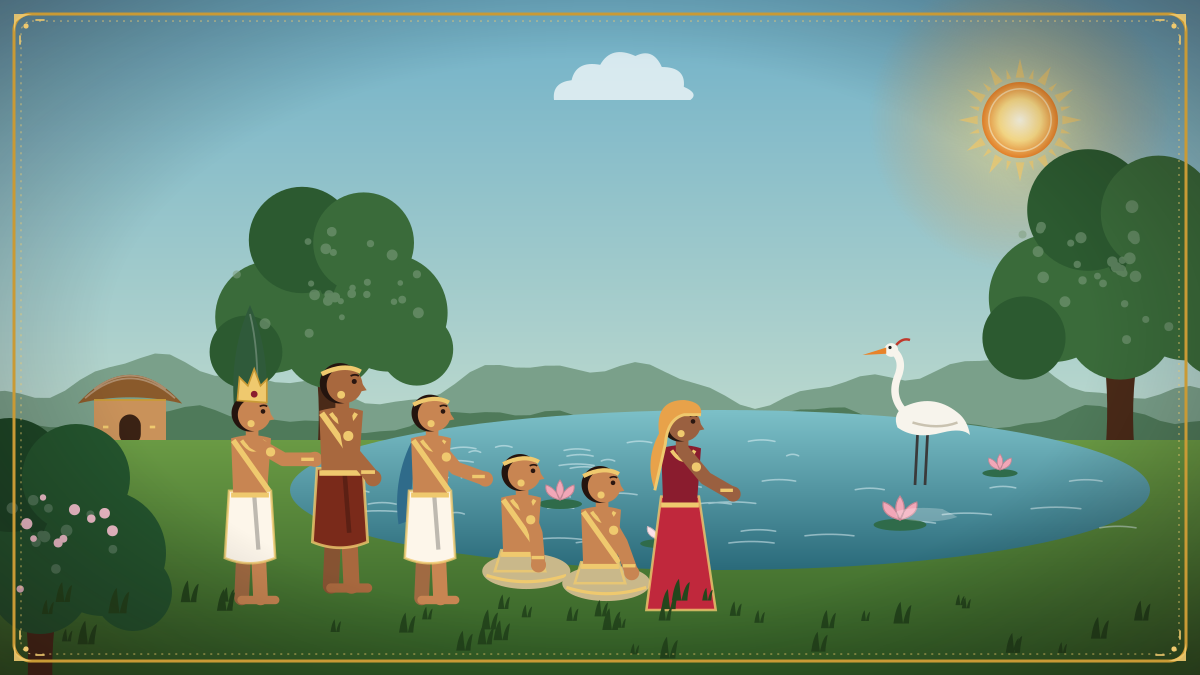
The Yaksha was pleased. “One of your brothers may live. Choose.” Yudhishthira chose Nakula. “Why not mighty Bhima or Arjuna?” “My father had two wives,” he said. “A son of Kunti lives in me. Let a son of Madri live too.” Delighted, the Yaksha showed himself as Dharma, Yudhishthira's divine father, who had also been the deer. He brought all four brothers back to life, returned the fire-sticks, and blessed them: “In the thirteenth year, even if you walk the earth in your own forms, no one will recognise you.” Twelve years were over. Now came the year of disguise.
Did you know?
- The Vana Parva, the Book of the Forest, is one of the longest books of the Mahabharata and also contains the stories of Nala and Damayanti, Savitri and Satyavan, and a short Ramayana.
- Bhima and Hanuman were brothers in a special way: both were sons of Vayu, the wind god.
- Because Hanuman sat on its flag, Arjuna’s chariot is often called Kapidhvaja, “the one with the monkey banner.”
- Yudhishthira’s conversation at the lake is famous as the Yaksha Prashna, “the questions of the Yaksha.”
What this chapter teaches us
Hardship can become a time of growth. In the forest the Pandavas gained divine weapons, humility and wisdom, and Yudhishthira chose forgiveness over anger again and again. His answers to the Yaksha remind us that fairness and wisdom are greater than strength. And Krishna's coming for Draupadi shows that God never abandons one who calls Him with a sincere heart.