Key moments
- Arjuna captures Drupada as Drona’s guru-dakshina
- Yudhishthira becomes crown prince; Duryodhana plots with Kanika’s advice
- Vidura warns Yudhishthira in a foreign tongue
- A secret tunnel saves the Pandavas from the burning house
- Bhima kills Hidimba; Ghatotkacha is born to Hidimbi
- Bhima eats the demon’s food and defeats Bakasura
- Dhrishtadyumna and Draupadi rise from Drupada’s sacred fire
The guru-dakshina: Drupada captured
When the princes had finished their training, Drona called them together and said, “The time has come for my guru-dakshina. Capture Drupada, the king of Panchala, in battle and bring him to me alive.” This was the task that Arjuna alone had promised to do on the very first day.
The princes set out for Panchala with their chariots. Duryodhana, Karna, Dushasana and the other Kauravas rushed ahead, each wanting the glory for himself. Arjuna said to Drona, “Let them try first. When they have finished, we will act.” The Kauravas attacked the city, but the Panchala army fought hard, and even the citizens rained blows and missiles from their rooftops. The Kauravas were driven back and fled.
Then the Pandavas went forward. Arjuna asked Yudhishthira to stay back. Nakula and Sahadeva guarded the wheels of Arjuna’s chariot, and Bhima, mace in hand, charged into the army like death itself. Arjuna fought Drupada face to face, broke his bow, leapt onto his chariot and captured him alive. Bhima was still destroying the Panchala army, but Arjuna stopped him: “Drupada is a relative of the Kurus. Let us not harm his people. We need only give him to our guru.”
Drupada was brought before Drona. Drona smiled and said, “Do not fear for your life; Brahmins are forgiving. As boys we played together at the hermitage, and I loved you. You once said that only a king can be a friend to a king. Now I have won your kingdom. I give you back half of it, so that we are equals and can be friends again.” Drona kept the northern half, with its city Ahichchhatra, and Drupada ruled the southern half, from Kampilya down to the river Charmanvati.
Drupada answered politely, “This is worthy of a great soul like you. I want your friendship always.” But in his heart the insult burned. He knew that no ordinary warrior could defeat Drona, a Brahmin with divine weapons. From that day he wandered among the hermitages, searching for a way to have a son who could defeat Drona and a daughter worthy of Arjuna.
A crown prince, and a jealous heart
A year later, King Dhritarashtra made Yudhishthira the yuvaraja, the crown prince, because of his steadiness, patience, kindness and honesty. Yudhishthira’s goodness soon won the hearts of all. Bhima learned still more of the mace from Balarama, and Arjuna and his brothers won great victories over kings who had troubled the Kurus. The fame of the Pandavas spread everywhere.
In the streets and squares the people began to say, “Dhritarashtra, because he is blind, was not given the kingdom before; how can he be king now? Bhishma has vowed never to rule. Let us crown Yudhishthira, who is young, wise and kind, and who respects Bhishma and Dhritarashtra.” When Dhritarashtra heard this praise of his nephews, his heart grew anxious, and he could not sleep at night.
The king called his minister Kanika, who was skilled in the crooked ways of politics, and asked his advice. Kanika said, “O king, a ruler should hide his weaknesses and watch his enemy’s. When an enemy is weak or in your power, do not let him rise. Speak sweetly, but strike when the time is right.” He told the story of a clever jackal who used his friends to win all the prey for himself. Dhritarashtra listened and became even more uneasy.
Meanwhile Duryodhana, Karna, Shakuni and Dushasana met in secret and made a plan. Duryodhana went to his father and said, “The people want Yudhishthira as king. If he rules, his sons will rule after him, and we will be nothing. Send the Pandavas away to the town of Varanavata for a while.” Dhritarashtra said, “Pandu was always devoted to me, and the people and the elders love his sons.” But Duryodhana argued, “Bhishma will stay neutral, Drona will side with his son Ashwatthama, who is with me, and Kripa will follow them. Vidura alone is with the Pandavas, and he can do nothing.”
The weak-willed king agreed. He had his ministers praise Varanavata in front of the Pandavas, saying that a grand festival of Lord Shiva was held there. Then Dhritarashtra said to Yudhishthira, “Go with your mother and brothers to Varanavata and enjoy yourselves there for some time.” Yudhishthira understood that something was wrong, but he saw that he could not refuse the king, and he agreed.
The house of lac
Duryodhana secretly called his trusted minister Purochana and said, “Go quickly to Varanavata before the Pandavas. Build a fine house for them with hemp, resin, lac and other things that catch fire easily, and plaster its walls with mud mixed with ghee, oil and fat. Furnish it beautifully so that no one suspects. When they are living there without fear, set it on fire at night, so that people think it was an accident.” Purochana hurried off in a fast cart.
When the Pandavas left Hastinapur, many citizens followed them sadly, blaming the king. Yudhishthira gently sent them home. Wise Vidura walked with them a little way. Then, so that no one else would understand, he spoke to Yudhishthira in a foreign tongue: “A weapon not made of iron can destroy the body; one who knows this is not harmed. A fire that burns the forest cannot burn the creature that lives in a hole in the ground. One who knows the way of the porcupine escapes. Find your direction by the stars.” Yudhishthira replied, “I have understood.” Later he explained the warning to his mother.
In Varanavata the people welcomed the Pandavas warmly. After ten days, Purochana led them to the new house, which he had named “Shiva”, the auspicious one, though it was meant for their destruction. As soon as Yudhishthira entered, he smelled ghee, fat and lac. He quietly told Bhima, “Our enemies have built this house to burn us. But if we run away now, Duryodhana will find another way to kill us. Let us live here, stay alert, and look as if we suspect nothing.”
Soon a man came to them and said, “I am a skilled miner sent by Vidura.” As a sign, he repeated the secret words Vidura had spoken in the foreign tongue. He told them, “Purochana will set fire to the house on the fourteenth night of the dark half of the month.” Working in secret, the miner dug a large tunnel from the middle of the house, with its opening covered and made level with the floor, so that no one could see it.
For a whole year the Pandavas lived in that house. By day they went hunting in the forests nearby and learned every path, so that they could escape even at night. Purochana lived at the door, watching them, and he grew sure that they trusted him completely. Then Yudhishthira said, “Purochana now believes we suspect nothing. This is the time to escape.”
Fire in the night
One evening Kunti held a feast and fed many Brahmins. Among the people who came was a Nishada woman with her five sons, looking for food. They ate and drank, and as fate would have it they fell fast asleep in the house, as if dead. Late that night, when everyone was asleep, Bhima set fire first to the room where Purochana was sleeping, then to the doors, and then all around the house. The lac house blazed up at once. The five brothers and their mother went down into the tunnel and escaped.
Purochana died in the very fire he had prepared. The townspeople ran up and watched the house burn all night, saying, “Wicked Duryodhana had this built to burn the innocent Pandavas! Shame on Dhritarashtra for allowing it.” In the morning, among the ashes they found the bodies of the Nishada woman and her five sons, and they believed that Kunti and the Pandavas had died.
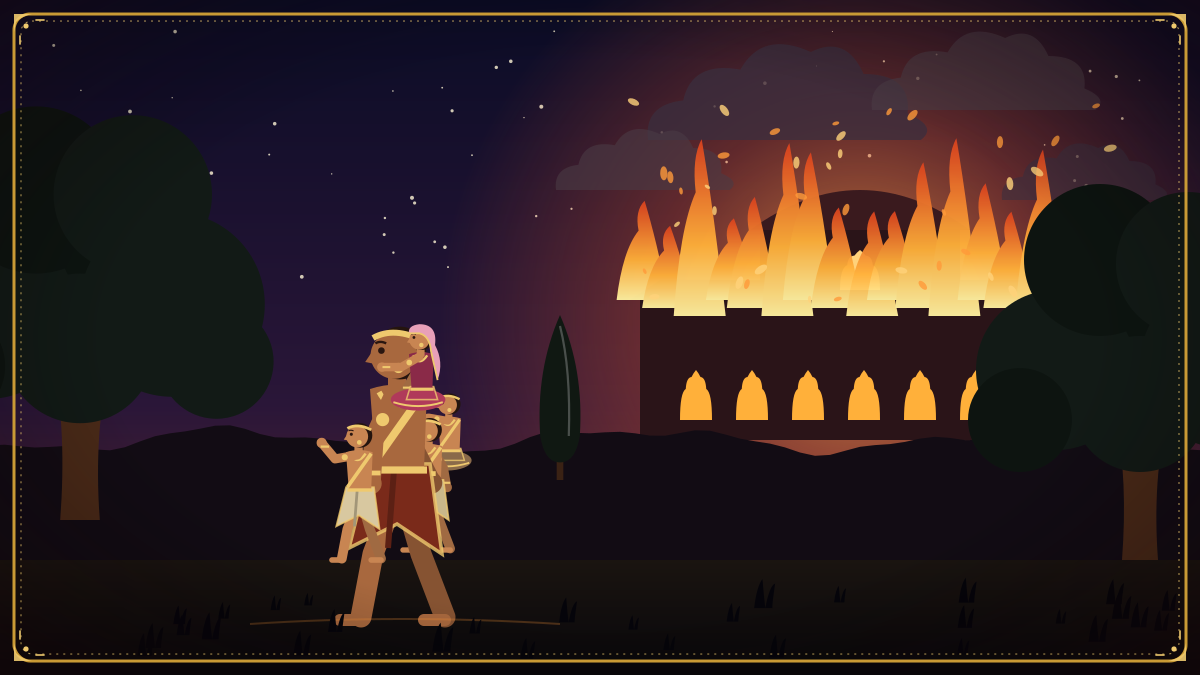
Out of the tunnel, in the darkness, the Pandavas were tired and afraid. Bhima lifted his mother onto his shoulders, took Nakula and Sahadeva on his hips, and held Yudhishthira and Arjuna by the hands. He strode through the forest so swiftly that the trees bent as he passed. On the bank of the Ganga a trusted man of Vidura was waiting with a boat. He gave them Vidura’s secret sign and said, “Vidura sends his blessing: you will defeat Karna, Duryodhana and Shakuni.” He carried them across the river that same night.
When the news reached Hastinapur, Dhritarashtra wept and the whole city mourned. The king and his sons performed the water-offerings for the dead, and Bhishma grieved deeply. Vidura also showed his sorrow, but he grieved only a little, because he alone knew that the Pandavas were alive.
Hidimba and Hidimbi
The Pandavas travelled south through a deep forest. At last, worn out with thirst and tiredness, Kunti and the four brothers lay down under a great banyan tree. Bhima went to find water, soaked his upper cloth in a lake and brought water back. Seeing his mother and brothers sleeping on the bare ground, he was full of sorrow and sat guarding them through the night.
Nearby, on a sal tree, lived a man-eating rakshasa named Hidimba with his sister Hidimbi. Smelling humans, Hidimba sent his sister to bring them to him for food. But when Hidimbi saw Bhima, she fell in love with him at first sight. She took a beautiful human form and said, “My brother wants to eat you all. Marry me, and I will carry you away through the sky.” Bhima replied, “I will never leave my sleeping mother and brothers to a rakshasa.”
Hidimba grew impatient and came himself. Seeing his sister in human form, he was furious with her. Bhima said, “Do not harm a woman. Fight me!” He dragged Hidimba far away so the noise would not wake the others. But the terrible fight woke them anyway. Arjuna called out, “Brother, finish him before dawn, for rakshasas grow stronger at twilight.” Bhima lifted Hidimba high, whirled him round and killed him.
Bhima was angry with Hidimbi too, but Yudhishthira stopped him: “Never kill a woman, even in anger.” Hidimbi folded her hands before Kunti and said, “Mother, I have left my brother and my people for your son. Let me marry him.” Yudhishthira agreed with a condition: “Bhima may be with you by day, but he must come back to us every night before sunset.” Bhima added, “I will stay with you only until a son is born.”
In time a son was born, who grew up at once into a mighty young man. Because his head was smooth like a pot (ghata) and without hair (utkacha), he was named Ghatotkacha. He bowed to his elders and promised, “Whenever you need me, just think of me and I will come.” Then he went north with his mother, and the Pandavas continued their journey.
Ekachakra and Bakasura
Wearing deer-skins and bark clothes, with matted hair, the Pandavas travelled through many lands. Then their grandfather, the sage Vyasa, appeared before them. He comforted Kunti and said, “Do not grieve. Good times will come.” He led them to the town of Ekachakra and settled them in the house of a Brahmin, saying, “Wait here for me.” There they lived as poor Brahmins, begging for alms each day. Kunti divided the food into two halves: one half for Bhima, and the other half for all the rest.
One day, when Bhima was at home with Kunti, they heard loud weeping from the Brahmin’s family. The Brahmin was crying, his wife was offering to give her own life, and their daughter was offering hers. Their little son picked up a blade of grass and said, “Don’t cry! I will kill the demon with this!” Kunti went in and asked what was wrong.
The Brahmin explained, “Near this town lives a mighty rakshasa named Baka. For many years he has demanded, by turns from each household, a cartload of rice, two buffaloes and one human being to eat. Our king does not protect us. Today it is our turn, and one of us must go.” Kunti said, “Do not fear. I have five sons. One of them will take the food to the demon.” The Brahmin refused: “I cannot let my guest die for me.” Kunti said, “My son is very strong and knows a powerful mantra. He has killed rakshasas before. Only, do not tell anyone, or people will trouble him to learn it.”
When Yudhishthira returned, he was alarmed: “Mother, how can you send Bhima into such danger?” Kunti answered, “We have lived happily in this Brahmin’s house; to repay his kindness is our duty. To protect a Brahmin is the highest duty of a kshatriya. And I know Bhima’s strength: he killed Hidimba, and as a baby, when he fell from my lap, the rock broke, not he.” Yudhishthira agreed.
The next morning Bhima took the cart of food into the forest, sat down and began eating it himself, calling out Baka’s name. The rakshasa came in a rage and struck Bhima on the back with both fists, but Bhima kept eating. Then Baka tore up a tree, and Bhima, having finished, smiled and fought back. At last Bhima pinned him down with his knee and broke his back, and Baka died. His frightened followers came out, and Bhima made them promise never to kill human beings again.
Bhima left Baka’s body at the town gate and quietly went home. In the morning the townspeople were amazed and asked the Brahmin whose turn it had been. He said only, “A great Brahmin who knows mantras took pity on us and went in my place.” The whole town celebrated, and the Pandavas’ secret stayed safe.
Born from the fire
Some time later a Brahmin traveller stayed in the house and told many tales of distant lands. When the Pandavas asked about Panchala, he told them how Drupada had lost half his kingdom to Drona, and how he had wandered in search of a way to have a son who could defeat Drona.
Drupada came to two learned Brahmin brothers, Yaja and Upayaja. He served the younger, Upayaja, for a whole year, but Upayaja refused and sent him to his elder brother. Yaja agreed to perform the yajna, with Upayaja helping him, and Drupada gave them rich gifts. When the sacrifice was complete and the offering was poured into the fire, a young warrior rose out of the flames, shining like fire, wearing a crown and armour and holding a sword and bow. He climbed onto a chariot with a great roar, and a voice from the sky said, “This prince is born to slay Drona and to take away the sorrow of the Panchalas.” He was named Dhrishtadyumna.
Then from the middle of the altar rose a young woman, dark and beautiful, with eyes like lotus petals and a fragrance like the blue lotus that spread far around her. The heavenly voice said, “This best of women, Krishnaa, will bring about the destruction of the kshatriyas and fulfil the purpose of the gods. Because of her, great fear will come to the Kauravas.” Because of her dark complexion she was named Krishnaa; as Drupada’s daughter she was called Draupadi, and as the princess of Panchala, Panchali. Drupada’s queen prayed that these children would know no mother but her, and Yaja blessed her wish.
The Brahmin added, “Drona knew that Dhrishtadyumna was born to kill him. Yet he took the boy into his own home and taught him all the weapons, for he knew that no one can escape destiny.” Finally he said, “Now King Drupada has announced a swayamvara for his daughter Draupadi.” When they heard this, the Pandavas grew restless.
Kunti saw their eagerness and said, “We have lived long enough in Ekachakra, and the alms here are growing less. Let us go to Panchala.” Just then the sage Vyasa came again. He told them that Draupadi was destined to be their wife and blessed them for the journey. So the Pandavas bowed to their kind host and set out for Panchala, still dressed as Brahmins.
Did you know?
- Because she was born from a yajna, Draupadi is also called Yajnaseni, and because she was the princess of Panchala, she is called Panchali.
- Drona knowingly taught weapons to Dhrishtadyumna, the very prince who was born to bring about his end.
- The Pandavas lived in the house of lac for a whole year, pretending to suspect nothing, before they escaped.
- At Ekachakra, Kunti divided the food the brothers begged into two halves: one half for Bhima alone, and the other for everyone else.
What this chapter teaches us
Jealousy led Duryodhana to plan a terrible crime, but alertness, patience and the help of a wise well-wisher like Vidura saved the Pandavas. Kunti’s decision at Ekachakra shows that we must repay kindness and protect those who shelter us. Drupada’s anger, too, reminds us that an insult can echo for a whole generation. Good people may face danger, but dharma finds a way to protect them.