Key moments
- Karna becomes commander, with Shalya as charioteer
- Shalya's crow-and-swan story mocks Karna's pride
- Karna spares four Pandavas, keeping his promise to Kunti
- Krishna settles Arjuna's vow with the subtle teaching of dharma
- Bhima keeps his vow against Dushasana
- Krishna presses the chariot down and the crown is lost
- Karna's wheel sinks and he forgets the Brahmastra
- Karna's light leaves his body and enters the sun
Karna Takes Command
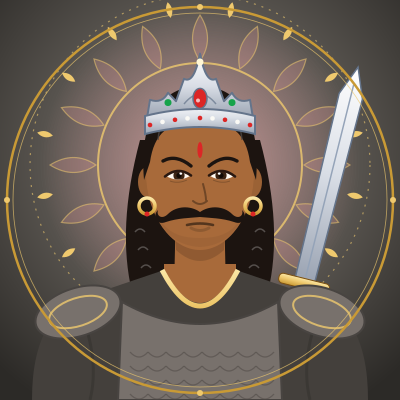
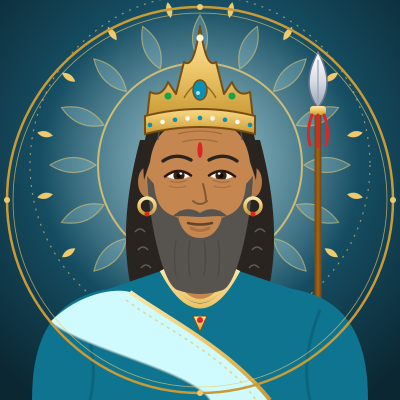
After Drona's fall, the Kaurava camp was full of sorrow. Duryodhana turned to his dearest friend and said, “Karna, you are my last hope. Lead my army.” Ashwatthama and the other kings agreed, and with sacred water Karna was made commander. The soldiers felt fresh courage, for many believed that only Karna could stand against Arjuna.
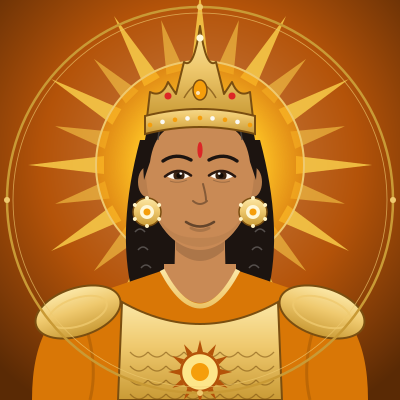
Karna was the son of Surya, the Sun god, and of Kunti, born before her marriage and raised by the charioteer Adhiratha and his wife Radha. Before the war Krishna and Kunti had both told him the truth: he was the eldest brother of the Pandavas. Yet Karna had chosen to stay loyal to Duryodhana, who had honoured him when others mocked him.
On the sixteenth day Karna arranged his army and fought hard. Many warriors fell on both sides, and Arjuna destroyed a great part of the Samshaptaka army. But the day ended without the meeting everyone was waiting for. That night Karna said to Duryodhana, “Arjuna has Krishna as his charioteer. If I had a charioteer equal to Krishna, I could defeat him. Only King Shalya knows horses as Krishna does.”
Shalya, king of Madra, was the brother of Madri and the uncle of Nakula and Sahadeva. He had come to help the Pandavas, but Duryodhana had won him over with clever hospitality on the way. Before the war, when Shalya met Yudhishthira, Yudhishthira had asked him one favour: “If you ever drive Karna's chariot, weaken his spirit with your words.” Shalya had promised.
Shalya the Charioteer
When Duryodhana asked Shalya to drive Karna's chariot, the proud king was furious. “I am a crowned king. Shall I hold the reins for a charioteer's son?” Duryodhana bowed to him and said, “King of Madra, you are greater than Karna, and equal to Krishna in handling horses. Long ago, when Lord Shiva went to destroy the three flying cities of the demons, Lord Brahma himself became his charioteer. A great charioteer is no less than the warrior.”
Shalya was pleased and agreed, on one condition: “I will say whatever I like to Karna, and he must bear it.” Duryodhana and Karna accepted. So on the seventeenth morning Shalya took the reins, and as soon as Karna boasted, “Today I will kill Arjuna,” Shalya began to mock him and praise Arjuna.
Shalya told him a story. “There was once a crow that ate the leftovers of a merchant's sons and grew fat and proud. It challenged the swans to a flying race. The crow showed off with a hundred twists and turns, while a swan flew calmly straight out over the sea. Soon the crow was worn out and fell into the waves, and the swan had to carry it back to the shore. Karna, you are that crow, and Arjuna is the swan.”
Karna's eyes burned, but he answered without fear. “I know well how great Arjuna and Krishna are. Still I will fight them today.” Then he told Shalya about two old curses. As a youth he had gone to learn from Parashurama, saying he was a Brahmin. One day, while his guru slept with his head on Karna's lap, an insect bored into Karna's thigh, and he bore the pain without moving. Parashurama awoke, saw the blood, and knew that only a Kshatriya could bear so much. “Because you lied, you will forget the Brahmastra when you need it most.”
“Another time,” Karna said, “my arrow killed a Brahmin's calf by mistake. He cursed me that in my most dangerous moment my chariot wheel would sink into the earth.” Even so, Karna said, he would not turn back. The two kept quarrelling as they drove into battle, and Shalya's sharp words slowly took away some of the fire from Karna's heart, just as he had promised Yudhishthira.
A Promise Kept to Kunti
Before the war, Kunti had gone to Karna and told him that she was his mother. Karna refused to leave Duryodhana, but he gave her a gift: “I will not kill four of your sons, Yudhishthira, Bhima, Nakula and Sahadeva. I will fight only Arjuna. Either he or I will live, and you will still have five sons.”
On the seventeenth day Karna faced Sahadeva and overpowered him. He could have killed him, but he only touched him with the tip of his bow and said, “Go and fight with your equals.” Then Nakula came forward. Karna broke his chariot, hung his bow around Nakula's neck, laughed, and let him go.
Next Karna fought Yudhishthira himself. He cut his bow and armour and wounded him badly, but remembering his word to Kunti, he again let him go with mocking words. Earlier, on the fourteenth day, he had overcome Bhima in the same way and spared him. Bhima, however, struck back fiercely on this day too, and once even knocked Karna senseless, so that Shalya had to drive him away to safety.
Wounded and ashamed, Yudhishthira was taken back to the camp to rest. The Kaurava soldiers did not understand why their commander kept sparing his enemies. Only Karna knew the secret in his heart.
A Quarrel Between Brothers
Arjuna, worried about his brother, came with Krishna to the camp. Yudhishthira was in great pain and thought Arjuna had come because Karna was dead. When he heard that Karna was still alive, he lost his temper. “For thirteen years we trusted your strength! Give your Gandiva bow to someone else, if you cannot use it.”
Arjuna had once made a secret vow: he would kill anyone who told him to give his Gandiva to another. Hearing those words, he drew his sword. Krishna stopped him and asked what he was doing. Arjuna explained his vow, and Krishna said, “Arjuna, you do not yet understand the subtle ways of dharma.”
Krishna told him two short stories. A Brahmin named Kaushika had vowed always to speak the truth. When robbers asked him where some frightened travellers were hiding, he told them, and the innocent people were killed. His truth brought him sin, not merit. And a hunter named Balaka once killed a blind creature that had been destroying all living beings; though he was only a hunter, he was honoured in heaven. “True dharma,” said Krishna, “is what protects life and does good to all.”
Krishna showed Arjuna a way: “For an elder, being spoken to with disrespect is like death. Speak harshly to Yudhishthira, and your vow is kept.” Arjuna did so, and then, full of sorrow, fell at his brother's feet and begged forgiveness. Yudhishthira too was ashamed of his angry words. The brothers embraced, Yudhishthira blessed Arjuna, and Arjuna went back to the field, vowing that Karna would not live to see another sunrise.
Bhima's Vow and Vrishasena
Meanwhile Bhima came face to face with Dushasana. Thirteen years earlier, in the dice hall, Dushasana had dragged Draupadi by her hair before the elders, and Bhima had sworn a terrible oath to punish him on the battlefield. Now that moment had come.
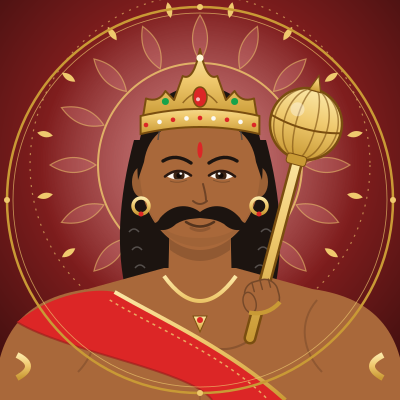
The two fought fiercely. Bhima threw Dushasana from his chariot with a mighty blow of his mace, and then, remembering every tear Draupadi had shed, he kept his terrible vow exactly as he had sworn it in the dice hall. His roar shook the battlefield, and seeing his fury, even the bravest Kaurava warriors stepped back in fear. “Draupadi, the oath I made in the hall is fulfilled today,” he cried. Soon after, Bhima also struck down ten more of Duryodhana's brothers who rushed at him together.
Karna was shaken by Dushasana's fall, but Shalya told him, “This is no time to grieve. Fight, and fight for your friend.” Then Karna's brave son Vrishasena attacked Nakula and the Pandava warriors. Arjuna called out to Karna, “You and others together killed my son Abhimanyu when I was far away. Now, before your own eyes, I will strike down your son.”
Arjuna kept his word. Vrishasena fought bravely but fell to Arjuna's arrows while Karna watched. Karna's heart was filled with grief and anger, and he turned his chariot straight towards Arjuna. The moment that both armies had waited for was at last at hand.
The Great Duel
The two great archers came face to face: Karna in his chariot with its elephant-rope banner, Arjuna in his chariot with Hanuman on the flag and Krishna at the reins. The gods gathered in the sky to watch, Indra wishing victory for his son Arjuna and Surya for his son Karna. Many soldiers on both sides stopped fighting just to look.
Arrow met arrow and divine weapon met divine weapon. Fire answered water, wind answered cloud. At times Arjuna seemed to win, at times Karna. Karna released the Bhargava weapon that Parashurama had taught him, and it swept away many Panchala soldiers; Arjuna answered with weapons of his own, and the sky was filled with light and thunder. Bhima cheered Arjuna on, and Duryodhana cheered Karna. Neither hero would give an inch.
Then Karna took out a special arrow. Inside it was the serpent Ashvasena, whose mother had died when Arjuna and Krishna burned the Khandava forest long ago. Ashvasena had waited all these years for revenge and had hidden himself in Karna's quiver. Shalya said, “Aim at his chest, Karna.” But Karna proudly replied, “Karna never aims twice,” and shot at Arjuna's head.
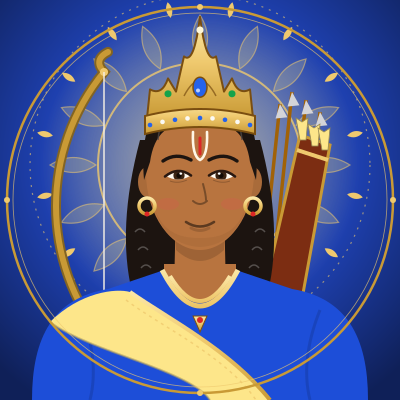
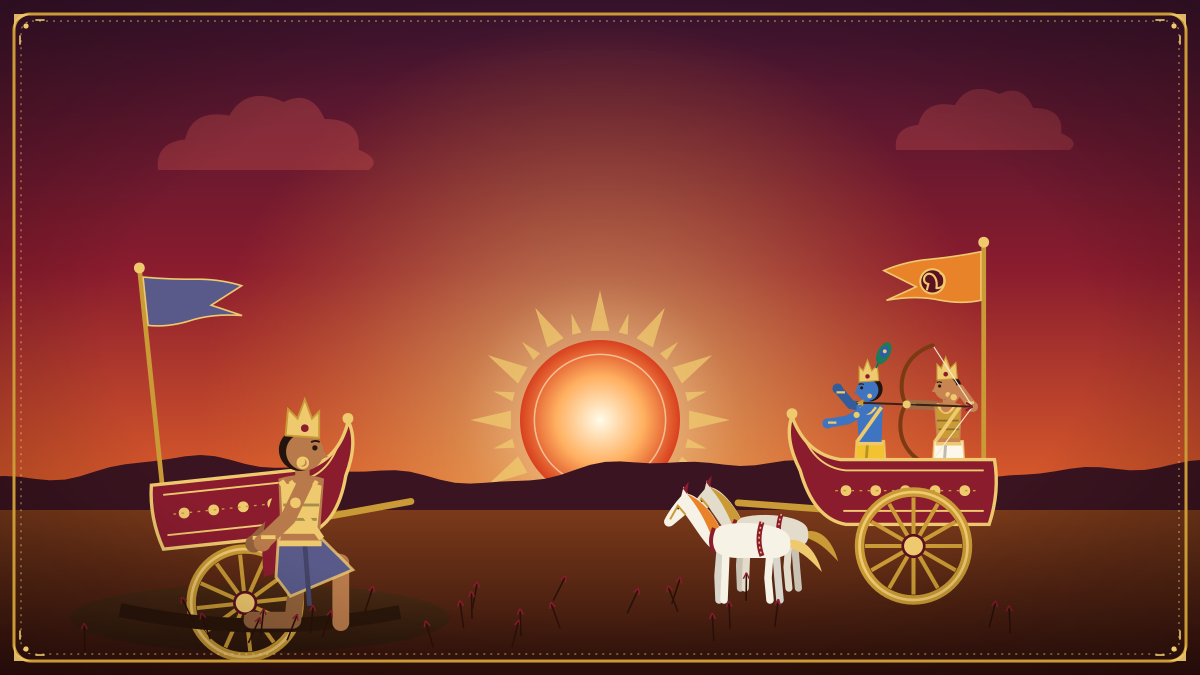
As the blazing arrow flew, Krishna pressed the chariot down with his feet. The horses sank to their knees and the wheels sank into the earth, so the arrow struck only Arjuna's crown, the shining Kiriti given to him by Indra, and carried it away. Arjuna was saved. Ashvasena returned to Karna and begged to be shot again, but Karna said, “I will not win by another's strength.” Arjuna then struck the serpent down.
Now the old curses came true. Karna's left chariot wheel sank deep into the earth, just as the Brahmin had said. And when he tried to call up the Brahmastra, the mantra slipped from his memory, just as Parashurama had warned. Karna jumped down and tried with all his strength to lift the wheel. He shook the chariot, pushed and pulled, but the earth held it fast. Tears of anger came to his eyes, and he cried out that dharma does not protect those who follow it.
Karna called out, “Arjuna, wait! A noble warrior does not strike a man who is on the ground with a stuck wheel. Remember dharma!” Krishna answered, “Now you remember dharma, Karna? Where was it when the lac house was set on fire, when Yudhishthira was cheated at dice, when Draupadi was insulted in the hall, when the Pandavas were sent to the forest, and when many of you together killed young Abhimanyu?” Karna hung his head and had no answer.
The Sun Sets on Karna
Karna did not give up. He climbed back into his chariot and fought on, and one of his arrows struck Arjuna so hard that he swayed for a moment. Karna again leapt down to free his wheel. Krishna said, “Arjuna, strike now, before he mounts his chariot again.” Arjuna first cut down Karna's banner, and then took up the Anjalika arrow, shining like the fire at the end of time.
With a prayer that his good deeds and truth would make the arrow true, Arjuna released it. It struck Karna, and the great hero fell. People saw a bright light rise from Karna's body and go up into the sky, where it entered the sun. The son of the Sun had returned to his father as the evening came.
Duryodhana wept like a child for his dearest friend, and the Kaurava army fled in fear. Shalya drove the empty chariot back and said to Duryodhana, “There has never been a battle like the one fought today between Karna and Arjuna. Karna was great, but fate was stronger. It was destiny that protected the Pandavas and destiny that has struck us down. Do not grieve too much; no one can escape what is destined.” Duryodhana listened in silence, sighing again and again, and the field grew dark around the fallen hero.
So ended the seventeenth day. Karna had been brave, generous and true to his friend, yet he had stood beside wrongdoing. Few in the world yet knew that he was Kunti's eldest son; that secret would come out only after the war. With Karna gone, Duryodhana's greatest hope had fallen, but he still would not make peace. The eighteenth day was about to dawn.
Did you know?
- Karna’s birth name was Vasusena. He was also called Radheya, after Radha, the loving mother who raised him.
- The Karna Parva covers only two days of the war, the sixteenth and the seventeenth.
- The serpent hiding in Karna’s arrow, Ashvasena, wanted revenge on Arjuna because his mother had died in the burning of the Khandava forest.
- Shalya was the real uncle of Nakula and Sahadeva, yet he fought for the Kauravas because Duryodhana won his promise through a trick of hospitality.
What this chapter teaches us
Karna was generous, brave and loyal, yet he stood beside wrongdoing for the sake of friendship. His story teaches that good qualities cannot protect us if we stay silent in the face of injustice. Krishna's answer reminds us that dharma must be remembered always, not only when it helps us. And the quarrel between Arjuna and Yudhishthira shows that true dharma is guided by kindness and wisdom, not only by the letter of a vow.