Key moments
- Arjuna chooses unarmed Krishna over the Narayani army
- Shalya, won by hospitality, promises to weaken Karna's courage
- Vidura's night counsel to sleepless Dhritarashtra
- Yudhishthira asks for just five villages
- Duryodhana refuses even a needle-point of land
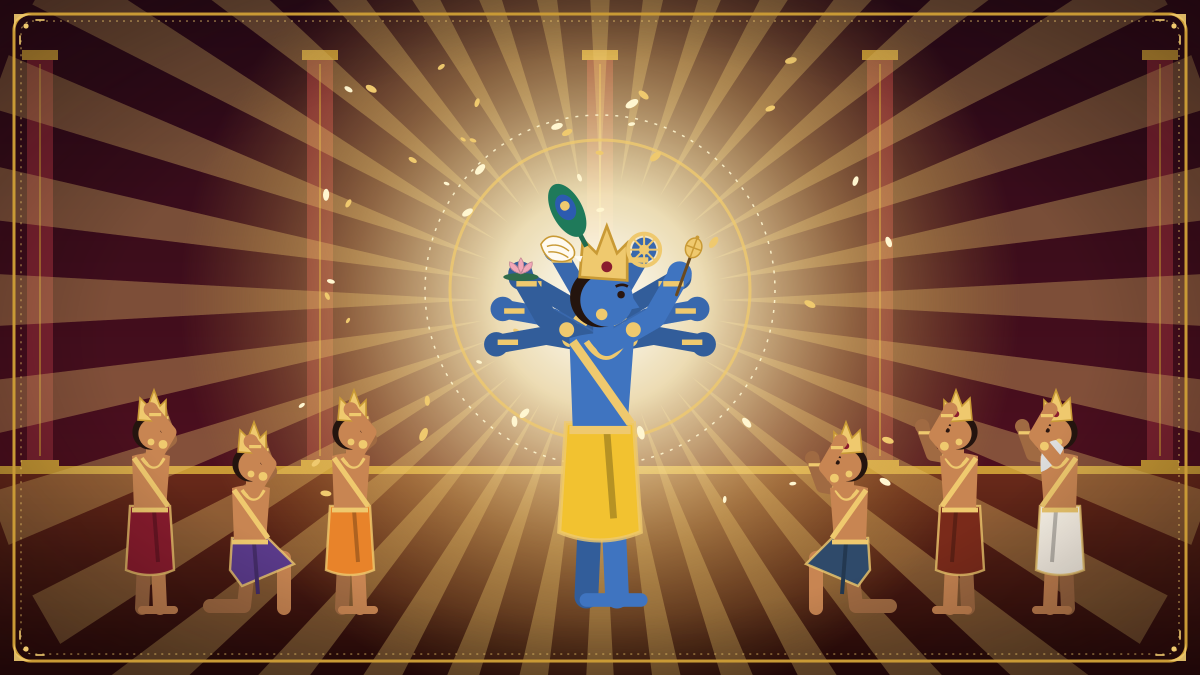
- Krishna reveals his cosmic form in the Kuru court
- Karna promises Kunti: “You will always have five sons”
- Seven akshauhinis face eleven at Kurukshetra
The Council at Virata's Court
After the wedding of Abhimanyu and Uttara, the Pandavas, their friends and their relatives sat together in King Virata's assembly hall. Drupada, Virata, Krishna, Balarama, Satyaki and many other kings were there. The thirteen years of exile had been completed honestly, and now the question was simple: would Duryodhana return the Pandavas' half of the kingdom?
Krishna spoke first. He said that Yudhishthira had kept every promise and asked only for what was rightfully his. A wise and gentle messenger should be sent to Hastinapur. Balarama added that the message must be soft, because Yudhishthira had lost his kingdom at the dice game by his own choice. Satyaki disagreed sharply, but King Drupada calmed everyone. “Duryodhana will not give anything easily,” he said. “Let us send a messenger, and let us also invite our allies, so that we are ready for either peace or war.”
So Drupada's own family priest, a learned and respected Brahmin, was sent to Hastinapur as the Pandavas' envoy. In the Kaurava court he spoke clearly: the Pandavas had kept their word, and their share should now be returned. Bhishma agreed that the request was just. But Karna interrupted angrily, and Bhishma rebuked him. At last Dhritarashtra said, “I will think about this and send Sanjaya to the Pandavas with my reply.” The priest returned with no promise of land.
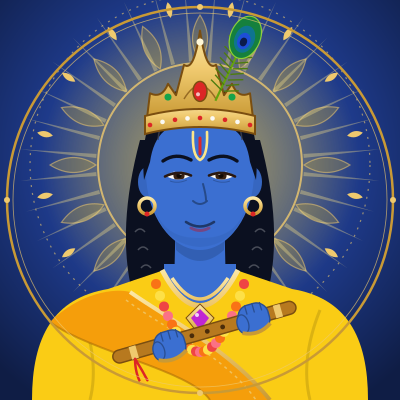
Meanwhile, both sides began to look for allies. Arjuna and Duryodhana each set out for Dwarka to ask Krishna for help, and they reached his palace on the same day. Krishna was asleep. Duryodhana arrived first, walked in, and sat on a fine seat near Krishna's head. Arjuna came a little later and stood near Krishna's feet with folded hands.
When Krishna woke up, his eyes fell first on Arjuna. Then he saw Duryodhana and welcomed both. Duryodhana said, “I came first, so I should be helped first.” Krishna replied, “You came first, but I saw Arjuna first, so I will help you both. On one side is my Narayani army of brave cowherd warriors. On the other side am I alone, and I will not take up any weapon in the battle. Arjuna is younger, so he may choose first.” Without a moment's doubt, Arjuna chose Krishna. Duryodhana was delighted to receive the large army.
Later Krishna asked Arjuna, “Why did you choose me, when I will not even fight?” Arjuna said, “You alone could defeat them all, but I wish to win this battle myself. Please be my charioteer.” Krishna smiled and agreed. Duryodhana then went to Balarama, who said, “I will not help Arjuna, and I will not help you. I will stay with neither side.” When the war came near, Balarama left on a pilgrimage to the holy places along the river Saraswati. Kritavarma, a Yadava chief, gave Duryodhana one army.
Shalya's Promise and Sanjaya's Mission
Shalya, the king of Madra, was the brother of Madri and so the uncle of Nakula and Sahadeva. He set out with a large army to join the Pandavas. Duryodhana heard of this and quickly had beautiful rest houses built all along Shalya's road, with food, drink and every comfort. Shalya enjoyed them and, thinking that Yudhishthira had arranged everything, said, “I wish to reward the person who did this.”
Duryodhana then came forward and said, “It was I. If you are pleased, please be the leader of my army.” Shalya had given his word, so he agreed. Then he went to meet Yudhishthira and told him honestly what had happened. Yudhishthira said, “Uncle, you must keep your word. But I ask one thing. When Karna fights Arjuna, you will surely be made his charioteer. At that time, please weaken Karna's courage with your words.” Shalya promised to do so.
Soon Sanjaya, Dhritarashtra's charioteer and advisor, arrived at Upaplavya, where the Pandavas were staying. He brought the king's greetings and many gentle words, but no land. “War between brothers is a great sin,” he said. “It would be better for you to live by begging than to win a kingdom by killing your own family.”
Yudhishthira answered calmly. “I do not want war, Sanjaya. Give me back Indraprastha. If that is too much, give us just five villages: Kushasthala, Vrikasthala, Makandi, Varanavata, and any one more that Duryodhana chooses. With five villages for five brothers, I will make peace.” Krishna also spoke, saying that the Pandavas were ready for peace but would not run from a just war. Arjuna sent a firm message: if Duryodhana did not return their share, the Gandiva bow would answer.
A Sleepless Night: Vidura's Wisdom
Sanjaya returned to Hastinapur late in the evening. He told Dhritarashtra, “Your sons are choosing a wrong path. Tomorrow I will report the Pandavas' words in the full court,” and he went home. Dhritarashtra could not sleep. Troubled and restless, he called for his wise brother Vidura in the middle of the night and said, “Speak to me. My heart is burning.”
Vidura gave him long and loving advice, which is known as Vidura Niti. He said, “A man who wants success must give up six faults: too much sleep, drowsiness, fear, anger, laziness and putting things off.” He also said, “There are three doors to ruin: desire, anger and greed. A wise person shuts all three.” And he explained, “The truly wise man is one whom anger, joy, pride and stubbornness cannot pull away from his goal.”
Then Vidura came to the point. “O King, you have cheated the Pandavas of their share. Give it back. Yudhishthira is honest and gentle, and he will treat your sons with love. If you hold on to one bad son, you may lose the whole family. Sometimes a family must let go of one person to save itself.”
When Dhritarashtra asked about the deeper truth of life and death, Vidura called the ancient sage Sanatsujata, one of Brahma's eternal sons. The sage taught the king that carelessness is death, and steady watchfulness is immortality. A person who lives honestly and knows the Self within does not fear death. Dhritarashtra listened through the whole night. But in the morning his love for Duryodhana was still stronger than all this wisdom.
Krishna Goes to Hastinapur
Before giving up hope, Yudhishthira asked Krishna to go to Hastinapur himself. Krishna agreed, saying, “I will try my best for peace, so that no one can ever say we did not try.” Draupadi came to him with tears in her eyes, holding her long, open hair. “When you speak of peace,” she said, “remember this hair, which Dushasana dragged.” Krishna promised her that justice would be done.
Dhritarashtra prepared grand welcomes and costly gifts for Krishna. Krishna politely greeted the king and the elders, then went to Vidura's simple house. There he met Kunti, his father's sister, who had stayed with Vidura during her sons' exile. Kunti wept as she asked about her sons and Draupadi, and gave Krishna a message: “Tell Yudhishthira to remember his duty as a Kshatriya.” Duryodhana invited Krishna to a royal feast, but Krishna refused. “One eats at another's house out of love, or out of need,” he said. “You have no love for me, and I have no need.” He happily ate Vidura's simple food.
The next morning Krishna entered the great court. Bhishma, Drona, Kripacharya, Vidura and many kings and sages were present. Krishna spoke with deep love. “O King, peace between the Kurus and the Pandavas is in your hands. The Pandavas are ready to serve you as their father. Give them their share, and the Kuru family will be the strongest in the world. Let not so many brave men die because of one person's greed.”
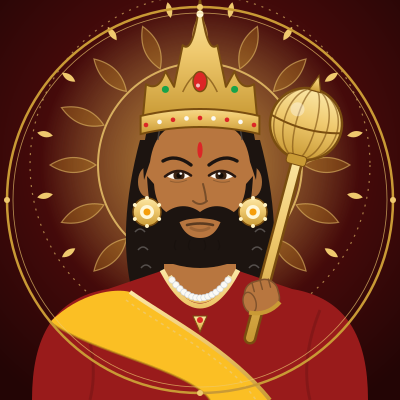
Bhishma, Drona and Vidura all begged Duryodhana to listen. But Duryodhana said, “I have done nothing wrong. As long as I live, I will not give the Pandavas even as much land as can be pierced by the point of a needle, without war.” Then he walked out of the court in anger.
Krishna told the elders, “It is sometimes right to restrain one person to save a whole family.” Dhritarashtra then called Gandhari, and she sent for her son. Gandhari spoke to him firmly. “Son, a person who cannot control his own anger and desire cannot rule a kingdom. The senses are like wild horses; only one who controls them wins. Make peace with your brothers.” But Duryodhana did not listen even to his mother, and he left the hall again.
The Cosmic Form in the Court
Outside, Duryodhana met secretly with Karna, Shakuni and Dushasana. “Let us capture Krishna and tie him up,” he said. “Without Krishna, the Pandavas will lose heart.” But wise Satyaki understood the plan. He told Kritavarma to keep their soldiers ready at the gate, and quietly warned Krishna and the elders. Vidura told Dhritarashtra, “Your sons are trying to catch fire with their hands.”
Krishna laughed and said, “Let them try, O King.” Then, in front of everyone, he showed his Vishwarupa, his cosmic form. Brahma appeared on his forehead and Rudra on his chest. The guardians of the world were on his arms, and fire came from his mouth. The Adityas, Vasus and other gods shone around him. Balarama and Arjuna stood at his sides, and the Pandavas, Vrishnis and Andhakas stood ready with weapons. The court was filled with a light brighter than a thousand suns.
Most of the kings shut their eyes in fear. Only Bhishma, Drona, Vidura, Sanjaya and the sages could look, because Krishna gave them divine sight. Blind Dhritarashtra folded his hands and prayed, “O Lord, give me eyes just for now, so that I may see you.” Krishna granted him sight, and for the first time in his life the king saw, and what he saw was the Lord himself. Then, at his own request, he became blind again, for he did not wish to see anything else after that.
Krishna withdrew the form, took Satyaki and Kritavarma by the hand, and left the court. The plan to bind him came to nothing. He went to say goodbye to Kunti, and then he called Karna to ride with him in his chariot.
Karna and His Two Visitors
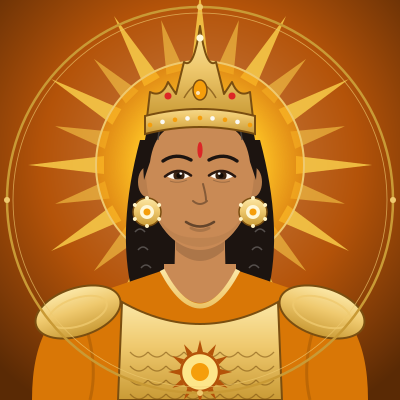
Outside the city, Krishna told Karna a secret. “Karna, you were born to Kunti before her marriage, by the blessing of the Sun god. By dharma, you are Pandu's son and the eldest of the Pandavas. Come with me. The five brothers will touch your feet, Draupadi will honour you, and you will be crowned king.”
Karna listened quietly, then said, “I know this, Krishna. But my mother Kunti abandoned me as a baby. It was Adhiratha the charioteer and his wife Radha who raised me with love. I married in their community, and my children and grandchildren are there. For thirteen years Duryodhana has given me honour and trust. I cannot betray him now, out of fear or greed.” He added, “Please keep this secret. If Yudhishthira learns that I am his elder brother, he will give the kingdom to me, and I would give it to Duryodhana. Let Yudhishthira rule. I know that where you and Arjuna stand, victory will be.”
Krishna said sadly, “Then it is decided. Tell Bhishma, Drona and Kripa that in seven days, on the new moon, the battle will begin.” Karna embraced Krishna and returned to the city.
Kunti, too, was full of worry. She went to the bank of the Ganga, where Karna stood every morning praying to the Sun with folded hands. She waited behind him in the heat until his prayer was done. Karna turned, bowed, and said, “I am Karna, son of Radha and Adhiratha. What can I do for you?” Kunti said, “You are my son, my firstborn, the son of the Sun god. Join your brothers.” Then a voice came from the Sun himself: “Kunti speaks the truth.”
Karna replied, “You abandoned me when I was a newborn, and I was denied the honour of a Kshatriya. Only now, for your other sons' sake, do you call me your son. I cannot leave Duryodhana now.” Then his voice softened. “But your coming here will not be wasted. I will not kill Yudhishthira, Bhima, Nakula or Sahadeva, even when I have the chance. I will fight only Arjuna. If Arjuna falls, you will have five sons with me. If I fall, you will have five sons with Arjuna.” Kunti embraced him, trembling, and said, “Remember this promise.” Then she went back.
The Armies Gather
Now both sides prepared for war. An akshauhini was a huge army of about 21,870 chariots, the same number of elephants, 65,610 horsemen and 109,350 foot soldiers. The Pandavas gathered seven akshauhinis, led by Drupada, Virata, Dhrishtadyumna, Shikhandi, Satyaki, Chekitana and Bhima. After talking with his brothers and with Krishna, Yudhishthira made Dhrishtadyumna, Draupadi's brother, the commander of the whole army.
The Kauravas gathered eleven akshauhinis, and Duryodhana asked Bhishma to lead them. Bhishma agreed, but said, “I will not kill the sons of Pandu. Each day I will defeat thousands of their soldiers. And either Karna fights first, or I do, because he always competes with me.” While counting the great warriors, Bhishma called Karna only half a chariot-warrior, because of a sage's curse and because he had given away his armour. Karna was deeply hurt and said, “As long as you live, I will not fight. Only when you have fallen will I enter the battle.”
Before the battle, Duryodhana sent Uluka, Shakuni's son, to the Pandava camp with a proud and insulting message. It reminded them of the dice game and of Draupadi's suffering, and dared them to come and fight. The Pandavas listened with flashing eyes. Arjuna replied calmly, “Tell Duryodhana that his answer will come on the battlefield.”
Duryodhana once asked Bhishma why he would not fight Shikhandi, Drupada's son. Bhishma told him the story. Long ago, Bhishma had won three princesses of Kashi for his brother Vichitravirya. The eldest, Amba, said she had already given her heart to King Shalva, so Bhishma let her go. But Shalva refused her. Amba blamed Bhishma for ruining her life. Even Parashurama could not defeat Bhishma for her sake. So Amba did hard penance, and Lord Shiva blessed her: “In your next birth you will cause Bhishma's death.”
Amba was reborn as the daughter of King Drupada. Because of Shiva's words, Drupada raised her as a son and named her Shikhandi. Later, a kind yaksha named Sthunakarna exchanged his manhood with Shikhandi, and so Shikhandi became a man. “I will never shoot an arrow at one who was born a woman,” Bhishma said. “That is my vow.” With this story ringing in their ears, the two vast armies marched towards the holy field of Kurukshetra.
Did you know?
- This part of the epic is called the Udyoga Parva, meaning “the book of effort”, because both sides worked so hard to prepare, and Krishna worked so hard for peace.
- Vidura's night-long advice to Dhritarashtra, known as Vidura Niti, is still studied today as a guide to wise and honest living.
- Together, the two armies had eighteen akshauhinis, which matches the eighteen days of the war and the eighteen parvas of the epic.
- Karna asked Krishna not to tell Yudhishthira the secret, because he knew Yudhishthira would give him the kingdom at once.
What this chapter teaches us
Krishna tried every path to peace, teaching us that war must always be the very last choice. Arjuna chose God's presence over any amount of power, and that choice decided everything. Vidura's wisdom shows that good advice helps only when we are willing to act on it. Karna's story shows how loyalty and gratitude can pull a good heart in painful directions.