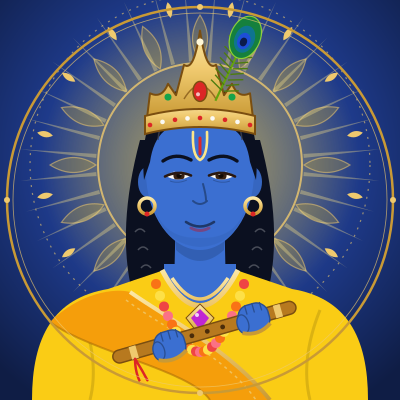
Shri Krishna, the avatar of Lord Vishnu, stands at the heart of the Mahabharata. He was the son of Vasudeva and Devaki of the Yadava clan. Vasudeva’s sister was Pritha, better known as Kunti, the mother of the Pandavas, so Krishna was their cousin. He was also Balarama’s younger brother and Subhadra’s brother, and he lived with the Yadavas in Dwaraka by the western sea. Krishna never sat on the throne of Hastinapur, yet he was present at every turning point of the story. He was Arjuna’s dearest friend, Draupadi’s protector, Yudhishthira’s adviser and the messenger of peace. When war could not be avoided, he drove Arjuna’s chariot without lifting a weapon, and on the battlefield he gave the world the Bhagavad Gita.
Birth, childhood and Dwaraka
Krishna was born in Mathura, in the prison of the cruel King Kansa, who had locked up his own cousin Devaki and her husband Vasudeva because of a prophecy that her eighth child would kill him. To save the baby, Vasudeva carried him across the Yamuna to Gokul, where the cowherd chief Nanda and his wife Yashoda raised him as their own.
The Harivamsha, the appendix to the Mahabharata, tells his childhood in full, and the Mahabharata itself recalls it in Bhishma’s words at Yudhishthira’s Rajasuya: how the child destroyed the demoness Putana and other demons, how he lifted the Govardhana hill to shelter the cowherds, and how he grew up with his elder brother Balarama among the cows of Vraja. Finally he returned to Mathura and ended Kansa’s cruel rule.
Kansa’s father-in-law, the mighty King Jarasandha of Magadha, attacked Mathura again and again to take revenge. To keep their people safe, Krishna led the Yadavas to the western coast, where they built the strong city of Dwaraka.
Krishna married Rukmini, princess of Vidarbha, carrying her away just before she was to be given to Shishupala and defeating her brother Rukmi in battle. Later he married Satyabhama, Jambavati and many other queens. Among his many sons were Pradyumna, son of Rukmini, and Samba, son of Jambavati.
Friend of the Pandavas
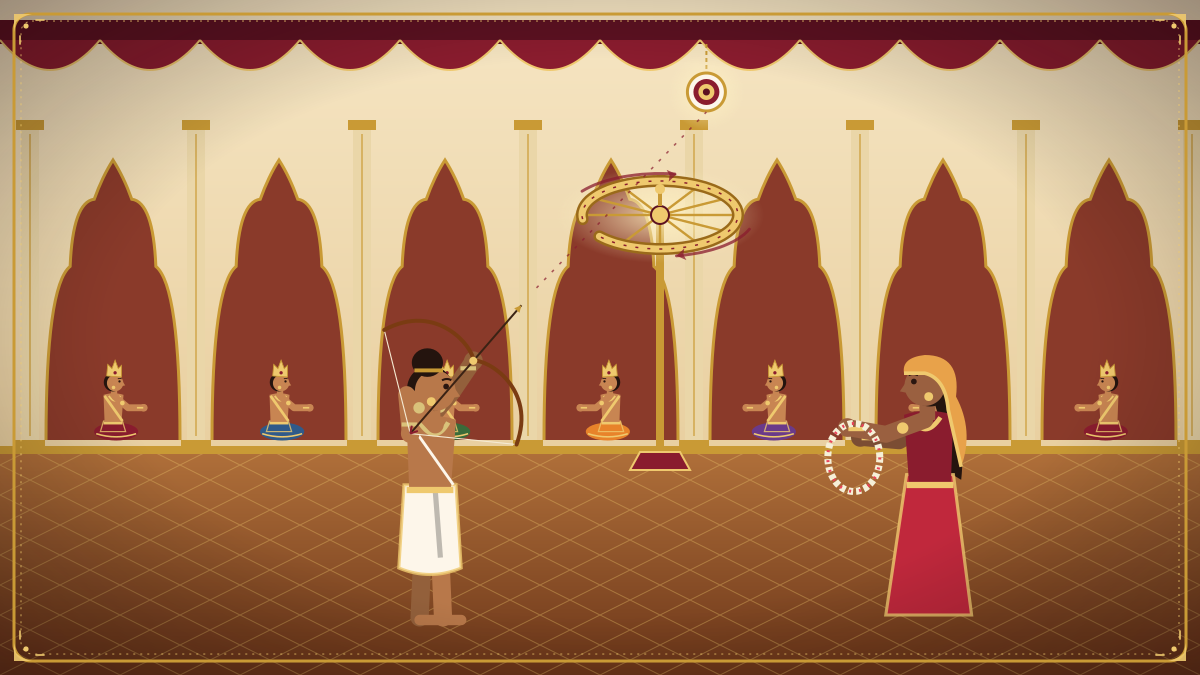
Krishna first met the Pandavas as grown men at Draupadi’s swayamvara. Though they were disguised as brahmins, he recognised them and quietly pointed them out to Balarama. After Arjuna won Draupadi, Krishna and Balarama went to the potter’s house where the Pandavas were staying, bowed at the feet of their aunt Kunti, and embraced their cousins. From that day, Krishna and Arjuna were inseparable friends.
Later, when Arjuna came to Dwaraka on a long pilgrimage, he fell in love with Krishna’s sister Subhadra at a festival on the Raivataka hill. Krishna advised him to carry her away in the manner of Kshatriya heroes, and Yudhishthira gave his consent. The Yadavas were angry at first, but Krishna calmed them, and Subhadra and Arjuna were married. Their son Abhimanyu became Krishna’s beloved nephew.
One summer day, Krishna and Arjuna were resting by the Yamuna near the Khandava forest when Agni, the fire god, came to them in the form of a brahmin and asked to consume the forest. Agni gave Arjuna the Gandiva bow and Krishna the Sudarshana Chakra and the Kaumodaki mace. Together the two friends guarded the fire, even against Indra, until the forest was consumed.
During that fire, Arjuna spared the demon architect Maya. In gratitude Maya built the Pandavas a wonderful assembly hall at Indraprastha, the new capital Krishna had helped them establish.
Jarasandha, the Rajasuya and Shishupala
When Yudhishthira wished to perform the Rajasuya sacrifice, Krishna told him that it could not be done while Jarasandha lived, for he had imprisoned many kings and meant to offer them in sacrifice. So Krishna, Bhima and Arjuna went to Jarasandha’s capital Girivraja dressed as snataka brahmins and challenged him to single combat.
Jarasandha chose to wrestle Bhima. They fought for many days and nights without rest. When Jarasandha was at last tired, Krishna gave Bhima a sign, and Bhima overcame him. Krishna then freed all the imprisoned kings and placed Jarasandha’s son Sahadeva on the throne of Magadha.
At the Rajasuya, Bhishma said that the first honour of the sacrifice should go to Krishna, and Sahadeva offered it to him. King Shishupala of Chedi, Krishna’s cousin, rose in fury and insulted Krishna, Bhishma and the Pandavas before all the kings.
Long before, when Shishupala was a baby, it had been foretold that he would die at the hands of the one on whose lap his extra arms would fall away. They fell away on Krishna’s lap. His mother, Krishna’s aunt, begged for her son’s life, and Krishna promised to forgive a hundred of his offences. Now, when Shishupala went beyond that number, Krishna ended his life with the Sudarshana Chakra, and a light rose from his body and entered Krishna.
Draupadi and the forest years
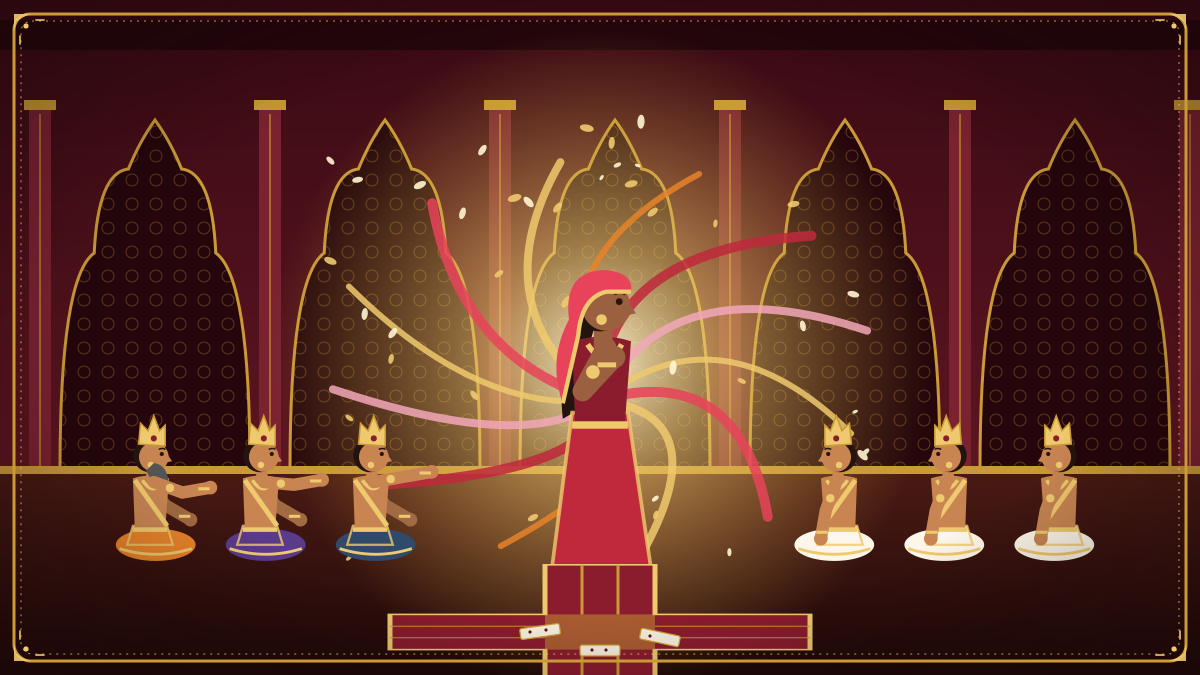
When Yudhishthira lost everything at dice and Dushasana dragged Draupadi into the assembly, no one there could help her. Draupadi prayed to Govinda, the Lord of Dwaraka, with complete faith. As Dushasana pulled at her garment, another garment appeared beneath it, again and again, until he fell back exhausted, and her honour was saved.
Krishna later told the Pandavas that he had been away fighting King Shalva of the flying city Saubha, and that if he had been in Dwaraka he would have stopped the game of dice altogether. He came to see them in the Kamyaka forest. Weeping, Draupadi reminded him that he was her relative, her friend and her protector. Krishna promised her that the wives of those who had wronged her would one day weep as she did.
Once Duryodhana sent the short-tempered sage Durvasa with thousands of disciples to the Pandavas’ hermitage, after Draupadi had already eaten and the day’s food was finished. Draupadi called on Krishna. He came at once and asked her for something to eat. In the vessel he found one tiny piece of leaf with a grain of rice, and he ate it. At that moment Durvasa and his disciples, bathing in the river, felt completely full, and they quietly went away.
The peace mission and Vishwarupa
When the thirteen years were over, both sides prepared for war. Duryodhana and Arjuna came to Dwaraka on the same day to ask for Krishna’s help. Krishna offered a choice: his great army of Narayani warriors, or himself alone, who would not fight. Arjuna chose Krishna, and Duryodhana happily took the army.
Still, Krishna went to Hastinapur himself to try for peace. He refused Duryodhana’s feast and stayed with Vidura. In the royal assembly he spoke wisely and lovingly, reminding the Kauravas that the Pandavas were ready to settle even for five villages. Duryodhana answered that he would not give them even as much land as the point of a needle could cover.
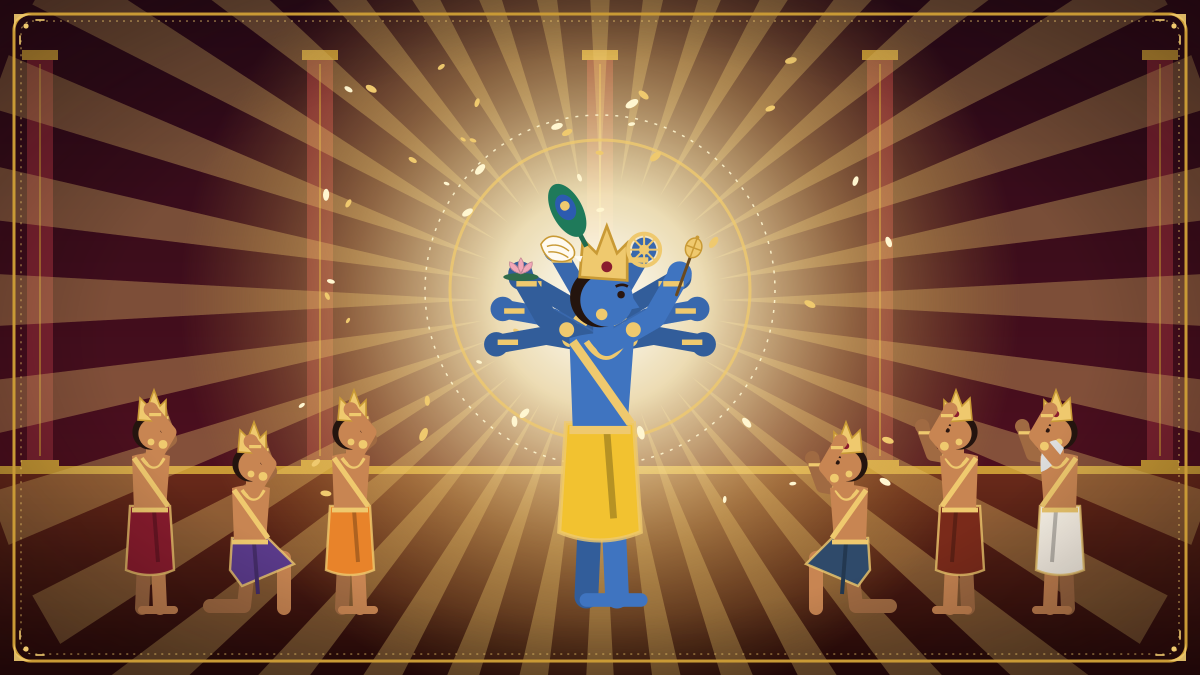
Duryodhana then plotted with his friends to take Krishna prisoner. Krishna only laughed and revealed his Vishwarupa, his universal form, in which gods, sages and the heroes of both sides could be seen. Everyone was dazzled, and for a moment the blind Dhritarashtra was given sight to behold it. Then Krishna calmly left the hall.
As he left Hastinapur, Krishna took Karna in his chariot and told him that he was Kunti’s eldest son. He offered him the throne if he would join his brothers. Karna gently refused, because of his loyalty to Duryodhana, and the two parted with respect.
The Gita and the charioteer
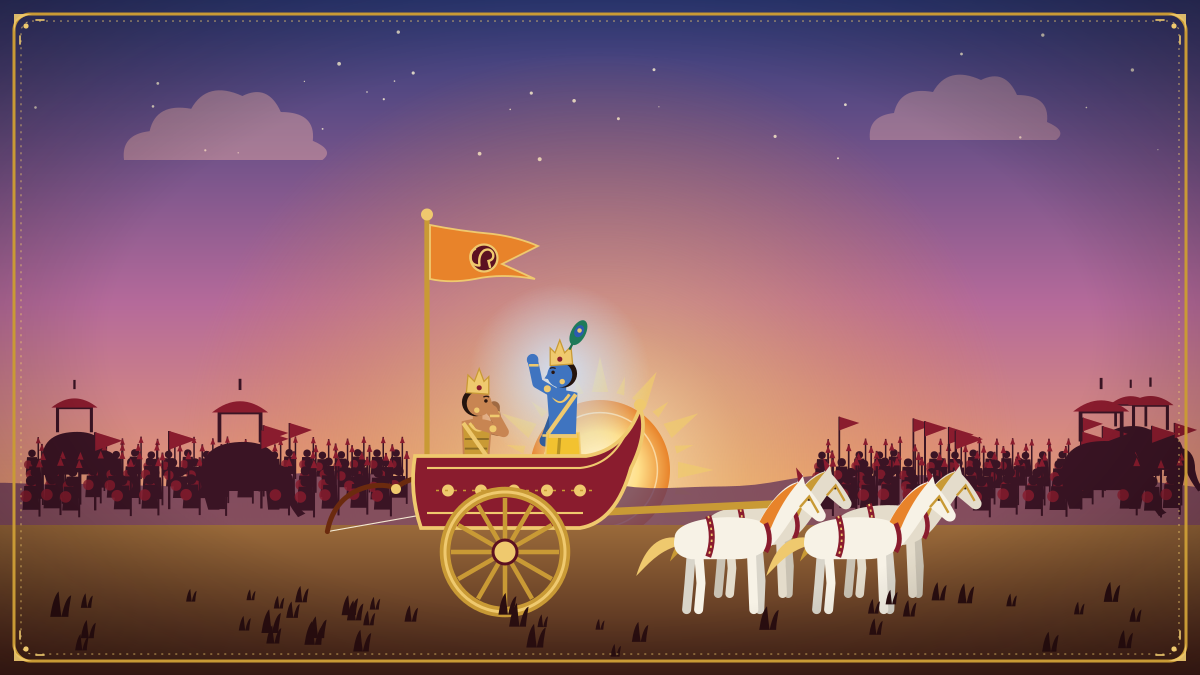
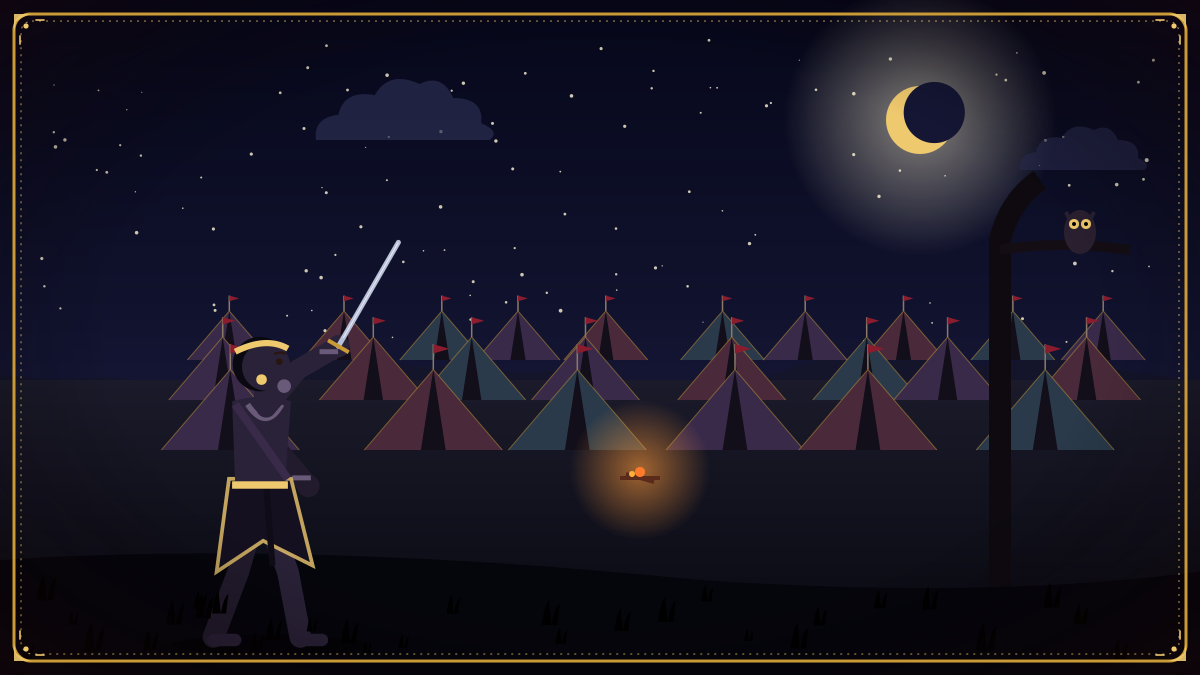
On the first morning at Kurukshetra, Arjuna asked Krishna to drive the chariot between the two armies. Seeing Bhishma, the grand elder whom he called grandfather, his teacher Drona and his own relatives ready to fight, Arjuna was overwhelmed with grief, put down his bow and said he would not fight.
Then Krishna taught him the Bhagavad Gita. He explained that the soul is eternal and never dies, that one must do one’s duty without attachment to its fruits, and that the one who acts with devotion and surrenders everything to God is never lost. He revealed his Vishwarupa to Arjuna, and Arjuna, his doubts gone, picked up the Gandiva once more.
Twice, when Arjuna was fighting Bhishma too gently, Krishna jumped down from the chariot to face Bhishma himself, once with the Sudarshana Chakra and once with his whip, and Arjuna had to hold him back. On the twelfth day he took Bhagadatta’s deadly weapon on his own chest, and it turned into a garland. On the fourteenth day he hid the sun so that Arjuna could keep his vow against Jayadratha.
On the fifteenth day Krishna advised that Drona would stop fighting only if he heard that Ashwatthama was dead, and when Ashwatthama hurled the Narayana weapon, Krishna saved the Pandava army by telling every warrior to lay down his arms. On the seventeenth day he pressed the chariot into the earth to save Arjuna from Karna’s serpent-arrow.
On the eighteenth day, during the mace fight, Krishna reminded Arjuna of Bhima’s vow, and Arjuna signalled Bhima to strike Duryodhana’s thigh. When the war was over, Krishna asked Arjuna to step down first. The moment Krishna himself stepped down, the chariot burst into flames; only his presence had kept it safe from the divine weapons that had struck it.
After the war, and his departure
That night Ashwatthama attacked the sleeping Pandava camp, and later he aimed a terrible weapon at the unborn child in Uttara’s womb. Krishna cursed Ashwatthama to wander the earth for three thousand years, and he promised to protect the child. Later the baby was born lifeless, and Krishna brought him back to life, saying, “If I have never spoken a lie, let this child live.” This child was Parikshit, the heir of the Pandavas.
When Krishna went with the Pandavas to grieving Gandhari, she blamed him for not stopping the war, though he could have done so. She cursed him that in the thirty-sixth year his own Yadava clan would destroy itself and he too would leave the world alone in a forest. Krishna accepted the curse calmly, saying that only he could bring the Yadavas to an end.
Krishna then took Yudhishthira to Bhishma, who lay on his bed of arrows. He freed Bhishma from pain and clouded mind so that he could teach Yudhishthira about dharma and kingship. Later, at Indraprastha, when Arjuna said he had forgotten the Gita, Krishna taught him again in what is called the Anugita.
Thirty-six years after the war, some Yadava youths mocked visiting sages, and a curse was laid upon the clan. At Prabhasa the Yadavas quarrelled and destroyed one another. Balarama left his body in yoga. Krishna then sat in deep meditation in the forest. A hunter named Jara, taking his foot for a deer, shot an arrow into it. Krishna comforted the frightened hunter and departed to his own divine abode.
Arjuna came from Hastinapur and led the remaining Yadava women and children away. As soon as they had left, the sea rose and swallowed the city of Dwaraka.
Did you know?
- The Bhagavad Gita has 700 verses in 18 chapters, spoken on the battlefield just before the war began.
- Krishna received his Sudarshana Chakra from Agni, the fire god, at the burning of the Khandava forest.
- Krishna showed his Vishwarupa three times in the Mahabharata: in the Kaurava court, to Arjuna at Kurukshetra, and later to the sage Uttanka.
- The Mahabharata says Krishna left the world thirty-six years after the war, when the hunter Jara’s arrow struck the sole of his foot as he sat in yoga.
What we learn from Shri Krishna
Shri Krishna teaches us to do our duty with a calm mind and to trust God in every situation. He showed that true friendship means guiding, protecting and sometimes correcting the ones we love. He tried for peace until the very end, and when war came he stood firmly on the side of dharma. His Gita reminds us that right action, done without selfishness and offered to God, is itself worship.
Shri Krishna in the story
Read the chapters where Shri Krishna plays a part.