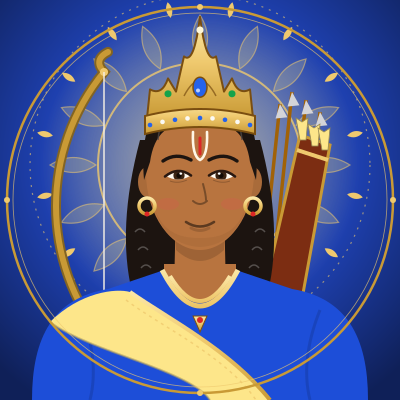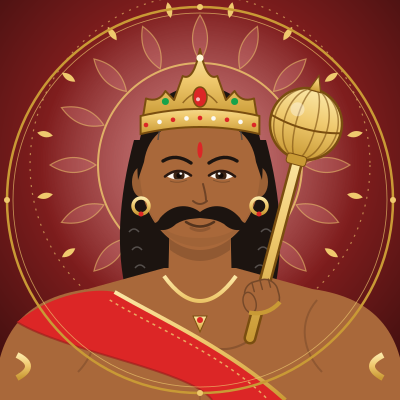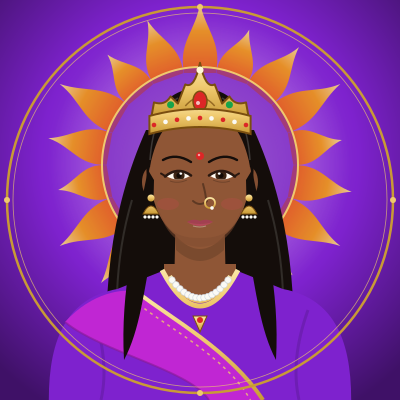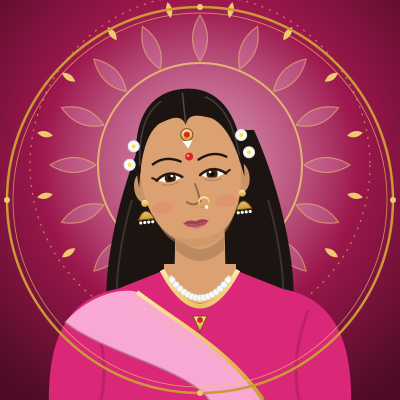
Key moments
- Dhaumya teaches how to live humbly in a king's service
- Weapons hidden in a Shami tree near the cremation ground
- Six humble disguises in King Virata's court
- Bhima ends the wicked Kichaka in the dance hall
- Bhishma confirms the thirteen years were complete
- Arjuna alone drives back the whole Kaurava army
- Arjuna accepts Uttara as daughter-in-law, not wife
- Uttara marries Abhimanyu at Upaplavya
Preparing to hide
Twelve years in the forest were over. Now the Pandavas had to live for one full year where no one could recognise them. If they were discovered, they would have to go back to the forest for another twelve years. After much thought they chose the kingdom of Matsya, ruled by the good and generous King Virata.
Before they left, Dhaumya, their priest, taught them how to live in a king's service. “Never sit on a seat meant for the king. Do not speak unless asked, and never give advice in front of others. Stand neither too close nor too far. Do not be friendly with the women of the palace. Keep the king's secrets, praise his good qualities, and do your work carefully without pride. One who serves this way lives safely in a royal court.” Yudhishthira thanked him, and Dhaumya went to Panchala with the sacred fires.
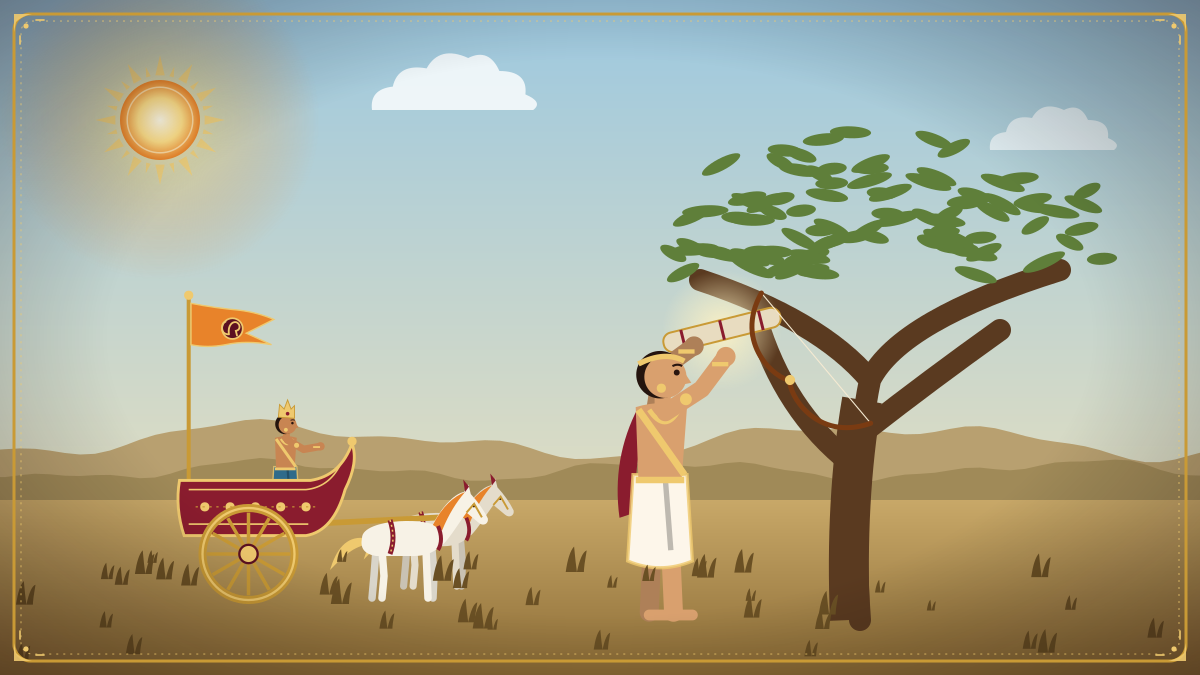
Near Virata's city was a cremation ground, and on a hill there stood a tall Shami tree. The brothers unstrung their bows, wrapped the Gandiva and all their weapons tightly in cloth, and Nakula climbed up and tied the bundle high among the branches. They also tied up a dead body there, so that people would keep away. To the herdsmen they said, “Our aged mother has died, and by our family custom we hang the body on a tree.”
They chose secret names to call one another in danger: Jaya, Jayanta, Vijaya, Jayatsena and Jayadbala. Then Yudhishthira prayed to Goddess Durga for protection, and she appeared and blessed them, promising that no one in Matsya would recognise them. One by one, at different times, they entered Virata's city.
Six new faces in Virata's court
Yudhishthira came first, as a Brahmin named Kanka, carrying golden dice. “I am skilled in dice,” he told the king, “and I was once a friend of King Yudhishthira.” Virata was so impressed by him that he made Kanka his close companion and honoured him almost like an equal. Next came Bhima, as Ballava the cook. “I once cooked for King Yudhishthira,” he said, “and I can wrestle with any strongman.” Virata made him the head of the royal kitchen.
Then came Arjuna, tall and broad, but wearing women's bangles and earrings, with his hair braided. Because of Urvashi's curse he was now neither man nor woman, and he called himself Brihannala. Virata appointed him to teach music, singing and dance to his daughter, Princess Uttara, and her friends. Brihannala lived in the women's quarters and soon became much loved by everyone there.
Nakula became Granthika, keeper of the royal horses, and under him the horses grew strong and fast. Sahadeva became Tantipala, keeper of the cows, and the herds of Matsya grew larger and healthier than ever. Draupadi came as Sairandhri, a maid skilled in arranging hair and making garlands, and served Queen Sudeshna. The queen worried that a woman so beautiful might attract the king, but Draupadi assured her, “Five gandharvas are my secret husbands. They protect me, and anyone who troubles me will die.”
Months passed in this way. Kings' sons cleaned stables and cooked food, and a queen did a maid's work, yet they kept their patience. Secretly, Yudhishthira shared the money he won at dice with his brothers, Bhima shared food, and Arjuna shared the clothes the palace women gave him.
In the fourth month there was a great festival in honour of Lord Brahma, and wrestlers came from many lands. The strongest of them was Jimuta, whom no one dared to face. Virata asked his cook Ballava to fight him. The two wrestled like angry elephants, and at last Bhima lifted Jimuta, whirled him round and threw him to the ground, defeating him. The king was delighted and rewarded Ballava richly.
Kichaka's insult
Near the end of the year, a new danger arose. Kichaka, Queen Sudeshna's brother and the mighty commander of Virata's army, saw Sairandhri and was overcome by desire. He tried to win her with gifts and sweet words, but she firmly refused him: “I am the wife of others. Gandharvas guard me. Do not walk the path to your own death.”
Kichaka would not listen. He begged his sister for help, and Sudeshna, though uneasy, sent Sairandhri to Kichaka's house to bring wine for her. Draupadi went trembling, praying to Surya for protection, and the Sun god sent an invisible guardian to stay with her. When Kichaka grabbed her hand, she pushed him away and ran to the royal court, where the king was sitting.
Kichaka chased her there and, in front of the king and all the courtiers, knocked her down and kicked her. Kanka and Ballava were both present. Bhima's eyes burned and he looked towards a tree, ready to tear it up. But Yudhishthira pressed his own toe on Bhima's foot as a warning, and said aloud, “Cook, if you need firewood, go and find it somewhere else.” If Bhima fought now, they would be recognised.
Draupadi cried out to the king, “Is there no justice in this court?” Virata, afraid of his powerful commander, did nothing. Then Kanka said quietly, “Sairandhri, go back to the queen. Your gandharva husbands surely know the right time to act. Do not weep before the court.” With her heart on fire, Draupadi went away.
That night she could not sleep. She went silently to the kitchen where Bhima lay sleeping, woke him, and poured out her sorrow: the dice game, the insult, the years in the forest, and now this. “The wife of five heroes is kicked like a servant,” she wept. “If Kichaka lives until sunrise, I will give up my life.” Bhima wiped her tears and held her hands, which had become rough from grinding sandalwood. “I will kill him tonight,” he promised.
The night in the dance hall
Together they made a plan. Next day, when Kichaka troubled her again, Sairandhri pretended to agree. “Come alone tonight to the dance hall,” she said, “where the girls practise in the day. At night it is empty. Tell no one.” Kichaka was overjoyed and spent the day dressing in fine clothes and perfumes.
That night Bhima went to the dance hall first and lay down on the bed in the dark, covered with a sheet. Kichaka came in and touched him, thinking it was Sairandhri. At once Bhima sprang up, laughing, and caught him by the hair. The two mighty men wrestled like two great bulls, and the whole hall shook. At last Bhima pinned Kichaka to the ground and ended his life. Then he showed Draupadi what he had done and returned quietly to the kitchen.
In the morning the guards found Kichaka dead, and all said, “Sairandhri's gandharva husbands have killed him.” Kichaka had a hundred and five brothers, called the Upakichakas. In their anger they tied Sairandhri to Kichaka's funeral bier to burn her with him. Draupadi called out the secret names: “Jaya! Jayanta! Vijaya! Jayatsena! Jayadbala!”
Bhima heard her. He jumped over the wall, uprooted a tree and ran at the brothers, looking like a gandharva in the dark. He killed all of them and freed Draupadi. The people of the city were terrified of the gandharvas. Sudeshna begged Sairandhri to leave, but she asked for just thirteen more days, saying that after that her husbands would be satisfied and would take her away.
Raids from the south and the north
Meanwhile Duryodhana's spies had searched every forest, village and city, but had found no trace of the Pandavas. Then they brought news that Kichaka had been killed at night by unseen gandharvas. Duryodhana guessed that only Bhima could have done this. King Susharma of Trigarta, whom Kichaka had often defeated, said, “Now that Kichaka is gone, let us attack Matsya and carry off Virata's cattle.” It was decided that Susharma would strike from the south, and the Kauravas from the north the next day.
Susharma raided the southern pastures, and Virata rode out with his army. Kanka, Ballava, Granthika and Tantipala went with him, dressed as warriors. In the fight Susharma captured King Virata and carried him off in his chariot. Yudhishthira said to Bhima, “Free the king, but do not uproot a tree, or they will know you. Fight with an ordinary bow.” Bhima rescued Virata and captured Susharma, and Yudhishthira kindly let Susharma go free.
The very next day, Duryodhana, Bhishma, Drona, Kripa, Ashwatthama and Karna attacked from the north and seized sixty thousand cows. The herdsmen ran to the palace, but only Virata's young son, Prince Uttar, was there. Among the women he boasted, “If only I had a good charioteer, I would defeat them all and they would think it was Arjuna himself!”
Draupadi heard this and said, “Brihannala once drove Arjuna's chariot. She is a fine charioteer.” Princess Uttara ran and begged her teacher. Brihannala pretended not to know how to wear armour, and put it on upside down, making everyone laugh, and then took the reins. As they left, Uttara and her friends called out, “Bring us fine coloured clothes from the warriors for our dolls!”
But when Uttar saw the huge Kaurava army, like an ocean of chariots and elephants, he began to shake with fear. “I cannot fight them!” he cried, and jumped from the chariot and ran. Brihannala ran after him, braid flying, and the Kaurava warriors wondered, “Who is this? Running like that, he looks like Arjuna.” Brihannala caught the prince, comforted him, made him the charioteer and drove to the Shami tree.
Arjuna reveals himself
At the Shami tree Brihannala asked Uttar to climb up and bring down the bundle. The prince was afraid to touch it, but obeyed. When the cloth was opened, the weapons shone like fire. There was the Gandiva, the bows of the other brothers, their quivers and swords. “Whose are these?” asked the astonished prince.
Arjuna told him the truth: Kanka was Yudhishthira, Ballava was Bhima, the keepers of horses and cows were Nakula and Sahadeva, and Sairandhri was Draupadi. “I am Arjuna,” he said. Uttar did not believe it until Arjuna told him his ten names and the meaning of each: Arjuna, Phalguna, Jishnu, Kiriti, Shvetavahana, Bibhatsu, Vijaya, Krishna, Savyasachi and Dhananjaya. Then Uttar bowed at his feet.
Arjuna took off his bangles, tied back his hair and put on armour. He thought of the fire god, and his own flag with the great monkey appeared on the chariot. He strung the Gandiva and twanged it, and blew his conch Devadatta. The sound was so loud that Uttar fell down in the chariot from fright, and Arjuna had to calm him and set him back on his seat.
In the Kaurava camp, Drona recognised the sound at once. Duryodhana said, “If it is Arjuna, then the Pandavas have been found before the thirteenth year ended, and they must go back to the forest for twelve more years.” But Bhishma counted carefully: “By the reckoning of the stars, with the extra months that come in some years, the thirteen years were completed, with five months and twelve nights to spare. The Pandavas have kept their word.”
Arjuna first sent two arrows to fall at the feet of Drona and Bhishma as a respectful greeting. Then he chased after Duryodhana, who was leaving with a part of the army, and freed the cows, which ran back towards Matsya. One after another he fought and drove back Karna, Kripacharya, Drona, Ashwatthama and Dushasana. When Bhishma came forward, they fought long, and at last Bhishma was struck and his charioteer drove him out of the battle. Duryodhana too was wounded and turned away, but when Arjuna called him a coward, he came back to fight.
Then all the great warriors surrounded Arjuna together. He used the Sammohana weapon, and they all fell into a deep sleep in their chariots. Only Bhishma, who knew the way to resist it, stayed awake. Remembering Uttara's request, Arjuna asked Uttar to take the white upper garments of Drona and Kripa, the yellow one of Karna, and the blue ones of Ashwatthama and Duryodhana for her dolls, but to leave Bhishma alone. When the warriors woke, Bhishma told Duryodhana it was time to go home, and the Kaurava army returned to Hastinapur.
Recognition and a royal wedding
On the way home, Arjuna put his weapons back in the Shami tree and became Brihannala again. He asked Uttar to tell no one yet, and to say that he himself had won the battle. In the palace, Virata, back from defeating Susharma, heard that his son had gone alone to fight the Kauravas and was very worried. Then messengers came: “Prince Uttar has won! The cows are coming home!”
The happy king sat down to play dice with Kanka and kept praising his son. Kanka said, “With Brihannala as his charioteer, how could he not win?” Virata was angry to hear his son compared with a dancer, and he threw the dice hard at Kanka's face. Kanka's nose began to bleed. Sairandhri quickly caught the drops in a golden bowl so that they would not fall on the ground. When Uttar arrived, Kanka had the guard keep Brihannala outside, because if Arjuna saw Yudhishthira's blood, he would not forgive the one who had shed it.
Uttar entered, saw the blood and was horrified. He said that the battle had been won by a divine youth, not by him. On the third day, the five Pandavas bathed, dressed in royal clothes and sat on royal seats in the court. Virata came in and was angry to see Kanka on a king's seat. Then Arjuna told him who they all were. Uttar confirmed it, and Virata's joy knew no bounds. He embraced them, begged forgiveness and offered his whole kingdom to Yudhishthira.
Virata wished to give his daughter Uttara in marriage to Arjuna. Arjuna gently refused: “For a whole year I lived in the women's quarters and taught her. She trusted me as a daughter trusts her father. It is not right for me to marry her. But I accept her gladly as my daughter-in-law, as the wife of my son Abhimanyu, Krishna's nephew.” Everyone praised Arjuna's pure heart.
The wedding took place at Upaplavya, a town in Virata's kingdom. Krishna came with Balarama, Subhadra and Abhimanyu, and Drupada came with Dhrishtadyumna, Shikhandi and Draupadi's sons. Many kings who were friends of the Pandavas gathered there. The year of hiding was over and the promise had been kept. Now the Pandavas could rightfully ask for their kingdom back. Would Duryodhana return it?
Did you know?
- This part of the epic is called the Virata Parva, after King Virata, in whose court the Pandavas lived in disguise.
- Arjuna told Prince Uttar his ten names, including Dhananjaya, Vijaya, Savyasachi and Phalguna, to prove who he really was.
- Before going into disguise, the Pandavas hid their weapons high in a Shami tree near a cremation ground, so that no one would want to go near them.
- Princess Uttara's dolls got their new clothes from the upper cloths of the sleeping Kaurava warriors after Arjuna's victory.
What this chapter teaches us
Humility is a strength, not a weakness. Great warriors served others patiently for a whole year to keep their word, and Yudhishthira bore even a blow without anger. Urvashi's curse became a blessing, showing that what seems like misfortune can become a way to fulfil our duty. And Arjuna's answer about Uttara teaches that the bond between teacher and student is sacred, like that of a parent and child.