Key moments
- Arjuna defeats the Gandharva Angaraparna; Dhaumya becomes the Pandavas' priest
- Arjuna strings Drupada's hard bow and strikes the target
- Krishna recognises the Pandavas and meets them for the first time
- Vyasa explains Draupadi's past birth and Shiva's boon of five husbands
- The Pandavas build Indraprastha on the wild land of Khandavaprastha
- Arjuna's exile: Ulupi, Chitrangada and Subhadra; Abhimanyu is born
- Agni gives Arjuna the Gandiva bow at the burning of Khandava
- Arjuna saves Maya, who promises to build a wonderful hall
On the Road to Panchala
After escaping the house of lac, the five Pandavas and their mother Kunti were living quietly in the town of Ekachakra, dressed as poor Brahmins and living on alms. One day a travelling Brahmin stayed in their host's house. He told them that King Drupada of Panchala was going to hold a swayamvara, a ceremony in which a princess chooses her husband, for his daughter Draupadi.
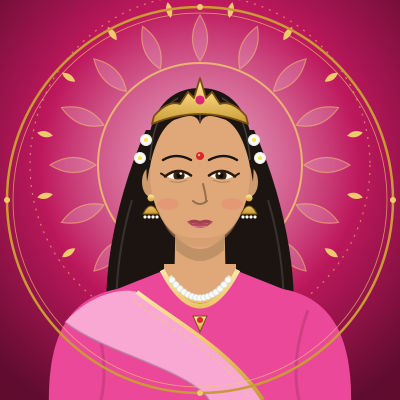
The Brahmin also told them how Draupadi had been born. Drupada had once been defeated by Drona, the teacher of the Kuru princes, and he longed for a son who could defeat Drona. He performed a great yajna, and from the sacred fire rose a shining young warrior, Dhrishtadyumna. Then from the altar rose a dark and beautiful maiden. She was named Krishnaa for her dark complexion, and is better known as Draupadi, the daughter of Drupada.
Soon afterwards the sage Vyasa, the grandfather of the Pandavas, came to visit them. He told them that in an earlier birth this maiden had been the daughter of a sage. She had prayed to Lord Shiva for a husband, and in her eagerness she had said, “Give me a husband,” five times. “She is destined to be your wife,” said Vyasa. “Go to Panchala.” Taking their mother with them, the brothers set out.
They walked by night, and Arjuna went in front holding a torch. At the bank of the Ganga a Gandharva named Angaraparna was playing in the water with his wives. He shouted at them to go away, for the night belonged to Gandharvas and spirits. Arjuna replied that the holy Ganga belongs to everyone. The Gandharva shot arrows at him, and Arjuna answered with the fire weapon that Drona had taught him. The Gandharva's chariot was burnt and he himself was dragged before Yudhishthira.
His wife begged for his life, and Yudhishthira, the eldest Pandava, let him go. The grateful Gandharva became Arjuna's friend. He gave him a special knowledge by which one could see anything one wished, and offered the brothers fine horses. He also gave them advice: “I could not stand against you, yet you travel without a family priest. A king should always have a wise priest to guide him.” On his advice, the Pandavas went to the sage Dhaumya and made him their priest.
Drupada's Hard Test
In his heart Drupada wished to give his daughter to Arjuna, whom he admired even though Arjuna had once defeated him for Drona. He believed the Pandavas were still alive. So he set a test that only a supreme archer could pass. He had a very hard bow made that hardly anyone could even bend.
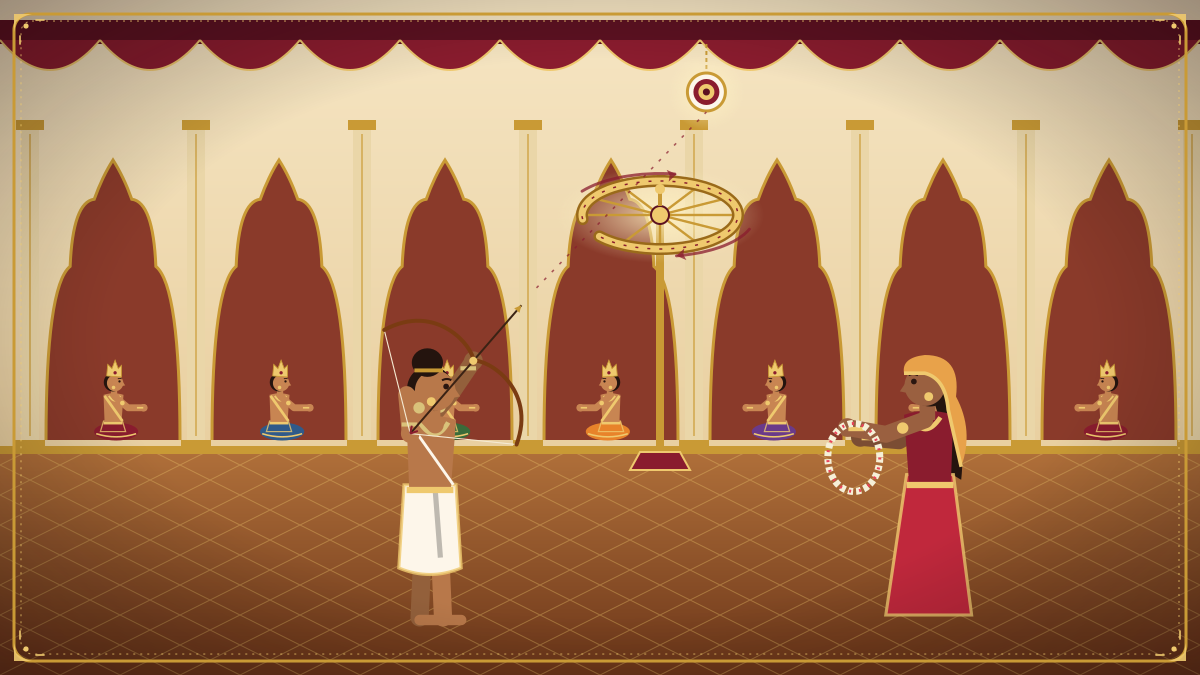
High up in the air he had a machine, a yantra, set up, which kept turning. Above its opening was placed a target. Drupada announced that whoever strung the bow and, with the arrows provided, shot through the opening of the turning machine and struck the target would win Draupadi.
Kings and princes came from every corner of the land, and the city was filled with music and celebrations. Krishna and his elder brother Balarama came with the Yadavas. The Pandavas, still dressed as Brahmins, sat quietly among the Brahmins. On the appointed day Draupadi entered the hall holding a garland of gold, and her brother Dhrishtadyumna announced the terms of the contest and named the great kings who had come.
One after another the kings rose to try. The bow was so stiff that many could not string it at all. Some were thrown back by its force and fell to the ground, their crowns and ornaments scattered. Powerful kings such as Shishupala, Jarasandha and Shalya tried and failed, and went back to their seats ashamed.
Then Karna, the great archer and friend of Duryodhana, stepped forward and strung the bow. In the Gita Press text, Draupadi said aloud that she would not choose a charioteer's son, and Karna, with a bitter smile, looked up at the sun and set the bow down. Other old manuscripts tell this moment a little differently. In every version, the prize was not his: it was waiting for Arjuna.
Arjuna Wins Draupadi
Then, from the row where the Brahmins sat, a young man rose. It was Arjuna in disguise. Some Brahmins worried that he would fail where great kings had failed. Others said, “Look at his arms and his steady walk. He will surely succeed.” Arjuna walked around the bow with respect, bowed to it in his heart to Lord Shiva and to Krishna, and lifted it.
In the twinkling of an eye he strung the bow. Taking the arrows, he shot through the opening of the turning machine and struck the target, which fell to the ground. A great roar rose from the hall. Flowers rained from the sky, drums and conches sounded, and Draupadi came forward with a gentle smile and placed the garland around Arjuna's neck.
The kings were furious that a Brahmin had won a princess at a contest meant for kings. They rushed at Drupada and at the young man. Arjuna stood with his bow, and Bhima pulled up a whole tree, stripped its leaves and stood beside him holding it like a club. Watching this, Krishna said quietly to Balarama, “That archer is Arjuna, and the one with the tree is Bhima. The Pandavas have escaped the fire.”
Karna fought Arjuna and was amazed by his skill. He asked whether this was the god of archery himself, or Parashurama, or Indra in disguise. Arjuna replied that he was a Brahmin who had learned the divine weapons from his teacher. Karna turned away, unwilling to fight a Brahmin of such power. Meanwhile Bhima wrestled the mighty Shalya and threw him to the ground, yet spared him.
Then Krishna spoke to the angry kings with calm words. He told them that the maiden had been won fairly and according to dharma, and that there was no reason to fight. The kings slowly gave up and returned to their kingdoms, while Arjuna and Bhima led Draupadi away through the crowd.
Five Husbands for Draupadi
Kunti was waiting anxiously in the potter's house where they were staying, for her sons were late. Arjuna and Bhima arrived and called out, “Mother, we have brought alms!” Kunti, inside the house, replied without looking, “Enjoy it all together, all of you.” When she came out and saw the princess, she was deeply troubled. “What have I said!” she cried, for a mother's word must not prove false, and yet she feared doing wrong.
Yudhishthira thought carefully. He asked Arjuna to marry Draupadi, since he had won her. But Arjuna said that the eldest brother must marry first. Yudhishthira saw that all the brothers were looking at Draupadi, and remembering the words of Vyasa, he said that she would become the wife of all five. That same evening Krishna and Balarama came to the potter's house. Krishna, the son of Kunti's brother Vasudeva, touched the feet of his aunt Kunti and of Yudhishthira and met his cousins with great love. This was the beginning of the deep friendship between Krishna and Arjuna.
Dhrishtadyumna had secretly followed his sister. Hiding near the house, he heard the brothers talking about weapons, chariots and battles, not about alms and scriptures, and he told his father that these must be great warriors. Drupada invited them to his palace and set out many gifts: things for farming, things for worship, and fine weapons. The brothers went straight to the weapons. Then Yudhishthira told Drupada the truth: “We are the sons of Pandu.” Drupada was overjoyed.
But when Yudhishthira said that Draupadi would be the wife of all five brothers, Drupada was shocked. Such a thing was not the custom. Yudhishthira said his heart told him this was right, and while they were still discussing it, Vyasa arrived. He took Drupada aside and told him two secrets.
The first was the story of Draupadi's past birth. As the daughter of a sage she had prayed to Shiva, and when Shiva appeared to grant her a boon, she asked five times for a husband with every virtue. Shiva said, “You have asked five times, so in your next birth you will have five husbands.” The second was the story of the five Indras. Long ago, Indra had offended Shiva and found four earlier Indras shut up in a mountain cave. Shiva decreed that all five would be born on earth as men, and that the goddess Shri would be born to be their wife. The Pandavas were those five, and Draupadi was Shri herself. Vyasa gave Drupada divine sight for a moment, and he saw the brothers in their shining heavenly forms.
Drupada's doubts were gone. With Dhaumya performing the rites, Draupadi was married to each brother in turn, one day after another, beginning with Yudhishthira. Krishna sent rich wedding gifts of jewels, cloth, elephants and horses.
Return to Hastinapur and the Founding of Indraprastha
News travelled to Hastinapur that the Pandavas were alive and had married Drupada's daughter. Vidura, the wise younger brother of King Dhritarashtra, was overjoyed. Duryodhana, the king's eldest son, and his friend Karna were alarmed. Duryodhana wanted to create quarrels among the brothers, while Karna said they should attack at once, before the Pandavas grew stronger.
Dhritarashtra called his elders. Bhishma, the grand old man of the Kuru family, said clearly, “The Pandavas have as much right to this kingdom as your sons. Give them half.” Drona, the teacher of the princes, agreed and advised sending gifts and a warm invitation. Vidura added that the Pandavas now had Drupada and Krishna as friends, and that it was wise as well as right to make peace. Dhritarashtra sent Vidura to bring them home.
Vidura went to Panchala with gifts, and the Pandavas returned with Kunti, Draupadi and Krishna. The people of Hastinapur came out to welcome them with joy. Dhritarashtra then said to Yudhishthira, “To avoid quarrels with my sons, take half the kingdom and live at Khandavaprastha.” Khandavaprastha was a wild, forested land. Yudhishthira accepted without a word of complaint.
With Krishna's help the Pandavas built a city there, with strong walls, deep moats, wide roads, gardens and lakes. It was named Indraprastha, and it became so beautiful that it was compared to Indra's own city. Yudhishthira ruled it with justice. After seeing them settled, Krishna returned to Dwarka.
One day the sage Narada visited Indraprastha. He saw the five brothers and their single wife, and wished to protect their love for one another. He told them the story of two asura brothers, Sunda and Upasunda, who loved each other so much that they did everything together. By hard penance they won a boon that only they could kill each other, and they conquered the three worlds. Then the gods sent a heavenly maiden of matchless beauty named Tilottama. Both brothers wanted her, quarrelled, and struck each other down.
Taking the lesson to heart, the Pandavas made a rule in Narada's presence: if any brother disturbed Draupadi while she was with another brother, he must go and live in the forest as a celibate for twelve years.
Arjuna's Twelve-Year Journey
One day thieves stole the cows of a Brahmin, who ran to the palace crying for help. Arjuna's weapons were in the room where Yudhishthira was sitting with Draupadi. Arjuna faced a hard choice: break the rule, or fail to protect someone who had asked for help. He chose duty. He went in, took his bow, chased the thieves and brought back the cows. Then he asked for permission to go into exile. Yudhishthira said, “A younger brother entering his elder's room is no fault.” But Arjuna replied, “I have learned from you that dharma must not be kept by excuses,” and he set out for twelve years.
At Gangadvara, where the Ganga comes down from the mountains, Arjuna was bathing when Ulupi, a Naga princess, drew him down into the world of the Nagas. She told him that her heart was set on him and asked him to marry her. Arjuna stayed with her, and she gave him a boon that he would be unbeatable in water. Later she bore him a son, Iravan.
Arjuna travelled to many holy places in the east and south. At Manipura he met Chitrangada, the daughter of King Chitravahana. In that family each generation had only one child, so the king agreed to the marriage on one condition: the son born of it would stay in Manipura as the heir. Arjuna agreed, and a son named Babruvahana was born there.
At last Arjuna came to Prabhasa on the western sea. Krishna heard of it and came to meet him with great joy. At a festival on Raivataka mountain near Dwarka, Arjuna saw Subhadra, Krishna's sister, and his heart was drawn to her. Krishna noticed and smiled. He told Arjuna that at a swayamvara no one could know whom a bride would choose, and that among Kshatriyas, carrying away a bride was an accepted way of marriage. A messenger was sent to Yudhishthira, who gladly agreed.
So when Subhadra was returning from worship at Raivataka, Arjuna took her in his chariot and drove away. The Yadava warriors were angry and prepared to fight, and Balarama was the angriest of all. Krishna calmed him with wise words: Arjuna came from a noble family, was a worthy husband, and was unbeatable in battle. It was better to bring him back with honour and make him a friend. Balarama agreed. Arjuna was brought back and married Subhadra with full ceremony.
When his twelve years ended, Arjuna returned to Indraprastha with Subhadra. She went to Draupadi dressed simply like a cowherd woman, bowed and said, “I am your servant.” Draupadi embraced her lovingly. Krishna came with rich gifts. In time Subhadra gave birth to a brave son, Abhimanyu, who learned archery from his father. Draupadi had five sons, one with each brother: Prativindhya, Sutasoma, Shrutakarma, Shatanika and Shrutasena.
The Burning of Khandava
One hot summer Krishna and Arjuna went to the bank of the Yamuna with their friends. A tall, shining Brahmin came to them and asked for food. He was Agni, the god of fire. Agni had become weak and ill after receiving too much ghee in a king's long sacrifice, and Brahma had told him that eating the Khandava forest would cure him. But Takshaka, the king of the Nagas, lived there, and Indra was his friend. Seven times Agni had tried, and seven times Indra's rain had put out the flames.
Arjuna said, “I know divine weapons, but I have no bow strong enough for my arm, and no chariot. Krishna too has no weapon.” So Agni called upon Varuna, the lord of the waters. Arjuna received the great bow Gandiva, two quivers whose arrows would never run out, and a chariot yoked with white horses and flying a banner with a monkey on it. Krishna received the Sudarshana discus and the mace Kaumodaki.
Agni began to burn the forest, and Krishna and Arjuna guarded it from both sides. Indra sent thunderclouds and rain, but Arjuna covered the sky with a canopy of arrows so that not a drop reached the fire. The gods came to fight, and they too were turned back. Then a heavenly voice told Indra that his friend Takshaka was not in the forest at all, and that these two were the ancient sages Nara and Narayana. Indra was pleased and returned to heaven.
In the burning forest the asura architect Maya ran from the flames. Agni chased him and Krishna raised his discus. Maya cried out, “Arjuna, save me!” Arjuna said, “Do not be afraid,” and Krishna lowered the discus. So Maya's life was saved. When Agni had been satisfied, Indra appeared and blessed them. Krishna asked for only one boon: that his friendship with Arjuna would last forever.
Maya said to Arjuna, “You have saved my life. Tell me what I can do for you.” Arjuna wanted nothing in return. But Krishna said, “Build a hall for Yudhishthira, one unlike any other in the world.” Maya gladly agreed. That wonderful hall would bring the Pandavas great glory, and it would also plant a seed of jealousy in Duryodhana's heart.
Did you know?
- Draupadi had many names: Panchali (princess of Panchala), Yajnaseni (born from a yajna) and Krishnaa (the dark one).
- Arjuna’s famous bow Gandiva was not made for him; it came from Varuna, the god of the waters, just before the burning of the Khandava forest.
- Arjuna had a son with each of his four wives: Shrutakarma with Draupadi, Iravan with Ulupi, Babruvahana with Chitrangada and Abhimanyu with Subhadra.
- Indraprastha was built on the land of Khandavaprastha, which Dhritarashtra gave the Pandavas as their half of the kingdom.
What this chapter teaches us
True skill shines even when it is hidden behind a humble disguise. Yudhishthira accepted a wild land without complaint, and with patience and Krishna's friendship it became a glorious city. Arjuna kept his word even when no one would have blamed him for breaking it. A promise kept, even at a cost, makes a person truly great.