Key moments
- Sanjaya receives divine sight to narrate the war
- Arjuna lays down his bow between the two armies
- Krishna teaches the Bhagavad Gita and shows his cosmic form
- Yudhishthira walks unarmed to seek his elders' blessings
- Yuyutsu crosses over to the Pandava side
- Krishna twice rushes at Bhishma; Arjuna holds him back
- Bhishma himself reveals how he can be defeated
- Bhishma lies on a bed of arrows, awaiting Uttarayana
Divine Sight and the Rules of War
As the armies stood ready, the sage Vyasa came to blind King Dhritarashtra. “O King, your sons and the other kings are about to fight. If you wish to see the battle, I will give you sight.” Dhritarashtra replied, “I do not want to see my own family being killed. But I would like to hear everything.”
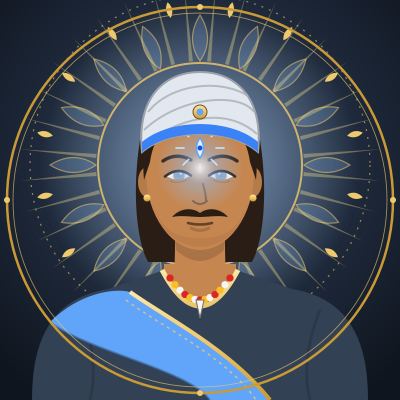
So Vyasa gave divine sight to Sanjaya. “Sanjaya will see everything that happens on the battlefield, by day or by night, in the open or in secret, and even what people think in their minds. No weapon will harm him, and he will never grow tired.” Ten days later, Sanjaya came to the king with the terrible news that Bhishma had fallen, and then told him everything from the very beginning. It is through Sanjaya's words that we have the Bhagavad Gita.
Before the battle, both sides agreed on rules of fair fighting. Warriors would fight only with equals: chariot with chariot, elephant with elephant, foot soldier with foot soldier. No one would strike a person who was running away, who had surrendered, who had no weapon, or who was already fighting someone else. Charioteers, animals, drummers and conch-blowers would not be attacked. When the day's fighting ended, the warriors could meet each other with friendship again.
Conches at Kurukshetra and Arjuna's Grief
The two armies stood face to face on the field of Kurukshetra. To cheer Duryodhana, Bhishma roared like a lion and blew his conch, and drums, horns and trumpets thundered on the Kaurava side.
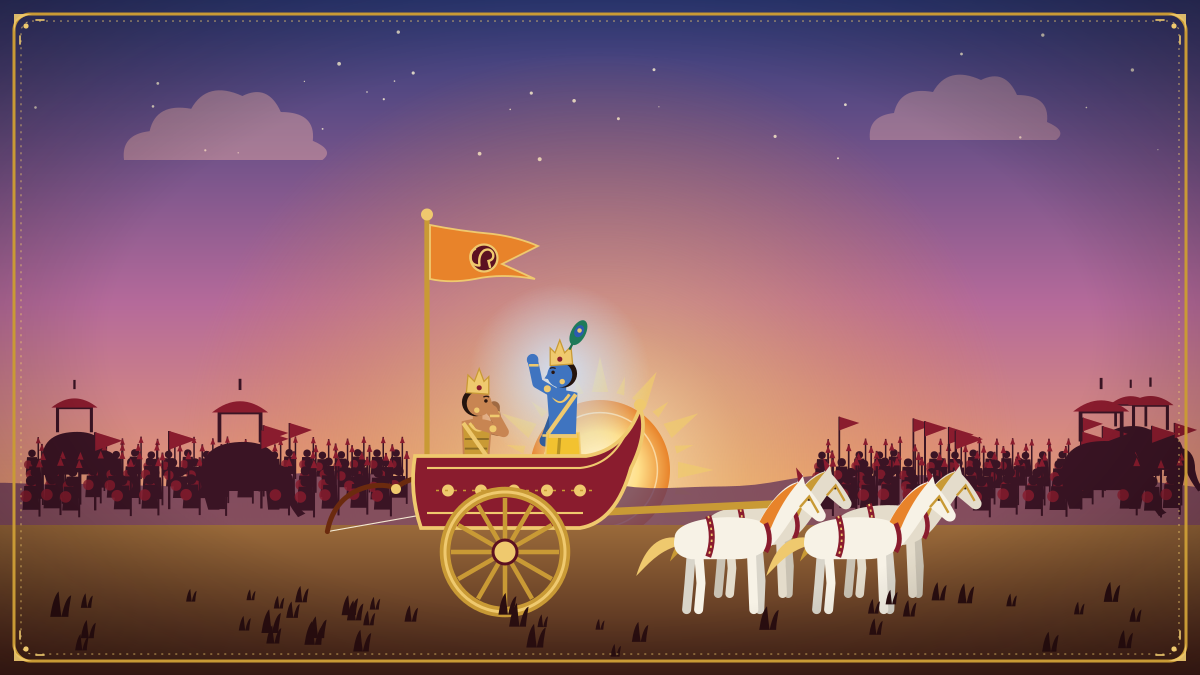
Then, from their great chariot drawn by white horses, Krishna blew his conch Panchajanya and Arjuna blew Devadatta. Bhima blew his mighty conch Paundra. Yudhishthira blew Anantavijaya, Nakula blew Sughosha and Sahadeva blew Manipushpaka. Drupada, Dhrishtadyumna, Virata, Satyaki, Abhimanyu and the sons of Draupadi blew their conches too, and the sound shook the earth and sky.
Arjuna said, “Krishna, take my chariot between the two armies, so that I can see who has come to fight.” Krishna drove the chariot to the middle and said, “Look, Arjuna, at the Kurus gathered here.” Arjuna looked. He saw grandfathers, teachers, uncles, brothers, sons, grandsons and friends on both sides.
His heart broke. “Krishna,” he said, “my limbs are weak, my mouth is dry and my body trembles. My bow Gandiva is slipping from my hand. I do not want victory, kingdom or happiness won by killing my own family. What joy can come from this?” Saying this, Arjuna put down his bow and arrows and sat down in the chariot, overcome with sorrow.
The Song of the Lord
Arjuna said, “I am confused about my duty. I am your disciple; please teach me what is truly good for me.” Krishna smiled gently and began. “You grieve for those who should not be grieved for. The soul is never born and never dies. Weapons cannot cut it, fire cannot burn it, water cannot wet it, and wind cannot dry it. Just as a person throws away old clothes and puts on new ones, the soul leaves a worn-out body and takes a new one. So do not grieve for what can never be destroyed.”
“As a warrior, your duty is to stand up for dharma,” Krishna continued. “You have a right to your work, but never to its fruits. Do not let the result be your motive, and do not cling to doing nothing either. Do your work steadily, treating success and failure alike. This evenness of mind is called yoga.” This is karma yoga, the path of action without attachment to results, offered to God.
Krishna also described the person of steady wisdom. “One who is not shaken by sorrow, who does not chase pleasure, who is free from desire, fear and anger, and who controls his senses as a tortoise draws in its limbs, is a sage of steady mind.” He said, “Whenever dharma declines and adharma rises, I come again and again, age after age, to protect the good, destroy evil and establish dharma.”
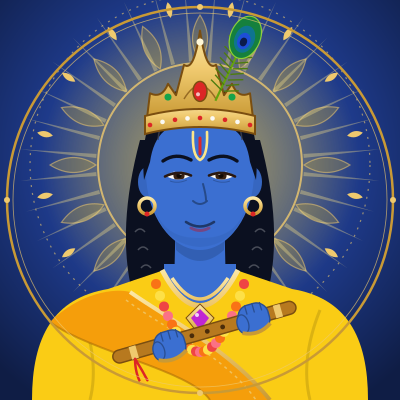
Krishna then taught the path of knowledge and the path of loving devotion. “Whoever offers me with love even a leaf, a flower, a fruit or a little water, I accept it.” Arjuna begged, “Lord, show me your divine form.” Krishna gave him divine eyes, and Arjuna saw the Vishwarupa: countless faces, eyes and arms, the whole universe and all the gods within one body. He saw the warriors of both armies rushing into its blazing mouths. Krishna said, “I am Time, the destroyer of worlds. These warriors are already slain by me. Be only my instrument, Arjuna.”
Trembling, Arjuna bowed again and again and asked Krishna to show his gentle form once more. Krishna became the loving four-armed and then the two-armed Lord again. Finally he gave his most secret teaching: “Fix your mind on me, be devoted to me, bow to me. Abandon all dharmas and take refuge in me alone. I will free you from all sins. Do not grieve.”
Arjuna stood up with new strength. “My delusion is destroyed, and by your grace I have regained my memory. My doubts are gone. I will do as you say.” He lifted Gandiva again. These eighteen chapters of wisdom, spoken on the battlefield, are the Bhagavad Gita, the Song of the Lord.
Yudhishthira Seeks Blessings
Just before the fighting began, Yudhishthira did something that surprised everyone. He took off his armour, put down his weapons, stepped down from his chariot and walked with folded hands towards the Kaurava army. His brothers followed him in alarm, but Krishna understood and smiled. “He is going to seek the blessings of his elders,” he said.
Yudhishthira bowed at Bhishma's feet. Bhishma was deeply pleased. “If you had not come, child, I might have cursed you to defeat. I am bound to the Kauravas by the food I have eaten from them, but I bless you: you will be victorious.” Drona also blessed him and said, “Where Krishna is, there is victory.” Kripacharya said, “I will pray every morning for your victory.” Shalya repeated his promise to weaken Karna's courage. Bhishma explained honestly why he still had to fight against them: “A man is a servant of wealth, but wealth is no one's servant. The Kauravas have fed and supported me all my life, so my body must fight for them. But my heart wishes you well.”
As he returned, Yudhishthira called out loudly, “Whoever wishes to join us, may come now.” Yuyutsu, a son of Dhritarashtra by a Vaishya mother, stepped forward. “I will fight for you, for the sake of dharma,” he said. To the sound of drums, he crossed over to the Pandava side, and the Pandavas welcomed him with joy.
Nine Days of Battle
The battle began. On the very first day, Prince Uttara, Virata's young son, fell fighting King Shalya. His brother Shveta fought Bhishma with great courage, but he too fell to the grandsire's arrows. The Pandavas were saddened, for Bhishma seemed like a storm that no one could stop.
Yet the Pandava side also showed great courage that day. Young Abhimanyu, Arjuna's son, rode straight at Bhishma and fought him like an equal. With one sharp arrow he cut down the grandsire's tall palm-tree banner, and even Bhishma praised the boy's skill. Bhima's war cry made the Kaurava elephants turn back. When the sun set, both armies returned to their camps, tired and thoughtful, knowing that this war would be long and terrible.
On the second day, Bhima fought the large army of the king of Kalinga. Alone on his chariot and then on foot with his mace, he defeated the Kalinga king, his sons and their elephants. On the third day, Bhishma struck the Pandava army so fiercely that it began to break. Arjuna, still loving his grandfather, was fighting gently. Krishna leapt down from the chariot, took up his blazing discus, and rushed towards Bhishma. Bhishma lowered his bow and said joyfully, “Come, Lord of the gods! To fall by your hand would be my greatest honour.” Arjuna ran after Krishna, caught his legs at the tenth step, and promised to fight with full strength.
On the following days, Bhima defeated many of Dhritarashtra's sons. Ghatotkacha, Bhima's mighty son, fought with great magic and frightened the Kaurava soldiers. On the eighth day, Iravan, Arjuna's brave son by the Naga princess Ulupi, was killed by the rakshasa Alambusha. Arjuna grieved deeply, and Ghatotkacha attacked the Kauravas in fury.
On the ninth day, Bhishma's arrows covered the Pandava army like a cloud, and Arjuna still did not fight with full force. Krishna, unable to bear it, jumped down from the chariot with only his whip in his hand and ran towards Bhishma. Bhishma said again, “Come, lotus-eyed one, I bow to you. Strike me down.” Once more Arjuna caught Krishna and brought him back, promising to do his duty.
The Secret in Bhishma's Tent
That night Yudhishthira was full of sorrow. “As long as Bhishma fights, we cannot win, and so many will die,” he said. Krishna said, “If you wish, I will fight Bhishma myself.” But Yudhishthira said, “No, you must keep your promise not to fight. Before the battle, Grandfather told me he would give us advice. Let us go and ask him.” So the five brothers and Krishna, without armour or weapons, went humbly to Bhishma's tent at night and bowed at his feet.
Bhishma welcomed them lovingly. Yudhishthira asked, “Grandfather, how can we defeat you?” Bhishma replied, “As long as I hold my bow, even the gods cannot defeat me. But I will not fight one who has thrown away his weapons, who has fallen, who has surrendered, or who was born a woman.”
“Drupada's son Shikhandi was born a woman,” Bhishma continued. “Put him in front of Arjuna. I will not shoot at him. Then let Arjuna strike me with his arrows. No one else in the world can bring me down.” The Pandavas bowed to him and returned with heavy hearts. Arjuna said sadly, “How can I fight the grandfather on whose lap I played as a child?” Krishna gently reminded him of his duty.
The Bed of Arrows
On the tenth day, Shikhandi rode in front of Arjuna's chariot. He shot many arrows at Bhishma, but Bhishma only smiled and did not shoot back. Behind Shikhandi, Arjuna shot arrow after arrow at the grandsire. Bhishma said to Dushasana, “These arrows that pierce me like lightning are not Shikhandi's. They are Arjuna's.” He tried to take up a sword and shield to step down from his chariot, but Arjuna cut them to pieces.
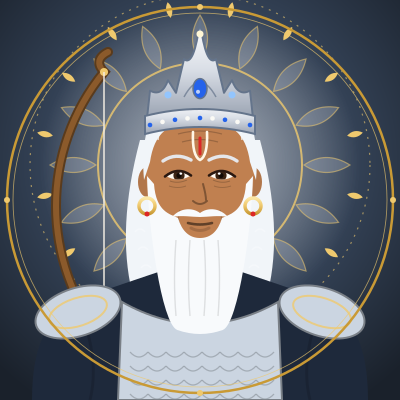
Late in the day, Bhishma fell from his chariot. His body was so full of arrows that it did not touch the ground; he lay on a bed of arrows. The gods bowed in the sky, and the fighting stopped on both sides. Bhishma had a boon from his father Shantanu that he could choose the moment of his death. It was the time of Dakshinayana, so he decided to keep his life until Uttarayana, the holy time when the sun begins its northward journey.
Kauravas and Pandavas alike gathered around him with folded hands. “My head hangs down,” Bhishma said. “Give me a pillow.” The kings brought soft silk pillows, but he refused them. “Arjuna, give me a pillow fit for a warrior.” With tears in his eyes, Arjuna shot three arrows into the ground to support his grandfather's head. Bhishma was pleased.
The next morning Bhishma was thirsty. The kings brought cool water and fine food, but he said, “I am now beyond the comforts of men.” Arjuna shot an arrow into the earth beside him, and a stream of pure, sweet water rose up into Bhishma's mouth. Bhishma praised Arjuna and told Duryodhana, “See Arjuna's strength. Make peace now, while there is still time.” But Duryodhana did not listen.
That evening, Karna came alone and bowed at Bhishma's feet. “Grandfather, I am Radha's son, whom you always disliked.” Bhishma held him with one arm, like a father. “I know you are Kunti's son, not Radha's. I spoke harshly only to curb your pride, not out of hate. Join your brothers.” Karna said, “I cannot leave Duryodhana. Please allow me to fight.” Bhishma gave him permission and blessed him. Karna returned, and the Kauravas made Drona their new commander.
Did you know?
- The Bhagavad Gita has 700 verses in 18 chapters, like the 18 days of war and the 18 parvas of the Mahabharata.
- The Gita is told as a flashback: Sanjaya first tells Dhritarashtra that Bhishma has fallen, and then describes everything from the start.
- Bhishma lay on his bed of arrows for fifty-eight nights before he chose to leave his body at Uttarayana.
- Each Pandava's conch had its own name: Yudhishthira's Anantavijaya, Bhima's Paundra, Arjuna's Devadatta, Nakula's Sughosha and Sahadeva's Manipushpaka.
What this chapter teaches us
The Gita teaches us to do our duty with a calm mind, without clinging to results, and to place our trust in God. Arjuna's grief turned into strength only when he listened humbly to Krishna. Yudhishthira's humility won blessings even from the other side. Bhishma's fall reminds us that even the greatest are bound by their own promises and choices.