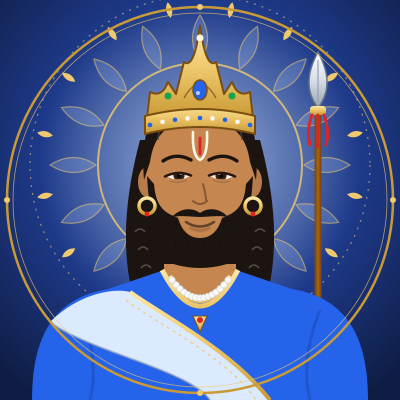
Yudhishthira was the eldest of the five Pandava brothers. His mother was Kunti and his father was King Pandu; he was born through the blessing of Dharma, the god of righteousness. Bhima and Arjuna were his younger brothers from the same mother, and Nakula and Sahadeva, the sons of Madri, were his half-brothers. Karna, though no one knew it until the end, was his elder brother. Yudhishthira was called Dharmaraja because he loved truth and justice, and Ajatashatru, “one whose enemy was never born”, because he bore no hatred towards anyone. He was calm, patient and forgiving. His weakness for the game of dice brought terrible suffering to his family, but his goodness carried them through, and in the end it led him to heaven.
Son of Dharma
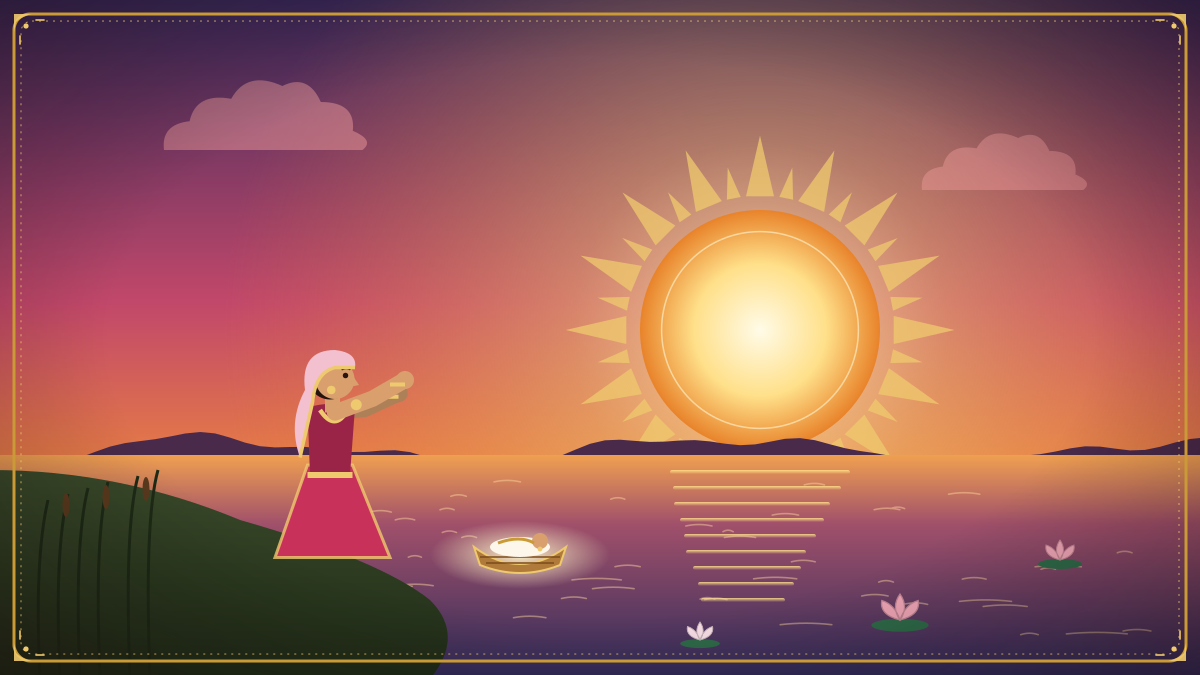
King Pandu had been cursed by a sage and could not have children in the usual way, so he lived as a hermit in the forest with his queens, Kunti and Madri. Kunti knew a mantra, given by the sage Durvasa, by which she could call a god and receive a son. Pandu asked her to call Dharma first, so that their eldest son would be devoted to what is right. So Yudhishthira was born, and a voice from the sky declared that he would be the best of the righteous.
After Pandu's death, the sages brought Kunti and the five boys to Hastinapur, where they grew up with their cousins, the hundred Kauravas, sons of Pandu's blind elder brother Dhritarashtra. Yudhishthira learned the scriptures and the arts of war from Kripacharya and Dronacharya, and became the best of the princes at fighting from a chariot.
Even as a boy he was gentle, truthful and fair, and the people wished to see him on the throne. When the princes' education was complete, Dhritarashtra made Yudhishthira the crown prince. This filled Duryodhana, the eldest Kaurava, with jealousy, and from then on he looked for ways to get rid of the Pandavas.
From the house of lac to Indraprastha
Duryodhana had the Pandavas and Kunti sent to Varanavata, where a house of lac had been built to burn them alive. As they left, Vidura warned Yudhishthira in a secret language, and Yudhishthira replied, “I have understood.” Through a tunnel dug by Vidura's miner, the family escaped the fire. They lived in disguise in the forests and later as Brahmins in Ekachakra.
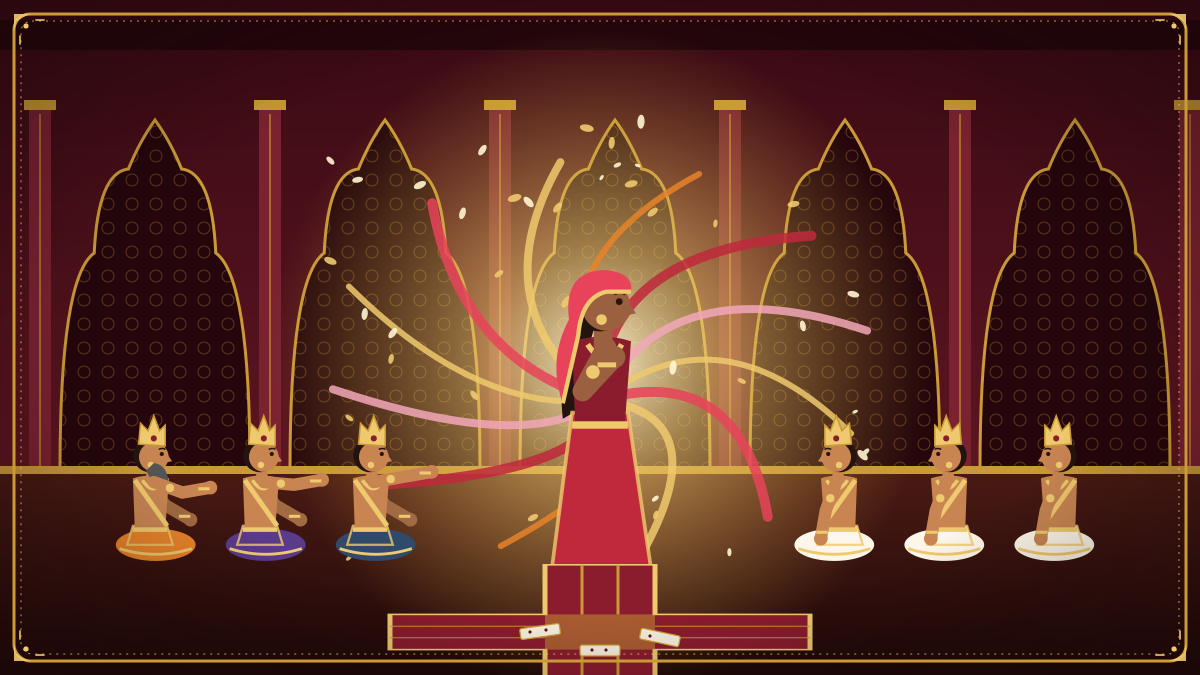
At the swayamvara of Draupadi, the princess of Panchala, Arjuna won her hand. Because of Kunti's words, “Enjoy it together, all of you,” and the sage Vyasa's explanation of Draupadi's earlier life, Yudhishthira agreed that Draupadi would be the wife of all five brothers. With King Drupada now their ally, Dhritarashtra called them back and gave them half the kingdom, a wild land called Khandavaprastha.
There they built the beautiful city of Indraprastha, and Yudhishthira ruled with justice. The sage Narada had the brothers make a rule so that Draupadi would never be a cause of quarrel: whoever disturbed a brother while he was with her would go away for twelve years. When Arjuna broke it to help a Brahmin, Yudhishthira forgave him at once, but Arjuna kept his word and went. Yudhishthira also married Devika, a princess of the Shibis, and had a son, Yaudheya; with Draupadi he had a son, Prativindhya.
Emperor, and the game of dice
Narada told Yudhishthira that his father Pandu wished him to perform the Rajasuya, the sacrifice by which a king becomes emperor. On Krishna's advice Bhima first killed the mighty King Jarasandha, and the four brothers brought the kings of all four directions under Yudhishthira's rule. In the wonderful hall built by Maya the sacrifice was held. The first honour was given to Krishna, and Krishna killed King Shishupala, who insulted him again and again.
Afterwards the sage Vyasa told Yudhishthira that in thirteen years a great destruction of kings would take place, and he would be its cause. Troubled, Yudhishthira vowed never to speak harshly to his brothers or to any king, so as to give no one a reason to quarrel. But Duryodhana, burning with jealousy, planned with his uncle Shakuni, a master of dice, to win the Pandavas' wealth by trickery. Yudhishthira felt that a king should not refuse a challenge or an invitation from his uncle Dhritarashtra, his father's elder brother, and he came.
Shakuni threw the dice for Duryodhana and won every time. Yudhishthira lost his wealth, his kingdom, then his brothers — Nakula, Sahadeva, Arjuna and Bhima — then himself, and finally Draupadi. Draupadi was dragged into the hall and insulted, and she asked whether a man who had already lost himself could stake her. Lord Krishna protected her honour. Frightened by terrible omens, Dhritarashtra granted her boons, and she freed Yudhishthira and his brothers.
But Yudhishthira was called back for one more game. The losers would live twelve years in the forest and a thirteenth year in disguise; if discovered in that year, they would go into exile again. Yudhishthira lost once more, and the Pandavas and Draupadi left for the forest.
Twelve years in the forest
Many Brahmins followed the Pandavas into the forest. To feed them, Yudhishthira prayed to the Sun god on the advice of the priest Dhaumya, and received a copper vessel that gave food every day until Draupadi had eaten.
Draupadi and Bhima often urged him to break the agreement and fight at once. Yudhishthira patiently replied that he had given his word, that forgiveness is the strength of the good, and that he followed dharma not for reward but because it was right. The sage Brihadashva told him the story of King Nala, who had also lost his kingdom at dice and won it back.
Once Duryodhana was captured by the Gandharvas near the Pandavas' forest home. Bhima was glad, but Yudhishthira sent his brothers to free him, saying, “Among ourselves we may be five against a hundred, but against outsiders we are a hundred and five.” Later he spared King Jayadratha, who had tried to carry off Draupadi, for the sake of the Kauravas' sister Dushala.
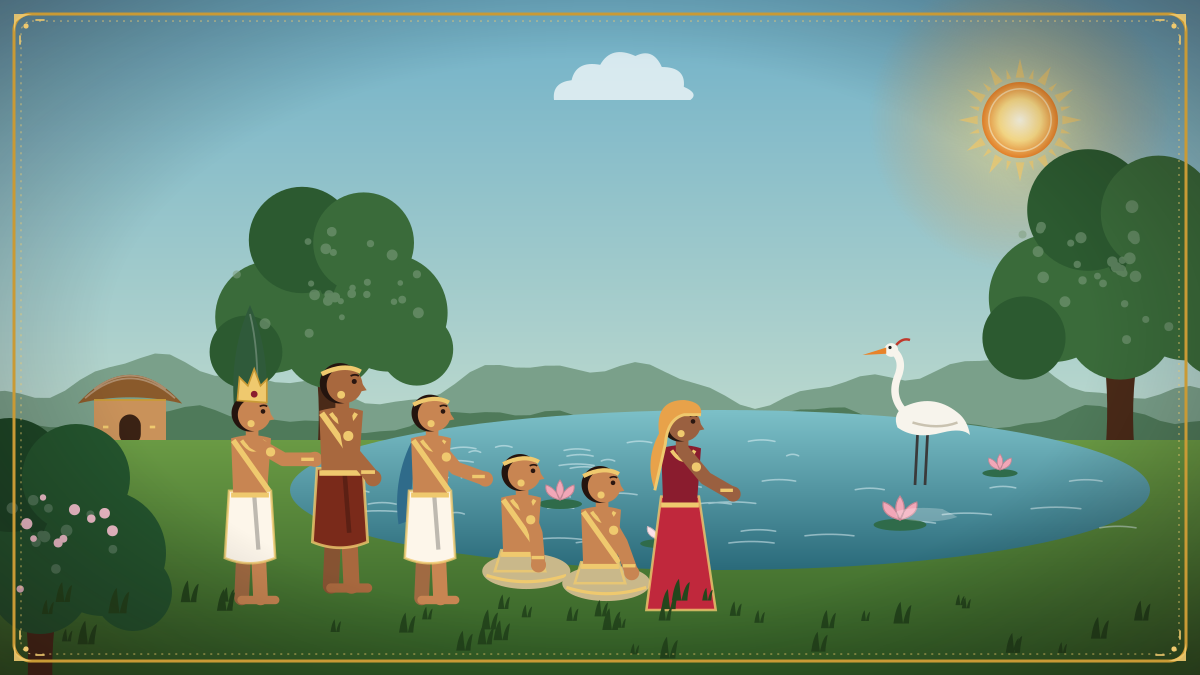
Near the end of the exile, the four younger brothers, one by one, drank from a lake without answering the questions of a Yaksha who guarded it, and fell lifeless. Yudhishthira answered every question with wisdom. What is heavier than the earth? “The mother.” What is higher than the sky? “The father.” What is the greatest wonder? “Every day creatures go to the house of death, yet those who remain think they will live forever.”
The Yaksha offered to bring back one brother, and Yudhishthira chose Nakula, so that both his mothers, Kunti and Madri, would have a living son. The Yaksha then revealed himself as Dharma, Yudhishthira's own father. He brought all four back to life and blessed them that no one would recognise them in their year of disguise.
The year in disguise, and the search for peace
In the thirteenth year, Yudhishthira lived in the court of King Virata as Kanka, a Brahmin who played dice with the king. Once, in anger, Virata struck him on the face with a die, and Draupadi quickly caught the blood in a vessel so that it would not fall to the ground. Yudhishthira bore the insult calmly, and when the Pandavas revealed themselves, Virata begged their forgiveness.
Duryodhana now refused to return the kingdom. Yudhishthira did not want a war between brothers, and through Sanjaya he said he would be content with just five villages. Krishna himself went to Hastinapur for peace, but Duryodhana would not give even as much land as the point of a needle could cover.
On the first day at Kurukshetra, Yudhishthira took off his armour and walked on foot to the Kaurava army. He bowed to Bhishma, Drona, Kripacharya and his uncle Shalya and asked for their blessings, and each of them blessed him with victory. Then he called out that anyone who wished to join the side of dharma was welcome, and Yuyutsu, a son of Dhritarashtra, crossed over to the Pandavas.
The war
After nine days in which no one could defeat Bhishma, Yudhishthira humbly went to him at night and asked how he could be overcome. Bhishma told them that he would not fight against Shikhandi, and the next day Arjuna, sheltered behind Shikhandi, brought down the great grandsire of the Kuru family.
When Dronacharya became commander, Krishna said Drona would lay down his arms only if he heard that his son Ashwatthama was dead. Bhima killed an elephant named Ashwatthama and announced the news. Drona asked Yudhishthira, who never lied. Yudhishthira said aloud, “Ashwatthama is dead,” and then softly, “the elephant.” At once his chariot, which had always moved four fingers above the ground because of his truthfulness, came down and touched the earth. Drona put down his weapons and was killed.
Karna had promised Kunti that he would kill none of her sons except Arjuna, and when he defeated Yudhishthira he let him go. Wounded and in pain, Yudhishthira spoke harsh words to Arjuna for not having killed Karna yet, and Arjuna raised his sword in anger. Krishna calmed them both, and the brothers embraced.
On the eighteenth day, Shalya, the twins' uncle, led the Kaurava army. Yudhishthira, the gentlest of the brothers, fought him himself and killed him with a mighty spear. Duryodhana then hid in a lake; Yudhishthira challenged him to come out and fight any one Pandava with any weapon, and Bhima defeated him with the mace.
The victory brought little joy. That night Ashwatthama killed Draupadi's sleeping sons, among them Prativindhya. When the Pandavas went to Gandhari, her angry glance fell through her blindfold on Yudhishthira's toes and scorched his nails. Then Kunti revealed that Karna had been their eldest brother, and Yudhishthira's heart broke.
King, pilgrim and the gate of heaven
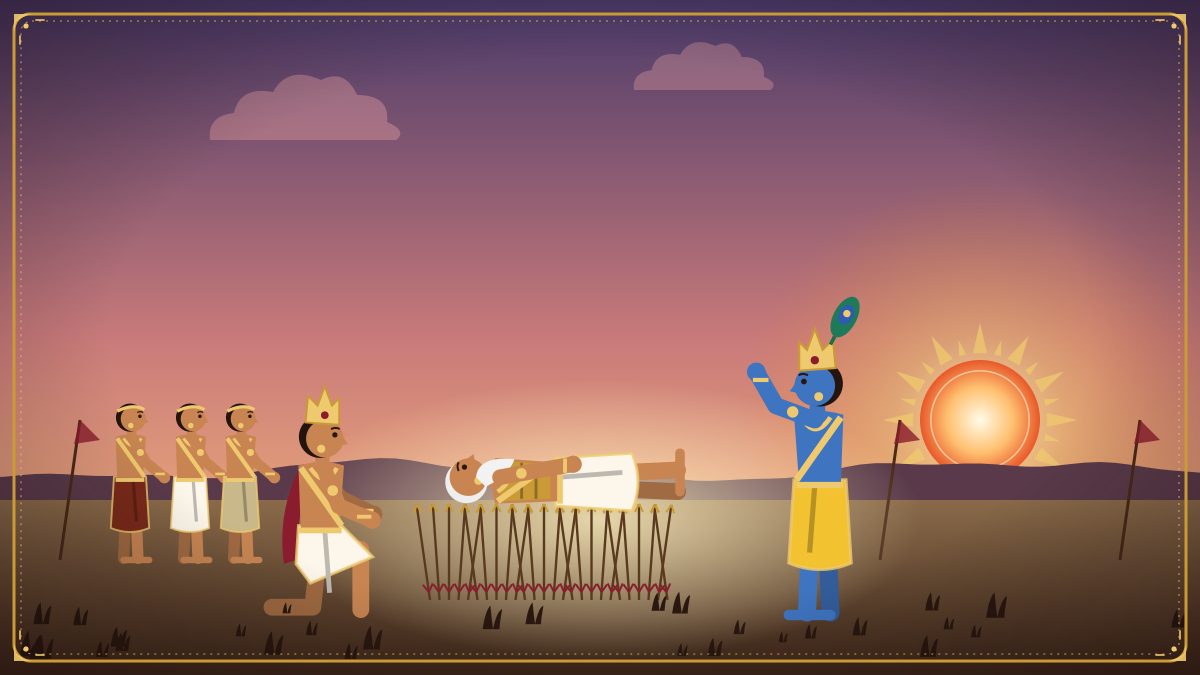
Full of grief, Yudhishthira wanted to give up the throne and become a hermit, but his brothers, Draupadi, Vyasa and Krishna reminded him that a king's duty is to protect his people. He was crowned in Hastinapur, and Bhishma, lying on his bed of arrows, taught him at length about the duties of a king and the path to liberation. Later he performed the great Ashvamedha sacrifice. At its end a half-golden mongoose said that it was not equal to the gift of a poor family who had shared their last flour with a guest, and Yudhishthira learned that charity is measured by love.
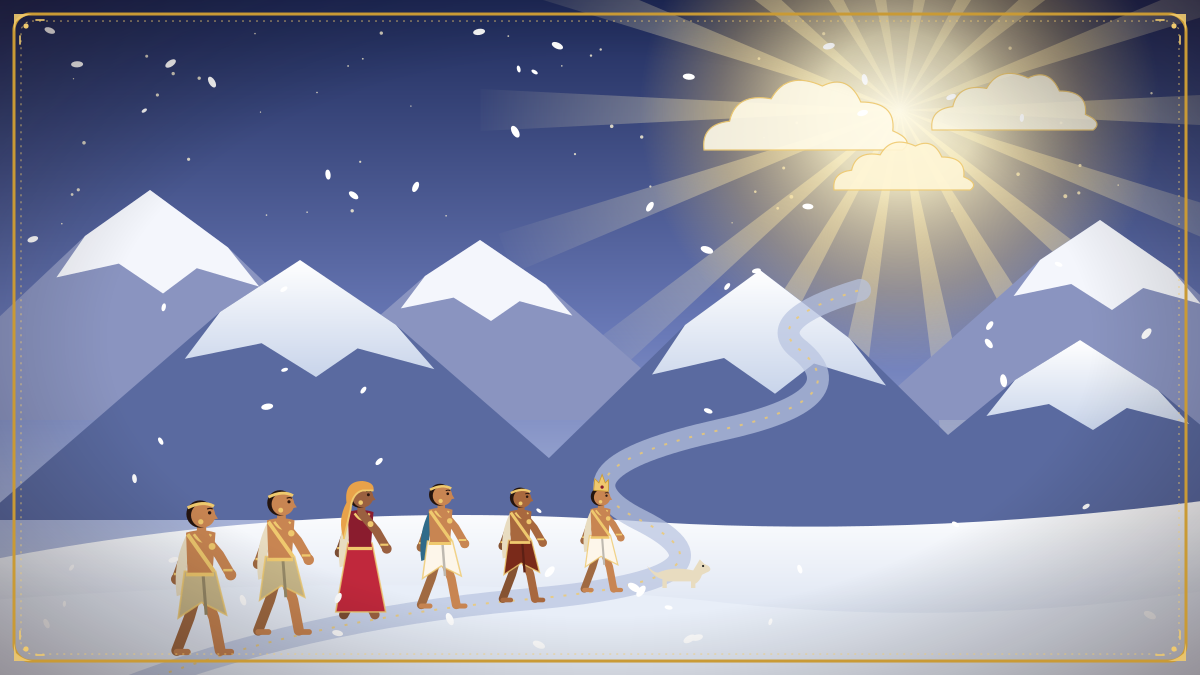
He ruled with justice for thirty-six years and cared for Dhritarashtra and Gandhari as a son. When the Yadavas destroyed themselves and Krishna left the world, he crowned Arjuna's grandson Parikshit and set out with his brothers and Draupadi on the final journey to the Himalayas. A dog followed them all the way.
One by one the others fell: Draupadi, then Sahadeva, Nakula, Arjuna and Bhima. Yudhishthira explained each one's small fault — Draupadi had loved Arjuna more than the others, Sahadeva was proud of his wisdom, Nakula of his beauty, Arjuna of his skill, and Bhima ate too much and boasted of his strength — and walked on with only the dog.
Indra came in his chariot to take him to heaven, but said there was no place for dogs. Yudhishthira replied that abandoning one who is devoted to us is a great sin, and he would not leave the dog even for heaven. At once the dog became Dharma, his father, who praised him for passing this test, as he had once passed the Yaksha's.
In heaven he saw Duryodhana in glory but not his brothers or Draupadi, and asked to be wherever they were. He was led to a dark, terrible hell, where he heard their voices begging him to stay, and he chose to stay. Then Indra and Dharma appeared and the darkness vanished: he had seen hell for a moment only because of his half-truth to Drona. Yudhishthira bathed in the heavenly Ganga, left his human body, and found Krishna, his brothers, Karna and Draupadi shining in their divine forms.
Did you know?
- His name Ajatashatru means “one whose enemy was never born”, because he bore no ill will towards anyone.
- Yudhishthira’s chariot always moved a little above the ground, until the day he spoke a half-truth to Drona.
- Before the war, he walked unarmed to the Kaurava side to seek the blessings of Bhishma, Drona, Kripacharya and Shalya.
- He refused to enter heaven without the faithful dog, which turned out to be his father Dharma in disguise.
What we learn from Yudhishthira
Yudhishthira teaches the value of truth, patience and forgiveness, and shows that a leader should care for others before himself. His fall in the dice game warns us that even a good person must stay away from bad habits. His single half-truth shows how much one small untruth weighs, and his refusal to abandon a faithful dog shows that loyalty to the helpless is the highest dharma.
Yudhishthira in the story
Read the chapters where Yudhishthira plays a part.