Key moments
- Jaya grows into the Bharata and then the Mahabharata
- About 100,000 verses in 18 parvas, with the Harivamsha supplement
- Vyasa, son of Parashara and Satyavati, is born on an island
- Ganesha writes nonstop; Vyasa makes him understand each verse
- Vaishampayana tells the epic at Janamejaya's snake sacrifice
- Sauti retells it to the sages of Naimisharanya
- Bharata, son of Dushyanta and Shakuntala, names the family
- Mahabhisha is cursed and born as King Shantanu
What is the Mahabharata?
Before we meet the heroes, let us sit together the way a family sits around an elder in the evening, and ask a simple question: what is the Mahabharata? It is the story of one royal family, the descendants of King Bharata and King Kuru. Two groups of cousins in that family, the five Pandavas and the hundred Kauravas, grew up under one roof, became rivals, and finally fought a terrible war on the field of Kurukshetra. Around that one family, the poem gathers kings and sages, gods and demons, forests and pilgrim places, and almost every question a human being can ask about right and wrong.
The epic did not always carry this name. In the poem itself Vyasa calls his history “Jaya”, which means victory, the victory of dharma. The text also tells us that the core story of the Bharatas, without the many side tales, was told in twenty-four thousand verses, and this was known as the “Bharata”. When it was told in full, with all its teachings and stories, it became the “Mahabharata”, the great Bharata.
The Adi Parva gives a lovely explanation of that name. Once the gods placed the four Vedas on one side of a scale and this history on the other, and the history proved heavier. Because of its greatness (mahattva) and its weight (bharavattva), it came to be called the Mahabharata. The poem says that whoever understands its meaning is freed from wrongdoing.
In the form we hear today it has about one hundred thousand verses, called shlokas, arranged in eighteen books called parvas. After those eighteen parvas comes the Harivamsha, a supplement that tells the story of Lord Krishna's family and his childhood. Hidden inside the Bhishma Parva, like a jewel inside a crown, is the Bhagavad Gita, the song of wisdom that Lord Krishna gave to Arjuna on the battlefield.
Vyasa himself says about his work: “Whatever is found here about dharma, wealth, desire and liberation may be found elsewhere; but what is not found here is found nowhere else.” That is why our elders have told and retold its stories for thousands of years, in temples, in homes, and beside the cradles of children.
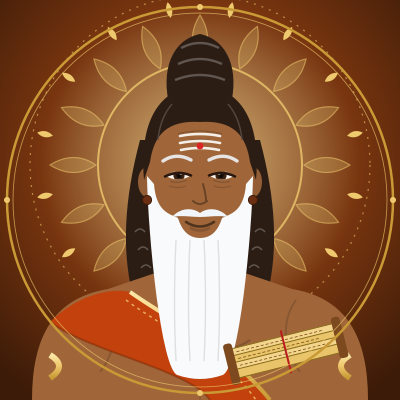
Sage Vyasa, the poet
The poet of the Mahabharata is Sage Vyasa, and his own birth is part of the story. Long ago, a beautiful young woman named Satyavati lived with the chief of the fishermen on the banks of the river Yamuna. Following her father's command, she rowed a ferry boat to carry travellers across the river.
One day the great Sage Parashara, who was travelling on pilgrimage, came to cross the river in her boat. By the will of destiny and the sage's blessing, Satyavati gave birth to a son on a small island in the middle of the Yamuna. Parashara blessed Satyavati so that she remained a maiden, and he also gave her a wonderful fragrance. Before this she had been called Matsyagandha, “the one who smells of fish”; now her sweet fragrance spread for a whole yojana, and she was called Yojanagandha.
The child grew up at once by the power of his austerities. Because he was born on an island (dvipa) he was called Dvaipayana, and because his complexion was dark he was called Krishna. So his full name was Krishna Dvaipayana. Before leaving for the forest to do tapasya, he told his mother, “Whenever you are in need and you remember me, I will come to you.” Keep this promise in mind, because it will change the whole Kuru family later.
Later, Dvaipayana divided the one great body of the Vedas into four parts, the Rigveda, Yajurveda, Samaveda and Atharvaveda, so that people could learn them more easily. Because he arranged (vyasa) the Vedas, he became known as Veda Vyasa. He taught these Vedas, and later the Mahabharata too, to his disciples Sumantu, Jaimini, Paila and Vaishampayana, and to his own son, Shukadeva.
The epic says that Vyasa spent three years composing the Mahabharata. He was not a stranger to the story he told. Satyavati would one day become the queen of Hastinapur, so Vyasa was connected to the Kuru family. With his own eyes he saw many of the events he describes, and he often appears inside the story to guide, comfort and warn the people he loved.
Lord Ganesha writes the epic
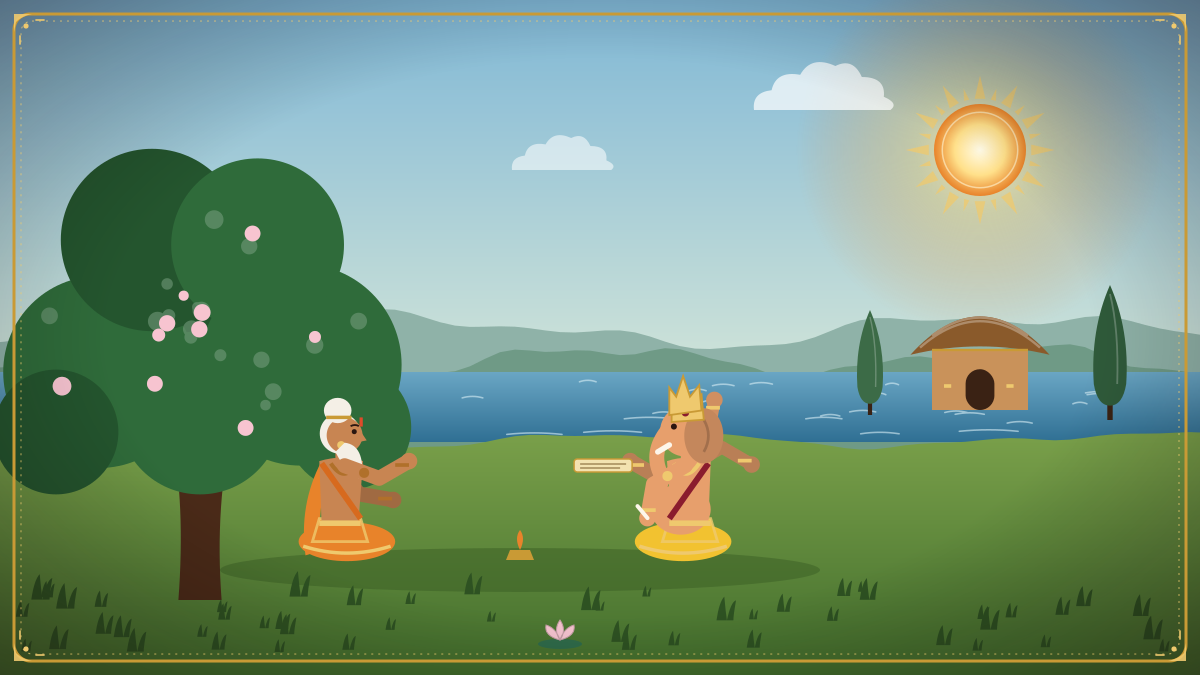
When the whole history had taken shape in Vyasa's mind, a question troubled him: who on earth could write down so vast a work? At that moment Lord Brahma, the creator, came to his hermitage. Vyasa bowed to him and said, “Lord, I have composed a great poem, but I cannot find anyone on earth who can write it down.”
Brahma praised Vyasa's work and said, “Remember Lord Ganesha. Let him be the writer of your poem.” Then Brahma returned to his own world. Vyasa thought of Ganesha with devotion, and Ganesha, the remover of obstacles, appeared before him. Vyasa worshipped him and asked him to become the writer of the Mahabharata.
Ganesha agreed, but he made one condition: “I will write only if my pen never has to stop for even a moment while I am writing.” This was a great challenge, because no one can keep speaking verses without ever pausing to think.
Vyasa accepted, and gently made a condition of his own: “Then, Lord, you must not write down any verse until you have understood its meaning.” Ganesha said “Om”, meaning yes, and the writing began. Whenever Vyasa needed time to think, he spoke a verse with a very deep, knotted meaning. While Ganesha paused to understand it, Vyasa composed many more verses in his mind.
The poem tells us that there are eight thousand eight hundred such difficult verses. Vyasa said about them, “I know their meaning, Shuka knows it, and Sanjaya may or may not know it.” In this way, through the wisdom of the poet and the patience of the writer, the great history of Bharat was set down. It is a beautiful lesson for us: even Lord Ganesha would not write a single word without understanding it.
How the story reached us
After composing the Mahabharata, Vyasa first taught it to his son Shukadeva, and then to his other worthy disciples. The epic says it was told in many worlds: Narada told it to the gods, Shukadeva to other beings of the heavens, and Vaishampayana, Vyasa's dear disciple, told it among human beings.
Many years after the great war, Arjuna's grandson Parikshit ruled Hastinapur. He died from the bite of the serpent king Takshaka. When his son Janamejaya grew up and became king, he was filled with grief and anger, and he began a great fire sacrifice in which serpents were drawn into the flames. This was the famous sarpa-satra, the snake sacrifice of King Janamejaya.
Sage Vyasa came to that sacrifice with his disciples. Janamejaya welcomed him with honour and said, “You saw everything with your own eyes. Please tell me how my forefathers, the Pandavas and the Kauravas, came to quarrel, and how that great war happened.” Vyasa then turned to Vaishampayana and said, “Tell the king the whole story, just as you heard it from me.” So, in the breaks between the rites of the sacrifice, Vaishampayana narrated the entire Mahabharata in Janamejaya's court.
Among the listeners was a bard named Ugrashrava, known as Sauti, the son of Lomaharshana. Later he travelled to the Naimisha forest, Naimisharanya, where Sage Shaunaka and many other rishis were performing a sacrifice that lasted twelve years. When the sages had finished their daily duties, they gathered around Sauti and asked him to tell them the stories he had heard. Sauti then told them the whole Mahabharata, exactly as Vaishampayana had told it at the snake sacrifice.
So the story we read today comes to us like water flowing from a sacred spring: from Vyasa to Vaishampayana, from Vaishampayana to King Janamejaya and his court, and from Sauti to the sages of Naimisharanya. That is why so many chapters of the epic begin with words like “Vaishampayana said” or “Sauti said”.
The family of the Moon
Now let us go back to the beginning of the family itself. The Kuru kings belonged to the Chandravansha, the family of the Moon. From Lord Brahma came Sage Atri, and from Atri came Soma, the Moon. The Moon's son was Budha, and Budha's son was the famous King Pururava, who loved the heavenly apsara Urvashi. Pururava's son was Ayu, and Ayu's son was Nahusha, who for a time even ruled heaven as Indra.
Nahusha's son was King Yayati. Because of a curse from Shukracharya, Yayati became old while he still longed for the pleasures of youth. He asked his sons to take his old age in exchange for their youth. The elder sons refused, but the youngest, Puru, gladly agreed. After many years Yayati returned the youth to Puru and made him king, even over his elder brothers. Yayati's eldest son Yadu became the father of the Yadavas, the family in which Lord Krishna would later be born. From Puru came the Puru family, the ancestors of our heroes.
Many generations later in Puru's line came King Dushyanta. While hunting in the forest, he reached the hermitage of Sage Kanva and met Shakuntala, the daughter of Sage Vishvamitra and the apsara Menaka, who had been raised by Kanva. They married by the gandharva rite, and Dushyanta promised that her son would be his heir. Their son grew up in the hermitage and was so strong that at six years old he tied lions and tigers to the trees, so the sages called him Sarvadamana, “the tamer of all”.
When Shakuntala brought the boy to the royal court, Dushyanta at first acted as if he did not know her. Then a voice from heaven declared, “This is your son, Dushyanta. Support him (bhara).” Because of these words the boy was named Bharata. Dushyanta explained that he had waited for this divine proof so that his people would accept the boy without doubt. Bharata became a great and righteous emperor, and from him the family came to be known as the Bharatas. That is why the epic is called the great story of the Bharatas, and why our land is lovingly remembered as Bharat.
Later in the same line, King Hastin founded the city of Hastinapur on the banks of the Ganga, and it became the capital of these kings. After him came King Kuru, the son of King Samvarana and Tapati, the daughter of the Sun god. Kuru made a great field holy through his austerities; the Shalya Parva tells that he ploughed it himself and Indra blessed it, so that whoever dies there doing tapasya or fighting bravely goes to heaven. That field became Kurukshetra, the field of Kuru. His descendants were called Kurus, and in our story the sons of Dhritarashtra are called the Kauravas, “the children of Kuru”.
Mahabhisha, Pratipa and the river goddess
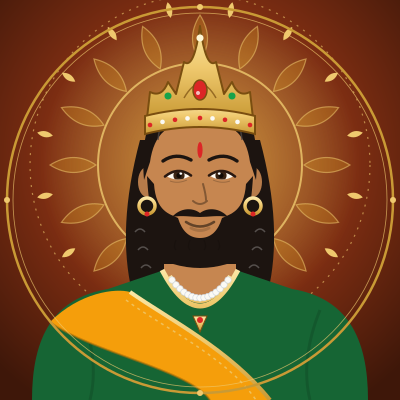
Our story now comes close to King Shantanu, and it begins in heaven. There was a king of the Ikshvaku family named Mahabhisha, who had performed a thousand Ashvamedha sacrifices and a hundred Vajapeya sacrifices, and had won a place in heaven. One day the gods and royal sages were sitting in Lord Brahma's court, and Ganga, the goddess of the holy river, came there. A breeze blew her garment aside. All the gods at once lowered their eyes, but Mahabhisha kept gazing at her.
Brahma was displeased and said, “Mahabhisha, you will be born among humans. Ganga, who has stolen your heart, will do things that displease you, and when you become angry with her, you will be freed from this curse.” Mahabhisha accepted the curse and chose to be born as the son of King Pratipa of the Kuru family. Ganga too left Brahma's court, thinking of Mahabhisha.
On earth, King Pratipa was then sitting at the source of the Ganga, doing japa and austerities for many years. One day Ganga rose from the water in the form of a beautiful woman and sat on the king's right thigh. When she asked him to accept her, Pratipa replied, “That is not right. The left thigh is the place of a wife. You have sat on my right thigh, which is the place of a child or a daughter-in-law. So become the wife of my son.” Ganga agreed, saying that whatever she did, his son must never question her.
Pratipa and his queen then prayed for a son, and in their old age a boy was born to them. He was Mahabhisha himself. Because he was born when his father had become calm (shanta) through austerity, he was named Shantanu. Shantanu grew up to be truthful, brave and generous, and he loved to hunt in the forests along the Ganga.
When Shantanu was a young man, Pratipa called him and said, “Son, long ago a heavenly woman came to me for your sake. If she comes to you, do not ask who she is or whose daughter she is, and do not question anything she does. Accept her as your wife, because I command it.” Then Pratipa placed Shantanu on the throne of Hastinapur and went to the forest. Soon, by the banks of the Ganga, Shantanu would meet that woman, and the true story of the Kuru family would begin.
Did you know?
- The Mahabharata is roughly seven times longer than the Iliad and the Odyssey put together.
- Guru Purnima is also called Vyasa Purnima, because on that day we honour Sage Vyasa as the guru of all gurus.
- The very first word of the Bhagavad Gita, “dharmakshetre”, calls Kurukshetra “the field of dharma”.
- The Mahabharata calls itself “Jaya”, meaning “victory”, and it was first recited in full by Vyasa’s disciple Vaishampayana at King Janamejaya’s snake sacrifice.
What this chapter teaches us
The Mahabharata begins by reminding us that a great story needs both a wise teller and a patient listener who truly understands. Ganesha would not write a single verse without knowing its meaning, and that is how we too should read and learn. The long line of kings shows that every family carries the deeds of its ancestors, good and bad, into the future.