Key moments
- Yudhishthira wants to renounce; his family and Vyasa persuade him
- The disguised rakshasa Charvaka is burnt to ashes
- Bhishma teaches Rajadharma, Apaddharma and Mokshadharma
- Bhishma recites the Vishnu Sahasranama before Krishna
- Krishna brings the lifeless baby Parikshit to life
- Babruvahana strikes down Arjuna; Ulupi's jewel revives him
- A half-golden mongoose praises a poor brahmin's flour
- Vyasa shows the slain warriors for one night
A King Who Wanted to Renounce
After the war the Pandavas stayed for a month on the bank of the Ganga, offering water to the souls of the dead. Yudhishthira told the sage Narada what hurt him most: “Karna was our own elder brother, and we did not know it. Mother hid it, and I let him be killed for a kingdom.” Narada told him how Karna had been bound by curses, of Parashurama and of a brahmin whose cow he had killed by mistake, so that his fate was sealed long before the battle.
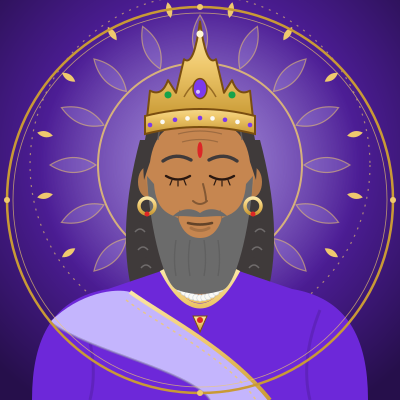
But Yudhishthira's grief did not go away. “I have killed my grandfather, my teachers, my brothers and the sons of my friends,” he said. “What joy is there in this kingdom? I will give it to Arjuna and go to the forest. I will live on fruits and roots, wear bark, and wander with a quiet mind.”
His family would not let him go. Arjuna said that a king without wealth and without the power of just punishment cannot protect anyone, and that a kshatriya who runs away from his duty does not become a sage. Bhima said, “You are like a man who digs a well and then refuses to drink the water. We have fought for this kingdom; now you want to throw it away.” Nakula and Sahadeva also begged him to rule.
Draupadi spoke too. “In the forest, when we suffered, it was you who comforted us,” she said. “Now that the earth is yours, why do you wish to leave it? A king who does not protect his people does not shine. Your brothers are like elephants in rut. If you leave, they will be lost.”
Then Vyasa explained that the war had been the work of Time and destiny, and that a king who has done wrong can cleanse himself by good rule, by charity and by a great sacrifice such as the Ashvamedha. Slowly Yudhishthira's mind grew steady, and he agreed to enter Hastinapur as king.
Charvaka and the Coronation
The city was decorated with flowers and banners, and thousands of brahmins came to bless the new king. Among them stood one who looked like a brahmin. Suddenly he cried out, “These brahmins are ashamed to say it, so I will. Shame on you, Yudhishthira! You have killed your own relatives and elders. What good is your life?”
Everyone was shocked, and Yudhishthira bowed his head in sorrow. But the brahmins looked closely and said, “This is no brahmin. This is Charvaka, a rakshasa and a friend of Duryodhana, who has come in disguise to hurt the king.” Filled with righteous anger, they let out a cry of “Hum!”, and Charvaka fell, burnt to ashes, like a tree struck by lightning.
Krishna explained that Brahma had once granted Charvaka safety from all beings, but had warned that he would die if he ever insulted brahmins. His own wicked words had brought his end. Yudhishthira's sorrow lifted, and the ceremony went on.
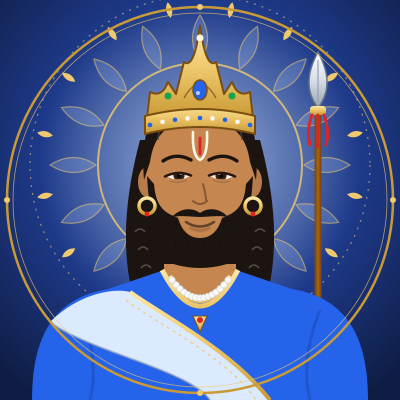
With Krishna's consent the family priest Dhaumya crowned Yudhishthira. The new king gave each person a duty. Bhima became the yuvaraja, the crown prince. Vidura was made chief counsellor on war, peace and policy. Sanjaya was to look after the treasury and its accounts. Nakula would keep the records of the army, Arjuna would guard the kingdom against enemies and punish the wicked, Dhaumya would care for the brahmins and religious rites, and Sahadeva would always stay at the king's side. Yudhishthira also told everyone that Dhritarashtra was still to be served as the elder of the family.
At Bhishma's Bed of Arrows
One morning Yudhishthira found Krishna sitting in deep meditation. When Krishna opened his eyes, he said, “Bhishma, lying on his bed of arrows, is thinking of me, so my mind went to him. When he leaves this world, all his knowledge of dharma will go with him. Go to him, Yudhishthira, and ask him about everything you wish to know.”
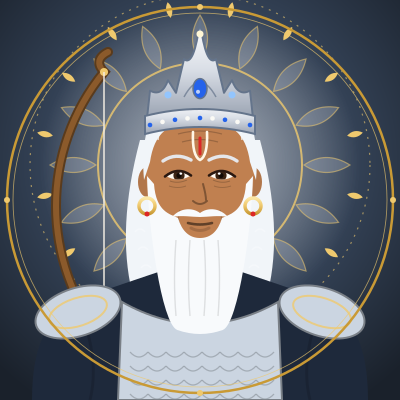
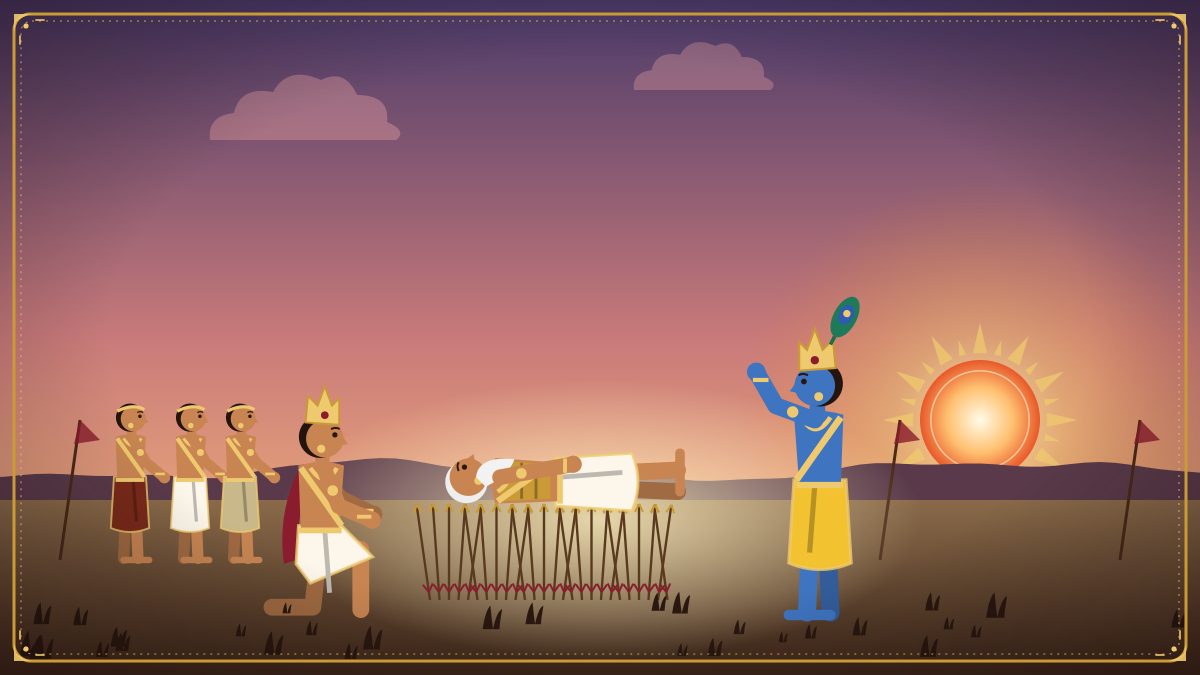
So the Pandavas drove with Krishna to Kurukshetra. Bhishma lay there on the arrows, shining like a fire about to go out, with great sages sitting around him. Bhishma had the boon of choosing the moment of his death, and he was waiting for Uttarayana, the sun's northward journey.
Krishna asked him to teach Yudhishthira. Bhishma folded his hands and said, “My body burns with the arrows and my mind is confused. How can I speak about dharma in front of you, who are the source of all dharma?” Krishna replied, “By my blessing, your pain, your tiredness and your confusion will leave you. Your mind will be clear, and whatever you say will be honoured on earth like the Vedas.” At once Bhishma felt fresh and strong in mind.
Yudhishthira was ashamed to come near the grandfather whom he had brought down. Bhishma said gently, “Do not be afraid, my child. It is a kshatriya's duty to fight, even against elders, when dharma demands it. Come, sit near me and ask.” So day after day the Pandavas came at dawn, listened till evening and returned to the city at night.
Lessons for a King and for Every Soul
Bhishma first taught rajadharma, the duty of a king. In the beginning, he said, when there was no king, people swallowed one another as big fish swallow small fish. So they went to the gods and asked for a ruler, and Manu became the first king. A king is called raja because he must please, ranjana, his people. Protecting them is his highest dharma.
A king must be like a pregnant mother, who gives up what she likes for the good of the child in her womb. He should take taxes the way a bee takes honey from a flower without hurting it, and the way a good cowherd milks a cow without harming the calf. He must reward the good, punish the guilty fairly and choose honest ministers. “Do not doubt,” said Bhishma, “whether the age makes the king or the king makes the age. The king makes the age.” A just king brings a golden age; a cruel king brings the age of Kali.
Then Bhishma taught apaddharma, how to act wisely in times of danger. He told the story of the three fish in a pond. When fishermen began to drain it, the first fish, who planned ahead, swam away at once. The second, who was quick-witted, escaped by a clever trick at the last moment. The third, who kept putting things off, was caught. He also told of a mouse named Palita who, when trapped between enemies, made a short and careful friendship with a cat named Lomasha, freed it from a net at just the right moment, and saved himself, but never trusted it blindly afterwards.
Last came mokshadharma, the path to freedom of the soul. Bhishma said that desire is the root of sorrow. He told of Pingala, a woman who waited all night for a lover who never came, and at dawn said, “Hope is the greatest sorrow; giving up hope is the greatest happiness,” and then slept in peace. He spoke of King Janaka, who said, “My wealth is endless, yet nothing is mine. If the city of Mithila burns, nothing of mine burns.”
He said that a wise person draws in his senses as a tortoise draws in its limbs, and that contentment is the greatest wealth. Truth, self-control, forgiveness and kindness to all beings, he said, are the doors to freedom.
All these teachings fill the Shanti Parva, the Book of Peace. As he listened, Yudhishthira felt the burning in his heart slowly grow cool.
The Gift of Giving and the Thousand Names
The teaching went on in the Anushasana Parva, the Book of Instruction. Bhishma spoke at length about dana, charity. Giving food to the hungry is the greatest gift, he said, for life depends on food. Giving fearlessness, protecting someone who is afraid, is equal to it. Giving knowledge, land, cows and water are all holy. But a gift should be given at the right time, to a worthy person, with respect and without pride or the wish for praise. He also praised ahimsa, non-violence, calling it the highest dharma, and spoke of the glory of Lord Shiva, whose thousand names Krishna had once learned from the sage Upamanyu.
Then Yudhishthira asked six questions. “Who is the one God in the world? What is the one highest refuge? By praising whom and worshipping whom does a person reach the good? What is the greatest dharma of all? And by chanting what is a living being freed from the bonds of birth and death?”
Bhishma answered, “Praising with devotion Lord Vishnu, the master of the universe, the God of gods, the endless Supreme Person, by his thousand names, a person goes beyond all sorrow.” Then he recited the Vishnu Sahasranama, the thousand names of Vishnu, beginning with “Vishvam, Vishnur, Vashatkaro…”. As he spoke, his eyes rested on Krishna standing before him. Devotees chant these names to this day.
Bhishma had lain on the arrows for fifty-eight nights when the sun turned north. He said, “Krishna, give me leave to go.” He blessed the Pandavas and asked all to hold on to truth. Then, fixing his mind on Krishna, he drew his life upward by yoga. One by one the arrows fell from his body, and his life rose from the crown of his head like a great meteor and went to the sky.
The Pandavas, with Vidura and Yuyutsu, covered him in silk and garlands and performed his last rites by the Ganga. Then the goddess Ganga rose from the water, weeping. “My son, whom even Parashurama could not defeat, has been struck down by Shikhandi!” she cried. Krishna comforted her: “Mother, do not grieve. He was brought down by Arjuna, not by Shikhandi, and he has gone back to the Vasus, where he belongs.” Then Ganga was at peace.
The Horse Sacrifice and the Half-Golden Mongoose
Yudhishthira's grief returned again and again. Vyasa advised him to perform the Ashvamedha, the great horse sacrifice, to cleanse his heart. But the treasury was empty after the war. Vyasa told him of King Marutta, long ago, at whose sacrifice so much gold was given that the brahmins could not carry it away and left it in the Himalayas. The Pandavas went north, worshipped Lord Shiva, and brought back that gold on thousands of camels, horses and elephants.
Meanwhile Uttara gave birth to Abhimanyu's son. Because of Ashwatthama's weapon the baby was born lifeless. Kunti and Uttara wept and fell at Krishna's feet. Krishna took water in his hand and said, “I have never told a lie, even in jest. I have never turned my back in battle. If truth and dharma live in me, let this child live.” At once the baby moved and began to cry. He was named Parikshit, because he was born when the Kuru family had been worn away.
On the full moon of Chaitra the sacred horse was set free, and Arjuna followed it with an army. Yudhishthira had told him not to kill kings if he could avoid it. Arjuna fought the Trigartas and beat them, but spared their lives. In the land of Sindhu the Saindhavas, Jayadratha's people, fought him, until Duhshala, Dhritarashtra's daughter and the only sister of the Kauravas, came out holding her little grandson. Her son had died of fear on hearing that Arjuna was coming. Arjuna, filled with pity, stopped fighting, comforted his sister and moved on.
In Manipur, Arjuna's son Babruvahana, born of the princess Chitrangada, came out humbly to greet his father. Arjuna scolded him: “A kshatriya should fight when a horse enters his land!” Then the Naga princess Ulupi, also Arjuna's wife, urged Babruvahana to fight. In the battle Babruvahana's arrow struck Arjuna, and he fell lifeless. Chitrangada wept and Babruvahana swore to fast until death. Then Ulupi brought a wondrous jewel from the Naga world and placed it on Arjuna's chest, and he rose as if from sleep.
Ulupi explained that the Vasus had cursed Arjuna for bringing down Bhishma from behind Shikhandi. Her father had begged them for mercy, and they had said the curse would end when Arjuna's own son struck him down. Now he was free. Arjuna came home with the horse, and the yajna was held with Vyasa as its guide, with gifts beyond counting.
At the end, a mongoose with half its body golden came out of a hole and said in a human voice, “This great yajna is not equal to a handful of barley flour given by a poor brahmin of Kurukshetra.” That brahmin lived by gleaning grains left in the fields. In a famine, after days of hunger, his family got a little flour and divided it into four shares. A hungry guest arrived, and the brahmin, his wife, his son and his son's wife each gave their share in turn. The guest was Dharma himself, and he took the family to heaven. “I rolled in the few grains left there,” said the mongoose, “and half my body turned to gold. I have rolled at every yajna since, but the other half stays as it is.”
The Elders Go to the Forest
For fifteen years Yudhishthira ruled with kindness and served Dhritarashtra, his father's elder brother, and Gandhari as his own parents. But Bhima could not forget the past. Sometimes, out of the king's hearing, he would slap his arms and say, “With these arms I sent the blind king's sons to Yama.” The words reached Dhritarashtra and hurt him deeply. At last the old king began to fast and asked Yudhishthira's permission to go to the forest. Yudhishthira begged him to stay, but Vyasa said, “Let him go. It is the right time for him.”
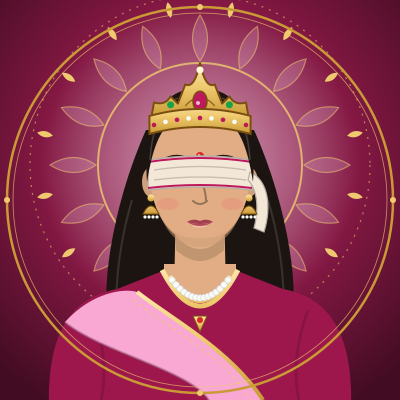
Gandhari went with her husband, holding his hand. Kunti walked beside them, and her sons followed, weeping. Yudhishthira said, “Mother, you sent us the message to fight for the kingdom. How can you leave us now?” Kunti replied, “I urged you to fight so that you would not live in shame, and to win back what was rightly yours, not so that I could enjoy a kingdom. I have enjoyed a kingdom in your father's time. Now I want to serve my elders and reach your father's world through austerity. Go back, my son, and keep your mind always on dharma.” Vidura and Sanjaya went too.
They lived by the Ganga at Kurukshetra, in the hermitage of the sage Shatayupa. Some time later the Pandavas came to visit with Draupadi and the women of the palace. Yudhishthira followed Vidura, who was in hard penance in the forest. Vidura stopped by a tree, thin and still, and looked into Yudhishthira's eyes. By the power of yoga he joined himself to him, his life entering Yudhishthira's life, his senses entering his senses. Vidura's body stood lifeless against the tree, and Yudhishthira felt stronger. Vyasa later explained that Vidura and Yudhishthira were both born of Dharma.
Then Vyasa granted a wonder. Gandhari and Kunti longed to see their sons once more. That night, everyone gathered on the bank of the Ganga, and Vyasa called out to the dead. With a great sound, the warriors rose from the water: Bhishma and Drona in front, then Karna, Duryodhana, Abhimanyu, the sons of Draupadi, Ghatotkacha, Drupada and countless others, shining in heavenly bodies, free of anger and hatred. Vyasa gave Dhritarashtra divine sight so that he too could see his sons. For one night fathers met sons and mothers met children. At dawn they went back into the Ganga and vanished.
The Pandavas returned to Hastinapur. About two years later, Narada brought sad news. The old king had moved deeper into the forest near Gangadwara and lived only on water and air. One day a great forest fire swept through. Dhritarashtra told Sanjaya to save himself. Then Dhritarashtra, Gandhari and Kunti sat facing east in meditation and gave up their bodies in the fire. Narada said the fire had come from their own sacred fire, so they had gone to the highest worlds.
Sanjaya told the hermits what had happened and went away to the Himalayas. The Pandavas wept for their elders and performed their rites with love. Yudhishthira ruled on, but his heart was quiet and heavy, until, many years later, terrible news came from Dwarka.
Did you know?
- Bhishma lay on his bed of arrows for fifty-eight nights before he finally left his body.
- The Shanti Parva, full of Bhishma’s teachings, is the longest of all the eighteen parvas of the Mahabharata.
- Bhishma Ashtami, the eighth day of the bright half of the month of Magha, is remembered as the day Bhishma left his body.
- Ulupi later explained that Arjuna’s defeat by his own son freed him from a curse he had earned by bringing down Bhishma with Shikhandi’s help.
What this chapter teaches us
Bhishma shared his knowledge even while lying on arrows, showing that true wisdom is meant to be given away. A king's greatness lies in protecting his people, not in enjoying power. The half-golden mongoose teaches that a small gift made with love outweighs the grandest show. And Kunti shows that real peace comes from duty, service and letting go.