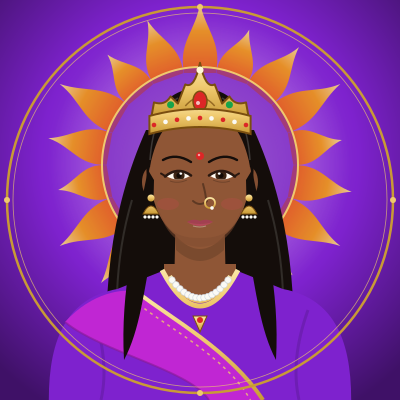
Draupadi is one of the greatest women of the Mahabharata. She was the daughter of King Drupada of Panchala and the sister of Dhrishtadyumna, and both of them rose from the same sacred fire. She became the wife of all five Pandava brothers, the mother of their five sons, and the queen first of Indraprastha and later of Hastinapur. She was insulted before the whole Kuru court, lived thirteen years in the forest and in disguise, and lost all her sons in a single night. Yet she never stopped asking what was right, and she never lost her faith in Shri Krishna, whom she trusted as her friend and protector. Vyasa tells us that she was a portion of Shri, the goddess Lakshmi, born on earth for a divine purpose.
Born from the sacred fire
Years earlier the young Kuru princes had defeated King Drupada as a gift to their teacher Dronacharya, and Drona had taken half his kingdom. Drupada could not forget this shame and wanted a son who would one day kill Drona. With the help of two learned brahmin brothers, Yaja and Upayaja, he performed a great fire sacrifice.
From the flames rose a young warrior in shining armour, holding a bow. This was Dhrishtadyumna. Then from the middle of the altar rose a young woman of wonderful beauty. Her skin was dark, her eyes were like lotus petals, her hair was long and curling, and the fragrance of a blue lotus spread around her. A voice from the sky declared that this best of women would fulfil the purpose of the gods, and that because of her many kshatriyas would perish.
Because of her dark complexion she was named Krishnaa. As Drupada’s daughter she is called Draupadi, as the princess of Panchala she is Panchali, and because Drupada was also known as Yajnasena, she is called Yajnaseni. Vyasa also reveals who she truly was: a portion of Shri, the goddess of fortune, who came into the world not from a mother’s womb but from the sacred altar.
The swayamvara and five husbands
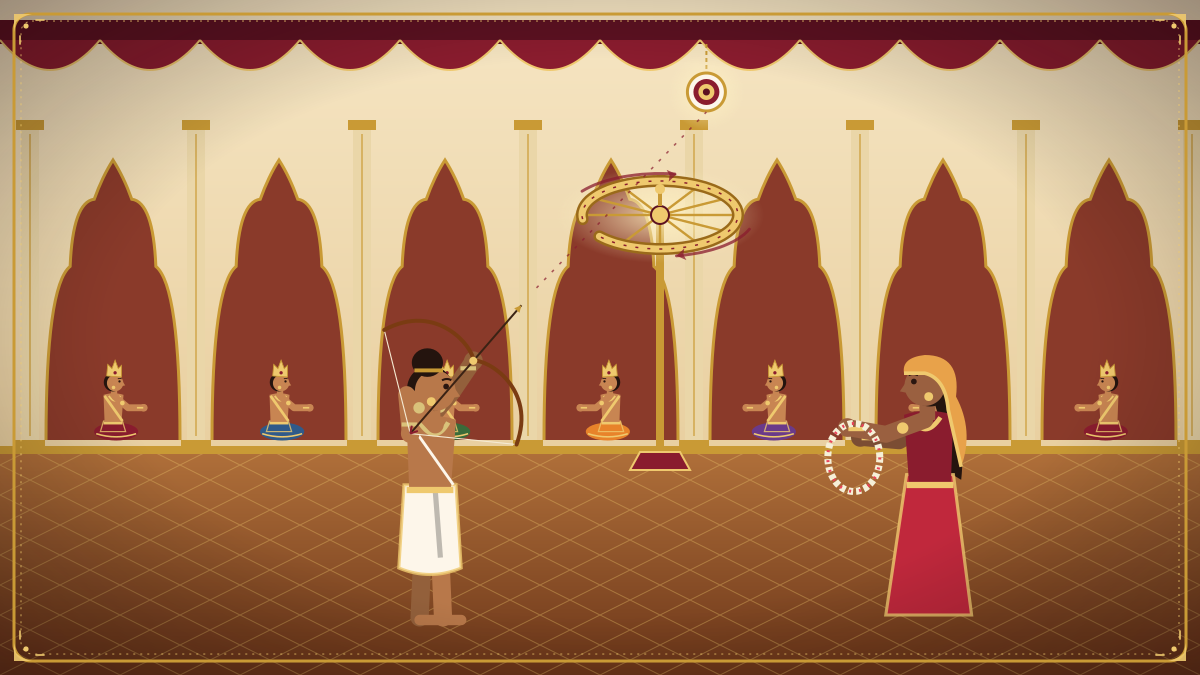
Drupada had always hoped to give his daughter to Arjuna, though he had heard that the Pandavas had died in the fire at Varanavata. So he had a very stiff bow made and set a target high in the air above a revolving device. Only the man who could string that bow and strike the target with five arrows through the opening of the device would win Draupadi’s hand.
Kings came from every land, among them Duryodhana, Shishupala, Jarasandha and Shalya, but they could not even string the bow. Then a young man stood up from among the brahmins. It was Arjuna, living in disguise with his brothers. He strung the bow in a moment and brought down the target. Draupadi came forward and placed the wedding garland on him.
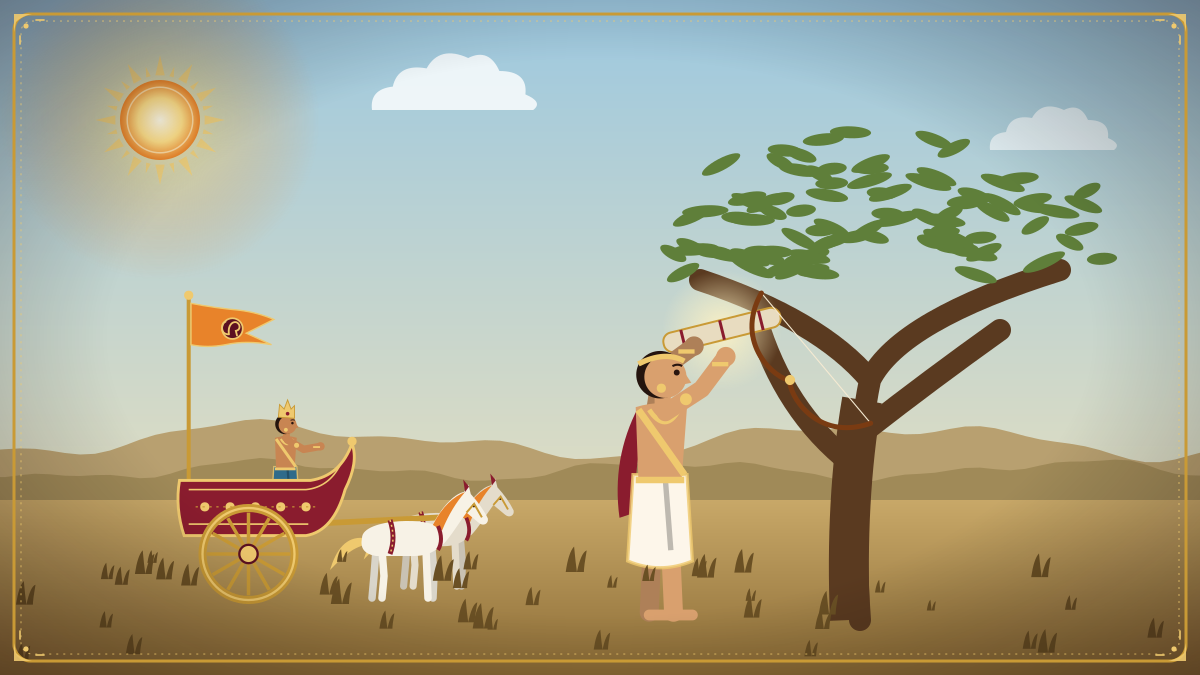
The kings were angry that a brahmin had won a princess, and they attacked. Bhima pulled up a tree to use as a club, and he and Arjuna drove them back. Shri Krishna, who was watching, recognised the Pandavas and persuaded the kings to stop, saying that the princess had been won fairly.
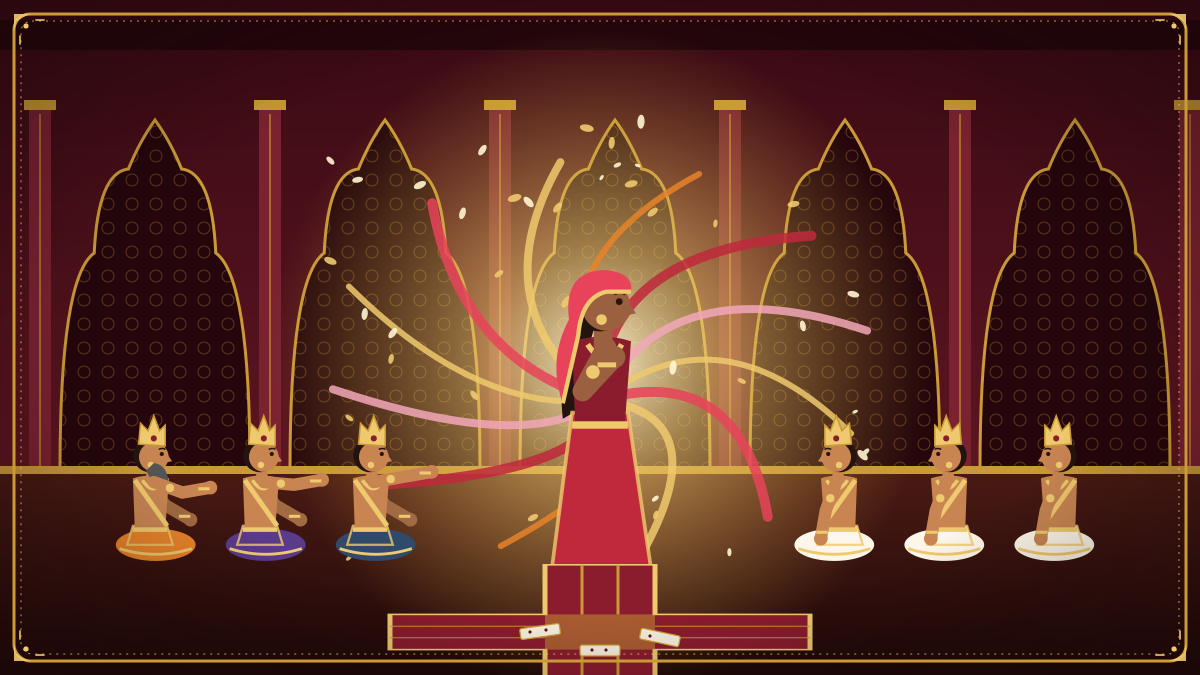
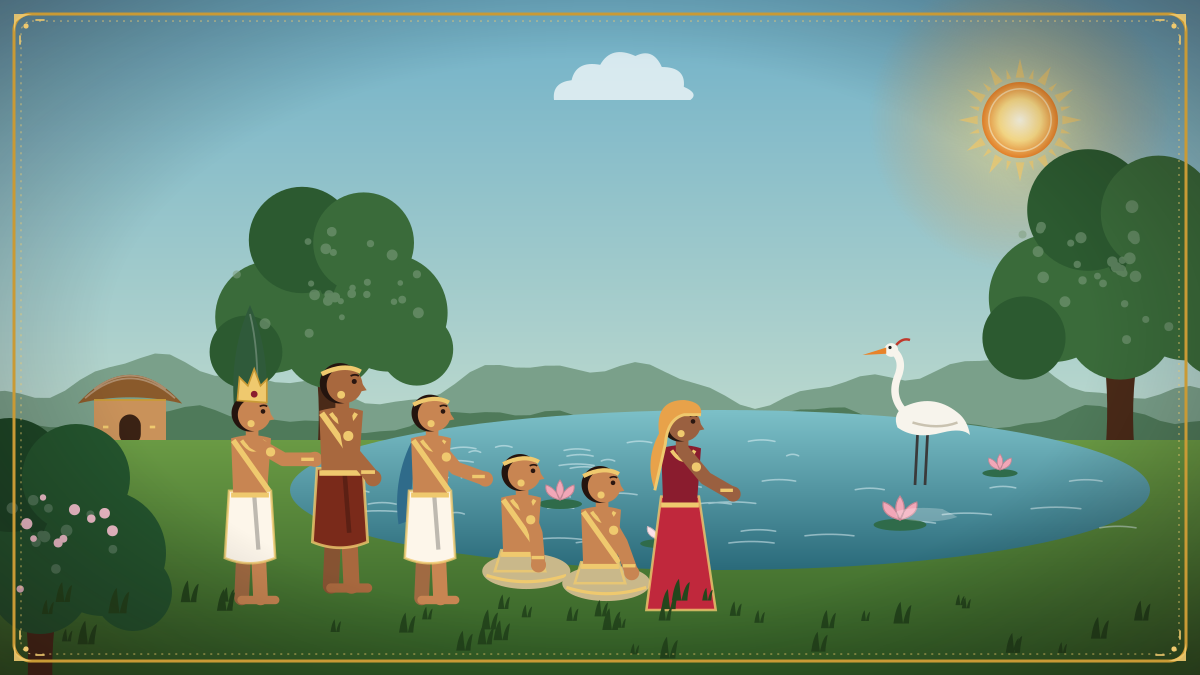
The brothers brought Draupadi to the potter’s house where they were staying and called out that they had brought the day’s alms. Kunti, not seeing them, replied, “Enjoy it all together.” When she saw the princess she was deeply troubled, for a mother’s word should not prove false. Yudhishthira remembered that Vyasa had already told them about this maiden, and seeing that all his brothers had given their hearts to her, he decided she would be the wife of all five.
King Drupada was shocked, for this was against the custom he knew. Then Vyasa explained. In an earlier life Draupadi had been a sage’s daughter who prayed to Lord Shiva for a virtuous husband and asked five times, so Shiva granted her five husbands in her next life. Vyasa also gave Drupada divine sight to see that the brothers were divine beings. Satisfied, Drupada agreed, and Draupadi was married to the brothers one by one on successive days. In time she bore a son to each of them: Prativindhya, Sutasoma, Shrutakarma, Shatanika and Shrutasena.
Queen of Indraprastha
Dhritarashtra gave the Pandavas the wild land of Khandavaprastha, and there they built the splendid city of Indraprastha, with Draupadi as their queen. To keep the brothers united, the sage Narada told them of two demon brothers, Sunda and Upasunda, who destroyed each other over one woman. So the Pandavas made a rule: when Draupadi was with one brother, no other would enter, and whoever broke this rule would live twelve years in the forest.
Arjuna broke the rule to fetch his weapons and save a brahmin’s cows, and he left for twelve years. During those travels he married Subhadra, Krishna’s sister. When he returned, he first sent Subhadra to Draupadi dressed as a simple cowherd woman. Draupadi teased Arjuna with gentle hurt, but when Subhadra bowed and called herself Draupadi’s servant, Draupadi embraced her warmly and blessed her.
Draupadi’s five sons and Subhadra’s son Abhimanyu grew up together in Indraprastha. At the great Rajasuya sacrifice Draupadi sat beside Yudhishthira as the honoured queen of an emperor. But that glory and the wonders of the palace filled Duryodhana with jealousy, and with his uncle Shakuni he began to plan how to take it all away.
The dice hall and her question
Shakuni challenged Yudhishthira to a game of dice in Hastinapur and won throw after throw by trickery. Yudhishthira lost his wealth, his kingdom, his four brothers and finally himself. Then Shakuni said, “You still have one stake, your queen.” Yudhishthira staked Draupadi and lost her too. The elders sat silent.
Duryodhana sent an attendant, Pratikami, to bring Draupadi to the hall as a servant. She was in her own rooms, unwell and wearing a single garment. Instead of coming, she sent back a question: “Ask the king whom he lost first, himself or me?” Then Duryodhana sent his brother Dushasana, who seized her by her long hair and dragged her into the assembly.
Before all the Kuru elders, Draupadi asked again: if Yudhishthira had already lost himself, what right did he have to stake her? Bhishma said the way of dharma was subtle and he could not decide. Only Vikarna, a younger brother of Duryodhana, said openly that she had not been won fairly, and Vidura too spoke for her. But Karna mocked her and told Dushasana to strip the Pandavas of their upper garments and Draupadi of her robe.
As Dushasana began to pull at her garment, Draupadi called out with all her heart to Shri Krishna, Govinda, the dweller of Dwarka. By divine grace, each time a cloth was pulled away, another just like it appeared. Cloth piled up until Dushasana grew tired and sat down, ashamed. Bhima, shaking with anger, vowed before everyone that he would one day break Duryodhana’s thigh and kill Dushasana in battle.
Then jackals howled and evil omens appeared. Afraid, Dhritarashtra offered Draupadi a boon. She asked for Yudhishthira’s freedom, so that her son would not be called a slave’s son. With a second boon she asked for the freedom of the other four brothers, with their weapons and chariots. Offered a third, she refused, saying that a kshatriya woman should ask for only two. Even Karna admitted that she had been like a boat that carried the Pandavas across a sea of trouble.
Twelve years in the forest
Soon Yudhishthira was called back to a second game and lost again. Now the Pandavas had to live twelve years in the forest and a thirteenth year in hiding. Draupadi went with them, leaving with her hair unbound and her face covered, saying that one day the wives of those who had wronged her would weep in the same way. In the forest the Sun god gave Yudhishthira a vessel that supplied food each day until Draupadi herself had eaten.
When Krishna visited them in the Kamyaka forest, Draupadi poured out her grief. She asked how she, a queen, a daughter-in-law of the Kuru house and Krishna’s friend, could be dragged into the court while her husbands sat silent. She said she felt she had no one at all. Krishna promised that the wives of those who had wronged her would one day weep, and that his word would not fail even if the heavens fell.
Draupadi often spoke with Yudhishthira about dharma. She urged him to use his strength, reminding him of the teaching of Prahlada to his grandson Bali, that there is a time to forgive and a time to act. Yudhishthira replied that forgiveness is the greatest strength and that dharma should be followed without seeking reward. Draupadi agreed that dharma must never be doubted, but insisted that a person must also make effort, for nothing is gained by sitting idle.
Once the sage Durvasa arrived with thousands of disciples just after Draupadi had eaten, when the vessel could give no more food. Fearing his curse, she prayed to Krishna. He came and ate one leaf of vegetable stuck to the vessel, and the sages bathing in the river suddenly felt full and quietly left. Another time Krishna’s queen Satyabhama asked what charm kept her five husbands devoted. Draupadi said she used no charm: she served them with humility, rose early, honoured the elders and herself kept the accounts of the household and treasury.
On the way to the Gandhamadana mountain Draupadi fainted in a storm, and Bhima called his son Ghatotkacha, who carried her through the sky. There the wind brought her a fragrant Saugandhika flower, and at her wish Bhima went to find more, meeting Hanuman on the way. Later, in the Kamyaka forest, King Jayadratha, husband of Duryodhana’s sister, tried to carry her off while the brothers were hunting. She pushed him down, but he forced her into his chariot. The Pandavas captured him, and at Yudhishthira’s word and Draupadi’s request he was let go after being shamed.
The year in disguise and the peace talks
For the thirteenth year the Pandavas hid in the kingdom of King Virata. Draupadi became Sairandhri, a maid who dressed the hair of Queen Sudeshna, and she said that five Gandharvas were her secret husbands and protectors. It was hard for a queen to serve, but she bore it.
Sudeshna’s brother Kichaka, the army’s powerful commander, troubled her again and again. When she ran to the royal hall for help, Kichaka kicked her before King Virata, and Yudhishthira, in disguise, had to stay silent. That night she went to Bhima in the kitchen and told him she could bear no more.
Bhima told her to invite Kichaka to the empty dance hall at night. There Bhima waited in her place, and Kichaka was killed. Kichaka’s brothers then tried to burn Sairandhri on his funeral pyre, but Bhima rescued her, and they all perished. Soon the year ended and the Pandavas revealed themselves.
When Krishna was leaving for Hastinapur to seek peace, Draupadi took her long dark hair in her hand and said, “Krishna, when you speak of peace, remember this hair that Dushasana seized. If my husbands want peace, my old father and brothers will fight, and my five sons, led by Abhimanyu, will fight.” Tears filled her eyes. Krishna told her that she would soon see the Kaurava women weeping, and that his word would not be false.
Loss, forgiveness and the last journey
During the war Draupadi stayed in the Pandava camp at Upaplavya. The Pandavas won, but on the last night Ashwatthama, Drona’s son, entered the sleeping camp and killed her brothers Dhrishtadyumna and Shikhandi and all five of her sons. Draupadi fell to the ground in grief. She told Yudhishthira that she would sit without food until death unless Ashwatthama was punished and the jewel he had been born with on his head was brought to her.
Bhima went after Ashwatthama, and Krishna and Arjuna followed. Ashwatthama was defeated and had to give up the jewel. When Bhima placed it in Draupadi’s hands, she said that her wish was fulfilled and the debt was paid, and that the son of their teacher deserved respect like the teacher himself. She asked Yudhishthira to wear the jewel on his head.
After the war Yudhishthira was so full of sorrow that he wanted to give up the kingdom and go to the forest. Draupadi reminded him that a king’s duty is to protect his people and urged him to rule. He was crowned in Hastinapur, and Draupadi became queen of the whole land. She served the elders, and years later visited Kunti, Dhritarashtra and Gandhari in their forest hermitage.
When the Pandavas finally left the world, Draupadi walked with them towards the Himalayas. She was the first to fall on the way. Bhima asked why, and Yudhishthira said it was because she had loved Arjuna more than the others. In heaven Yudhishthira saw her shining, and Indra told him that she was Shri herself, who had taken birth for the Pandavas’ sake.
Did you know?
- In an earlier life Draupadi prayed to Shiva five times for a virtuous husband, and so Shiva granted her five husbands in her next birth.
- She was called Krishnaa because of her dark, beautiful complexion, and Yajnaseni because she was born from a yajna, a sacred fire.
- In the dice hall Draupadi asked the elders whether Yudhishthira had lost himself before he staked her, and no one in the assembly could answer her.
- Draupadi went with the Pandavas through all twelve years of forest exile, and on their last journey to the Himalayas she was the first to fall.
What we learn from Draupadi
Draupadi teaches us to ask what is right, even when everyone around us is silent. She shows that sincere prayer gives strength in the darkest hour, and that faith and effort must go together. Her words about Ashwatthama remind us that even justice can be sought without hatred.
Draupadi in the story
Read the chapters where Draupadi plays a part.