Key moments
- Kripa advises peace, but Duryodhana refuses to bend
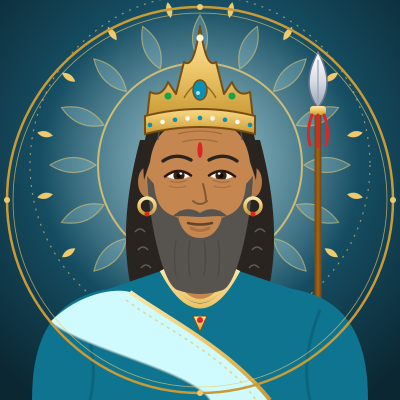
- Yudhishthira kills Shalya with a jewelled spear
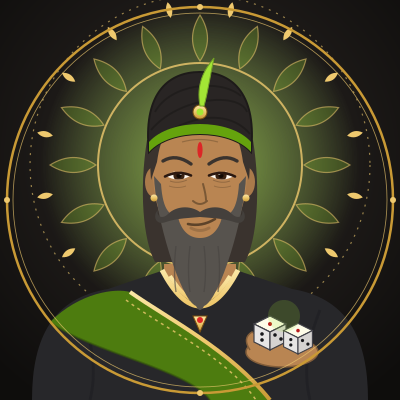
- Sahadeva keeps his dice-hall vow and Shakuni falls
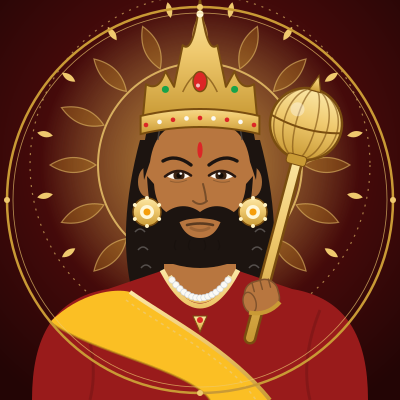
- Duryodhana hides in the Dvaipayana lake by his power over water
- Krishna scolds Yudhishthira for repeating the gamble
- Arjuna strikes his own thigh as a sign to Bhima
- Krishna calms the angry Balarama, who leaves for Dwarka
- Flowers fall on Duryodhana as he lies dying
A Council in the Night
When Karna fell on the seventeenth day, a deep silence came over the Kaurava camp. The soldiers sat beside their fires with their heads bowed, and no one spoke of victory any more. That night the old teacher Kripacharya, who had loved the Kuru princes since they were children, went to Duryodhana and spoke to him gently but honestly.
“My son,” he said, “Bhishma has fallen, Drona has fallen, and now Karna is gone. Your brothers lie on the field, and Arjuna and Bhima cannot be stopped. Make peace with the Pandavas while there is still something left to save. Yudhishthira is kind; he will let you rule beside him. A wise king knows when to bend.”
Duryodhana listened, then sighed. “Teacher, your words are good, but they come too late. I have insulted the Pandavas, I took their kingdom by dice, and I let Draupadi be dragged into the court. How could they ever trust me now? So many kings and friends have given their lives for me. If I make peace now, I will be shaming them. I will fight on, and if I die, I will die as a warrior and reach the heavenly worlds where they have gone.”
The other warriors praised his courage, though Kripa's heart was heavy. Then Ashwatthama, Drona's son, said, “Let King Shalya lead us. He is brave, wise and strong, and he is the equal of any warrior on the field.” Everyone agreed. Shalya, the king of Madra and brother of Madri, was the maternal uncle (mother's brother) of Nakula and Sahadeva, but he had given his word to Duryodhana before the war, and he kept it. That night he was made commander of what remained of the Kaurava army.
Yudhishthira and Shalya
On the morning of the eighteenth day the two armies met once more. Shalya fought with great fury. His arrows fell like rain, and for a time the Pandava soldiers were pushed back. Duryodhana's hopes rose again, and the Kaurava drums thundered across Kurukshetra.
Then Krishna turned to Yudhishthira and said, “O king, Shalya is your share in this battle. No one else should face him today. You are gentle by nature, but today you must fight without pity, for he is the enemy's commander. Do not think of him as your uncle. Think only of your duty.” Yudhishthira bowed his head and agreed.
So the son of Dharma, who had always been the calmest of the brothers, rode out against Shalya himself. Bhima, Nakula, Sahadeva, Satyaki and Dhrishtadyumna stood around him to guard his chariot. For a long time the two kings fought, each breaking the other's bow and wounding the other's horses. The soldiers on both sides stopped to watch, for they had never seen Yudhishthira fight like this.
At last Yudhishthira took up a mighty spear decorated with gold and jewels. He fixed his mind, spoke a prayer, and hurled it with all his strength. The spear shone like a flash of lightning and struck Shalya in the chest. The great king of Madra fell from his chariot like a tall tower falling to the ground, his arms spread wide as if to embrace the earth. Shalya's younger brother rushed forward to avenge him and was also struck down by Yudhishthira. When the Kaurava soldiers saw their commander fall, their courage broke and they began to flee.
Sahadeva's Vow and the End of an Army
Duryodhana tried to gather his scattered men, and a fierce battle broke out again. In the middle of it Sahadeva, the youngest Pandava, looked for the two people who had caused so much sorrow with their tricks: Shakuni, the brother of Gandhari, and his son Uluka. Years before, in the dice hall, Sahadeva had sworn that he would end Shakuni's life on the battlefield.
First Uluka came against him, and after a short, sharp fight Sahadeva struck him down. Shakuni saw his son fall and wept, but he could not escape. Sahadeva called out to him, “Remember the game of dice, O king of Gandhara! Today you will receive the reward of that game.” Then, with a broad-headed arrow, Sahadeva ended Shakuni's life. The vow made in the dice hall was kept on the battlefield, and the gods praised Sahadeva.
By evening the great Kaurava army of eleven akshauhinis was gone. Of all the kings and warriors who had stood with Duryodhana, only three great fighters were still alive: Kripacharya, Ashwatthama and Kritavarma. Duryodhana himself, his horses killed and his chariot broken, took his mace and walked away from the field alone.
During this time Sanjaya, Dhritarashtra's minister, was caught by Dhrishtadyumna's soldiers. Satyaki raised his sword to kill him, but just then the sage Vyasa appeared and said, “Let Sanjaya go free. He must not be killed.” Satyaki bowed to the sage and released him. On his way back to Hastinapur, Sanjaya met Duryodhana, who was wounded and weary. Duryodhana said to him, “Tell my father that I have entered the lake.”
Duryodhana knew a special art of stopping and holding water. He went into the lake called Dvaipayana, made the water stand still around him, and rested hidden beneath its surface. Meanwhile Yuyutsu, the son of Dhritarashtra who had joined the Pandavas, took the royal women safely back to Hastinapur, and the news of the defeat spread through the city.
The Prince in the Lake
Soon Kripacharya, Ashwatthama and Kritavarma learned from Sanjaya where Duryodhana was. They came to the edge of the lake and spoke to him through the water. “Rise up, O king,” said Ashwatthama. “Come out and fight with us. We will defeat the Pandavas yet.” Duryodhana answered, “I am tired and wounded. Let me rest tonight. Tomorrow I will fight.”
Some hunters were passing by, carrying meat for Bhima, whom they served every day. They overheard this conversation. Thinking that Bhima would reward them well, they went quickly to the Pandava camp and told him that Duryodhana was hiding in the lake. Bhima gave them a rich reward, and the Pandavas set out at once with Krishna and their army. Hearing them coming, the three warriors left the lake and went away.
Yudhishthira stood on the bank and called out, “Duryodhana, why are you hiding in the water after causing the death of all the Kshatriyas and your own family? Where is your pride now? You were born in a great family. Come out and fight!” From under the water Duryodhana replied, “I am not hiding out of fear. I only came here to rest. My brothers and friends are dead. The earth is now like a widow to me. Take it and rule it. I will put on deerskin and go to the forest.”
Yudhishthira answered, “You cannot give away what is no longer yours. Once you would not give us even as much land as the point of a needle. Now the earth is not yours to give. Come out and fight. Choose any weapon you like, and fight any one of us. If you kill that one, you will be king.” Stung by these words, Duryodhana rose from the lake, his mace on his shoulder, and said, “I will fight with the mace. Let any one of you come.”
Krishna was alarmed and spoke sharply to Yudhishthira. “What have you done, O king? This is the dice game all over again! If Duryodhana had chosen you, or Arjuna, or Nakula, or Sahadeva, which of you could stand before him with the mace? For thirteen years he has practised every day on an iron statue of Bhima. Only Bhima can face him, and even Bhima is not more skilled than he is.”
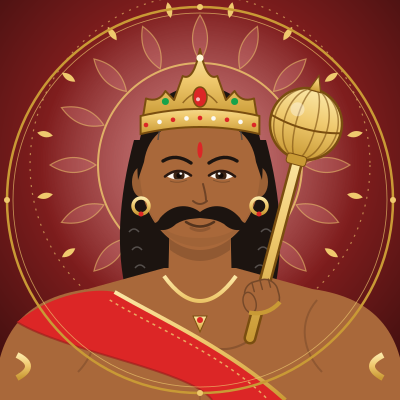
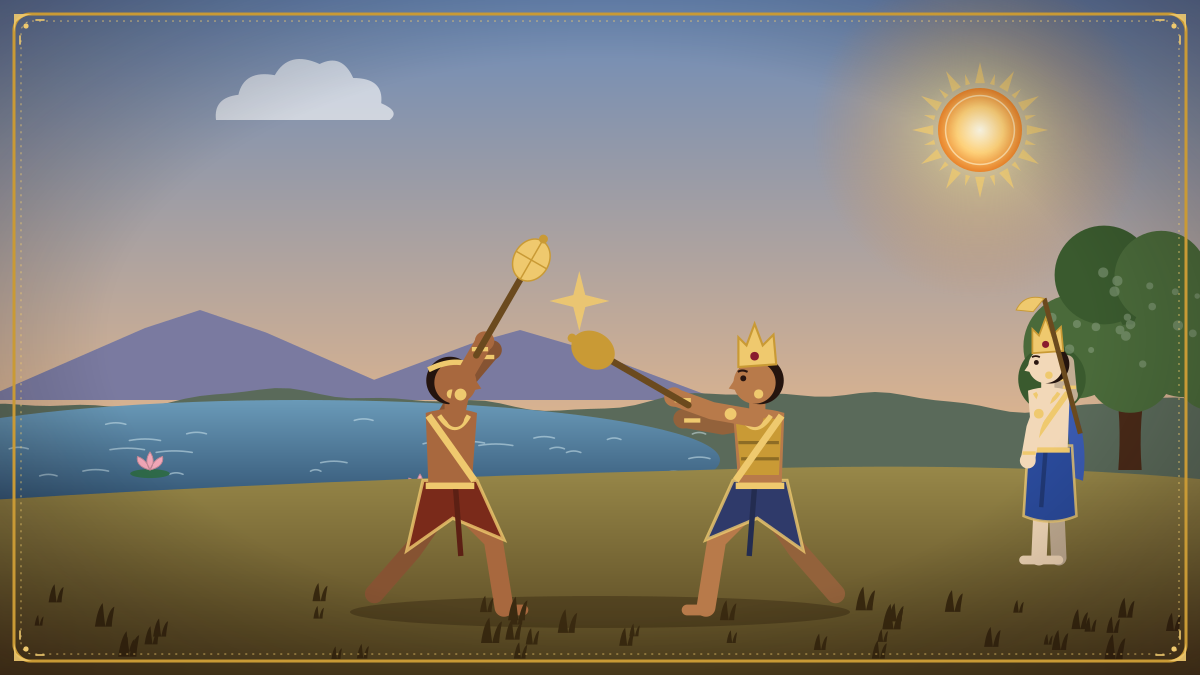
Bhima stepped forward and said, “Do not worry, Krishna. I will fight him and keep my vow.” Duryodhana looked at the brothers and said proudly, “I will fight Bhima.” The two mighty warriors faced each other, both holding heavy maces decorated with gold.
Balarama's Return and the Duel
Just as the duel was about to begin, Balarama, Krishna's elder brother, arrived. Before the war he had refused to take sides, because both Bhima and Duryodhana were his students in the art of the mace. So he had gone on a long pilgrimage along the holy Sarasvati river, bathing at its sacred places, giving gifts to brahmins and hearing the stories of each holy spot. After forty-two days he had heard that his two students were about to fight, and he had hurried back.
Krishna and the Pandavas welcomed him with respect. Balarama said, “Let this duel be fought at Samantapanchaka, the holy field of Kurukshetra. Whoever dies there goes to heaven.” Everyone agreed, and they walked together to that sacred place. There the two warriors began to circle each other like two angry bulls.
The fight was long and terrible. The maces clashed with a sound like thunder, and sparks flew. Sometimes Bhima struck and Duryodhana staggered; sometimes Duryodhana's blows made Bhima fall to his knees. The watching warriors held their breath. Arjuna turned to Krishna and asked, “Who will win this fight?”
Krishna said, “They learned from the same teacher. Bhima is stronger, but Duryodhana is more skilled and has practised more. If Bhima fights only by the rules, he will not win. But in the dice hall Bhima vowed to break Duryodhana's thighs, the thighs he had shown to insult Draupadi. Let Bhima remember that vow.” Arjuna understood. While Bhima was looking, Arjuna struck his own left thigh with his hand.
Bhima saw the sign and understood it at once. When Duryodhana leaped high into the air to avoid a blow, Bhima swung his mace with all his strength and struck both his thighs. Duryodhana fell to the ground, and the earth seemed to tremble. Dust storms rose, the sky darkened, and strange sounds were heard in all directions. The vow made in the dice hall was kept at last.
Anger, Answers and Flowers from the Sky
In the heat of the moment Bhima placed his left foot on Duryodhana's head and spoke harsh words about the insults of the past. Yudhishthira quickly stopped him. “Enough, Bhima! He is a king, the son of our father's elder brother Dhritarashtra, and he has fallen. Do not touch his head with your foot. Your vow is fulfilled; do not go beyond dharma.” Then Yudhishthira himself wept for Duryodhana and spoke gently to him.
Balarama could not bear what he had seen. “Striking below the navel is forbidden in a mace fight!” he roared. Raising his plough, he rushed toward Bhima. Krishna ran forward and held his brother in his arms. “Brother, the Pandavas are our own kin. Bhima had made a vow in front of everyone, and a Kshatriya must keep his vow. A sage also once cursed Duryodhana that Bhima would break his thighs. And remember, the age of Kali has now begun.” Balarama calmed down a little, but he said, “Duryodhana will reach heaven, and Bhima will be called an unfair fighter.” Unhappy, he left for Dwarka.
Then Duryodhana, lying in great pain, raised himself on his arms and spoke bitterly to Krishna. “Krishna, you had Bhishma brought down by placing Shikhandi in front of him. You had Drona killed by making Yudhishthira speak a lie about Ashwatthama. You had Karna killed when his chariot wheel was stuck. You let Arjuna cut off Bhurishrava's arm. And now you have made Bhima strike me unfairly. Is there no shame in you?”
Krishna answered calmly. “Duryodhana, all of this happened because of your own wrong path. You tried to poison Bhima, you tried to burn the Pandavas in the house of lac, you cheated them at dice, and you had Draupadi insulted in the open court. You had young Abhimanyu killed by many warriors together. Bhishma, Drona and Karna fell because they stood on the side of wrong. Warriors like these could not have been defeated in a straight fight. Even the gods have used such means against the demons.”
Duryodhana replied, “I studied well, I gave many gifts, I ruled the earth with its seas, and I stood on the heads of my enemies. I enjoyed every pleasure that even the gods find hard to get. Now I fall in battle, facing my enemy, as a Kshatriya should. Who could be more fortunate than I? I go to heaven with my friends, and you stay behind in sorrow.”
As he finished, a shower of fragrant flowers fell from the sky upon Duryodhana. The gandharvas played sweet music, and the siddhas cried, “Well done!” Seeing this, the Pandavas felt ashamed and sad. Krishna spoke to them in a deep, steady voice: “Do not grieve. These great warriors could not have been defeated by fair means alone. It was for your sake that I used these ways. Duryodhana is fallen; your task is done.”
Leaving the Field
The Pandavas then went to Duryodhana's empty camp and took charge of its treasure. When they arrived, Krishna said to Arjuna, “Take down your bow and quivers and get down from the chariot first.” Arjuna did so, and then Krishna stepped down. At that very moment the monkey on Arjuna's flag vanished, and the great chariot burst into flames and turned to ashes. Krishna explained, “This chariot was burnt long ago by the divine weapons of Drona and Karna. Only my power held it together until the war was won.”
Krishna then said, “For the sake of good fortune, we should not spend tonight inside the camp.” So the five Pandavas, Satyaki and Krishna stayed that night outside the camp, on the bank of the Oghavati river. They did not know how much their lives would depend on this advice.
Yudhishthira was worried about Gandhari. “Her sons are all dead,” he said to Krishna. “If she is angry, her curse could burn us. Only you can calm her.” So Krishna went to Hastinapur that night in his chariot. He bowed to Dhritarashtra and Gandhari, held Gandhari's hand, and gently reminded her that she herself had told Duryodhana again and again, “Where there is dharma, there is victory.” Gandhari wept, and her anger softened. Then, sensing that Ashwatthama was planning something dark, Krishna quickly returned to the Pandavas.
Did you know?
- Yuyutsu, a son of Dhritarashtra, crossed over to the Pandava side just before the war began and was one of the very few who survived it.
- Balarama spent the whole war on a pilgrimage along the Sarasvati river and came back just in time for the mace duel between his two students.
- Arjuna’s chariot burst into flames as soon as Krishna stepped down; it had been held together only by Krishna’s presence.
- The mace duel was fought at Samantapanchaka in Kurukshetra, the place where Parashurama is said to have once made five lakes.
What this chapter teaches us
Duryodhana was offered peace again and again, even on the last night, but his pride would not let him bend. Every wrong done in the dice hall returned to its doer in time, from Shakuni's fall to Bhima's vow. Yet the chapter also shows Yudhishthira's restraint and Krishna's patient answers: even in victory, a good person does not insult the fallen.