Key moments
- Karna proposes Drona as the new Kaurava commander
- Krishna takes Bhagadatta's Vaishnavastra on his own chest
- Abhimanyu breaks into the Chakravyuha and fights alone
- Jayadratha's boon from Shiva holds back the other Pandavas
- Krishna veils the sun and Arjuna keeps his vow
- Karna spends Indra's Shakti on Ghatotkacha
- “Ashwatthama is dead,” and Drona lays down his weapons
- Krishna saves the army from the Narayanastra
A New Commander
When Bhishma fell on the tenth day and lay on his bed of arrows, the Kaurava army felt like a herd without a shepherd. Now Karna, who had stayed away from the fighting for ten days, came forward at last. He first went to the old grandsire, bowed before him and received his blessing. Then he put on his armour and drove to the front, and the soldiers cheered as if a lost light had come back.
Duryodhana asked Karna, “Who should lead us now?” Karna answered wisely, “Every king in this army is great, but if we choose one, the others will feel hurt. Choose Dronacharya. He is the teacher of all of us, old in years, rich in wisdom, and no one alive knows more about weapons.” Duryodhana agreed, and with music and blessings Drona was made commander of the Kaurava army.
Pleased by the honour, Drona said, “Ask me for a boon.” Duryodhana replied, “Guru, capture Yudhishthira alive and bring him to me.” Drona was surprised and even a little glad, thinking that Duryodhana did not want his cousin dead. But Duryodhana's real plan was different: with Yudhishthira as prisoner, he could force the Pandavas into another game of dice and send them back to the forest.
Drona gave his word with one condition. “I can capture Yudhishthira only if Arjuna is kept away from him. Arjuna is my own student, and while he stands beside his brother, even the gods could not take Yudhishthira.” The news of this promise soon reached the Pandava camp through their spies, and from that day Arjuna kept close watch over his eldest brother.
Bhagadatta and the Samshaptakas
On the eleventh day Drona fought like a storm and rushed straight towards Yudhishthira. For a moment it seemed he would seize him, but Arjuna arrived, covered the field with arrows and drove the Kaurava army back. Drona's plan had failed. That evening Duryodhana's friends, the Trigarta brothers led by King Susharma, made a terrible oath. They called themselves the Samshaptakas, “those bound by an oath,” and swore either to kill Arjuna or to die fighting him.
On the twelfth day the Samshaptakas challenged Arjuna at the far southern end of the field. A Kshatriya could not refuse a challenge, so Arjuna went, leaving Satyajit, a brave prince of the Panchalas, to guard Yudhishthira. While Arjuna fought the oath-bound warriors, Drona attacked again. Satyajit fought bravely and gave his life, and Yudhishthira had to withdraw to safety.
In the same battle, old King Bhagadatta of Pragjyotisha rode out on his giant elephant Supratika. The elephant crushed chariots, horses and soldiers, and the Pandava ranks scattered in fear. Hearing the uproar, Krishna turned the chariot back, and Arjuna came to face the elephant king. Bhagadatta, angry and proud, released his most powerful weapon, the Vaishnavastra, charged with a sacred mantra, straight at Arjuna.
At that moment Krishna stood up in the chariot and took the weapon on his own chest, where it turned into a garland of fresh flowers. Arjuna asked, a little hurt, why Krishna had broken his promise not to fight. Krishna gently explained, “That weapon was my own, given long ago to Bhagadatta's father Naraka. No one but me could have stopped it.” Then Arjuna struck down the great elephant Supratika and its brave old rider, Bhagadatta.
The Chakravyuha
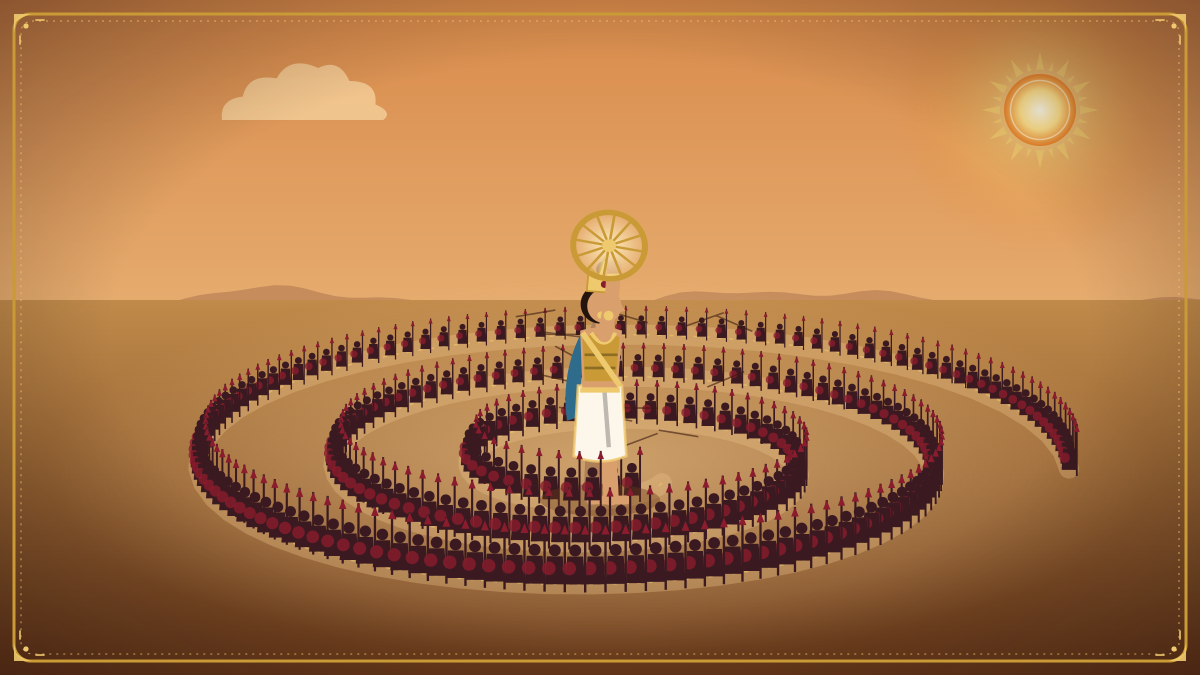
On the thirteenth day the Samshaptakas once again called Arjuna away to the south. This time Drona arranged his army in the Chakravyuha, a huge wheel of warriors, ring inside ring, turning and closing like a living fortress. The greatest heroes of the Kaurava side stood in its rings, and one by one the Pandava attacks broke against its walls.
Yudhishthira was worried. Only Arjuna, Krishna and a very few others knew how to break such a formation. Then he turned to Abhimanyu, the sixteen-year-old son of Arjuna and Subhadra. “Child, your father is far away. Can you open this wheel for us?” Abhimanyu answered honestly, “Uncle, I learned from my father how to break into the Chakravyuha. But if trouble comes, I do not know how to come out again.”
Yudhishthira and Bhima promised, “You break the first ring, and we will all follow right behind you. Where you go, we will go.” Abhimanyu's charioteer Sumitra gently warned him that Drona was the greatest master of war. The young hero smiled. “Today I will fight in a way that will make my father and my uncle Krishna proud. Drive on.”
Like a lion cub leaping into a herd, Abhimanyu broke through the outer ring. But as Bhima, Satyaki, Dhrishtadyumna, Nakula, Sahadeva and the others rushed to follow, Jayadratha, king of Sindhu, closed the gap. Years before, after Bhima had humbled him in the forest for trying to carry off Draupadi, Jayadratha had pleased Lord Shiva with hard penance. Shiva had granted him that for one day he could hold back all the Pandavas except Arjuna.
That day had come. Bhima struck and struck again, Yudhishthira and the twins shot arrow after arrow, but Jayadratha stood firm in the opening like a mountain. The wheel of warriors closed behind Abhimanyu, and the boy was left alone inside, surrounded by the mightiest warriors of the age.
Abhimanyu's Last Battle
Alone inside the wheel, Abhimanyu fought as if the spirit of Arjuna himself was in him. His arrows flew in every direction. He defeated Drona's companions one after another, wounded Karna, drove back Shalya, and struck down many brave princes. Duryodhana's beloved young son Lakshmana came to fight him and fell. Brihadbala, king of Kosala, also fell before him.
Even Drona praised him openly. “I have never seen anyone like this boy. He is a true son of Arjuna.” Hearing this, Duryodhana grew angry, and the Kaurava heroes understood that no one could defeat Abhimanyu face to face. Drona then advised that his bow should be cut from behind and his chariot broken.
So six great chariot-warriors, among them Drona, Karna, Kripacharya, Ashwatthama and Kritavarma, surrounded him together. Karna cut his bow from behind. Others killed his horses and his charioteers. Without bow or chariot, Abhimanyu leapt down with sword and shield, flashing like lightning, but Drona cut his sword and Karna broke his shield.
Still the brave boy would not give up. He lifted a wheel of his broken chariot and whirled it high, rushing at Drona like Lord Vishnu with his discus. The warriors cut the wheel to pieces with their arrows. Then he picked up a mace and fought the son of Dushasana, mace against mace. Both fell to the ground with the force of their blows.
The son of Dushasana rose first. As Abhimanyu was getting up, tired and wounded, his opponent struck him with his mace, and the young hero fell and did not rise again. Abhimanyu lay on the field like the setting moon. Even in the Kaurava camp many hearts were heavy, for all knew that many great men together had brought down one boy. At home his young wife Uttara was expecting their child.
Grief and a Terrible Vow
That evening Yudhishthira sat broken with sorrow. “I sent him in. I promised to follow him, and I could not.” Then Sage Vyasa came to comfort him. He told an old story that Narada had once told King Akampana, who was grieving for his own son. When creation began, Brahma created a woman named Mrityu, Death, and asked her to take the lives of living beings. She wept and did not want to do it, but Brahma explained that she would only take away those whose time had come, and that each being's own deeds decide its end. So, said Vyasa, a brave warrior who falls doing his duty goes to the higher worlds and should not be wept for without end.
Meanwhile Arjuna had defeated the Samshaptakas and was returning. As he came near, the camp was strangely silent; no music played and no one came out to greet him. When he heard how his son had died alone, and how Jayadratha had blocked the way for the others, his grief turned into fire.
Before all the warriors Arjuna made a vow: “If I do not kill Jayadratha before the sun sets tomorrow, I will enter the fire myself.” Krishna blew his conch Panchajanya, and Arjuna blew Devadatta, and the sound shook the Kaurava camp. Jayadratha was terrified and wanted to run home, but Duryodhana and Drona promised to keep him hidden behind the whole army.
That night Krishna went to comfort Subhadra and Uttara. Later he called his charioteer Daruka and said, “Keep my own chariot ready with all my weapons at dawn. If Arjuna needs me, I will not let his vow fail. Arjuna is dearer to me than my own life.”
As Arjuna slept, he had a holy dream. In it, Krishna took his hand and the two flew to Mount Kailash. There they bowed to Lord Shiva, who once again gave Arjuna the knowledge of the mighty Pashupata weapon. Arjuna woke up with a calm heart and new strength, ready for the hardest day of his life.
Before the Sun Went Down
On the fourteenth day Drona arranged a huge formation, and Jayadratha was placed far behind it. At its front stood Drona himself. Arjuna bowed to his teacher and said, “You are like my father. Please let me pass.” Drona smiled. “You will not reach Jayadratha without defeating me.” Arjuna did not want to fight his guru all day, so he went around him and drove on into the army. When Drona called out, “You never leave an enemy undefeated,” Arjuna replied, “You are my teacher, not my enemy.”
Arjuna cut his way through rank after rank. When his horses grew tired and thirsty in the middle of the battlefield, Arjuna made a pool of water with his arrows, and Krishna calmly unyoked the horses, washed them and pulled out the arrows from their bodies, while Arjuna alone held back the whole army. Duryodhana came wearing magic armour that Drona had bound on him, but Arjuna struck at the places it did not cover and drove him back.
Back in the camp, Yudhishthira grew anxious when he could no longer hear Arjuna's bow. He sent Satyaki, and then Bhima, to find him. Satyaki fought his way through the army. Bhima defeated Karna again and again and struck down many sons of Dhritarashtra. When the good Vikarna fell, Bhima wept for him, remembering how Vikarna alone had spoken up for Draupadi in the dice hall.
Tired from his long fighting, Satyaki was thrown down by Bhurishrava, who caught him by the hair and raised his sword. Krishna said, “Arjuna, save Satyaki!” Arjuna shot an arrow and cut off Bhurishrava's raised arm. Bhurishrava blamed Arjuna for striking while he was fighting someone else, then sat down on the field in yoga to give up his life. At that moment Satyaki rose and struck off his head, though many warriors cried out against it.
The sun was now sinking, and Jayadratha was still far away, guarded by six great warriors. Then Krishna, by his yoga power, covered the sun with darkness. The Kauravas thought the day was over and shouted with joy, and Jayadratha raised his head to look at the sky. Krishna withdrew the darkness and said, “The sun has not set. Strike now!”
Krishna also warned him, “His father Vriddhakshatra once declared that whoever made his son's head fall to the ground would have his own head burst. Send the head far away.” Arjuna's arrow cut off Jayadratha's head and, with more arrows, carried it to the place where old Vriddhakshatra sat at his evening prayers, dropping it into his lap. When the king stood up startled, the head fell to the ground, and his own words came true upon him. Arjuna's vow was kept.
The Night Battle and the Fall of Drona
That night the fighting did not stop. Torches were lit, and in the darkness Ghatotkacha, son of Bhima and Hidimbi, became terrible, for rakshasas grow stronger at night. He rained down weapons and illusions, and the Kaurava army began to flee. Duryodhana begged Karna, “Save us, or there will be no army left by morning.”
Karna had one great weapon, the Shakti that Indra had given him in exchange for his golden armour and earrings. It could be used only once, and Karna had kept it for Arjuna. Now, pressed by his friend, he hurled it at Ghatotkacha. The rakshasa made his body huge as he fell, crushing many enemy soldiers even in his death.
The Pandavas wept, but Krishna embraced Arjuna with joy. He explained, “As long as Karna held that Shakti, your life was in danger. It is spent now. Even Ghatotkacha's sacrifice has protected you. That is why I kept him away from Karna until this night.” Then the tired armies rested on the field until the moon rose, and the fighting began again.
On the fifteenth day Drona fought with frightening anger, using divine weapons even on ordinary soldiers. Drupada and Virata fell before him. Then the great sages, Vishvamitra, Vasishtha, Bharadvaja and others, appeared and said, “Drona, you are a Brahmin. This killing does not suit you. Your time has come; lay down your weapons.” Krishna said, “Drona will stop only if he hears that his son Ashwatthama is dead.”
Bhima killed an elephant named Ashwatthama and shouted, “Ashwatthama is dead!” Drona did not believe it and turned to Yudhishthira, who never lied. Urged by Krishna, Yudhishthira said loudly, “Ashwatthama is dead,” and then, so softly that it could not be heard, “the elephant.” Until then his chariot had always run a little above the ground; now it touched the earth. Drona laid down his weapons, sat on his chariot in yoga, and his spirit rose towards heaven. Dhrishtadyumna, born from the sacred fire to end Drona's life, rushed up and cut off his head, while Arjuna cried, “Bring him alive, do not kill him!”
Arjuna was deeply pained and spoke hard words to Yudhishthira and Dhrishtadyumna. Hearing of his father's death, Ashwatthama burned with rage and released the Narayanastra, which rained fire over the Pandava army. Krishna shouted, “Lay down your weapons and step down from your chariots! This weapon spares those who do not fight.” Everyone obeyed except Bhima, until Krishna and Arjuna pulled him down. The weapon grew calm, and the fifteenth day ended with Drona gone.
Did you know?
- The name Drona means a vessel or pot. Drona, son of the sage Bharadvaja, is said to have been born from a pot rather than from a mother.
- When Bhagadatta hurled the Vaishnavastra at Arjuna, Krishna took it on his own chest, and it turned into a garland of flowers.
- On the fourteenth day the armies kept fighting through the night by torchlight, breaking the rule that fighting should stop at sunset.
- Abhimanyu’s son, born after his death, was Parikshit, who later became king of Hastinapur and carried on the Kuru family line.
What this chapter teaches us
Courage is not measured by age: young Abhimanyu stood firm against the greatest warriors of his time. When many strong people join against one, the shame is theirs, not his. The chapter also shows that even a half-spoken truth leaves its mark, as Yudhishthira's chariot touching the ground reminds us. And Krishna's care for Arjuna shows that God protects his devotee in ways the devotee may not even see.