Key moments
- An owl attacking sleeping crows gives Ashwatthama a cruel idea
- Ashwatthama worships Lord Shiva at the camp gate
- Dhrishtadyumna and Draupadi's five sons fall in the night raid
- Arjuna withdraws his Brahmashira; Ashwatthama cannot
- Krishna promises to save Uttara's unborn child
- Ashwatthama is cursed to wander for three thousand years
- Krishna saves Bhima with an iron statue
- Kunti reveals that Karna was her eldest son
The Owl and the Crows
As evening fell on the eighteenth day, Kripacharya, Ashwatthama and Kritavarma came to the place where Duryodhana lay with broken thighs. Seeing the proud king lying in the dust, Ashwatthama burned with anger and grief. “They killed my father by a trick,” he said, “and now they have struck you down unfairly. I swear that tonight I will send all the Panchalas to the land of Yama.” Duryodhana asked Kripa to bring a pot of water, and there, lying on the ground, he made Ashwatthama the commander of the Kaurava army.
The three warriors then went into a nearby forest and rested under a huge banyan tree. Kripa and Kritavarma were exhausted, and they soon fell asleep on the bare ground. But Ashwatthama could not sleep. His father's death and the sight of Duryodhana in the dust kept his mind on fire.
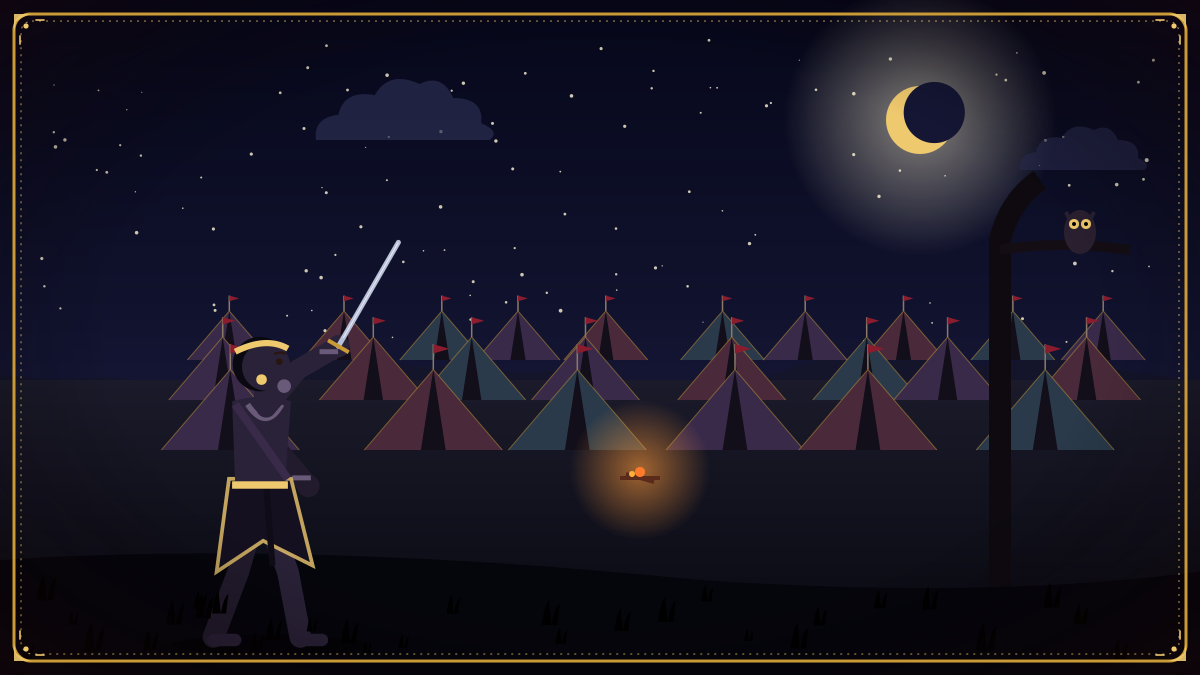
As he lay awake, he saw thousands of crows sleeping peacefully in the branches of the banyan tree. Suddenly a large, fierce owl with brown eyes swooped down silently. One by one it attacked the sleeping crows, and soon the ground was covered with them. Ashwatthama watched and thought, “This owl has taught me a lesson. The Pandavas are too strong to defeat in open battle. But at night, while they sleep, they cannot fight back.”
He woke Kripa and Kritavarma and told them his plan. Kripa was shocked. “My son, this is a great sin. Attacking people while they sleep, when they have put down their weapons, is against all the rules of war. Let us first go to Dhritarashtra, Gandhari and the wise Vidura and ask their advice. Do not do something that will bring shame on your name forever.”
But Ashwatthama would not listen. “The Pandavas broke the rules first,” he said. “Dhrishtadyumna killed my father while he sat in meditation with his weapons laid down. They struck Duryodhana below the waist. Why should I follow rules that they did not follow? Tonight I will kill Dhrishtadyumna while he sleeps.” He climbed into his chariot and set off. Kripa and Kritavarma, unwilling to leave him alone, followed him.
The Guardian at the Gate
When Ashwatthama reached the gate of the Pandava camp, he saw a huge, mighty being standing there, shining like the sun and the moon together. The being wore a tiger skin, snakes were wound around its body, and flames seemed to come from its mouth. From those flames appeared countless shining forms. The sight was so fearful that even the bravest heart would tremble.
Ashwatthama was not afraid. He shot arrows and hurled weapons at the being, but every weapon simply vanished into it, as rivers vanish into the ocean. Soon he had no weapons left. Then he remembered Kripa's words and thought, “Perhaps I should not have ignored good advice. When a person goes against what is right, even the gods stand against him.”
He decided to take refuge in Lord Shiva, the great god of gods. Ashwatthama bowed and sang Shiva's praises with deep devotion. A golden fire altar appeared before him, and he offered himself to the Lord, ready even to give his body into the fire. Pleased by his devotion, Lord Shiva appeared before him with a gentle smile.
Shiva said, “Krishna has always worshipped me with true devotion, and for his sake I have protected the Panchalas until now. But their time has come. They will live no longer.” Then Shiva gave Ashwatthama a shining sword and entered his body. Filled with the power of Lord Shiva, Ashwatthama entered the sleeping camp.
The Night of Sorrow
Ashwatthama went first to the tent of Dhrishtadyumna, who had killed his father. Dhrishtadyumna woke and begged, “Son of my teacher, kill me with a weapon, so that I may die as a warrior.” But Ashwatthama refused and took his life without any weapon, saying that a killer of his teacher did not deserve a warrior's death.
Then he went from tent to tent. Uttamaujas and Yudhamanyu, the brave Panchala princes who had guarded Arjuna's chariot wheels, fell one after another. The five young sons of Draupadi, Prativindhya, Sutasoma, Shrutakirti, Shatanika and Shrutasena, rushed out to fight bravely, but they could not stand before him. Shikhandi too fell that night, along with many Panchala and Matsya warriors.
Kripacharya and Kritavarma stood at the gate of the camp, and those who tried to escape could not get past them. The two also set fire to the camp in three places, so that the night became as bright as day. Many warriors said later that they had seen, in their dreams on the nights before, a dark goddess, Kalaratri, the night of death, leading the warriors away with a noose. Only Dhrishtadyumna's charioteer escaped to carry the terrible news.
At dawn the three warriors hurried back to Duryodhana, who was still breathing faintly. Ashwatthama said, “O king, the Panchalas are no more, and the sons of Draupadi are no more. On the Pandava side only seven are left: the five Pandavas, Krishna and Satyaki. On our side only we three remain.”
Hearing this, Duryodhana said, “What Bhishma, Drona and Karna could not do, you have done for me. Now I am at peace. May you be well. We shall meet again in heaven.” Saying this, the king who had once ruled the whole earth breathed his last. Sanjaya, who had been describing everything to Dhritarashtra, found at that moment that his divine sight had faded away.
Draupadi's Grief and the Brahmashira
When Dhrishtadyumna's charioteer told Yudhishthira what had happened, the king fell to the ground in grief. They had won the war, yet they had lost their sons. Nakula was sent to bring Draupadi from Upaplavya. When she saw the field and heard about her five sons and her brother, she cried out in a voice that broke every heart.
Draupadi said to Yudhishthira, “I will sit here and fast until death unless Ashwatthama is punished. He was born with a precious jewel on his forehead. Only if I see that jewel placed on your head will I keep my life.” Hearing this, Bhima took his bow and set out at once in his chariot, with Nakula driving, to find Ashwatthama.
Krishna said to Yudhishthira, “Bhima is in great danger. Ashwatthama knows the Brahmashira, a weapon that can burn the world. His father taught it to him, though he warned him never to use it against human beings. Once Ashwatthama even came to me at Dwarka and asked for my Sudarshana chakra, but he could not lift it. He is angry and reckless; he may do anything.” Krishna, Arjuna and Yudhishthira hurried after Bhima.
They found Ashwatthama on the bank of the Ganga, sitting among sages near Vyasa, wearing a garment of kusha grass. When he saw the Pandavas, with Krishna's chariot behind them, he was afraid. He took up a blade of grass, turned it into the Brahmashira with a mantra, and released it, saying, “Let this destroy the Pandavas!”
Krishna said to Arjuna, “Release your Brahmashira now to stop his.” Arjuna first prayed for the well-being of his brothers and of all the world, and then released his own weapon only to calm Ashwatthama's. The two blazing weapons rushed toward each other, and the sky caught fire. The earth shook, and all living beings were filled with fear. Then the sages Narada and Vyasa appeared and stood between the two weapons, shining like two great fires, to protect the worlds.
The Curse and the Jewel
The sages said, “Great heroes of the past knew these weapons but never used them against human beings. Why have you done this rash deed? Withdraw your weapons.” Arjuna folded his hands and at once called his weapon back. Only a person of pure heart and strict self-control could withdraw the Brahmashira after releasing it, and Arjuna was such a person.
Ashwatthama tried, but he could not withdraw his weapon. Ashamed, he said to Vyasa, “I cannot call it back. But I will turn it away from the Pandavas. Let it fall on the wombs of the Pandava women.” Vyasa told him, “Then do so, but give up the jewel on your forehead.” And Ashwatthama turned the weapon toward the unborn children of the Pandava family, including the child of Uttara, Abhimanyu's widow.
Krishna said firmly, “Your weapon will fall, but Uttara's child will live. A wise brahmin once said that when the Kuru family is nearly gone, a son named Parikshit will be born. I myself will bring that child back to life.” Then Krishna said to Ashwatthama, “Because of this cruel deed, you will wander the earth for three thousand years, alone, in lonely places, with no one to speak to, suffering from diseases.” Vyasa agreed with Krishna's words.
Ashwatthama said, “Let the words of the Lord come true.” He gave up the jewel from his forehead, which had protected him since birth from hunger, disease and fear. Then, sad and alone, he went away into the forest.
The Pandavas brought the jewel to Draupadi. Bhima said, “Here is the jewel. The one who killed your sons has been defeated. Now give up your fast.” Draupadi said, “My debt is paid. Let the king wear this jewel.” So Yudhishthira placed the jewel on his head, and Draupadi agreed to live. Later Krishna told Yudhishthira that Ashwatthama's deed had been possible only by Lord Shiva's grace.
Dhritarashtra and Gandhari
In Hastinapur, the old king Dhritarashtra sat crushed by sorrow, for all his hundred sons were gone. Vidura and Vyasa comforted him with words of wisdom about life and death. Then the blind king, with Gandhari, Kunti and all the royal women, set out for the battlefield. On the way the five Pandavas, with Krishna, came to bow before him.
Dhritarashtra embraced Yudhishthira, but his heart was still burning with anger against Bhima, who had killed so many of his sons. He said, “Where is Bhima? Let me embrace him.” Krishna understood what was hidden in the old king's heart. He gently moved Bhima aside and placed before Dhritarashtra the iron statue of Bhima that Duryodhana had used for practice. The king, with the strength of ten thousand elephants, crushed the statue in his arms.
Then he fell to the ground and cried, “Alas, Bhima!” thinking that he had killed him. Krishna said, “O king, do not grieve. That was not Bhima but an iron statue. I knew that you were filled with anger, and I did this to protect you from a great sin. Bhima is alive.” Dhritarashtra was ashamed of his anger. He wept, and then he embraced all the Pandavas with love.
Then the Pandavas went to Gandhari. She was full of grief and wanted to curse Yudhishthira. But Vyasa, knowing her mind, came before her first. “Daughter,” he said, “every day of the war, when Duryodhana came to ask for your blessing, you told him, ‘Where there is dharma, there is victory.’ Your words have come true. Do not let anger rule you now.” Gandhari answered, “I do not wish the Pandavas ill. But my heart is broken.” She asked Bhima why he had struck below the waist, and Bhima humbly explained his vow.
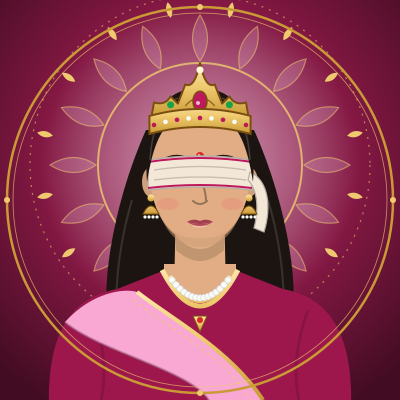
Yudhishthira came forward with folded hands and said, “Mother, I am the cruel one who has killed your sons. Curse me if you wish.” Gandhari said nothing, but from under the edge of the cloth over her eyes, her glance fell on the tip of his toe. At once his toenail turned dark and burnt. Seeing this, Arjuna quietly moved behind Krishna. Then Gandhari's anger passed, and she comforted them like a mother and sent them to meet Kunti.
The Field of Tears
Vyasa gave Gandhari the power to see the whole battlefield, even with her eyes covered. The women of both sides, mothers, wives and sisters, came to Kurukshetra searching for their loved ones, and the field was filled with weeping. Gandhari saw everything and spoke to Krishna about each fallen hero: her son Duryodhana, Dushasana, the gentle Vikarna, young Abhimanyu with Uttara weeping beside him, and Karna, mourned by his wife.
At last her grief became anger, and she said to Krishna, “You had the power to stop this war, but you let the Kurus and the Pandavas destroy each other. So hear my words: in the thirty-sixth year from now, your own family, the Yadavas, will destroy one another. You will die alone in the forest, and the women of your family will weep just as these women weep today.”
Krishna smiled gently and said, “Mother, I already knew this. The Yadavas cannot be defeated by anyone else; only they themselves can bring about their end. You have only spoken what was already going to happen.” The Pandavas were shocked to hear the curse, but Krishna accepted it calmly.
Then Yudhishthira had the funeral rites performed. Dhaumya, Vidura, Sanjaya and Yuyutsu gathered sandalwood and other wood, and great fires were lit for the fallen warriors of both sides, friend and enemy alike. Afterward everyone went to the bank of the holy Ganga to offer water for the souls of the dead.
As the Pandavas were offering water, Kunti could no longer keep her secret. Weeping, she said, “Offer water for Karna too. He was your eldest brother, my first son, born to me from the Sun god before I was married.” The Pandavas were stunned. Yudhishthira cried, “Why did you hide this from us, Mother? If we had known, this war might never have happened. I would gladly have served Karna as my king.” He offered water for Karna with great sorrow.
According to the Shanti Parva that follows, Yudhishthira was so hurt by this hidden secret that he said, “From today, women will not be able to keep a secret.” The kingdom was won, but the winners felt they had lost everything, and Yudhishthira's heart now wished to give up the throne itself.
Did you know?
- The Sauptika Parva, the “Book of the Sleeping Warriors”, is one of the shortest of the eighteen parvas, yet it tells of the darkest night in the whole epic.
- The gem on Ashwatthama’s forehead protected him from weapons, disease, hunger, gods and serpents, and he had to give it up after the night attack.
- Gandhari’s glance through a tiny gap in her blindfold was so powerful that it turned Yudhishthira’s toenails dark.
- The iron statue of Bhima that Dhritarashtra crushed had been made by Duryodhana himself, who used it to practise his mace fighting.
What this chapter teaches us
Ashwatthama let anger and revenge overrule good advice, and he paid with a lifetime of loneliness. Arjuna, by contrast, could call back his weapon because his heart was pure and controlled. In war there are no real winners: the mothers of both sides weep the same tears. Hidden truths, like Kunti's secret, can bring great sorrow when they come out too late.