Key moments
- The young Yadavas mock the sages; an iron pestle is born
- The Yadavas destroy each other with eraka reeds at Prabhasa
- Balarama leaves his body; a great serpent goes to the sea
- Jara's arrow strikes Krishna's foot; Krishna returns to his abode
- Dwarka sinks and the Kali Yuga begins
- Draupadi and four Pandavas fall on the way to Meru
- Yudhishthira will not leave the dog, who is Dharma
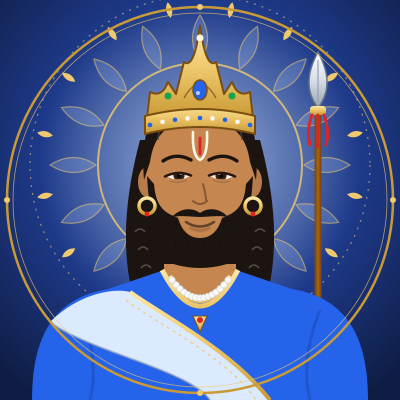
- Yudhishthira chooses hell with his brothers over heaven alone
Omens in Dwarka and the Iron Pestle
Thirty-six years after the war, Yudhishthira began to see strange signs: harsh winds, falling meteors, the sun dim at noon. In Dwarka the signs were even worse. A terrible dark figure, Time itself, was seen peeping into houses. Rats grew bold, cranes hooted like owls, and food went bad as soon as it was cooked. Krishna understood. Long ago, after the war, Gandhari had said in her grief that in the thirty-sixth year the Yadavas would destroy one another. Krishna knew that the time had come.
Some time before, the sages Vishvamitra, Kanva and Narada had come to Dwarka. A group of young Yadava princes, proud and careless, dressed Krishna's son Samba as a woman expecting a child. They brought him to the sages and asked, “This is the wife of Babhru, who longs for a son. Tell us, great ones, what will she give birth to?”
The sages saw through the mockery and grew angry. “This Samba,” they said, “will give birth to a terrible iron pestle, a musala, and with it you wicked and proud Yadavas will destroy your whole race, all except Balarama and Krishna.” The next day Samba did give birth to an iron pestle.
King Ugrasena, terrified, had the pestle ground into fine powder and thrown into the sea. A law was announced in Dwarka that no one should make or drink wine. But the iron powder washed back on the shore at Prabhasa, and there it grew into tall, hard reeds called eraka.
Krishna knew that the words of the sages and of Gandhari could not be changed. He announced that all the Yadavas should go on a pilgrimage to Prabhasa by the sea. They set out with their families, carrying food and drink.
The End of the Yadavas at Prabhasa
At Prabhasa the Yadavas held a great feast. Forgetting Krishna's warnings, many of them drank heavily, and soon old wounds came back to their minds. Satyaki laughed at Kritavarma: “What kshatriya kills men while they are asleep? You helped Ashwatthama do exactly that.” Pradyumna agreed with him.
Kritavarma answered angrily, “And you killed Bhurishrava when his arm was cut off and he was sitting in prayer to die!” Satyaki jumped up in fury and struck Kritavarma down in front of Krishna. Then the Bhojas and Andhakas, Kritavarma's people, attacked Satyaki. Pradyumna rushed to help him, and both of them fell.
Krishna, seeing his son killed, pulled up a handful of eraka reeds. In his hand they became an iron club. Then all the Yadavas began pulling up the reeds, and every reed became a club, as the sages' curse had said. Father fought son and friend fought friend, as if driven by Time. Krishna's sons and grandsons, the great warriors of his clan, all fell.
When Krishna saw that almost all were gone, he sent his charioteer Daruka to Hastinapur to bring Arjuna. He sent Babhru to guard the women, but on the way Babhru too was killed. Krishna then went into the city and told his father Vasudeva, “Protect the women until Arjuna comes. I am going to Balarama.”
Balarama and Krishna Return to Their Abode
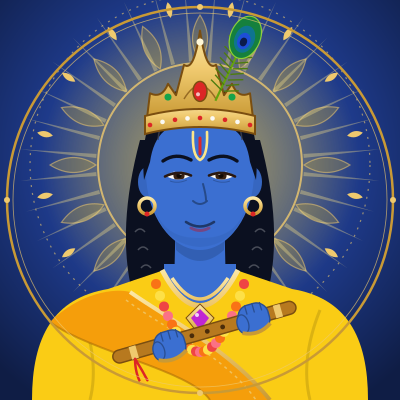
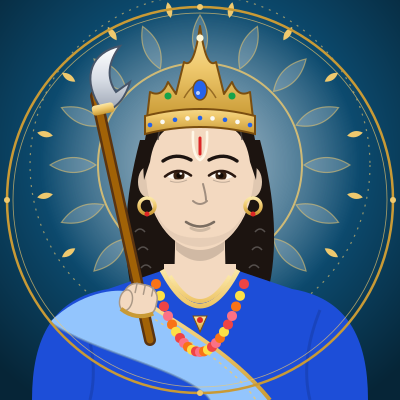
Krishna found Balarama sitting alone under a tree at the edge of the forest, deep in yoga. As Krishna watched, a great white serpent with a thousand heads and red eyes came out of Balarama's mouth and moved towards the sea. That was Shesha, the endless serpent, who had come to earth as Balarama. The ocean, the great Nagas and the sacred rivers came forward to welcome him back.
Krishna wandered for a while in the lonely forest. He remembered Gandhari's words and the words once spoken to him by the sage Durvasa, and he knew that it was time to leave. He lay down on the earth, controlled his senses, mind and speech, and entered deep yoga.
A hunter named Jara was passing that way. From a distance he saw Krishna's foot, mistook it for a deer, and shot an arrow that pierced the sole of his foot. When Jara ran up to catch the deer, he saw a radiant figure with four arms in yellow robes, absorbed in yoga. Trembling with fear, he fell at Krishna's feet and begged forgiveness.
Krishna comforted him with great kindness. Then he rose upward, filling the earth and sky with his light, and returned to his own eternal abode. Indra, the Ashvins, the Rudras, the Adityas, the Vasus, the sages and the celestial beings came to welcome him, and he entered his supreme home as Narayana.
Arjuna's Sorrow and the Sinking of Dwarka
Daruka reached Hastinapur with the news, and Arjuna hurried to Dwarka. The city looked like a widow, with no men left to protect it. Krishna's queens wept on seeing him, and Arjuna himself fell to the ground in grief. Old Vasudeva, Krishna's father and Kunti's brother, and so Arjuna's maternal uncle, embraced him and said, “The one who killed so many demons has gone. Krishna has told me that you will protect the women and children.”
The next morning Vasudeva gave up his life by yoga, and Devaki, Rohini, Bhadra and Madira chose to follow him. Arjuna performed his last rites. Then he went to Prabhasa, found the bodies of Krishna and Balarama, and performed their last rites too, with deep reverence.
On the seventh day Arjuna led the women, the children and the old people out of the city towards Indraprastha. As soon as they left, the sea rushed in and swallowed Dwarka, with its houses and palaces, in front of their eyes.
On the way, in the land of the five rivers, a band of Abhira robbers attacked them. Arjuna laughed at first and said, “Go away, if you value your lives!” But when he picked up his Gandiva, he could barely string it, and only with great effort. The divine weapons he had learned would not come to his mind. His quivers, which had never run out of arrows, were now empty. Many women were carried away before his eyes. With great sorrow Arjuna brought the rest to safety and settled Krishna's great-grandson Vajra as king at Indraprastha.
Heartbroken, Arjuna went to Vyasa. “Krishna is gone, and my strength has gone with him,” he said. Vyasa answered gently, “Do not grieve, my son. Krishna came to lighten the burden of the earth, and his work is done. Your weapons have done their work too. Time is the root of all things; it gives strength and takes it away. Now it is time for you and your brothers to go to the highest goal.” With Krishna's departure the Dwapara Yuga ended and the Kali Yuga began.
The Great Journey
When Yudhishthira heard what had happened, he said, “Time cooks all beings in its pot.” He decided that the Pandavas would leave the world. He crowned young Parikshit king of Hastinapur, gave Yuyutsu, his half-brother, charge of the kingdom, and asked Kripacharya to be the boy's teacher. Vajra was made king of Indraprastha, and Subhadra was asked to look after both young kings.
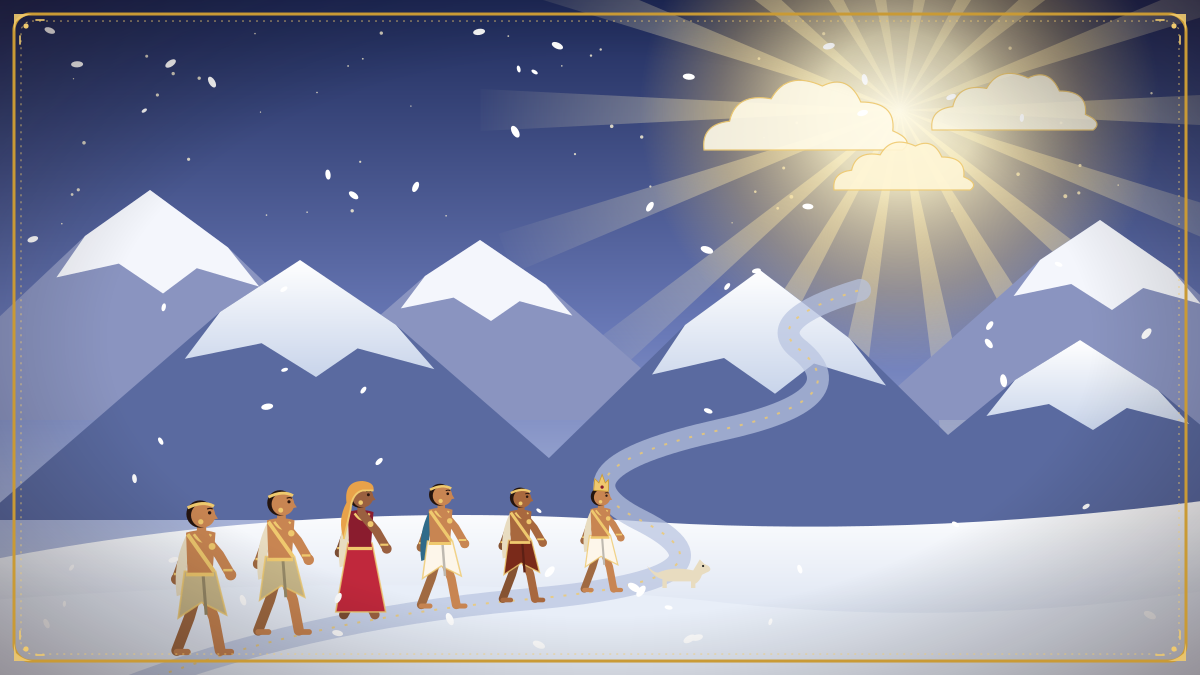
The five brothers and Draupadi took off their royal clothes and ornaments and put on bark garments. The people of the city followed them for a long way, weeping, but at last turned back. A dog joined them as they left the city and followed them all the way.
They walked east until they reached the sea. There Agni, the god of fire, stood before them like a mountain and said, “Arjuna, I brought you the Gandiva from Varuna for the war. Its work is done. Give it back to the waters.” Arjuna threw the great bow and his two endless quivers into the sea.
Then they walked south and west around the earth. They saw the place where Dwarka had stood, now covered by the sea. Turning north, they reached the Himalayas, crossed them, passed a great desert of sand, and saw before them Mount Meru, the king of mountains. They walked on in silence, their minds fixed on yoga.
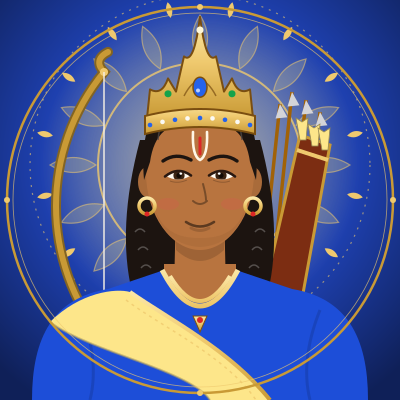
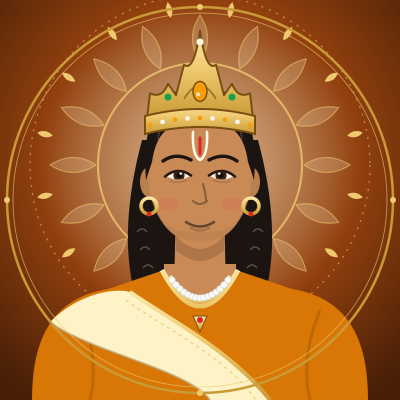
First Draupadi fell. Bhima asked, “She never did wrong. Why has she fallen?” Yudhishthira said, “She loved Arjuna more than the rest of us,” and walked on without looking back. Then Sahadeva fell. “He thought no one was as wise as he was,” said Yudhishthira. Then Nakula fell, “for he believed no one was as handsome as he was.” Then Arjuna fell. “He boasted that he would destroy all our enemies in one day, and did not, and he looked down on other archers.” Then Bhima himself fell and asked why. “You ate too much, and you were proud of your strength, without caring for others,” said Yudhishthira. Only Yudhishthira and the dog walked on.
The Dog and the Gates of Heaven
Then Indra, king of the gods, came down in his shining chariot. “Climb in, Yudhishthira,” he said. “You will enter heaven in this very body.” Yudhishthira said, “My brothers and Draupadi have fallen on the way. I do not wish to go without them.” Indra replied, “They have already reached heaven, having left their human bodies. Only you go with your body.”
Yudhishthira said, “This dog has been devoted to me all the way. Let him come with me.” Indra answered, “There is no place in heaven for a dog. Leave him; it is no sin.” But Yudhishthira said, “To abandon one who is devoted to me is as great a sin as killing a brahmin. I will never give up one who is frightened, who is devoted to me, who seeks my protection and who is weak, even to save my own life. I will not leave him, even for heaven.”
At once the dog changed form, and there stood Dharma himself, Yudhishthira's divine father. “My son,” he said with joy, “I tested you once before at the lake in the Dvaita forest, when you asked for Nakula's life rather than that of your own mother's son. Now you have given up even the chariot of the gods for a dog. There is no one in heaven equal to you.”
Then Yudhishthira climbed into Indra's chariot with Dharma and the gods and rose to heaven, while Narada and the sages praised him, saying that no king before had ever reached heaven in his own body.
Heaven, Hell and the Last Words of the Epic
In heaven the first person Yudhishthira saw was Duryodhana, seated in glory and shining like the sun. Yudhishthira turned away. “I do not want to share heaven with the man who brought Draupadi into the assembly hall and caused the death of our friends. Where are my brothers? Where are Draupadi and Karna?” Narada said gently, “Here in heaven old enmity ends. Duryodhana died fighting bravely as a kshatriya.” But Yudhishthira insisted, “Take me to my brothers.”
A heavenly messenger led him down a dark and gloomy path, full of frightening sights and bad smells, where souls suffered in many ways. Yudhishthira could not bear it and turned back. Then voices called out from all sides: “Son of Dharma, stay a little! When you are here, a cool breeze blows and our pain grows less.” He asked, “Who are you?” They answered, “I am Karna.” “I am Bhima.” “I am Arjuna.” “I am Nakula.” “I am Sahadeva.” “I am Draupadi.” Among them were Dhrishtadyumna and the sons of Draupadi too.
Yudhishthira's heart was torn. Then he told the messenger, “Go back to the gods. I will stay here. My being here gives my brothers comfort.” In that very moment the darkness vanished. Indra and the gods appeared, and the path became bright and fragrant. Indra said, “Every king must see hell. You deceived Drona with a half-truth about his son Ashwatthama, so you too were shown hell by an illusion. Your brothers also only seemed to be in hell. None of this was real.” Dharma added, “This was the third time I tested you, my son, and you have passed again.”
Yudhishthira bathed in the heavenly Ganga, and at once his human body fell away, and with it all grief and enmity. In a shining divine form he saw everyone in their true places. Krishna shone as Narayana, with Arjuna serving him. Karna shone with Surya, the sun god. Bhima stood with Vayu, Nakula and Sahadeva with the Ashvins, Abhimanyu with Soma, and Draupadi in the form of Shri, the goddess Lakshmi. Bhishma had returned to the Vasus, Drona sat beside Brihaspati, and Pandu was there with Kunti and Madri.
Here Vaishampayana ended the story he had been telling King Janamejaya at his great snake sacrifice. Janamejaya, Parikshit's son, completed the sacrifice, and the sage Astika saved the serpents. That is how this great story, composed by Vyasa, came down to us.
At the end, Vyasa speaks the Bharata-savitri: “I cry out with arms raised high, but no one listens. From dharma come wealth and the fulfilment of desire. Why then is dharma not followed? Never give up dharma out of desire, fear or greed, not even to save your life. Dharma is eternal; pleasure and pain pass away.” And as the epic says again and again, “Yato dharmas tato jayah”: where there is dharma, there is victory.
Did you know?
- The Mausala Parva takes its name from the musala, the iron pestle that the sages’ curse brought into the world.
- Before their last journey, Arjuna gave the Gandiva bow back to the sea at Agni’s request, returning it to Varuna, the god of the waters.
- Yudhishthira is the only Pandava who rode to heaven in his own human body, in Indra’s chariot.
- The Mahabharata is said to contain about one lakh verses, which is why it is also called the “Shatasahasri Samhita”, the collection of a hundred thousand verses.
What this chapter teaches us
Everything in this world, even the greatest kingdom, comes to an end; only dharma goes with us. Yudhishthira's refusal to abandon a humble dog shows that faithfulness and compassion open the gates of heaven. His choice to stay with his suffering brothers shows that love matters more than comfort. As Vyasa cries with raised arms, wealth and happiness come from dharma, so dharma must never be given up.