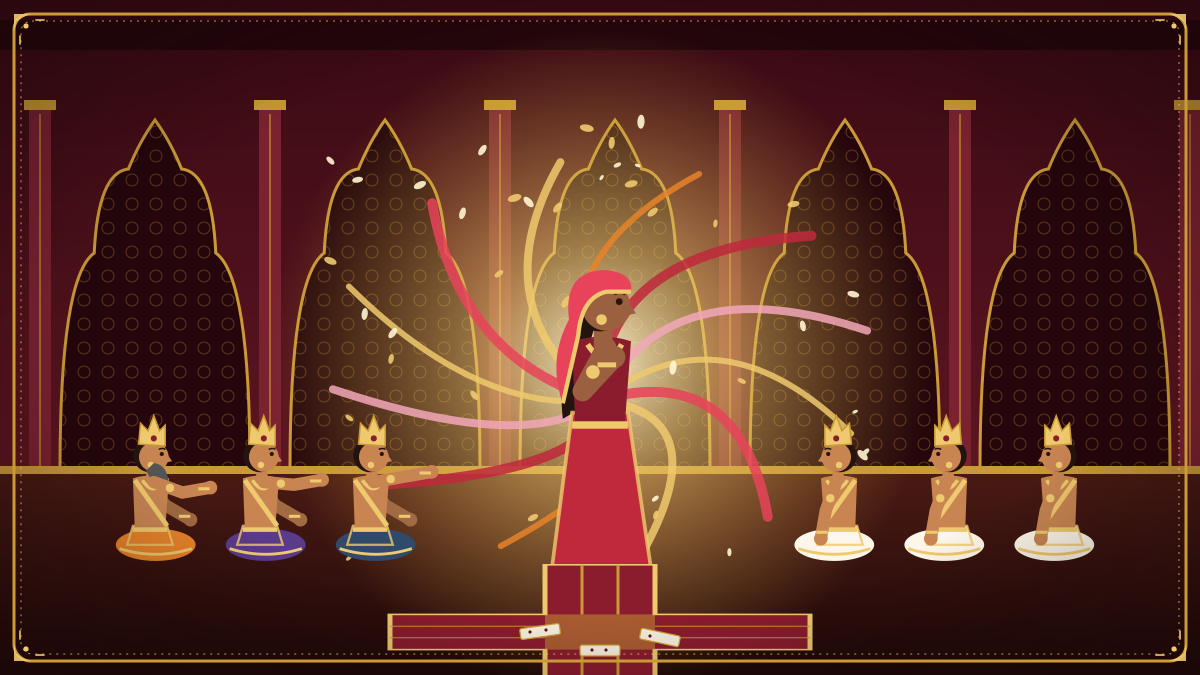
Vikarna was one of the hundred sons of King Dhritarashtra and Queen Gandhari, and so a younger brother of Duryodhana and Dushasana and a cousin of the Pandavas. He was a brave warrior, but he is remembered for something greater than his skill in battle: his sense of right and wrong. On the darkest day of the epic, when Draupadi was insulted in the royal court and even the great elders sat silent, Vikarna alone among the Kauravas stood up and spoke the truth. Yet he did not leave his brothers, and he fought on their side in the war until he fell.
One of the hundred
Vikarna was born from the same blessing of Vyasa as his brothers. When Gandhari’s lump of flesh was divided and kept in pots of ghee, a hundred sons and one daughter, Duhshala, were born. Vikarna was one of these hundred Kaurava princes.
He grew up in the palace of Hastinapur with his brothers and his Pandava cousins, the sons of his father’s younger brother Pandu. Like them he learned the arts of war from Kripacharya and Dronacharya, and he became a skilled archer and chariot-warrior.
The epic says little about his childhood. He comes to the front of the story only once, but at a very important moment, and that one moment has made him remembered for ever.
Draupadi’s question
In the game of dice Yudhishthira lost his wealth, his kingdom, his brothers and himself, and then staked and lost Draupadi. Dushasana dragged her into the court by her hair.
Standing before the assembly, Draupadi asked a question: Yudhishthira had already lost himself before he staked her, so did he still have any right to stake her? Was she truly won? She had already sent this same question through the attendant who first came to fetch her, but no one had answered it. Now she asked it again, in tears, before the whole court.
Bhishma said that the ways of dharma are subtle and he could not answer for certain. A man who has lost himself cannot stake what belongs to another, he said, yet a wife is under her husband’s authority; and Yudhishthira himself had not objected. The other kings and elders lowered their heads and stayed silent, out of fear of Duryodhana.
Vikarna speaks
Then Vikarna stood up. He asked the kings to answer Draupadi’s question, and when they did not, he said that whether they spoke or not, he would say what he believed to be right. He said that hunting, drinking, gambling and too much love of pleasure are the vices of kings, and a man caught in them does not act by dharma.
Yudhishthira, he said, had staked Draupadi while lost in gambling, only because Shakuni urged him, and after he had already lost himself. Draupadi was also the wife of all five brothers, not of Yudhishthira alone. “For these reasons,” said Vikarna, “I do not think Draupadi has been won.” A great cry of praise for Vikarna, and of blame for Shakuni, rose in the hall.
But Karna angrily stood up and told Vikarna he was only a boy speaking against his elders. He argued that Draupadi had been lost along with everything else, and the shouting drowned Vikarna’s words. The insult went on, but Vikarna’s speech remained as proof that one Kaurava, at least, had seen the truth.
A warrior for the Kauravas
When the Kauravas raided King Virata’s cattle in the Pandavas’ thirteenth year, Vikarna rode with them and was among the warriors whom Arjuna defeated.
Although he had spoken against the wrong done in the dice hall, Vikarna did not leave his brothers when the war came. He took his place in the Kaurava army at Kurukshetra and fought in many battles, first under Bhishma’s command for ten days and then under Drona’s.
He stood his ground as a warrior should. The epic remembers him as a prince who knew dharma, yet stayed with his family to the end.
His fall and Bhima’s regret
On the fourteenth day of the war, Bhima was fighting Karna fiercely. Duryodhana sent several of his brothers to rescue Karna, and Vikarna was among them. Bhima, who had vowed to slay all the sons of Dhritarashtra in battle, killed them one after another. Several of Vikarna’s brothers fell, and then Vikarna himself, fighting bravely to the end.
Then Bhima stopped and grieved. He said, “Vikarna, you knew dharma, yet you came to fight because it was your duty as a warrior. I had vowed to slay all of you in battle, and so I could not spare you.” Bhima, who rarely paused over a fallen Kaurava, mourned Vikarna openly. The memory of the dice hall, where Vikarna alone had spoken for Draupadi, made this death painful even for the warrior who had sworn to bring it about.
After the war, Gandhari saw Vikarna lying on the battlefield and wept for him. She remembered that he had been honoured by wise people, and grieved for his young wife sitting beside him.
Did you know?
- Vikarna was the only one of the hundred Kauravas who openly spoke for Draupadi in the dice hall.
- In his speech he gave reasons, such as that Yudhishthira had already lost himself before staking Draupadi.
- Bhima, who killed him, grieved for him and praised him as a man who knew dharma.
- Unlike his half-brother Yuyutsu, who joined the Pandavas, Vikarna stayed with his family to the end.
What we learn from Vikarna
Vikarna teaches us to speak the truth even when everyone around us is silent or against us. One honest voice matters, even if it is not heard at once. His story also shows how hard it can be to choose between love for family and doing what is right, and that even an enemy respects a person of dharma.
Vikarna in the story
Read the chapters where Vikarna plays a part.