Key moments
- Duryodhana poisons Bhima and throws him into the Ganga
- The Nagas’ nectar gives Bhima the strength of ten thousand elephants
- Drona lifts the ball from the well with blades of grass
- Arjuna sees only the bird and practises even in the dark
- Ekalavya offers his right thumb as guru-dakshina
- Arjuna saves Drona from a crocodile and receives Brahmashira
- Duryodhana makes Karna king of Anga at the tournament
Growing up together in Hastinapur
After King Pandu’s death, the sages brought Kunti and her five young sons back to Hastinapur. There the five Pandavas grew up in the same palace as their hundred cousins, the sons of the blind King Dhritarashtra, who are called the Kauravas. Grandfather Bhishma watched over all of them with equal love.
Among all the boys, Bhima, the second Pandava, was the strongest by far. In play he would catch the Kaurava boys by their hair and drag them along, or hold ten of them under the water at once until they gasped for air. When they climbed a tree to pick fruit, Bhima would kick the trunk so hard that the boys tumbled down along with the fruit.
Bhima did all this out of boyish high spirits, not out of hatred. But Duryodhana, the eldest Kaurava, began to burn with jealousy. He thought, “This Bhima is too strong. As long as he lives, my brothers and I will never be safe, and the kingdom will slip away from us.” From that thought came a wicked plan.
Duryodhana had pleasure-houses built on the bank of the Ganga at a place called Pramanakoti, with tents of fine cloth and many kinds of food and drink. He invited all the princes to come and play in the water. While they were eating, he secretly mixed a deadly poison into Bhima’s food, and with a smiling face he fed it to Bhima with his own hands, as if out of great love.
After playing in the river all day, Bhima felt tired and heavy, and he lay down on the bank. The poison spread through his body and he fell unconscious. Then Duryodhana tied him up with creepers and pushed him into the deep waters of the Ganga. When the princes returned to Hastinapur that evening, Duryodhana was glad in his heart, thinking his rival was gone forever.
Bhima in the land of the Nagas
Bhima sank down and down until he reached the realm of the Nagas, the serpent people who live beneath the waters. Many young serpents rushed at him and bit him again and again. But here something wonderful happened: the serpents’ venom fought against the poison in Bhima’s body and drove it out. Bhima woke up, broke free of the creepers, and began to throw the serpents about.
The frightened serpents ran to their king, Vasuki. Vasuki came to see this mighty boy, and with him came an old Naga named Aryaka. Aryaka recognised Bhima at once and embraced him with joy, for Aryaka was the maternal grandfather of Kunti’s father, Shura. Bhima was his own family. Vasuki was pleased and asked, “What gift shall we give him? Shall we give him gold and jewels?”
Aryaka said, “Great king, if you are pleased, let him drink the nectar kept in our pots, for in each pot is the strength of a thousand mighty serpents.” Bhima sat facing the east and drank pot after pot, eight in all, each in a single breath. Then he lay down on a soft bed and slept for eight days. When he woke, the Nagas told him, “You have drunk the nectar that gives the strength of ten thousand elephants. Now no one will defeat you in battle.” They bathed him, dressed him in white and sent him home.
Meanwhile in Hastinapur, Kunti was sick with worry. When the princes had come back without Bhima, she searched everywhere and then called Vidura, the wise younger brother of the king. In a low voice she said, “Bhima has not come home. Duryodhana is cruel and wants the throne. I fear he has harmed my son.”
Vidura gently replied, “Do not say such things aloud, good lady. If Duryodhana is accused, he may try to harm your other sons too. The great sage Vyasa has said that your sons will live long. Bhima will surely come back and make you happy.” Kunti waited with an aching heart, and on the ninth day Bhima walked in, stronger than ever. He told his mother and brothers everything. Yudhishthira said, “Tell no one. From now on, let us guard one another carefully.” Duryodhana tried again to poison Bhima, but Yuyutsu, a kind-hearted son of Dhritarashtra, warned the Pandavas, and Bhima digested even that poison without harm.
Kripa and the coming of Drona
Bhishma saw that the princes were growing up, and he wanted them to learn the use of weapons. Their first teacher was Kripacharya. Kripa had a wonderful birth. His father, the sage Sharadvan of the line of Gautama, was a great master of archery. From him twins were born in a clump of reeds. King Shantanu, out hunting, found the two babies and took them home out of kripa, which means compassion. So the boy was named Kripa and the girl Kripi. Kripa learned all of archery from his father and became the royal teacher.
But Bhishma wanted an even greater master for his grandsons. One day the princes were playing with a ball outside the city when it fell into a dry well. Then a ring also fell in, and no one could get them out. A thin, dark Brahmin, who had just finished his prayers, watched them and smiled. He said, “Shame on your warrior skill, princes of the Bharata line, that you cannot lift a ball out of a well!”
He took a handful of strong grass blades and, using the power of mantras, threw one blade at the ball so that it pierced it, then threw another that pierced the first, and another, until a long chain of grass reached the top. He pulled up the ball. Then he took up his bow and shot an arrow that brought up the ring as well. The amazed boys bowed to him and asked who he was. He said, “Go and describe me to Bhishma. He will know.”
Bhishma knew at once that this was Drona. Drona was the son of the great sage Bharadwaja; he was called Drona because he was born in a drona, a vessel. He had learned the science of weapons from his father and from the sage Agnivesha. He had married Kripi, the sister of Kripa, and they had a son named Ashwatthama. When Drona heard that Lord Parashurama was giving away all his wealth to Brahmins, he went to him, but by then only Parashurama’s weapons were left. Drona humbly asked for them, and Parashurama gave him all his divine weapons along with the knowledge of how to use them.
Even so, Drona remained very poor. One day little Ashwatthama saw rich children drinking milk and cried for some. Other boys gave him rice flour mixed in water, and he danced with joy, saying, “I have drunk milk!” Drona’s heart broke. He remembered Drupada, his childhood friend at Bharadwaja’s hermitage, now king of Panchala. As boys, Drupada had said he would share his kingdom with him. But when Drona went to King Drupada and said, “I am your friend,” Drupada answered proudly, “A king can never be the friend of a poor man. Friendship is only between equals.” Deeply hurt, Drona came to Hastinapur to find pupils worthy of his skill. Bhishma welcomed him with great honour and placed all the princes in his care.
Drona’s pupils and Arjuna’s devotion
On the very first day, Drona gathered the princes and said, “I have a task in my heart. When you have learned the use of weapons, promise that you will do it for me.” All the princes stayed silent. Only Arjuna stepped forward and said, “Gurudev, I will do it.” Drona embraced him with tears of joy, and from that day Arjuna was especially dear to him.
Many princes came to learn from Drona, including the Vrishnis and the Andhakas. Karna, known as the son of the charioteer Adhiratha, also studied there. Karna always tried to outdo Arjuna, and he took Duryodhana’s side against the Pandavas. Each prince chose his own skill: Bhima and Duryodhana became masters of the mace, Nakula and Sahadeva of the sword, Yudhishthira of the chariot, and Ashwatthama learned the deepest secrets of the weapons. But in every skill Arjuna stood first.
Arjuna’s eagerness knew no limit. Drona gave the other boys wide-mouthed pots to fill with water, but gave his own son a narrow-mouthed pot so that Ashwatthama would return early and get extra lessons. Arjuna noticed this and filled his pot quickly with the Varuna weapon, so he too was never left behind. One night, while Arjuna was eating, the wind blew out the lamp, yet his hand still found his mouth in the dark. He thought, “Practice is everything,” and from then on he practised archery even at night. Drona heard the twang of his bowstring and said, “I will see to it that no archer in the world is your equal.”
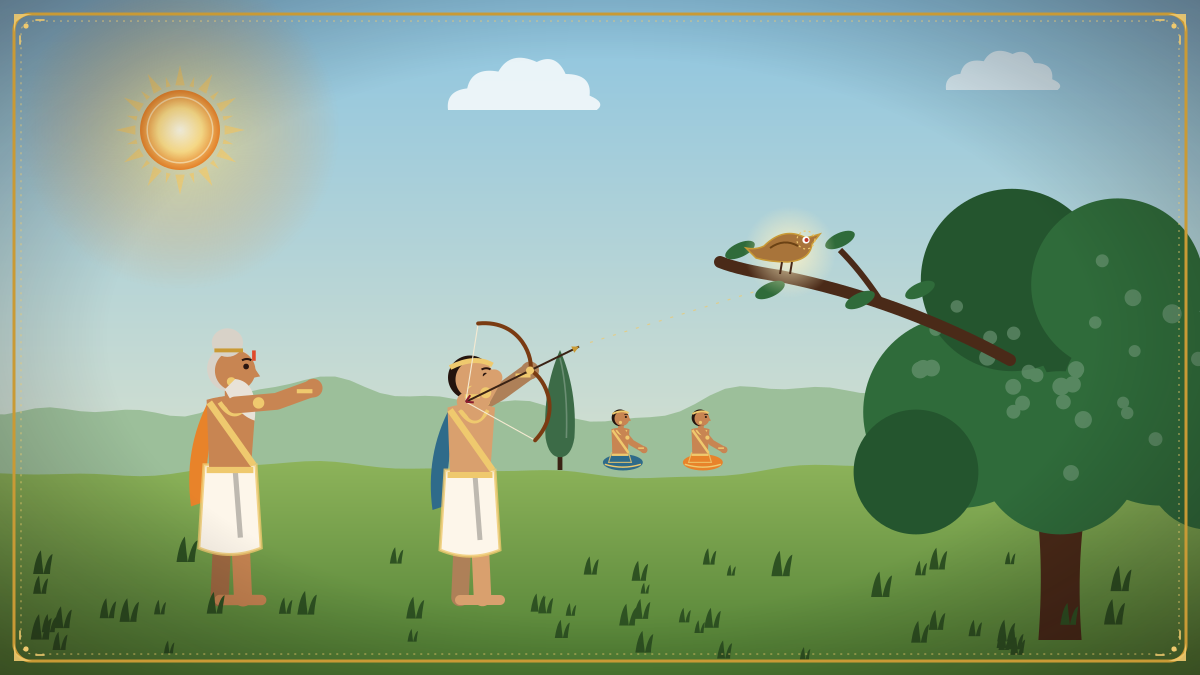
One day Drona had a wooden bird placed high on a tree and called the princes. “Aim at the bird,” he said, “and shoot when I tell you.” He asked Yudhishthira first, “Do you see the tree, the bird, me and your brothers?” “Yes, I see all of them,” said Yudhishthira. “Then step aside; you cannot hit this target,” said Drona. Each prince in turn said he saw many things, and each was sent away.
Then Arjuna drew his bow. “What do you see?” asked Drona. “I see only the bird. I do not see the tree, or you.” “Describe the bird.” “I see only its head, not its body.” “Shoot!” said Drona, and Arjuna’s arrow cut off the bird’s head. Later, when a crocodile seized Drona’s leg while he was bathing in the Ganga, the other princes stood confused, but Arjuna instantly killed it with five arrows. Pleased, Drona gave him the mighty weapon Brahmashira, warning him never to use it against ordinary human beings.
Ekalavya’s devotion
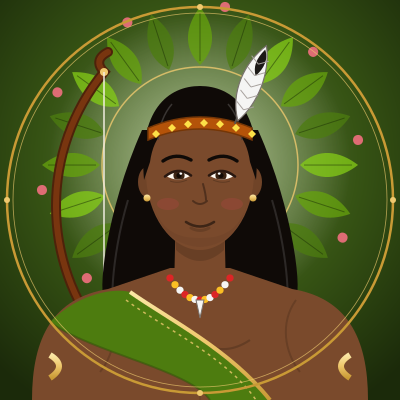
Word of Drona’s teaching spread far and wide. One day a young man named Ekalavya came to him. He was the son of Hiranyadhanu, king of the Nishadas, a forest people. Ekalavya bowed at Drona’s feet and asked to become his pupil. But Drona, thinking of the princes whose teacher he was, refused him because he was a Nishada. Ekalavya touched Drona’s feet once more and went back into the forest.
There he made an image of Drona out of clay and accepted that image as his guru. Every day he worshipped it with deep faith and practised archery before it with full attention. Because of his devotion and hard work, he became an archer of amazing speed and skill.
One day the princes went hunting in that forest with a dog. The dog wandered off and began barking at Ekalavya, who was dark, had matted hair and wore a deer-skin. Before the dog could close its mouth, Ekalavya shot seven arrows into it, all at once, filling its mouth without killing it. When the dog came back, the princes were astonished and went looking for the archer. Ekalavya told them, “I am Ekalavya, son of the Nishada king, a pupil of Drona.”
Arjuna was troubled. Privately he said to Drona, “You told me that no pupil of yours would ever be greater than me. But here is another pupil of yours who is greater.” Drona went with Arjuna to the forest. Ekalavya came running, bowed and stood with folded hands. Drona said, “If you are truly my pupil, give me my guru-dakshina, the teacher’s fee.” “Ask for anything, Gurudev,” said Ekalavya.
Drona said, “Give me the thumb of your right hand.” Without a moment’s hesitation and with a cheerful face, Ekalavya cut off his right thumb and placed it before his guru. After that he could shoot only with his fingers, and he was no longer as swift as before. Drona’s word to Arjuna was kept. Ekalavya’s devotion to his guru is remembered to this day with deep respect and also with sorrow.
The great tournament
When the princes’ training was complete, Drona told King Dhritarashtra, “Your sons and the sons of Pandu have finished their studies. With your permission, let them show their skill.” The king happily agreed and asked Vidura to make the arrangements. On a level, open ground a great arena, the rangabhumi, was built, with grand stands for the royal family and the citizens.
On the appointed day the whole city came. Bhishma, Kripa and the king sat in their places; Gandhari and Kunti watched from the ladies’ stand. Drona entered dressed in white, walking beside his son Ashwatthama. Then the princes, led by Yudhishthira, showed their skill with the bow, on horses, on elephants and on chariots, and the crowd cheered.
Then Bhima and Duryodhana came into the arena, maces in hand, roaring like two mighty bulls. What began as a display soon became real anger, and the crowd split into two sides, shouting for one or the other. Drona saw the danger and sent Ashwatthama to stop them, and the two were separated, still glaring at each other.
Then Drona announced, “Now see Arjuna, who is dearer to me than my own son!” Arjuna showed the wonders of divine weapons. With the fire weapon he made fire, with the Varuna weapon water, with the Vayavya weapon wind, and with another he became invisible. He shot five arrows into the mouth of a moving iron boar, and twenty-one arrows into the hollow of a swinging cow’s horn. The people were filled with wonder.
Karna enters the arena
Just as the show was ending, a sound like thunder was heard at the gate: a warrior was slapping his arms in challenge. In strode a tall, shining young man, wearing golden armour and earrings that had been part of his body since birth. It was Karna. He said, “Arjuna, I will do every feat you have done, and better.” With Drona’s permission he repeated every one of Arjuna’s feats. Duryodhana was overjoyed and embraced him.
Karna said, “I want to fight Arjuna in single combat.” Arjuna replied angrily, and the two stood ready to fight. At that moment Kunti recognised her first-born son by his armour and earrings, and she fainted. Vidura had the maids revive her with sandal-water, but she could say nothing of her secret.
Then Kripacharya stepped between them and said, “This is Arjuna, son of Pandu and Kunti, of the Kuru line. Tell us your mother, your father and your royal family. A prince does not fight with one whose lineage is unknown.” Karna lowered his face, like a lotus bent by rain. Duryodhana sprang up: “Royal rank comes from noble birth, from courage, or from leading armies. If Arjuna will fight only a king, I make Karna king of Anga this very moment!” And there in the arena Karna was anointed with gold pots of water, grains and flowers.
Karna asked, “King, what can I give you in return for this kingdom?” Duryodhana said, “I want only your friendship, for ever.” Just then old Adhiratha, the charioteer, came in trembling, leaning on his stick. Karna, his hair still wet from the royal bath, at once bowed his head at his father’s feet, and Adhiratha embraced him with love. Seeing this, Bhima mocked, “Son of a charioteer, you are not fit to die by Arjuna’s hand. Pick up a whip, as suits your family. You no more deserve Anga than a dog deserves the offering of a yajna!”
Karna’s lips trembled; he sighed and looked up at the sun. Duryodhana rose like an angry elephant and said, “Bhima, you should not speak like this. The origins of heroes and of rivers are hard to know. Kripa was born in a clump of reeds and Drona in a vessel. Could a common woman give birth to one shining like the sun, with armour and earrings? Karna deserves to rule the whole earth, not just Anga.” Then the sun set. Duryodhana took Karna by the hand and led him out by the light of lamps. From that day Karna and Duryodhana were friends for life, and the rivalry between Karna and Arjuna had begun.
Did you know?
- Drona’s name means “vessel”, because he was born in a vessel, not in the usual way.
- Kripacharya and his twin sister Kripi were found as babies in a forest by King Shantanu. Kripi later married Drona and became the mother of Ashwatthama.
- When Arjuna saved Drona from a crocodile in the Ganga, Drona rewarded him with the divine weapon Brahmashira.
- In Nagaloka, Bhima drank eight bowls of divine drink, each with the strength of a thousand elephants, and then slept for eight days.
What this chapter teaches us
Arjuna’s story shows that success comes from steady practice and a mind fixed on one goal. Ekalavya teaches that true devotion to a guru can overcome every obstacle. Karna’s pain in the arena reminds us that a person’s worth is not decided by birth. And Duryodhana’s jealousy shows how a small spark of envy, if fed, can grow into a fire.