Key moments
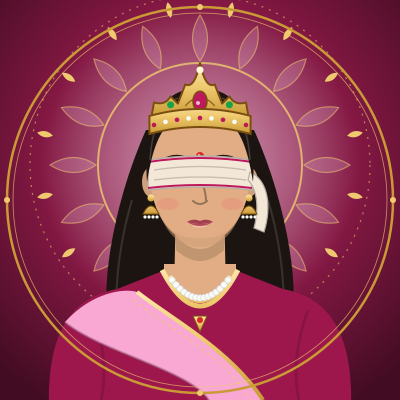
- Gandhari blindfolds herself for life to share her husband's darkness
- Sage Durvasa gives Kunti a mantra to call any god
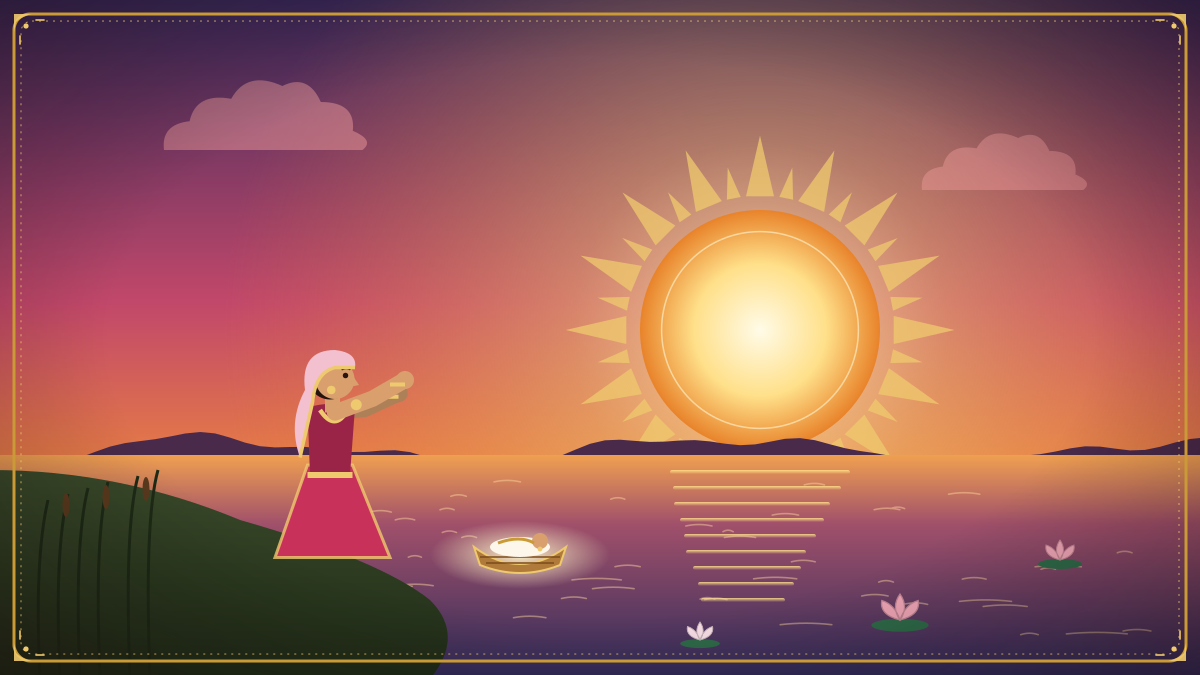
- Baby Karna floats away and is raised by Adhiratha and Radha
- Sage Kindama's curse sends Pandu to the forest as an ascetic
- Dharma, Vayu and Indra bless Kunti; the Ashvins bless Madri with twins
- Vyasa divides Gandhari's unborn child into a hundred and one pots
- Duryodhana is born amid ill omens, on the same day as Bhima
- Pandu dies in spring, and Madri follows him into the fire
Gandhari, the Blindfolded Bride
The three princes grew into fine young men. Because Dhritarashtra was born blind and Vidura was the son of a maid, the elders decided that Pandu should be king. Now Bhishma turned to the task of finding wives for the princes, so that the Kuru family would grow strong again.
Bhishma heard of Gandhari, the daughter of King Subala of Gandhara. She was good and devoted, and she had worshipped Lord Shiva, who had blessed her with the boon of a hundred sons. Bhishma sent messengers to King Subala asking for her hand for Dhritarashtra. Subala hesitated at first because the prince was blind, but thinking of the fame, wealth and goodness of the Kuru family, he agreed.
When Gandhari learned that her husband-to-be could not see, she took a cloth, folded it many times and tied it over her eyes. Out of devotion to her husband, she resolved, “I will not enjoy what my husband cannot see.” From that day on she lived with her eyes covered.
Gandhari's brother Shakuni brought her to Hastinapur with great wealth and handed her over to the Kurus. Bhishma welcomed them with honour, and the wedding took place. Then Shakuni returned to his own kingdom. Gandhari won everyone's heart in her new home by her good conduct and her respect for the elders. Later Bhishma also arranged Vidura's marriage, to a daughter of King Devaka.
Kunti and the Son of the Sun
Among the Yadavas there was a great king named Shurasena, whose son was Vasudeva, the father of Lord Krishna. Shurasena also had a daughter named Pritha, whose beauty had no equal. Long before, he had promised his childless cousin and friend, King Kuntibhoja, that he would give him his firstborn child. Keeping his word, he gave little Pritha to Kuntibhoja, who raised her as his own. So she came to be known as Kunti.
One day the great sage Durvasa, famous for his fiery temper, came to stay at Kuntibhoja's palace. Kunti was given the duty of serving him. She looked after him with such patience and care that the sage, who was very hard to please, was fully satisfied. Through his inner sight Durvasa saw that she would one day face trouble in having children, so he gave her a special mantra. “With this mantra,” he said, “you can call any god you wish, and by his grace you will receive a son.”
Kunti was young and curious. After the sage left, she wondered whether the mantra was really so powerful. One morning she looked at the rising sun and spoke the mantra. At once Surya, the sun god, stood before her in shining form. Kunti was frightened and begged him to go back, but Surya said the mantra could not go in vain, and he promised that she would remain a pure maiden. By his blessing a radiant baby boy was born, wearing golden armour (kavach) and earrings (kundal) that were part of his body.
Kunti loved the child, but she was unmarried and afraid of what people would say. With a heavy heart she laid the baby in a basket, closed it carefully and set it afloat on the river. Weeping, she prayed to the gods to protect him, and the basket floated away. It was carried from river to river until it reached the Ganga.
Near the city of Champa, the basket was found by Adhiratha, a charioteer, and his wife Radha, who had no children. When they opened it and saw the glowing baby, they were filled with joy and thanked the gods. They raised the child as their own and named him Vasusena, because he was born with armour and riches. He was also called Radheya, the son of Radha. Later the world would know him as Karna. He grew up never knowing that he was Kunti's eldest son.
Pandu the Conqueror and the Curse of Kindama
When Kunti grew up, King Kuntibhoja held a swayamvara for her. Many kings gathered, but Kunti placed the garland around the neck of Pandu, the brave and handsome king of the Kurus. Pandu brought her to Hastinapur with honour. Soon after, Bhishma went to Madra and asked King Shalya for the hand of his sister Madri for Pandu. By the old custom of the Madra family a bride-price had to be paid, so Bhishma gave rich gifts of gold, jewels, elephants and horses, and brought Madri home as Pandu's second wife.
Pandu was a great warrior. He set out on a campaign of victory and defeated the kings of Dasharna, Magadha, Videha, Kashi and many other lands, bringing huge treasures back to Hastinapur. People said that the glory of King Shantanu and King Bharata had returned. Pandu offered the wealth to Bhishma, to Satyavati, to his mothers and to Dhritarashtra, and everyone rejoiced.
After his victories Pandu went with Kunti and Madri to live in the forest on the southern slopes of the Himalayas, enjoying the beauty of nature and hunting. Dhritarashtra looked after the affairs of Hastinapur, and everything Pandu needed was sent to him in the forest. One day Pandu saw a pair of deer together and shot them with his arrows.
But the deer was really a sage named Kindama, who had taken the form of a deer with his wife. As he lay dying, he spoke in a human voice: “Even cruel men do not strike creatures at such a moment. You are born in a noble family, yet you have done this. Because of it, if you ever come close to your wife in love, you too will die at once.” Then the sage left his body.
Pandu was filled with grief and regret. He decided to give up royal life and live as an ascetic. He sent his jewels and royal robes back to Hastinapur with a message: “Pandu has gone to the forest as a hermit.” Kunti and Madri refused to leave him. “We will do tapasya with you,” they said. So the three went deep into the forest and lived on the holy mountain Shatashringa among the sages, serving them and living simply.
The Five Sons of Pandu
Living among the sages, Pandu carried one sorrow: “A man without children cannot repay his debt to his ancestors.” He spoke to Kunti and asked her to have sons through the blessing of a worthy sage. Then Kunti told him her secret: “When I was a girl I served Sage Durvasa, and he gave me a mantra with which I can call any god. With your permission, I will call a god now.”
Pandu was overjoyed. “First call Dharma, the god of righteousness,” he said, “for a son of Dharma will never turn away from what is right.” Kunti called Dharma, and Yudhishthira was born. At his birth a voice from the sky said, “This child will be the best of those who follow dharma. He will be truthful, generous and famous in the three worlds.”
Then Pandu said, “Warriors say that strength is the greatest gift. Ask for a son of great strength.” Kunti called Vayu, the wind god, and Bhima was born. Once, when baby Bhima lay in Kunti's lap, a tiger appeared and she jumped up in fright. The baby fell onto a rock, but it was the rock that broke into pieces, and the child was unhurt! On the very day Bhima was born, Duryodhana was born in Hastinapur.
Next Pandu wished for a son who would be the greatest in the world. He did tapasya for a whole year to please Indra, the king of the gods, and then Kunti called Indra. Arjuna was born. A voice from heaven announced, “This child will be as mighty as Indra himself. He will conquer many kings and bring glory to his family.” The sages rejoiced, and flowers rained down from the sky.
Madri felt sad that she had no children, and she asked Pandu to speak to Kunti for her. Kunti kindly gave Madri the mantra for one use. Madri thought carefully and called the twin Ashvini gods, the divine healers, and she gave birth to twins, Nakula and Sahadeva, who were very handsome. When Pandu asked Kunti again for Madri, Kunti said, “She called two gods with one call and outwitted me. Please do not ask me again.” So Pandu had five sons, born of the blessings of the gods. They are called the Pandavas.
Gandhari's Hundred Sons
Meanwhile in Hastinapur, Gandhari had once welcomed Sage Vyasa when he came to the palace tired and hungry, and she served him with great care. Pleased, Vyasa blessed her with a hundred sons. Soon Gandhari was expecting a child. But one year passed, then two, and still the children were not born.
Then news came that Kunti had given birth to a son, Yudhishthira, bright as the morning sun. Gandhari was filled with sorrow and frustration. Without telling her husband, she struck her womb, and what was born was a hard mass of flesh, like a ball of iron. She was about to have it thrown away when Sage Vyasa came to her. “What have you done, daughter of Subala?” he asked. Gandhari wept and told him everything.
Vyasa said, “My words never prove false.” He had a hundred pots filled with ghee and placed in a safe, hidden place. Cool water was sprinkled on the mass, and it divided into a hundred and one pieces, each the size of a thumb. Each piece was placed in a pot. Gandhari had quietly wished for a daughter too, and the hundred-and-first piece fulfilled that wish. The pots were carefully guarded, and Vyasa told them to open them only when the time came.
When the time came, Duryodhana was born first. At his birth the baby cried out like a braying donkey, and many bad omens appeared: donkeys, jackals and crows cried, fierce winds blew, and fires broke out in many places. Worried, Dhritarashtra called Bhishma, Vidura and the brahmins and asked, “Yudhishthira is the eldest prince. After him, will my son become king?” Vidura and the wise brahmins said, “These signs mean this son will bring ruin to the family. For the good of all, give him up. To save a family, one may be given up; to save a village, a family.” But Dhritarashtra loved his son too much and would not listen.
Within a month all hundred sons were born, and after them a daughter, Duhshala, who later married King Jayadratha of Sindhu. The second son was Dushasana. These hundred brothers are called the Kauravas. During the long time when Gandhari was expecting, a Vaishya maid served Dhritarashtra, and she gave birth to a son named Yuyutsu. He grew up wise and good, and in the great war he would choose the side of dharma.
Spring in the Forest
In the forest the five Pandava boys grew up among the sages, strong and happy. Pandu loved them dearly, and the sages taught them. Many years passed in peace. Then one day, in the season of spring, when the forest was full of flowers and birdsong, Pandu was walking alone with Madri, who was dressed in fine clothes.
Seeing Madri in that lovely season, Pandu forgot the sage's curse. Madri tried to stop him, but he did not listen. As soon as he came close to her, the curse came true, and Pandu died at once. Madri cried out in grief. Kunti came running with the children, and when she saw what had happened, she too was overcome with sorrow.
Both queens wished to follow their husband on the funeral fire. Kunti said, “I am the elder wife; I will go with him.” But Madri said, “He left this world because of his love for me, so I must go with him. You raise the children. I could not care for your sons as well as you will care for mine.” She placed Nakula and Sahadeva in Kunti's arms and entered the fire with her husband. Kunti kept her promise and loved the twins as dearly as her own sons.
The sages of Shatashringa then decided to take Kunti and the five boys to Hastinapur. They brought them, along with the remains of Pandu and Madri, to the gates of the city. Bhishma, Satyavati, Dhritarashtra, Vidura, Gandhari and all the people came out to meet them. The sages said, “These are the sons of Pandu. Raise them with love,” and then they vanished. The kingdom mourned Pandu, and his last rites were performed with honour.
Soon after, Sage Vyasa told his mother Satyavati, “The happy days are over. Hard times are coming for this family. Go to the forest and spend your days in prayer.” Satyavati went to the forest with Ambika and Ambalika, and there in time they left this world. Now the five Pandavas and the hundred Kauravas would grow up together in Hastinapur under Bhishma's care, as cousins, but not as friends.
Did you know?
- Karna’s first name was Vasusena, “born with wealth”, because he came into the world wearing golden armour and earrings.
- Bhima and Duryodhana, the two great rivals of the epic, were born on the very same day.
- Dhritarashtra had one more son, Yuyutsu, born to a maid of the palace. In the great war he left the Kauravas and fought on the side of the Pandavas.
- Duhshala, the only sister of the hundred Kauravas, later married Jayadratha, the king of Sindhu.
What this chapter teaches us
Kunti's fear made her give up her firstborn, and that hidden secret would bring great pain later. Pandu's one careless arrow changed his whole life, teaching us to act with thought and compassion. Gandhari's blindfold shows deep loyalty, yet parents must also keep their eyes open to guide their children. And Dhritarashtra ignored wise advice out of blind love, a mistake that would cost the family dearly.