Key moments
- Ganga's condition: never stop me, never speak harshly
- Seven sons go into the river; the eighth is saved
- The Vasus are cursed for stealing Vasishtha's cow Nandini
- Devavrata stops the Ganga with a wall of arrows
- Dasharaja demands that Satyavati's son become king
- Devavrata renounces the throne and vows lifelong celibacy
- Gods shower flowers and name him Bhishma
- Shantanu grants him death only by his own wish
Ganga's condition
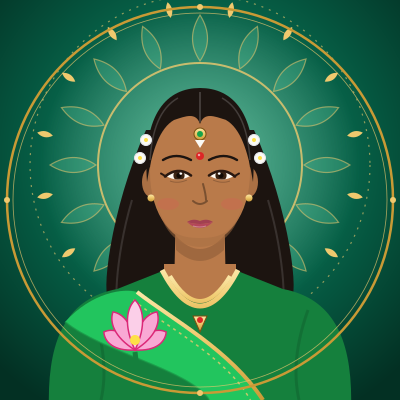
One day King Shantanu was walking alone along the bank of the Ganga. There he saw a young woman of dazzling beauty, glowing like the goddess Lakshmi herself. Shantanu was filled with wonder and love, and the woman too looked at the king with affection. Gently he asked her, “Are you a goddess, a gandharva maiden or an apsara? Whoever you are, please become my wife.”
The woman was Ganga herself, though she did not reveal it. She remembered her promise to Pratipa and replied, “O King, I will become your wife. But whatever I do, whether it seems good to you or bad, you must never stop me and never speak harshly to me. The day you stop me or speak unkindly, I will leave you at once.”
Shantanu remembered his father's words and gave his promise. Ganga became his queen, and they lived happily in Hastinapur. The king was delighted by her good nature, her beauty and her service, and the years passed like days.
Then a son was born to them. But as soon as the baby was born, Ganga carried him to the river, let the waters take him, and said, “I am pleasing you.” The king was shocked and heartbroken, but he remembered his promise and said nothing, for he feared that she would leave him.
In the same way a second son was born, then a third, and so on until seven sons had gone into the river. Each time Shantanu's heart broke, and each time he stayed silent, bound by his word.
The eighth son
When the eighth son was born and Ganga once again walked toward the river with a smile, Shantanu could bear it no longer. Wishing to save his child, he cried out, “Stop! Do not kill him! Who are you, and whose daughter are you? Why do you destroy your own sons? You are bringing a terrible sin upon yourself.”
Ganga stopped and said calmly, “O King, you wish for a son, so I will not take this one. But by our agreement, my time with you is now over. I am Ganga, the daughter of Sage Jahnu, worshipped by the great sages. I lived with you to complete a task of the gods.”
Then she explained, “These eight children are the eight Vasus, the gods who serve Indra. Because of a curse from Sage Vasishtha, they had to be born as human beings. They begged me to become their mother, and they asked me to set them free by giving them to the water as soon as they were born. That is why I did it. I have now freed seven of them from their human life.”
Ganga also told him why this had to happen through him. “There was no fitting father for them on earth except you, and no fitting mother except me. You were once King Mahabhisha, and by Brahma's word you were born here. Now that you have stopped me, you are also free from that curse.”
Shantanu asked, “What wrong did the Vasus do, that they were cursed to be born as humans? And why must this child alone live on earth?” Ganga then told him the story of the sage's wonderful cow.
The Vasus and Vasishtha's cow
On the slopes of Mount Meru was the peaceful hermitage of Sage Vasishtha, the son of Varuna. He had a wonderful cow named Nandini, the daughter of Kashyapa and Surabhi, the cow of plenty. Nandini could give whatever was asked of her, and she grazed freely in the sage's beautiful forest.
One day the eight Vasus came to that forest with their wives. The wife of the Vasu named Dyau saw Nandini and was amazed by her beauty. Dyau told her, “This cow belongs to Sage Vasishtha. Any human who drinks her milk will stay young and healthy for ten thousand years.” His wife said, “I have a friend in the human world, Princess Jitavati, the daughter of the royal sage Ushinara. Bring this cow and her calf for my friend, so that she may never grow old or fall ill.” (Some retellings name this Vasu Prabhasa; the Mahabharata calls him Dyau.)
To please his wife, Dyau, with the help of his brothers led by Prithu, took away Nandini and her calf. When Vasishtha returned with fruits and roots and could not find his cow, he searched the whole forest. Then, with his divine sight, he saw that the Vasus had stolen her. Filled with anger, he cursed them: “Since the Vasus have taken my cow, they will be born on earth as human beings.”
The Vasus were terrified. They came to the sage, bowed before him and begged for mercy. Vasishtha's anger softened and he said, “My words cannot be false, but I will make the curse lighter. Seven of you will be freed within a year of your birth. But Dyau, for whose sake the cow was taken, will live a long life on earth.”
Then he blessed that Vasu as well: “He will be righteous and wise, learned in all the scriptures, and always devoted to his father's welfare. But he will not marry or have children.” After this the Vasus came to Ganga and made their request, and each of them gave one eighth of his own power to the eighth child. “That child,” said Ganga, “is the Vasu Dyau. He will live long on earth, and no one will be able to defeat him.”
Devavrata returns
Having said this, Ganga took the baby with her and disappeared. She named him Devavrata, and he was also called Gangeya, the son of Ganga. Sad but wiser, Shantanu returned to Hastinapur. He ruled with truth and justice, and the kings of the earth honoured him as the best of rulers. In his kingdom no living being was harmed without cause, and everyone followed dharma.
Many years passed. One day, while hunting along the Ganga, Shantanu noticed that the great river had become very shallow. Surprised, he walked upstream to find the cause. There he saw a tall, handsome young man who had stopped the flow of the whole river with a wall of arrows, showing a divine skill with weapons like Indra himself.
Shantanu had seen his son only once, at his birth, and did not recognise him. The young man, however, knew his father at once. By his power he confused the king's mind for a moment and vanished from sight. Shantanu wondered whether this was his son, and he called upon Ganga, “Show me my son.”
Ganga then appeared in beautiful form, holding the young man by his right hand. She said, “O King, this is your eighth son, whom you gave to me. I have raised him. He has learned the Vedas from Sage Vasishtha. He knows all the knowledge of Shukracharya and Brihaspati, the teachers of the demons and the gods. He has also learned every weapon known to the invincible Parashurama. He is a great warrior and knows the duties of a king. Take him home with you.”
Overjoyed, Shantanu took Devavrata to Hastinapur, which shone with joy. He made him the yuvaraja, the crown prince. Devavrata pleased everyone by his good conduct and his service to the kingdom, and the people loved him. In this way four happy years passed.
Satyavati and the fisher-chief's condition
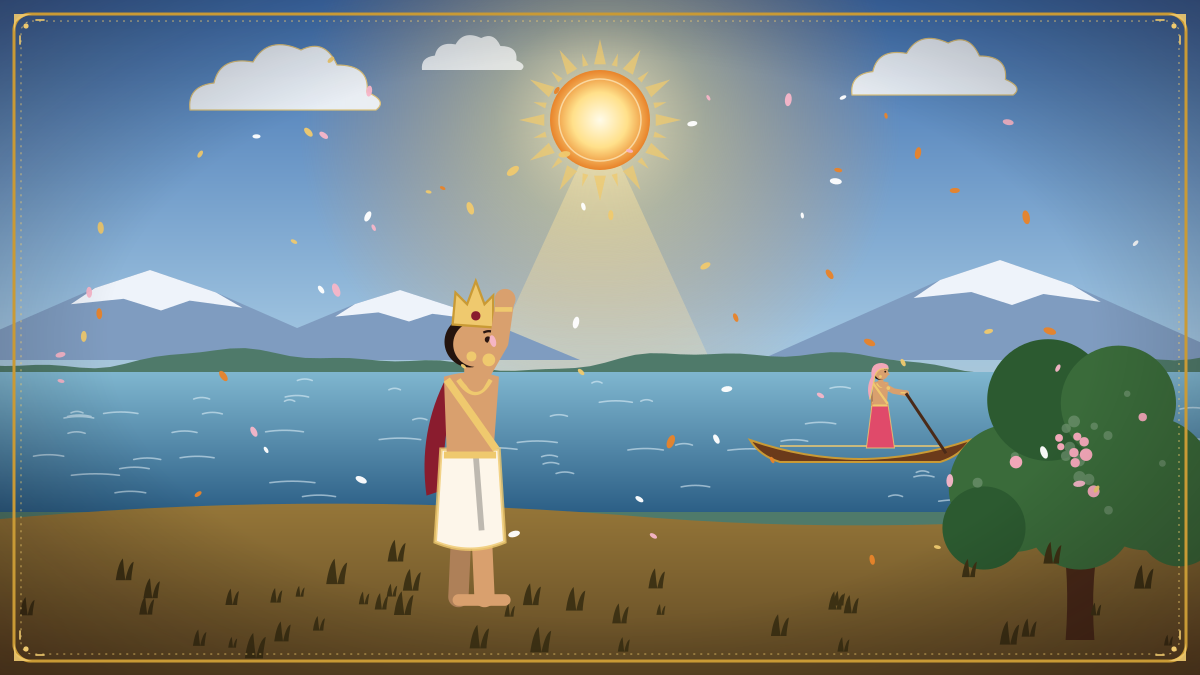
One day Shantanu was walking in the forest beside the Yamuna when he noticed a sweet, wonderful fragrance. Following it, he found a beautiful young woman who rowed a ferry boat. It was Satyavati, the same Yojanagandha whose fragrance Sage Parashara had blessed. The king asked who she was, and she replied, “I am the daughter of the chief of the fishermen. By my father's command I row this boat for the sake of dharma.”
Shantanu was charmed by her beauty and fragrance and wished to marry her. He went to her father, the fisher-chief named Dasharaja, and asked for her hand. Dasharaja said, “O King, since she was born, I have known that she must be given to a worthy husband. But I have one wish in my heart. If you are truly asking for her, promise me that the son born to her will be king after you.”
Shantanu could not make that promise. Devavrata was already the crown prince, a perfect son in every way. So the king returned to Hastinapur with a heavy heart, thinking of Satyavati day and night. He grew pale and sad and lost interest in everything.
Devavrata noticed his father's sorrow and asked him the reason. Shantanu did not tell him the whole truth. He said, “Son, you are my only son. The wise say that having only one son is like having none. You are a great warrior and always ready for battle. If anything happens to you, our family line will end. That is what worries me.”
Devavrata was wise, and he sensed there was more to it. He went to an old minister who cared for the king's welfare and asked him directly. The minister told him the full story: the king wished to marry the fisher-chief's daughter, and the chief had asked that her son be the next king.
The terrible vow
Devavrata did not hesitate for a moment. Taking some respected elder kshatriyas with him, he went to Dasharaja himself and asked for Satyavati as a bride for his father. The fisher-chief welcomed him with honour and said, “She is truly the daughter of King Uparichara Vasu, and he himself wished her to marry Shantanu. I see only one problem in this marriage: you are a mighty rival. Whoever has you as a rival cannot live in peace, not even a god or a gandharva.”
Devavrata understood, and before all the kshatriyas he declared, “Hear my vow, O chief. No one has spoken such words before, and no one will again. The son born to Satyavati shall be our king. I give up my right to the throne.”
Dasharaja, thinking carefully for his daughter's future, said, “You are noble and you will surely keep your word. But your sons may one day claim the kingdom. That is still my doubt.” Then Devavrata raised his hand and made his greatest vow: “O chief, I have already given up the kingdom. Now hear this too. From today I shall live as a brahmachari all my life. I will never marry and never have children.”
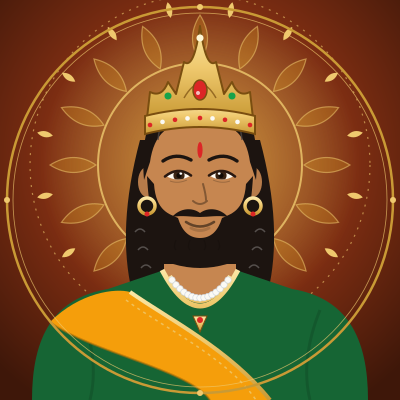
Hearing this, the fisher-chief trembled with wonder and said, “I give my daughter.” At that moment the apsaras, the gods and the groups of sages rained down flowers from the sky and cried out, “He is Bhishma! He is Bhishma!”, meaning “the one who has taken a terrible vow”. From that day the world knew Devavrata as Bhishma. Bhishma turned to Satyavati and said respectfully, “Mother, please sit in the chariot. Let us go home.”
When he brought Satyavati to Hastinapur and told his father everything, the kings who heard it praised him with one voice. Shantanu was deeply moved by what his son had done, and he gave him a rare boon: “As long as you wish to live, death will not touch you. Death will come to you only when you allow it.” This was the boon of svachchhanda mrityu, death by one's own wish.
Two new princes
Shantanu married Satyavati with full ceremony, and in time two sons were born to them. The elder was Chitrangada, a brave and strong prince. The younger was Vichitravirya, who would one day carry the Kuru family forward.
Bhishma kept his vow in every way. He served his father and Satyavati with respect, and he cared for his young half-brothers and the kingdom without any thought of the throne for himself.
But before Vichitravirya had even grown into a young man, King Shantanu passed away. Hastinapur mourned its noble king. Bhishma, honouring Satyavati's wishes, placed Chitrangada on the throne and stood beside him as guardian of the kingdom.
So the great Kuru family now rested on the shoulders of a prince who had given up both the crown and a family of his own. How Bhishma kept his vow, and how much that vow would cost him and others, we will see in the next chapter.
Did you know?
- Before Bhishma, Ganga bore Shantanu seven sons. They were seven of the eight Vasus, and she freed them from a curse as soon as they were born.
- Because he was Ganga’s son, Bhishma is also called Gangeya and Gangaputra.
- Satyavati had a twin brother, who grew up to become a king named Matsya.
- Bhishma’s boon of choosing his own time of death is called iccha mrityu, and his passing is remembered every year on Bhishma Ashtami.
What this chapter teaches us
Shantanu kept his promise to Ganga even when it broke his heart, and Bhishma gave up a crown and a family so that his father could be happy. Their story shows how sacred a promise is in our tradition. It also makes us think carefully, because a vow made in one moment can shape a whole family's future for generations.