Key moments
- Chitrangada falls to a Gandharva who shares his name
- Bhishma alone wins the three princesses of Kashi and defeats Shalva
- Shalva rejects Amba, and she blames Bhishma for her sorrow
- Parashurama and Bhishma fight for twenty-three days with no winner
- Blessed by Shiva, Amba enters the fire vowing Bhishma's destruction
- Bhishma refuses the throne; Satyavati reveals her son Vyasa
- Dhritarashtra is born blind, Pandu pale, and Vidura wise
- Vidura is Dharma himself, born through Animandavya's curse
The Fall of Chitrangada
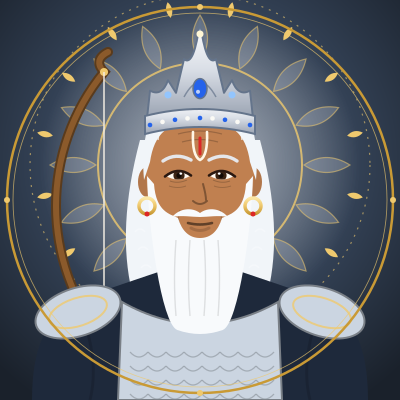
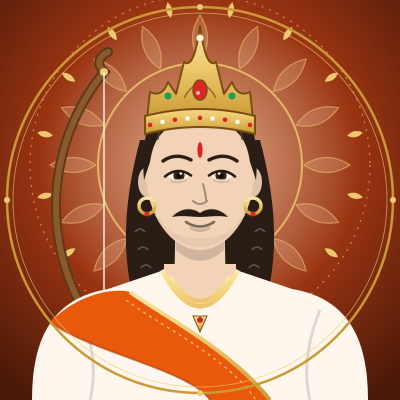
After Bhishma took his terrible vow, King Shantanu married Satyavati, and two sons were born to them: Chitrangada and Vichitravirya. Before the younger boy had even grown into a young man, King Shantanu passed away. Bhishma, true to his word, did not touch the throne. With Queen Satyavati's consent, he placed the elder prince, Chitrangada, on the throne of Hastinapur and stood beside him like a guardian.
Chitrangada was a mighty warrior. He defeated many kings and soon began to think that no man on earth was his equal. His pride grew with every victory. Then a king of the Gandharvas, heavenly beings famed for music and for war, came to challenge him. This Gandharva was also named Chitrangada, and he said, “You carry my name, but you have not earned it. Fight me, or give it up.”
The two Chitrangadas met on the field of Kurukshetra, on the bank of the river Hiranvati. Their battle lasted three long years. In the end the Gandharva, who knew many magical arts, overpowered the proud prince, and Chitrangada lost his life. Bhishma performed his brother's last rites with a heavy heart. Then he crowned the younger prince, Vichitravirya, who was still only a boy. Bhishma ruled the kingdom on his behalf, always taking Satyavati's advice, and Vichitravirya honoured his elder brother like a father.
The Swayamvara at Kashi
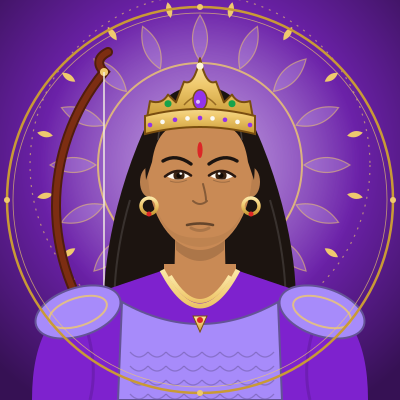
Years passed and Vichitravirya grew into a young man. Bhishma began to think about finding him a bride worthy of the Kuru family. Just then news came that the King of Kashi was holding a swayamvara for his three daughters, Amba, Ambika and Ambalika. A swayamvara was a grand ceremony where kings gathered and a princess chose her own husband, or where a hero won her by showing his strength.
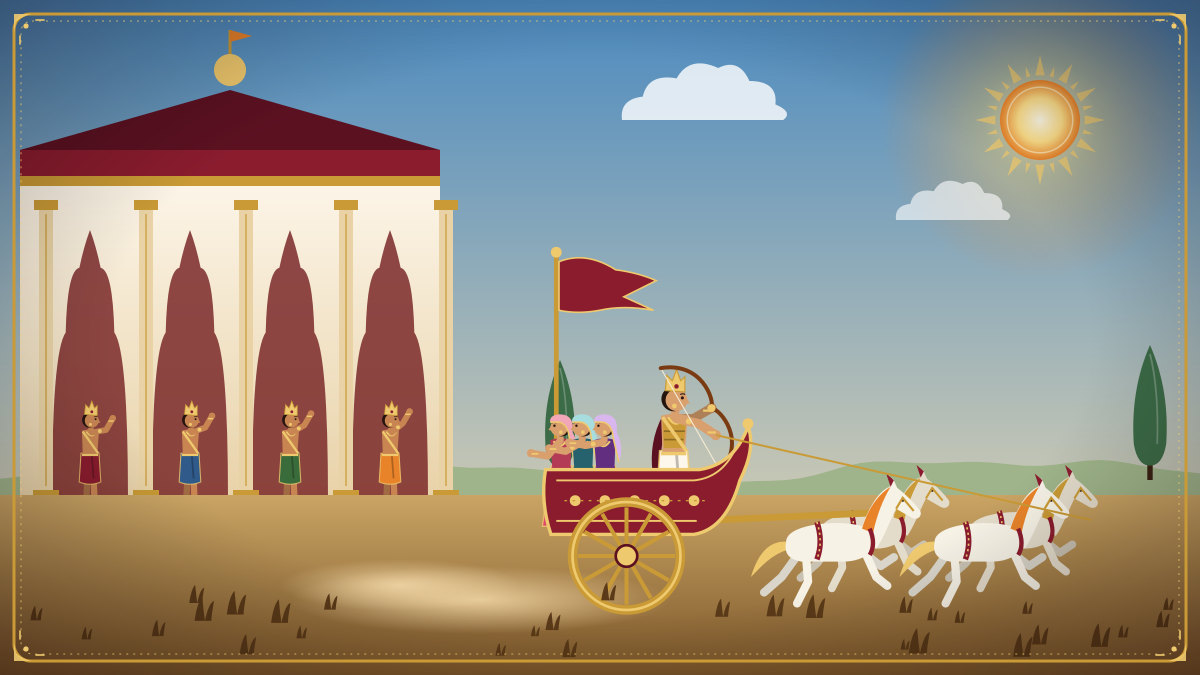
With Satyavati's permission, Bhishma set out for Kashi alone, in a single chariot. When he entered the hall, the gathered kings laughed and whispered. “Look, old Bhishma has come! Did he not vow never to marry? Has he forgotten his famous oath?” Even the princesses, seeing a grey-haired warrior, turned their faces away. They did not know that he had come not for himself but for his young brother.
Bhishma's face grew red with anger. He spoke in a voice like thunder: “The wise speak of many ways of marriage. A bride may be given as a gift, or won by gifts, or by love. But for a warrior, the wise praise most the bride who is won by strength from the midst of a gathering of kings. I am taking these princesses with me. Let any king who wishes to stop me come and fight!” Saying this, he lifted the three princesses into his chariot and drove away.
The kings leapt up in fury, threw off their ornaments, put on their armour and chased after him. A huge battle began. Bhishma stood alone against all of them. His arrows flew so fast that no one could see when he drew them from his quiver and when he let them go. One by one the kings were beaten back, and even his enemies praised him as he fought.
Only one king would not give up: Shalva, the lord of Saubha. Roaring like an elephant, he rushed at Bhishma. Bhishma turned his chariot and faced him. With his arrows he struck down Shalva's charioteer and horses and left the king helpless. But Bhishma did not take his life; he let him go. Shalva returned to his kingdom in shame. Bhishma then drove on to Hastinapur, treating the three princesses as gently as if they were his own daughters or younger sisters.
Amba's Secret
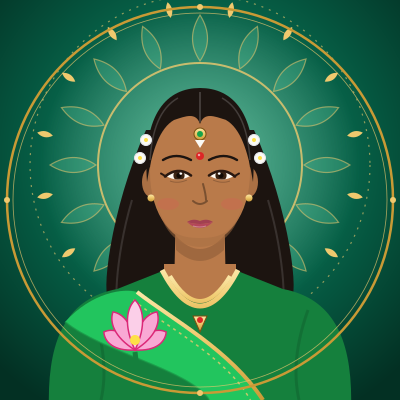
In Hastinapur, preparations began for Vichitravirya's wedding. Then the eldest princess, Amba, came to Bhishma and spoke with folded hands. “You know the laws of dharma well. Before you came, I had already chosen King Shalva of Saubha as my husband in my heart, and he had chosen me. At the swayamvara I would have placed my garland around his neck. How can I marry another man when my heart belongs to Shalva?”
Bhishma listened carefully. He did not wish to do anything against dharma. He talked with learned brahmins, and together they agreed that Amba should be allowed to go. So Bhishma sent her to Shalva with honour, with elderly brahmins and her own old nurse to protect her on the way.
Amba reached Shalva full of hope. “I have come to you, mighty king. Accept me as your wife, as we had both wished.” But Shalva answered coldly. “Bhishma carried you away in front of all the kings, and he defeated me in battle. You were taken by another man. Go back to him. I will not accept a woman whom another has won.” Amba wept and pleaded again and again, telling him that Bhishma had let her go of his own will, but Shalva did not change his mind.
Amba left Shalva's city in tears. She had nowhere to go. She thought, “Shame on me, and shame on my father for holding a swayamvara. Shame on Shalva who has rejected me. But it was Bhishma who carried me away. He is the root of all my sorrow.” Slowly her grief turned into a burning wish to punish Bhishma. She went to a hermitage of ascetics in the forest and told them her story.
Guru and Disciple on the Battlefield
In that forest Amba met her mother's father, the royal sage Hotravahana, who was deeply moved by her story. Soon the great Parashurama himself came to the hermitage. He was the mighty sage who had once fought the kshatriya kings across the earth, and he had also been Bhishma's teacher in archery. Amba fell at his feet and asked for justice. Parashurama promised to help her.
Parashurama went to Kurukshetra and sent for Bhishma. Bhishma came at once and bowed to his guru with great respect. Parashurama said, “You carried away this princess and then sent her away. Now no one will accept her. Take her back.” Bhishma replied humbly, “Gurudev, I cannot give my brother a woman whose heart belongs to another. And I myself have vowed never to marry. I will obey you in everything else, but I cannot give up dharma or my vow, not even out of fear of you.”
Parashurama grew angry and said, “Then fight me!” Bhishma first asked his guru's blessing, and then the two great warriors fought on the field of Kurukshetra. The battle went on for twenty-three days. Sometimes one seemed to be winning, sometimes the other. Each day they fought from morning till evening, and each night they rested. The gods themselves watched from the sky in wonder.
On the twenty-third day Bhishma was about to use a weapon called Prasvapa, which could put an enemy into a deep sleep. But the sage Narada and the gods stopped him, saying, “Do not use this against your guru.” At the same time the ancestors of Parashurama appeared and asked him to lay down his weapons. Both warriors obeyed. The battle ended with neither defeated, and Bhishma bowed at his guru's feet once more. Parashurama then told Amba, “I have done all I could. Bhishma cannot be conquered. Go and seek his protection.”
Amba's Vow of Fire
But Amba would not go back. “I will never seek shelter with Bhishma,” she said. “I will reach my goal through my own tapasya.” She went away into the forest and began the hardest austerities. For years she fasted and lived on almost nothing, standing still in prayer and bathing in holy rivers. Bhishma's heart was troubled when he heard of it, but he could do nothing.
At last Lord Shiva, pleased with her firm resolve, appeared before her. Amba bowed and said, “Lord, grant me that I may bring about Bhishma's death.” Shiva said, “So it will be. In your next birth you will be born in the family of King Drupada. First you will be a daughter, and later you will become a man and a great warrior. You will remember all of this, and you will be the cause of Bhishma's fall.”
Amba could not wait for old age to bring her next birth. She gathered wood on the bank of the Yamuna, lit a great fire, and entered it, saying, “This is for the destruction of Bhishma.” She was later born as Shikhandi, the child of King Drupada. Keep this name in your heart, for Shikhandi will return on the battlefield of Kurukshetra.
The Empty Throne and Satyavati's Secret
Meanwhile, Vichitravirya had married the two younger princesses, Ambika and Ambalika. They were beautiful and devoted, and he lived happily with them for seven years. But while still young he fell ill with a wasting disease called rajayakshma. The best physicians tried to save him, but he could not be cured, and Vichitravirya died without leaving any child.
Now Queen Satyavati's sorrow was very great. Her husband was gone, and both her sons were gone. The throne of Hastinapur stood empty, and the great Kuru line, which had come down from King Bharata and King Kuru, seemed about to end. She called Bhishma and said, “You are the support of this family. Take the kingdom and marry to continue your father's line, or give sons to your brother's widows. Do not let the family of Shantanu die out.”
Bhishma answered gently but firmly. “Mother, you know the vow I made for your sake. The earth may give up its fragrance, water its coolness, the sun its light and the moon its calm, but I will never give up the truth. I will not rule and I will not marry.” Then he reminded her of an ancient custom: when a royal line was about to end, a virtuous sage could be invited to bless the widows of the family with sons. “Find a worthy sage,” he said.
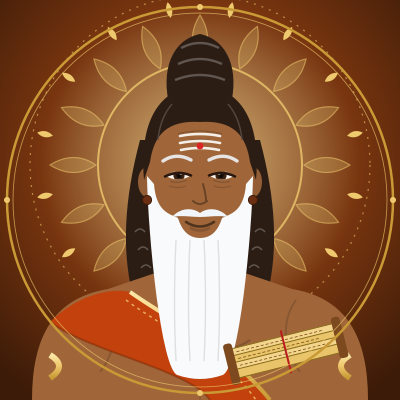
Then Satyavati, a little shyly, told Bhishma a secret. “Long ago, before I married your father, I used to row a ferry across the Yamuna. One day the great sage Parashara crossed the river in my boat. By his blessing a son was born to me on an island in the river, and the sage restored my maidenhood. That son is Krishna Dvaipayana, who divided the Vedas and is known as Vyasa. When he left for the forest, he promised me, ‘Mother, think of me whenever you are in trouble, and I will come.’ If you agree, I will call him.”
Bhishma joined his hands. “Mother, this is wise and right,” he said. Satyavati thought of her son, and Vyasa appeared at once. She embraced him with tears of joy and asked him to save the family. Vyasa agreed out of respect for his mother, but he said, “The queens should first keep a vow for one year to become pure.” Satyavati said, “A kingdom without a king cannot wait so long.” Vyasa answered, “Then let them bear with my rough looks and stern form. If they can do that, they will bear excellent sons.”
Dhritarashtra, Pandu and Vidura
Vyasa had lived for many years in the forests doing tapasya. His skin was dark, his hair matted and reddish, his eyes blazing and his body lean. When he came to Ambika, she was frightened at the sight of him and shut her eyes tight. Vyasa later told his mother, “Her son will be as strong as ten thousand elephants, wise and learned. But because his mother closed her eyes, he will be born blind.” Satyavati was troubled. “A blind man cannot rule the Kurus well,” she said. “Please give the family another son.”
Next Vyasa came to Ambalika. She did not close her eyes, but she turned pale with fear. Vyasa said, “Because she turned pale, her son too will be pale, and he will be named Pandu.” In time Ambika gave birth to Dhritarashtra, who was blind, and Ambalika gave birth to Pandu, whose skin was pale but who was full of good qualities.
Satyavati asked Vyasa to bless Ambika once more. But Ambika remembered the sage's fierce looks and could not bring herself to go. Instead she dressed one of her maids in her own ornaments and sent her. The maid welcomed the sage with respect, served him calmly and lovingly, and was not afraid at all. Vyasa was pleased and told her, “You will no longer be a servant. Your son will be the most virtuous and wise man in the world.” This son was Vidura. Vyasa told his mother everything that had happened, and then he returned to the forest.
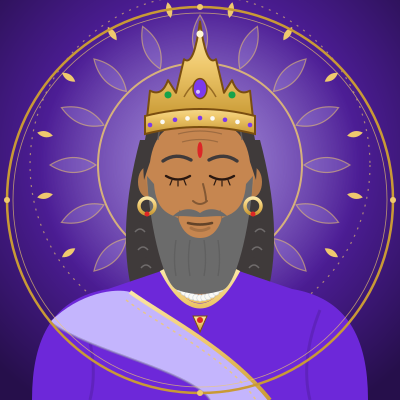
Vidura was no ordinary child. He was Dharma himself, the god of justice, born on earth because of the curse of a sage named Mandavya. Long before, this sage had been standing in silent meditation outside his hut when thieves hid their stolen goods there. The king's guards caught the thieves and the silent sage together, and the king wrongly ordered the sage punished on a sharp stake. Yet by the power of his tapasya the sage did not die. When the king learned the truth, he begged forgiveness. The point of the stake stayed in the sage's body, so he came to be called Animandavya, “Mandavya with the point”.
Animandavya went to Dharma and asked, “What sin did I commit to deserve such pain?” Dharma replied, “As a little child, you once pierced an insect with a blade of grass.” The sage said, “For a small fault done by a child who did not know better, you have given a very heavy punishment. From today, nothing a child does before the age of fourteen will be counted as a sin. And for this injustice you will be born as a human, from the womb of a maid.” So Dharma was born as Vidura, wise, truthful and ever devoted to what is right.
Bhishma raised the three boys as lovingly as a father. He saw to their sacred ceremonies, their study of the Vedas and their training in arms. The kingdom flourished: rains came on time, the fields were full of grain, the trees were heavy with fruit, and the people were happy and honest. Dhritarashtra grew immensely strong, Pandu became a matchless archer, and Vidura became the greatest knower of dharma. People said that of all mothers of heroes the princesses of Kashi were the best, and of all lands the land of the Kurus was the happiest.
Did you know?
- Sage Vyasa is the grandfather of both the Kauravas and the Pandavas, because Dhritarashtra and Pandu were born through his blessing.
- Parashurama taught three of the greatest warriors of the epic: Bhishma, Drona and Karna.
- Kashi, the home of Amba, Ambika and Ambalika, is the ancient name of Varanasi, one of the oldest living cities in the world.
- The wise advice that Vidura later gives King Dhritarashtra is so famous that it is collected and read on its own as “Vidura Niti”.
What this chapter teaches us
Bhishma acted for his family's good, yet his deed at Kashi broke a young woman's heart, and her pain followed him to the end. Even when we mean well, we should think about how our actions affect others. Bhishma's firmness in keeping his vow, even before his own guru, shows the strength of truth. And the birth of Vidura reminds us that a calm, respectful and loving heart brings forth goodness and wisdom.