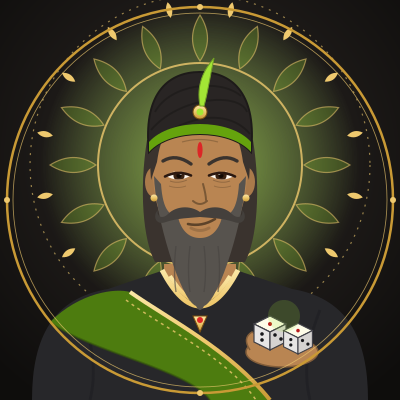
Shakuni was a prince of Gandhara, a kingdom in the far north-west, and the son of King Subala. He was the brother of Queen Gandhari, which made him the maternal uncle, or mama, of Duryodhana and all the Kauravas. Shakuni was very clever, but he used his cleverness for tricks and plots. He was a master of the game of dice, and it was he who threw the dice for Duryodhana in the famous game in which Yudhishthira lost his kingdom, his brothers and Draupadi. Through every plot against the Pandavas, Shakuni stood beside Duryodhana as his adviser, and he fought for him to the very last day of the war, when Sahadeva struck him down.
Prince of Gandhara
Shakuni’s father was King Subala, ruler of Gandhara, and among his brothers were Achala and Vrishaka. The epic says that Shakuni was born as a portion of Dvapara, the spirit of the age of doubt and quarrel. This is Vyasa’s own explanation of his nature.
Shakuni’s sister Gandhari had worshipped Lord Shiva and received a boon that she would have a hundred sons. Hearing this, Bhishma asked for her as a bride for the blind prince Dhritarashtra. King Subala hesitated because the groom was blind, but agreed because of the fame of the Kuru family. Shakuni brought his sister to Hastinapur. Gandhari tied a cloth over her own eyes for life, so as not to have more than her husband. Shakuni handed her over with honour and returned to his own city.
In later years Shakuni spent long periods at the Kuru court, close to his nephews. Duryodhana came to depend on him, and in the court he was known for his sharp mind and smooth words. The epic does not give him any hidden personal grudge; it simply shows him as Duryodhana’s cunning adviser, always ready with a plan against the Pandavas.
Adviser in every plot
The epic often names four men together: Duryodhana, Karna, Shakuni and Dushasana. They met in secret and made plans against the sons of Pandu. Shakuni was part of the efforts to harm the Pandavas from their youth.
When the Pandavas were sent to Varanavata, where the house of lac had been built to burn them, Shakuni was among those who supported Duryodhana’s plan. The Pandavas escaped through Vidura’s help, but the Kauravas did not give up their hatred.
When the Pandavas appeared again at Draupadi’s swayamvara, now allied with the powerful King Drupada, Duryodhana’s circle once more discussed how to weaken or destroy them. This time Bhishma, Drona and Vidura spoke firmly for justice, and Dhritarashtra gave the Pandavas half the kingdom. Shakuni’s schemes had to wait for another chance.
When Yudhishthira performed the Rajasuya sacrifice at Indraprastha, Shakuni went there with Duryodhana and stayed with him in Maya’s wonderful hall. He saw Duryodhana’s humiliation in that hall and heard all his bitter words on the way home. Vidura often warned Dhritarashtra about Shakuni and his advice, but the king, blinded by love for his son, did not listen. Step by step, Shakuni’s counsel pushed the family towards disaster.
The game of dice
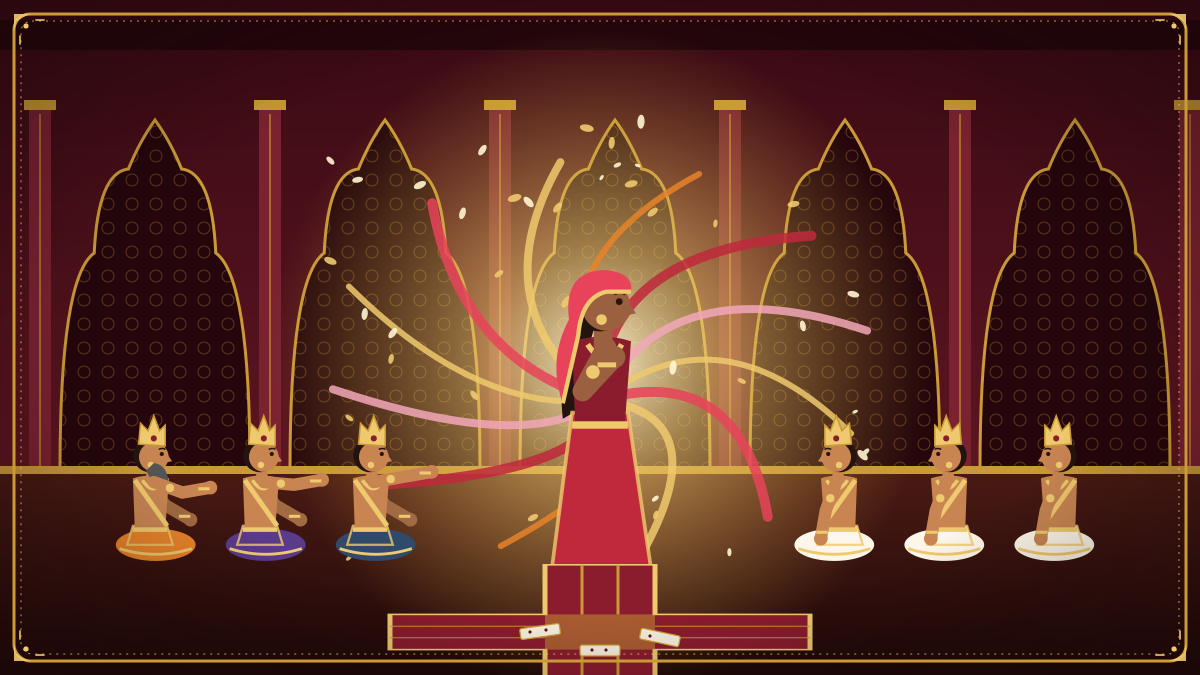
When Duryodhana came back from Yudhishthira’s Rajasuya burning with jealousy and humiliation, Shakuni saw his chance. He told Duryodhana that the Pandavas could not be beaten in battle, but Yudhishthira loved dice without knowing its tricks, while he, Shakuni, had no equal in the whole world. “I will play for you and win everything,” he said. Together they went to Dhritarashtra. The king wanted first to ask Vidura, but Duryodhana said that if the game did not take place he would die. So Dhritarashtra had a new hall built and, against Vidura’s warning, sent Vidura himself to invite the Pandavas.
When the game began, Yudhishthira said that winning by deceit was a sin. Shakuni replied that a skilled player always defeats an unskilled one, and if Yudhishthira was afraid, he need not play. Duryodhana provided the stakes and Shakuni threw the dice for him. Through deceit he won every throw, each time calling out, “I have won!”, while Vidura protested openly that the game was a cheat.
Yudhishthira lost his jewels, his gold, his chariots, his elephants, his servants and his kingdom. When he staked Nakula and Sahadeva and lost them, Shakuni sneered that perhaps Bhima and Arjuna were dearer to him than Madri’s sons. Stung, Yudhishthira staked Arjuna and Bhima too, and lost them, and then himself. Then Shakuni told him there was still one stake he had not lost, his beloved Draupadi, and urged him to stake her to win himself back. Yudhishthira did, and Shakuni won again. Draupadi was then insulted in the court.
After Dhritarashtra set the Pandavas free, Shakuni played once more in a second game. The loser would live twelve years in the forest and a thirteenth year in hiding. Shakuni won again. As the Pandavas left, Sahadeva vowed that he would slay Shakuni in battle.
During the exile and before the war
During the Pandavas’ exile, Shakuni and Karna advised Duryodhana to go to the Dvaita forest in royal splendour to make the exiled Pandavas suffer. The plan ended in disgrace when the Gandharvas captured Duryodhana and the Pandavas had to rescue him.
When Duryodhana resolved to fast unto death out of shame, Shakuni pleaded with him to give it up, telling him to return the Pandavas’ kingdom if he was so grieved, and to make friends with them. But Duryodhana did not listen.
When Krishna came to Hastinapur as a messenger of peace, Shakuni was one of the four who planned to capture him, but Krishna showed his divine universal form. Just before the war, Duryodhana sent Shakuni’s son Uluka to the Pandavas with a message full of mocking and insults, daring each of them to make good the vows of the dice hall. The Pandavas sent back a firm reply that they would answer on the battlefield.
In the war
At Kurukshetra Shakuni fought for the Kauravas with his son Uluka and led a large force of horsemen. On the eighth day, several of his brothers were killed by Iravan, Arjuna’s son, and later, on the twelfth day, Arjuna killed his brothers Vrishaka and Achala.
Shakuni then used his powers of illusion on the battlefield, filling it with frightening sights, but Arjuna destroyed all his illusions with divine weapons, and Shakuni had to flee. In this war the uncle who had once won everything with dice saw his own brothers fall one after another, yet he did not leave Duryodhana.
He stayed at Duryodhana’s side almost to the very end, even after Bhishma, Drona and Karna had fallen. When Kripacharya urged Duryodhana to make peace after Karna’s death, the king refused, and Shakuni remained with him for the final day under Shalya’s command.
Sahadeva keeps his vow
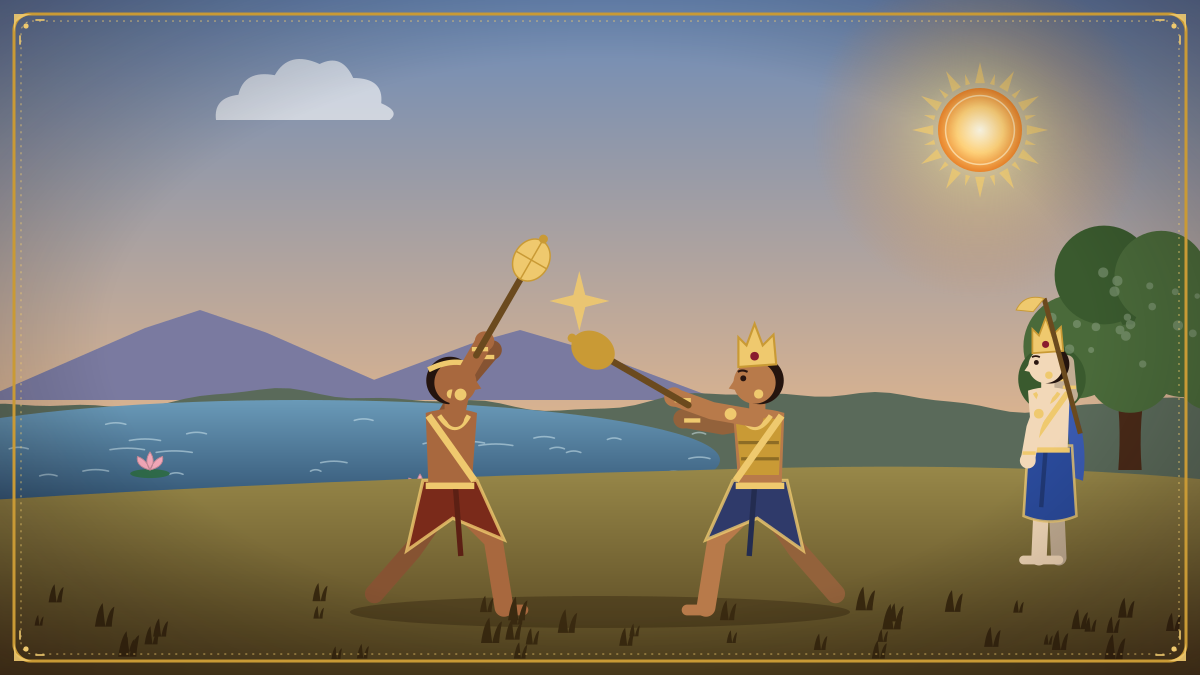
On the eighteenth day, the last day of the war, King Shalya fell to Yudhishthira. Shakuni then led his horsemen in an attack on the Pandava army, trying to strike it from behind. Sahadeva, the youngest Pandava, went after him to keep the vow he had made in the dice hall.
First Sahadeva killed Shakuni’s son Uluka. Shakuni was grief-stricken, but he fought on. Sahadeva told him to remember what he had done in the dice hall and to reap its fruit now.
Shakuni hurled a spear at Sahadeva, but Sahadeva cut it down, and with a sharp arrow he struck Shakuni down. The man whose dice had started all the sorrow fell on the battlefield, and the Pandavas rejoiced that Sahadeva’s vow was fulfilled. His remaining horsemen were destroyed, and Duryodhana was left almost alone.
After the war, when Gandhari walked across the battlefield, she saw her brother lying among the fallen. The uncle who had led her sons with clever words had been unable to save a single one of them.
Did you know?
- The Mahabharata describes Shakuni as a form of Dvapara, the spirit of the age before Kali Yuga.
- Shakuni was the son of King Subala of Gandhara, which is why he is also called Saubala.
- His son’s name, Uluka, means “owl”.
- Shakuni outlived Bhishma, Drona, Karna and Shalya, and fell only on the eighteenth and final day of the war.
What we learn from Shakuni
Shakuni shows that cleverness without goodness is dangerous. Tricks may win for a short time, but they bring ruin in the end, both to the cheater and to those who follow him. We should choose friends and advisers who guide us towards what is right.
Shakuni in the story
Read the chapters where Shakuni plays a part.