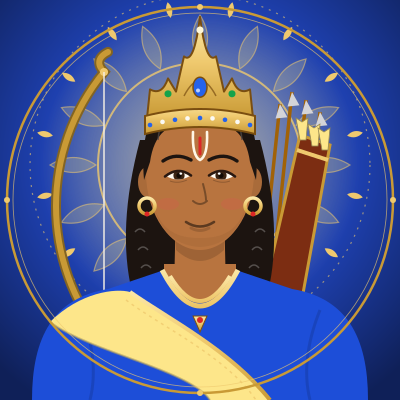
Arjuna was the third of the five Pandava brothers. His mother was Kunti and his father King Pandu; he was born by the blessing of Indra, king of the gods. Yudhishthira and Bhima were his elder brothers, and the twins Nakula and Sahadeva, sons of Madri, were his younger half-brothers. Kunti was the sister of Vasudeva, Krishna’s father, so Krishna was Arjuna’s cousin, and he became his dearest friend. Arjuna was the finest archer of his age, a disciplined student, a loving brother and a humble devotee. He married Draupadi, the Naga princess Ulupi, Chitrangada of Manipur and Krishna’s sister Subhadra, and each of them bore him a son. On the battlefield of Kurukshetra, Krishna drove his chariot and taught him the Bhagavad Gita.
Birth and boyhood under Drona
After the births of Yudhishthira and Bhima, Pandu performed a year of penance to please Indra, and Kunti then called upon the king of the gods. When Arjuna was born, a voice from the sky announced that he would be as brave as Lord Shiva and Indra, would conquer many kings and bring glory to his family. Arjuna later explained his many names: Phalguna, because he was born under the Phalguni star; Savyasachi, because he could shoot with either hand; Dhananjaya, “winner of wealth”; and Kiriti, for the crown Indra gave him.
In Hastinapur the princes learnt archery from Dronacharya, and Arjuna practised harder than anyone. One night, while he was eating, the wind blew out the lamp. Arjuna noticed that his hand still found his mouth in the dark, and he began to practise archery at night too. Drona promised him, “I will see that no archer in the world is your equal.”
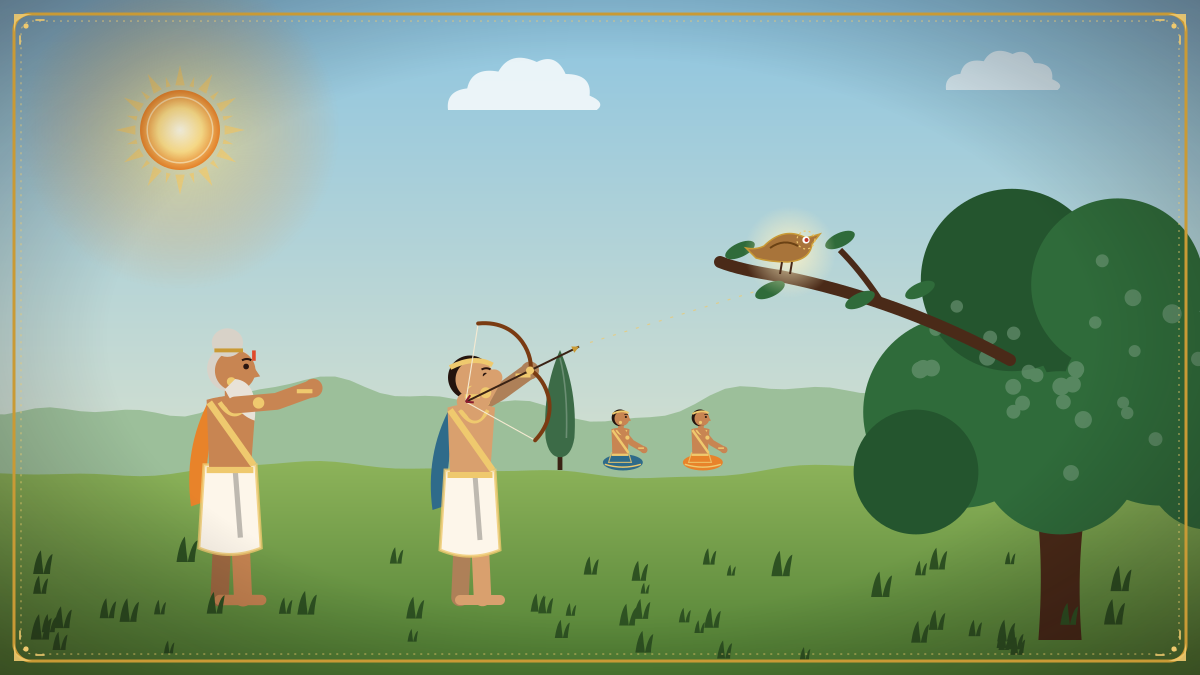
Once Drona placed a wooden bird on a treetop and asked each pupil what he saw. The others saw the tree, the branches, their brothers and the bird. Arjuna said, “I see only the bird’s head.” Drona told him to shoot, and the head fell. Another day a crocodile seized Drona while he was bathing in the Ganga; Arjuna freed him with five arrows before the others had moved, and Drona gave him the mighty Brahmashira weapon. It was also out of this promise to Arjuna that Drona later asked the tribal archer Ekalavya for his right thumb.
At the public tournament Arjuna amazed the people with his skill, until Karna appeared and challenged him, beginning a rivalry that lasted all their lives. When Drona asked his pupils, as their fee, to bring King Drupada of Panchala to him as a captive, the Kaurava princes failed, but Arjuna defeated Drupada and brought him before his teacher.
Winning Draupadi, and the years of travel
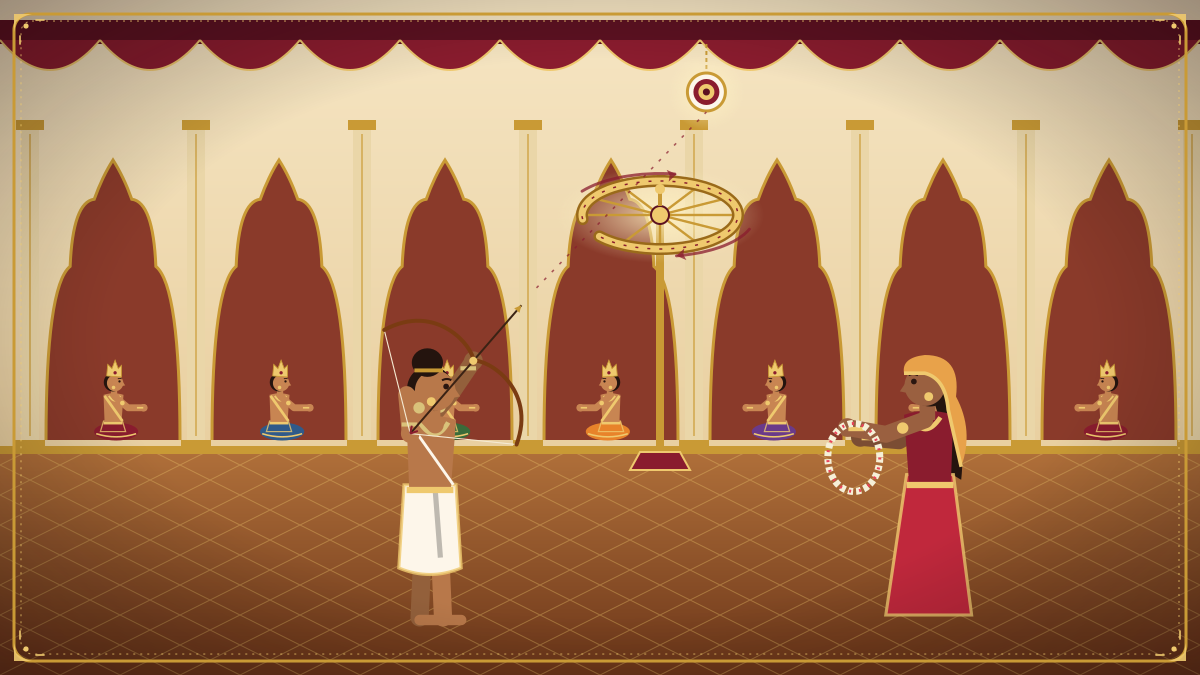
After escaping the house of lac, the Pandavas, disguised as Brahmins, went to the swayamvara of Drupada’s daughter Draupadi. The test was to string a very heavy bow and shoot a target set high above, through the opening of a turning device, with five arrows. King after king failed. Arjuna rose from among the Brahmins, strung the bow in a moment and brought the target down. When he came home and said, “See what we have received,” Kunti, without looking, told him to share it with his brothers. With the blessing of Vyasa, Draupadi became the wife of all five, and her son with Arjuna was Shrutakarma.
On the sage Narada’s advice the brothers made a rule: whoever disturbed another while he was alone with Draupadi would go away for twelve years. One day robbers stole a Brahmin’s cows, and Arjuna’s weapons were in the room where Yudhishthira sat with Draupadi. To protect the Brahmin, Arjuna went in, took his bow and recovered the cows. Then, though Yudhishthira forgave him, he kept the rule and left on a long pilgrimage.
On this journey Ulupi, a Naga princess, met him at the Ganga and became his wife; their son was Iravan. In Manipur he married Princess Chitrangada, on the condition that their son would stay with her father as heir to the kingdom; that son was Babruvahana. In the southern seas he freed five apsaras who had been cursed to live as crocodiles.
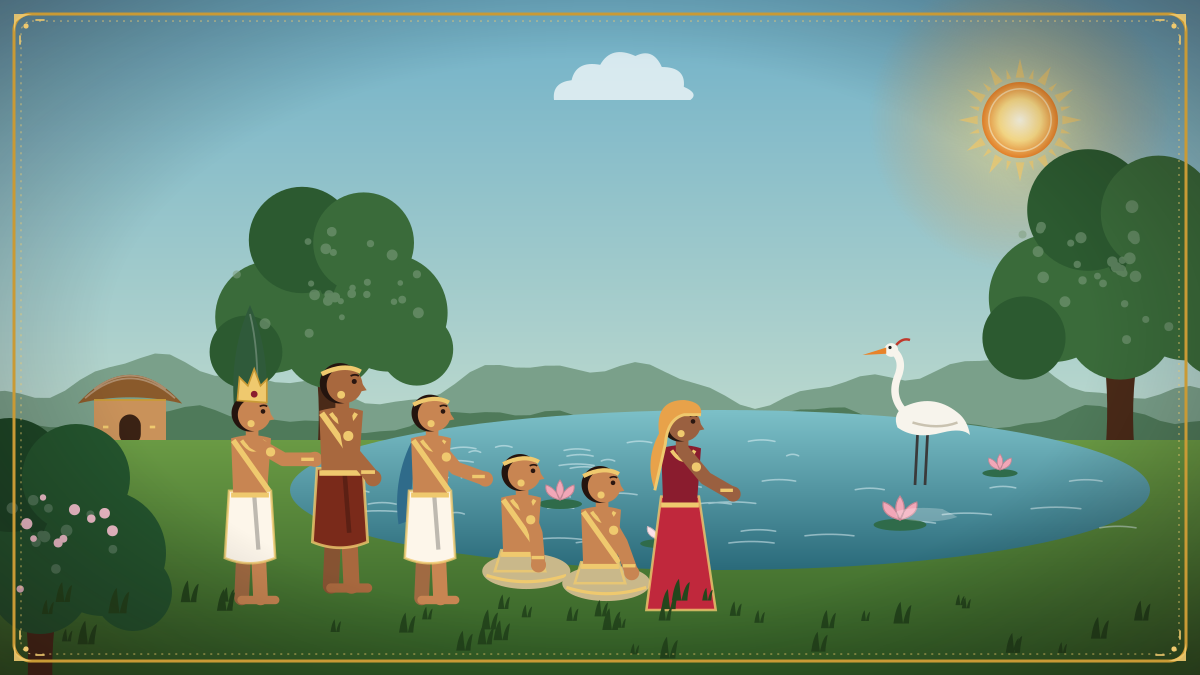
At Prabhasa he met Krishna, and at a festival on Mount Raivataka he saw Krishna’s sister Subhadra. Krishna advised him that a swayamvara was uncertain and that a Kshatriya might rightly carry away his bride. With Krishna’s blessing Arjuna took Subhadra away in his chariot. Balarama and the Yadavas were angry at first, but Krishna calmed them, and the marriage was celebrated in Dwarka. Back in Indraprastha, Subhadra won Draupadi’s affection, and their son Abhimanyu was born.
Gandiva and the glory of Indraprastha
One day, by the Yamuna, Agni, the god of fire, came to Krishna and Arjuna in the form of a Brahmin and asked their help to consume the Khandava forest. For this, Agni brought Arjuna the divine Gandiva bow, two quivers that would never run out of arrows and a chariot with a monkey on its banner, and gave Krishna his discus and mace. Arjuna held back even Indra, who came to protect the forest.
In that fire Arjuna spared the life of Maya, the great architect of the asuras. In gratitude Maya built the wonderful assembly hall of Indraprastha, and he brought Arjuna the conch Devadatta.
For Yudhishthira’s Rajasuya sacrifice, Arjuna rode to the north and brought back great wealth from many lands, which is one reason he is called Dhananjaya. But at the dice game Yudhishthira lost everything, and Draupadi was insulted in the open court. For his elder brother’s sake Arjuna held back his anger, but he vowed to kill Karna, who had mocked her, in battle.
Weapons from the gods
During the forest exile, on the advice of Vyasa, Yudhishthira gave Arjuna a sacred knowledge and sent him to the mountains to win divine weapons. At Indrakila, Indra came to him as an old Brahmin, blessed him and told him to first please Lord Shiva.
Arjuna performed hard penance. One day a demon in the form of a boar charged at him, and as he shot it, a hunter shot it at the same moment. The two quarrelled and fought, but none of Arjuna’s arrows touched the hunter, and at last even Gandiva was taken from him. Then Arjuna understood that the hunter was Lord Shiva himself, with Parvati beside him. He bowed down, and Shiva, pleased with his courage, gave him the Pashupata weapon. Yama, Varuna and Kubera also appeared and gave him their weapons.
Indra then took Arjuna to his heavenly city, Amaravati, where he stayed for five years, learning the use of divine weapons and also music and dance from the gandharva Chitrasena. When the apsara Urvashi came to him with love, Arjuna respected her as a mother of the Kuru family and refused. She cursed him to live without manhood among women, and Indra softened the curse so that it would last only one year, whenever Arjuna chose.
As his gift to Indra, Arjuna defeated the Nivatakavacha demons, who were troubling the gods, and Indra placed a shining crown on his head. Back in the forest, when the gandharvas captured Duryodhana, Arjuna freed him at Yudhishthira’s command. At the Yaksha’s lake he too fell lifeless, until Yudhishthira’s answers brought him back.
Brihannala, and choosing Krishna
In the year of disguise Arjuna used Urvashi’s curse. He lived in King Virata’s palace as Brihannala, who was neither man nor woman, and taught music and dance to Princess Uttara. His weapons stayed hidden in a shami tree outside the city.
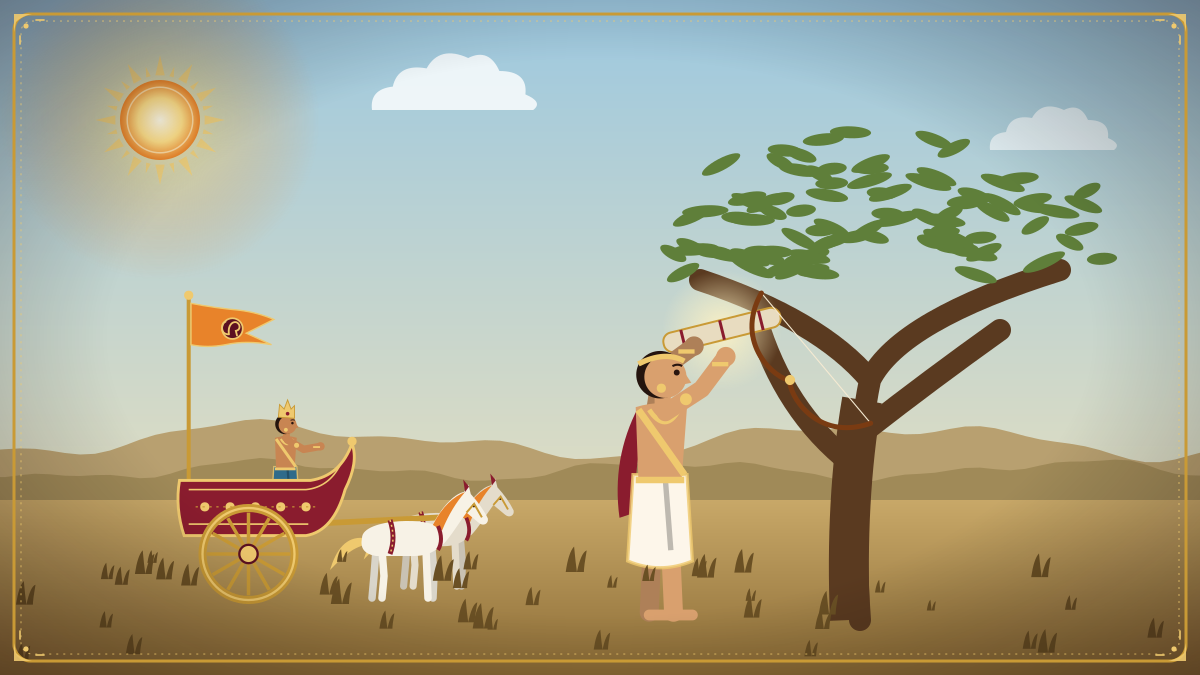
At the end of that year the Kauravas raided Virata’s cattle from the north while the king was away. Young Prince Uttara, also called Bhuminjaya, set out to fight with Brihannala as his charioteer, but lost courage when he saw Bhishma, Drona, Karna and Duryodhana. Arjuna took his weapons from the shami tree, made the prince his charioteer and alone defeated the whole Kaurava army. Before leaving he put the warriors to sleep with a special weapon and took their upper garments for Princess Uttara’s dolls.
Grateful, King Virata offered Uttara in marriage to Arjuna. Arjuna refused, saying that as her teacher he was like a father to her, and asked that she marry his son Abhimanyu instead.
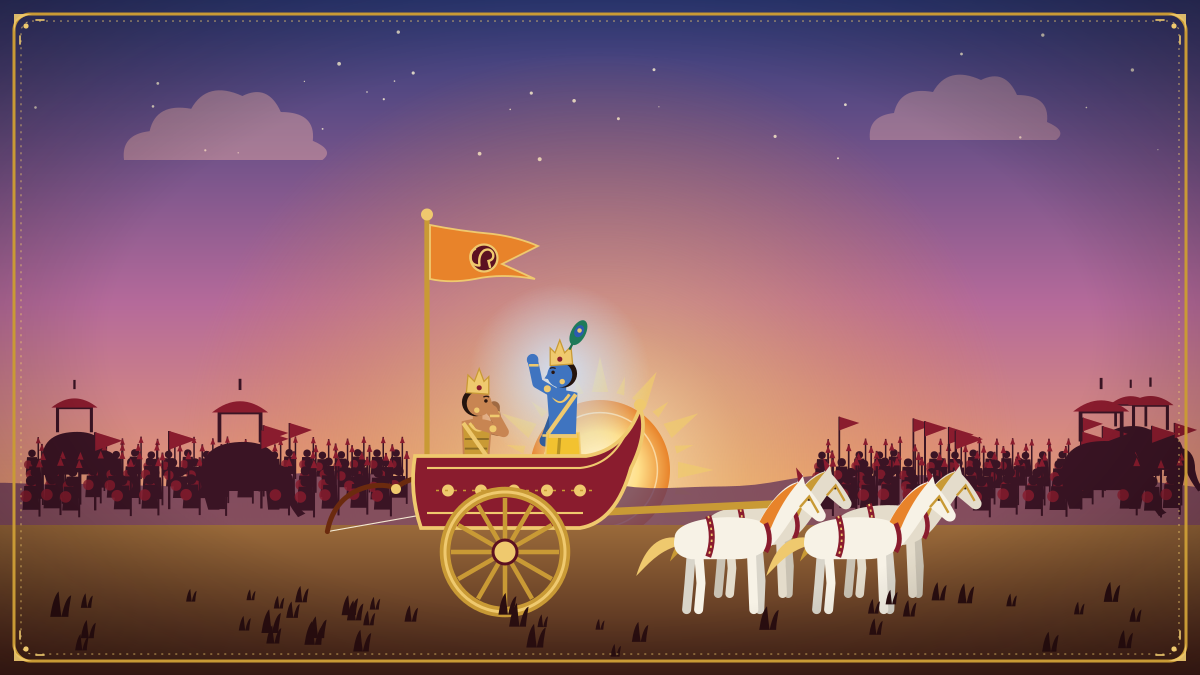
When war became certain, Arjuna and Duryodhana both went to Dwarka for help. Krishna was sleeping; Duryodhana sat near his head and Arjuna at his feet. Krishna saw Arjuna first on waking and let him choose first between Krishna himself, unarmed, and his great Narayani army. Without hesitation Arjuna chose Krishna, who became his charioteer.
The Gita and the great war
On the first morning at Kurukshetra, Arjuna asked Krishna to drive between the two armies. Seeing his grandsire Bhishma, his teacher Drona and his cousins ready to fight, he put down his bow, his heart full of sorrow. Krishna then taught him the Bhagavad Gita: the soul never dies, so do your duty without attachment to the result and take refuge in God. Krishna showed him his universal form, the Vishwarupa, and Arjuna picked up Gandiva again.
On the tenth day, with Shikhandi in front of him, Arjuna’s arrows brought down Bhishma, who lay on a bed of arrows. Arjuna gave him a pillow of three arrows, and later shot an arrow into the earth to bring up a stream of fresh water for him to drink.
On the thirteenth day the Samshaptaka warriors drew Arjuna away, and young Abhimanyu was killed inside Drona’s Chakravyuha. In grief Arjuna vowed that he would kill Jayadratha, who had kept the Pandavas from following Abhimanyu, before the next sunset, or enter the fire himself. All the next day he cut through the Kaurava army; when the horses were tired he made a pool of water with his arrows so they could drink. As evening came, by Krishna’s divine power the sun seemed to set, Jayadratha came out of hiding, and Arjuna kept his vow.
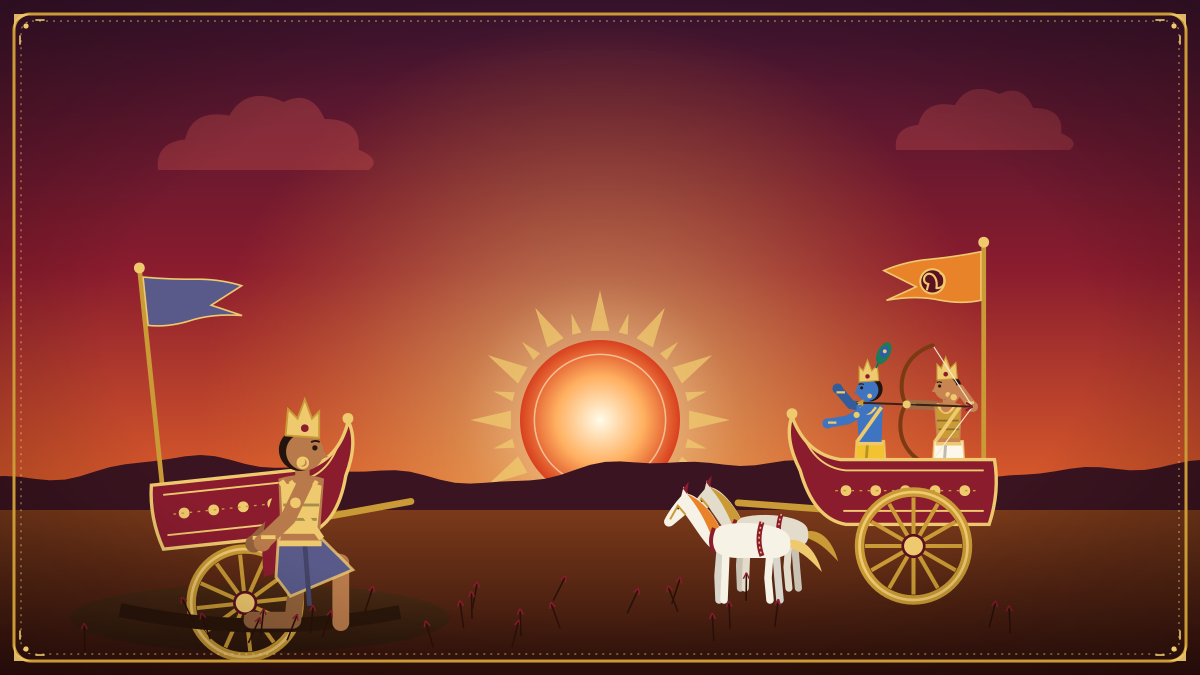
On the seventeenth day, after a hard-fought battle, Karna’s chariot wheel sank into the earth. Karna asked for fair play, but Krishna reminded him of the injustices done to Draupadi and to Abhimanyu. Arjuna then killed Karna, not knowing that his great rival was his own eldest brother.
After the war Ashwatthama released the terrible Brahmashira weapon, and Arjuna released his own to stop it. When Vyasa and Narada stood between the two, Arjuna, with his pure self-control, was able to withdraw his weapon. Ashwatthama could not, and turned his weapon towards the unborn child of Uttara, who was later saved by Krishna and born as Parikshit.
After the war and the last journey
When the war was won, Krishna asked Arjuna to step down from the chariot first. As soon as Krishna stepped down too, the chariot burst into flames. Krishna explained that only his presence had protected it from the weapons of Bhishma, Drona and Karna. Some time later Arjuna asked Krishna to teach him again what he had said at Kurukshetra, and Krishna gave him the teaching known as the Anugita.
When Yudhishthira performed the Ashvamedha sacrifice, Arjuna followed the sacrificial horse across the land. In Manipur his own son Babruvahana fought him, urged on by Ulupi, and Arjuna fell. Ulupi then brought him back to life with a magical Naga jewel, and explained that this had freed him from a curse for the way Bhishma had been brought down.
Years later news came that Krishna had left the world. Arjuna hurried to Dwarka and led the Yadava women and children towards Indraprastha, but on the way robbers attacked them. Arjuna could hardly string Gandiva, his divine weapons would not come to mind, and his arrows ran out. Heartbroken, he went to Vyasa, who told him gently that his work was done.
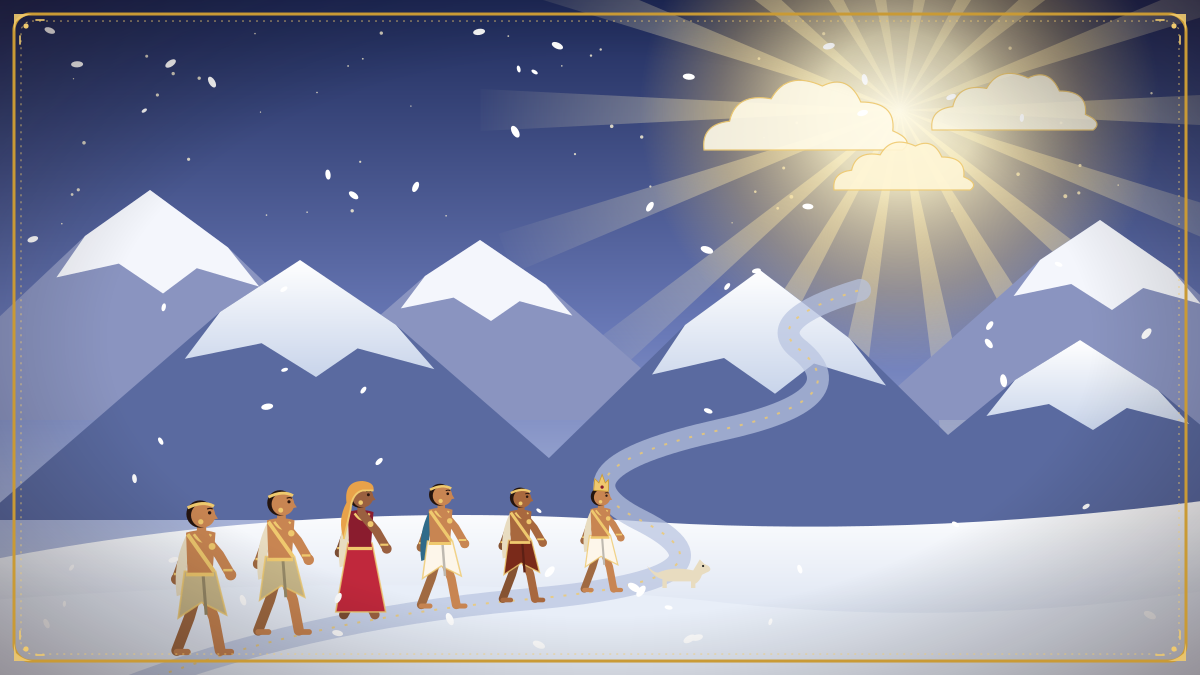
The Pandavas then set out on their last journey. On the way Agni appeared and asked Arjuna to return Gandiva and the quivers to Varuna, and Arjuna threw them into the water. In the Himalayas Arjuna fell after the twins. Yudhishthira told Bhima, “Arjuna said he would destroy all our enemies in a single day, but he did not; and he looked down on other archers.” In heaven Yudhishthira later saw him shining beside his divine father Indra.
Did you know?
- Arjuna is also called Savyasachi, because he could shoot arrows equally well with either hand.
- Krishna calls Arjuna “Gudakesha” in the Gita, meaning “one who has conquered sleep”.
- Arjuna was once defeated in battle by his own son Babhruvahana, and was brought back to life by Ulupi.
- On his last journey, Arjuna returned the Gandiva bow to Varuna, the god of the waters, who had given it to him.
What we learn from Arjuna
Arjuna teaches focus, hard work and humility before God. He became the greatest archer not by luck but by practising even in the dark, and he chose Krishna over a whole army. Through him we receive the Gita’s message: do your duty with a pure heart and leave the result to God. His last days remind us that all strength is a gift from God, and pride in it does not last.
Arjuna in the story
Read the chapters where Arjuna plays a part.