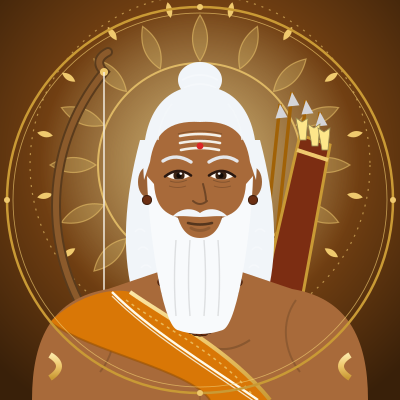
Dronacharya, usually called Drona, is the great teacher (acharya) of the Mahabharata. He was the son of the sage Bharadwaja and was born in a wondrous way, in a vessel called a drona. A brahmin by birth, he became the greatest master of weapons of his age, having received the divine weapons from Parashurama himself. His wife was Kripi, the sister of Kripacharya, and their only son was Ashwatthama. Poverty and an old friend's insult brought him to Hastinapur, where he trained the Pandavas and the Kauravas, and Arjuna became his dearest pupil. Bound by duty to the throne of Hastinapur, he fought for the Kauravas and led their army for five days. He laid down his weapons only when he believed that his son was dead.
Born from a vessel
The great sage Bharadwaja lived near Gangadwara, where the Ganga comes down from the mountains. The epic tells that his son came into being in a wondrous way, inside a vessel called a drona, and so the child was named Drona.
Drona studied the Vedas and their branches with his father. He was also drawn to the science of weapons. Bharadwaja had given the fiery Agneya weapon to his pupil, the sage Agnivesha, and from Agnivesha the young Drona learned that weapon and much more.
King Prishata of Panchala was a friend of Bharadwaja, and his son Drupada often came to the ashram. Drupada and Drona studied and played together and became close friends. Drupada used to say lovingly, “Drona, I am my father's dearest son. When I become king of Panchala, my kingdom will be yours to enjoy as well.”
Poverty, Parashurama and Drupada's insult
In time Bharadwaja passed away, Prishata died, and Drupada became king of Panchala. At his father's wish for a son, Drona married Kripi, the sister of Kripa, a gentle and steady wife. To them was born Ashwatthama. Drona lived as a poor brahmin, devoted to study and austerity.
Drona heard that Parashurama was giving away all his wealth to brahmins, and he went to him on the Mahendra mountain. Parashurama said, “I have already given away my gold and my land. Only my body and my weapons are left. Choose one.” Drona asked for all the weapons, together with the secrets of using and withdrawing them, and Parashurama gladly taught him everything.
Yet the family stayed very poor. Drona himself later told Bhishma what happened next. Little Ashwatthama saw the sons of rich families drinking milk and cried for milk too. Drona went from place to place looking for a cow and found none. Some boys then mixed flour in water and gave it to Ashwatthama. The child drank it and danced with joy, saying, “I have drunk milk!” People laughed and said, “Shame on Drona, who cannot earn wealth!” That laughter pierced Drona's heart.
Remembering his friend's promise, Drona went to King Drupada and said, “O king, I am your old friend.” But Drupada answered proudly, “A poor man cannot be the friend of a rich man, nor a learned man of a fool. Friendship is only between equals. Time wears away old friendships.” Hurt and angry, Drona left the court, quietly resolving to teach Drupada a lesson.
The teacher of Hastinapur
Drona came quietly to Hastinapur and stayed in the house of his brother-in-law Kripa. One day the young princes were playing with a wooden ball, and it fell into a well. A ring fell in too. The princes stood helpless. Drona, smiling, said, “Shame on your skill as warriors!” He then drew the ball out with a chain of grass blades, each one shot into the end of the last, and brought up the ring with a single arrow.
The amazed princes ran to tell Bhishma, who guessed at once that this was Drona. He welcomed him with honour and made him the teacher of all the princes. Drona said to his students, “I have a task in my heart. When you have learned the use of weapons, you must fulfil it.” The others were silent, but Arjuna promised at once, and Drona embraced him with tears of joy.
Princes came from many lands to learn from Drona: the Kauravas, the Pandavas, the young Vrishnis, and also Karna, the son of the charioteer Adhiratha. Bhima and Duryodhana became masters of the mace, Nakula and Sahadeva of the sword, Yudhishthira of the chariot, and Ashwatthama learned the secret arts of weapons. But in skill, effort and devotion, Arjuna stood above them all.
Once, while Arjuna was eating at night, the wind blew out the lamp, and his hand still found his mouth in the dark. He understood that practice can work without sight, and began to practise archery at night. Pleased with such dedication, Drona told him, “I will make sure that no archer in the world is your equal.”
Tests of the pupils, and Ekalavya
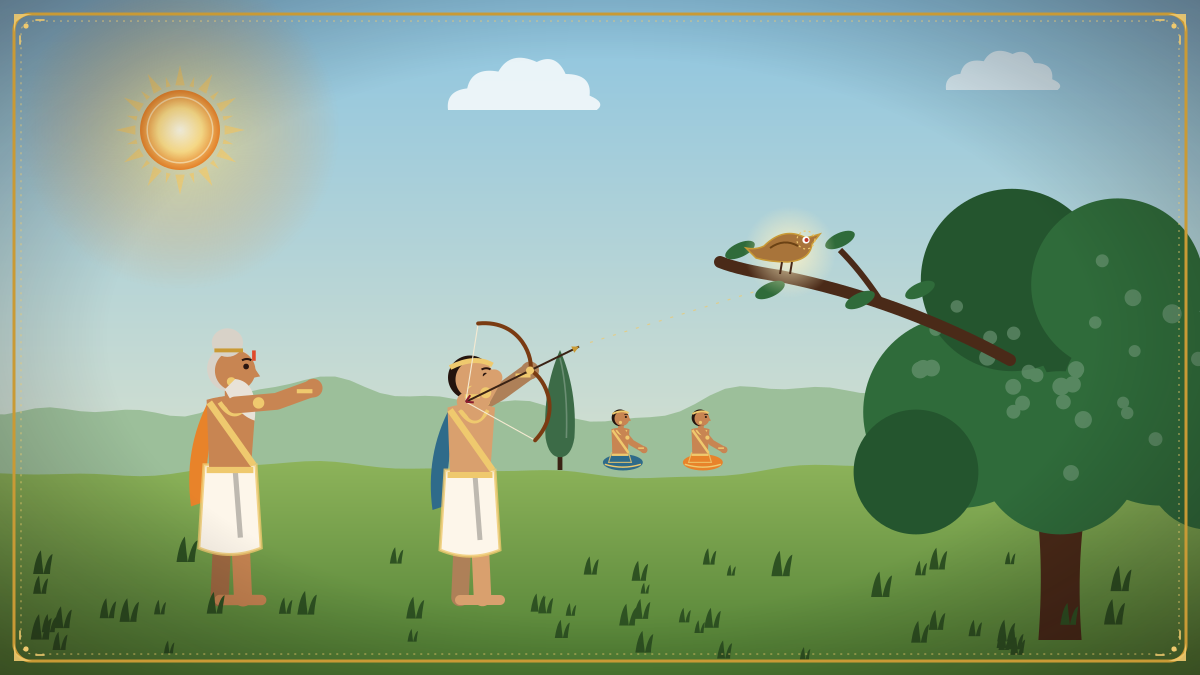
To test his pupils, Drona placed an artificial bird on top of a tree. He asked each one, “What do you see?” Yudhishthira said, “I see the tree, the bird, you and my brothers,” and Drona told him to step aside. Others gave the same kind of answer. When Arjuna's turn came, he said, “I see only the bird, nothing else. I see only its head.” Drona told him to shoot, and the bird's head fell.
Another day, while Drona bathed in the Ganga, a crocodile seized his leg. Though he could have freed himself, Drona called to his pupils. Before the others could move, Arjuna shot the crocodile with five arrows. Pleased, Drona gave Arjuna the mighty Brahmashira weapon, warning him never to use it against ordinary men.
Ekalavya, the son of Hiranyadhanu, king of the Nishadas, also came to learn from Drona. Drona refused him, because he was a Nishada and out of regard for the princes. Ekalavya went into the forest, made a clay image of Drona, and practised before it as his guru until he became an amazing archer. When the Pandavas found him, Arjuna reminded Drona of his promise. Drona went to Ekalavya and asked for his right thumb as a teacher's fee. Ekalavya cut it off at once and gave it with joy. After that his arrows were never as swift, and Arjuna remained without equal.
When the training was complete, a great tournament was held so that the people of Hastinapur could see the princes' skill. Drona and Kripa presided over it, and Arjuna's display of divine weapons filled everyone with wonder.
Guru-dakshina: half of Panchala
Then Drona asked his pupils for his teacher's fee: “Capture Drupada, king of Panchala, in battle and bring him to me.” The Kauravas, with Karna, rushed ahead first, but the Panchalas drove them back. Then Arjuna and his brothers attacked. Arjuna leapt onto Drupada's chariot and captured him.
Drupada was brought before Drona. Drona said, “I have taken your kingdom. Do you still want my friendship? You said that only a king can be a king's friend. So I will keep the part of Panchala north of the Ganga, and you rule the part to the south. Now we are equals, and I give you my friendship again.” He let Drupada go with honour.
But Drupada never forgot this humiliation. Wishing for a son who could kill Drona, he performed a great fire sacrifice with the help of the sages Yaja and Upayaja. From the fire rose a shining young warrior, Dhrishtadyumna, and from the altar came Draupadi. A heavenly voice said that this son was born to kill Drona.
Drona knew this prophecy well. Yet, believing that destiny cannot be avoided and wishing to keep his own good name, he took Dhrishtadyumna to his home and taught him the use of weapons too.
At the court of Hastinapur
Drona stayed loyal to the throne that had given him honour. He was present in the hall during the game of dice and sat silent while Draupadi was insulted. After the Pandavas left for the forest, he told Dhritarashtra and Duryodhana plainly that the Pandavas could not be destroyed. “I will not abandon those who have taken shelter with me,” he said, “but this quarrel will bring great ruin.”
When the Kauravas raided King Virata's cattle in the last year of the Pandavas' exile, Drona praised Arjuna openly and warned the Kauravas to be careful. Before the war he more than once advised Duryodhana to make peace with the Pandavas, but Duryodhana would not listen.
On the first morning of the war, Yudhishthira walked across the field to bow to his elders. Drona blessed him and said, “A man is the servant of wealth, and I am bound by the Kauravas' wealth. I must fight for them, but I wish you victory.” When Yudhishthira asked how he could be overcome, Drona said that he would lay down his weapons only when he heard very bitter news from a man whose word he trusted.
Commander for five days, and his end
After Bhishma fell on the tenth day, Drona became commander of the Kaurava army. Though eighty-five years old and white-haired, he fought like a youth of sixteen. Duryodhana asked him to capture Yudhishthira alive, and Drona agreed, if Arjuna could be drawn away. On the twelfth day the Samshaptaka warriors lured Arjuna away, but Arjuna returned in time to save his brother.
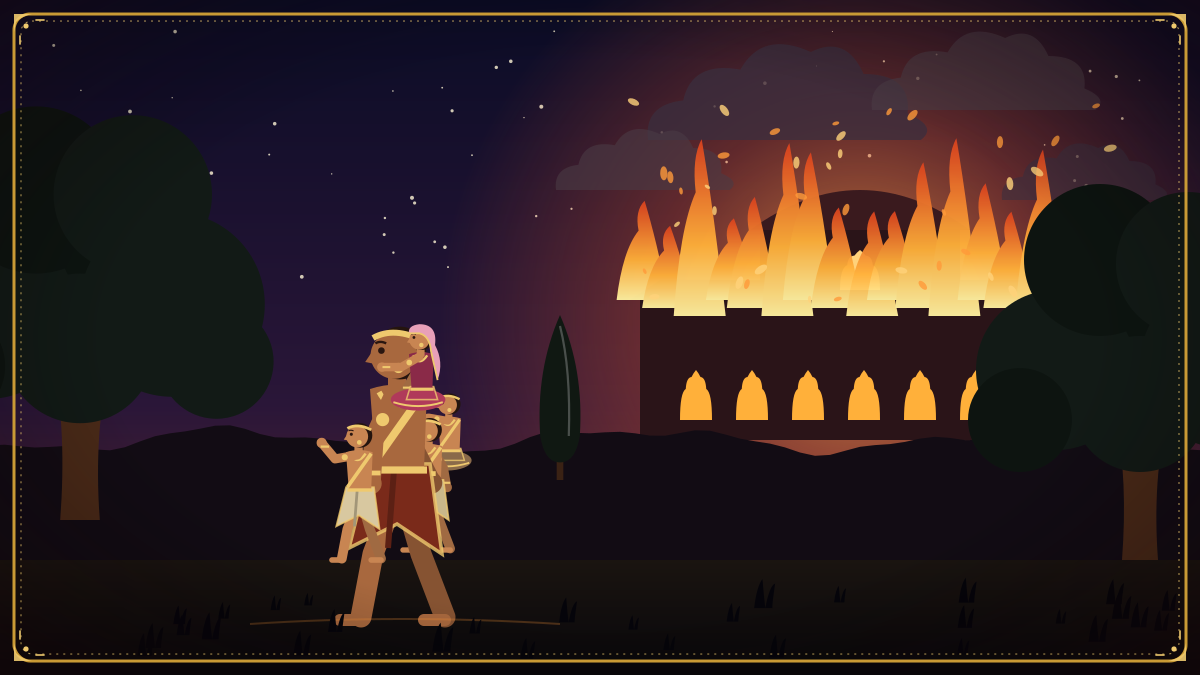
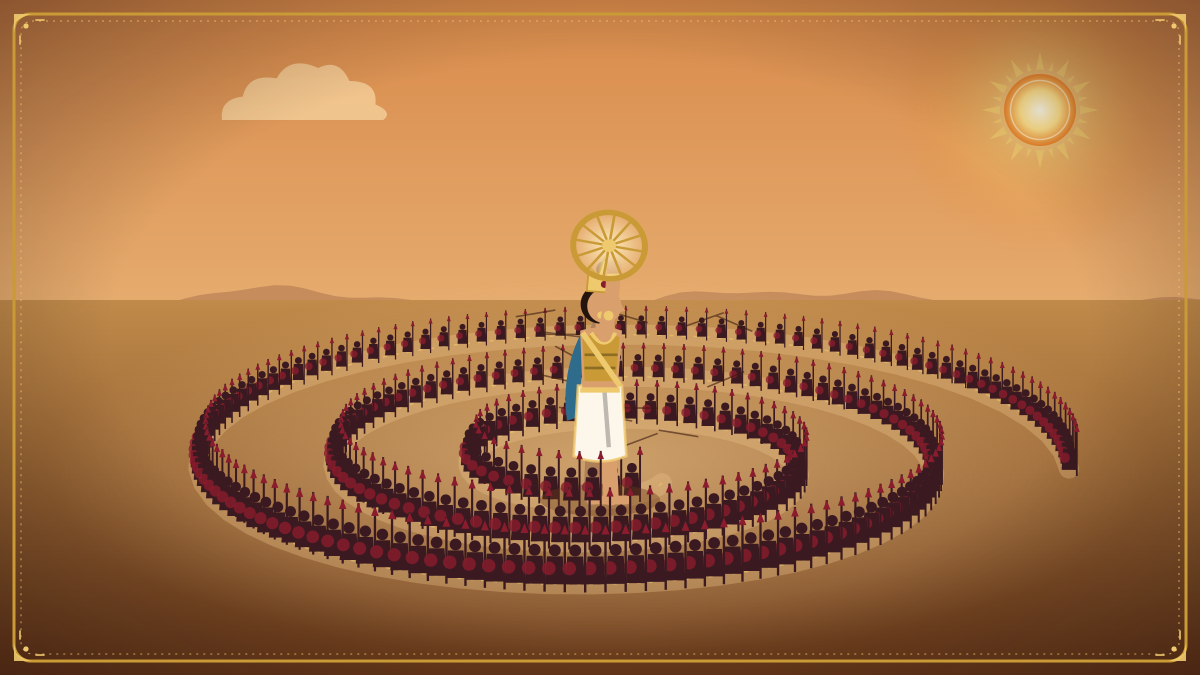
On the thirteenth day Drona arranged the Chakravyuha, the wheel formation. Young Abhimanyu broke into it and fought many great warriors alone, and he fell inside it. On the fourteenth day Drona guarded Jayadratha with strong formations, but Arjuna broke through and killed him before sunset. The fighting went on deep into the night.
At dawn on the fifteenth day Drona killed King Drupada and King Virata. He was using divine weapons against soldiers who did not know them. Then great sages, including Vishvamitra, Jamadagni, Vasishtha and Bharadwaja, appeared before him and said, “You are fighting unrighteously. Your time has come. Lay down your weapons.”
Krishna knew that no one could defeat Drona while he held his bow. Bhima killed an elephant named Ashwatthama and shouted, “Ashwatthama is dead!” Drona did not believe it and asked Yudhishthira, who always spoke the truth. Urged by Krishna, Yudhishthira said, “Ashwatthama is dead,” and added softly, “the elephant.” At that moment Yudhishthira's chariot, which had always moved a little above the ground, touched the earth.
Believing that his son was gone, and also stung by Bhima's harsh words, Drona put down his weapons and sat in his chariot in yoga, his mind fixed on the Supreme. His spirit rose to heaven, bright as a shining star, seen only by a few. Dhrishtadyumna then struck down his lifeless body, though Arjuna had cried out, “Bring the teacher alive! Do not kill him!” Arjuna grieved deeply for his guru.
Did you know?
- The name Drona means a wooden vessel or pot, because he is said to have been born in one.
- Before the war began, Drona himself told Yudhishthira the only way he could be defeated: by hearing terrible news from someone he trusted.
- Yudhishthira’s chariot is said to have touched the ground for the first time after he spoke the half-truth about Ashwatthama.
- India’s highest award for sports coaches is called the Dronacharya Award, after this great teacher.
What we learn from Dronacharya
Drona's life shows that great knowledge must be joined with fairness and freedom from anger. His wounded pride against Drupada, his partiality for Arjuna, his harshness to Ekalavya and his deep attachment to his son led him into hard choices. Yet he kept his word, served the throne that sheltered him, and left the world in meditation. His story teaches that a teacher's greatest gift is not skill alone, but a life of dharma.
Dronacharya in the story
Read the chapters where Dronacharya plays a part.