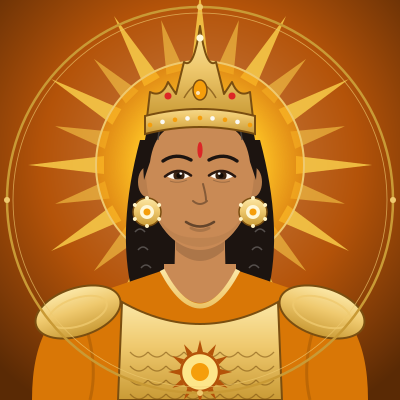
Karna was the eldest son of Kunti, born before her marriage by the blessing of Surya, the Sun god. That made him the elder brother of Yudhishthira, Bhima, Arjuna, Nakula and Sahadeva, though for most of his life he did not know it. Kunti, young and afraid, set the baby afloat on a river, and he was raised by the charioteer Adhiratha and his wife Radha, so the world called him Radheya, the son of Radha. He grew into one of the greatest archers of his time, a friend who never left Duryodhana’s side and a giver who never sent anyone away empty-handed. Yet the same loyalty kept him on the wrong side of the war. His life, full of courage, hurt pride, generosity and sorrow, is one of the most moving stories in the whole Mahabharata.
Born of the Sun, raised by a charioteer
When Kunti was a young girl in the house of King Kuntibhoja, she served the sage Durvasa with great care. Pleased, he taught her a mantra by which she could call any god and receive a son from him. Out of girlish curiosity she tried it at once and called Surya. The Sun god came and, by his blessing, a son was born to her, shining like the sun itself and wearing from birth a natural armour (kavacha) and a pair of earrings (kundala).
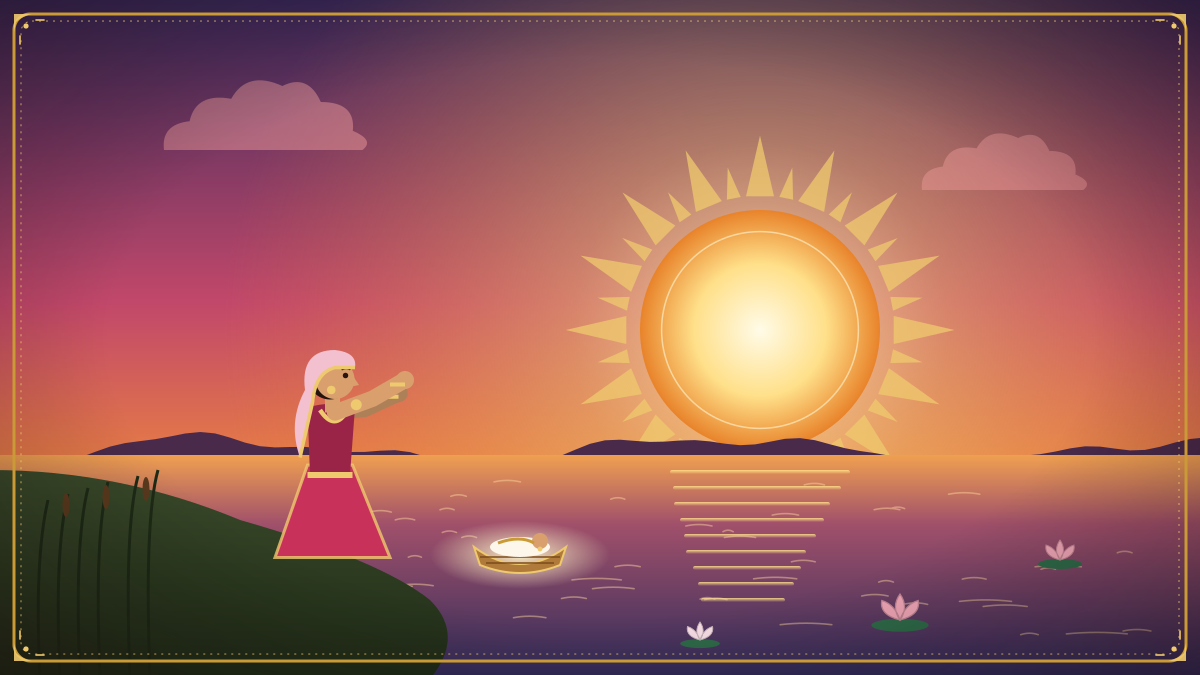
Kunti was unmarried and frightened of what the world would say. With a heavy heart she laid the baby in a covered basket and set it afloat on the river Ashva, weeping and praying for his safety. The basket drifted on from river to river until it reached the Ganga near the city of Champa.
There it was found by Adhiratha, a charioteer and a friend of King Dhritarashtra, and his wife Radha, who had no children of their own. They took the shining baby home as a gift from the gods. Because he was born with such treasures on his body, they named him Vasushena, “the one born with wealth”. Radha and Adhiratha raised him with deep love, and all his life Karna honoured them as his true parents.
Learning the bow, and two curses
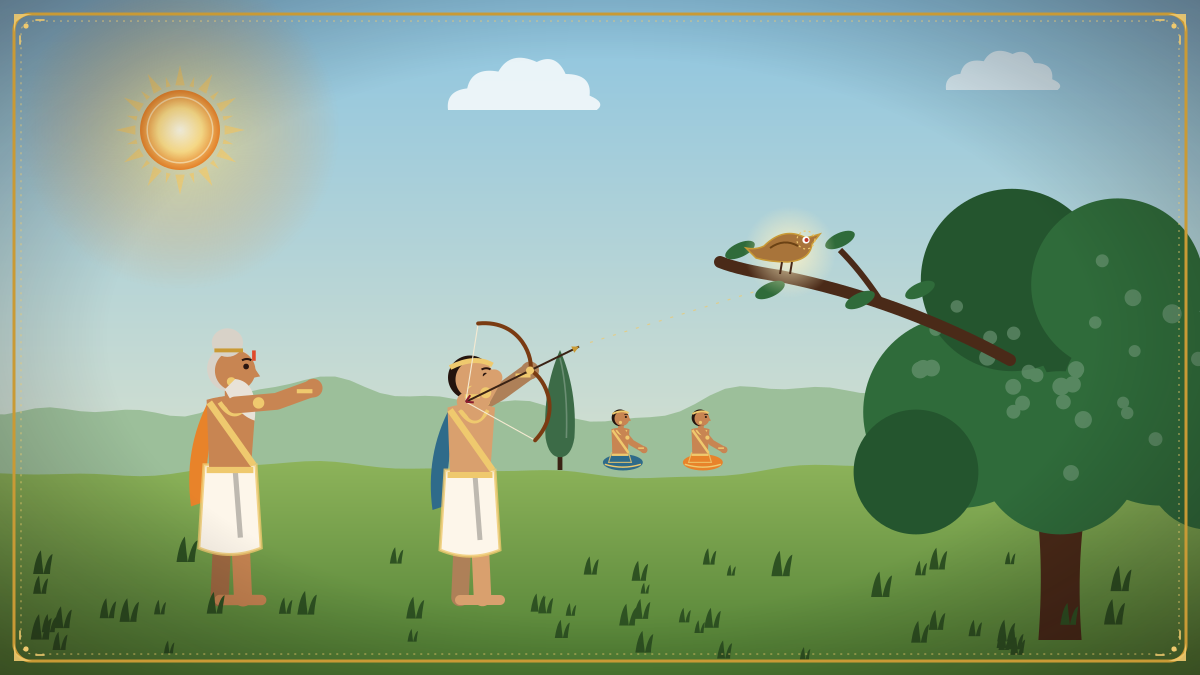
Karna longed to be a great warrior. He studied the bow with Dronacharya at Hastinapur along with the Kuru princes, and soon he could match Arjuna in almost every skill. From those days on, a fierce rivalry grew between the two, and Karna drew close to Duryodhana.
Karna wanted to learn the Brahmastra, the most powerful of divine weapons. Drona refused, saying that this knowledge was not to be given to him. So Karna went to the mountain Mahendra, to Parashurama, the great teacher of weapons, and introduced himself as a brahmin of the Bhrigu family. Parashurama accepted him and taught him the use of the Brahmastra and many other weapons.
While he was living there, Karna once went out practising with his bow and, without meaning to, killed a cow that belonged to a brahmin and was kept for his sacred fire rituals. Karna begged forgiveness, but the angry brahmin cursed him: “When you are fighting the enemy you most wish to defeat, the earth will swallow the wheel of your chariot, and he will strike you while you are in trouble.”
One day Parashurama fell asleep with his head on Karna’s lap. A stinging insect bored into Karna’s thigh, but he sat perfectly still so as not to wake his teacher, though blood flowed from the wound. When Parashurama woke and saw this, he said, “No brahmin could bear such pain. Tell me the truth.” Karna confessed that he was the son of a charioteer. Parashurama cursed him that when he needed the Brahmastra most, in a fight with his equal, he would forget how to call it. Then he sent him away.
The tournament and the crown of Anga
When the Kuru princes finished their training, Drona held a grand tournament in Hastinapur so the people could see their skill. Arjuna amazed everyone. Then Karna strode into the arena, shining in his armour and earrings, repeated every feat Arjuna had shown, and challenged him to a single combat. In the royal gallery, Kunti recognised her son and fainted.
Kripacharya stepped forward and said that before such a duel each fighter must announce his family; a prince fights only with an equal. Karna lowered his head in shame. At once Duryodhana declared, “If Arjuna will fight only a king, I make Karna king of Anga this very moment.” He had Karna crowned on the spot. Karna asked how he could ever repay this, and Duryodhana replied, “I want only your friendship forever.”
Just then old Adhiratha came into the arena, trembling with joy, and the newly crowned king bowed his head at his father’s feet. Seeing this, Bhima mocked Karna as a charioteer’s son. Duryodhana defended him angrily, but the sun was setting and the tournament ended. From that day Karna and Duryodhana were bound together for life.
The swayamvara and the dice hall
Karna was among the many kings and heroes who came to Draupadi’s swayamvara at King Drupada’s court, where the prize was to string a huge bow and hit a target. Different versions of the text tell what happened when Karna came to the bow in slightly different ways, but in the end it was Arjuna, dressed as a young brahmin, who won Draupadi. When the angry kings attacked, Karna fought the young brahmin and was amazed by his skill. He withdrew, saying he would not continue against a brahmin of such power.
Years later, when Yudhishthira lost everything to Shakuni at the game of dice, Karna was in the assembly hall. He stood firmly with Duryodhana. He scolded Vikarna, who alone among the Kauravas spoke up for Draupadi, spoke harsh and insulting words to her, and told Dushasana to take away the upper garments of the Pandavas and of Draupadi too.
It was the darkest moment of Karna’s life. Much later, speaking to Krishna before the war, he admitted that he had spoken those cruel words only to please Duryodhana, and that he now burned with regret for them.
The forest years and the gift to Indra
While the Pandavas lived in the forest, Duryodhana went with Karna to the cattle stations near the Dvaita lake, really to show off his wealth before them. There they clashed with the Gandharva king Chitrasena. Karna’s chariot was broken to pieces and he had to flee from the field, while Duryodhana was captured. It was the Pandavas themselves who rescued him, which shamed Duryodhana deeply. Karna comforted him and gave him new courage.
To lift his friend’s spirits, Karna set out on a great campaign of conquest in all four directions. He defeated many kings and made them pay tribute to Duryodhana, who then performed a grand sacrifice. At that time Karna made a vow: until he had killed Arjuna, he would not let anyone wash his feet, and he would never say “no” to anyone who asked him for anything.
Indra, Arjuna’s father, knew that while Karna wore his inborn armour and earrings, no one could defeat him. Surya came to Karna in a dream and warned him: “Indra will come disguised as a brahmin to ask for your armour. Do not give it.” Karna replied that he could not break his vow even to save his life. Surya then advised him at least to ask for Indra’s unfailing Shakti in return.
Indra came at noon, when Karna was worshipping the sun, and asked for the armour and earrings. Karna offered him land, cattle and treasure instead, but the brahmin wanted only those. So Karna cut them from his own body and gave them away with a smile. Amazed, Indra gave him the Vasavi Shakti, a weapon that could surely kill one enemy, but only once, and blessed him that his body would bear no scar. Because he had cut his armour away, Karna was also called Vaikartana.
The secret revealed
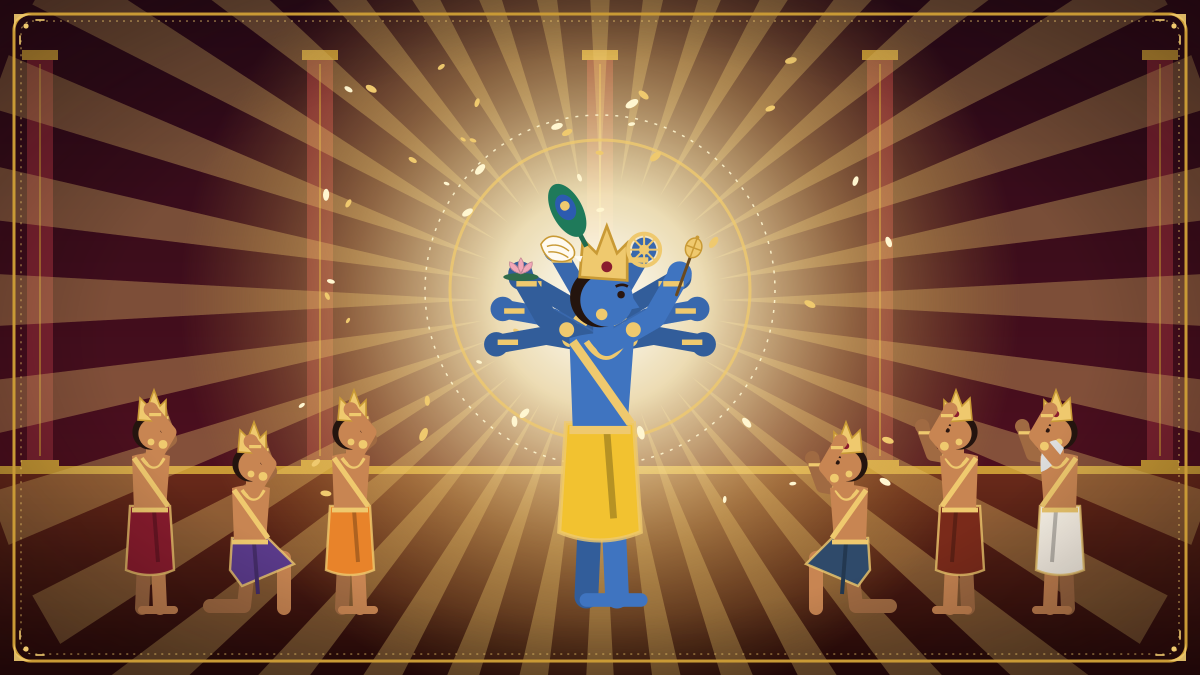
During the Pandavas’ year in disguise, Karna rode with the Kaurava army to seize King Virata’s cattle, and he was defeated by Arjuna. When the Pandavas returned and asked for their kingdom, Krishna came to Hastinapur as a messenger of peace. As he was leaving, he took Karna aside in his chariot and told him the secret: “You are Kunti’s son, born before her marriage. By dharma you are the eldest of the Pandavas. Come with me, and they will make you king, and they will all serve you.”
Karna replied that he already knew the truth. But Radha and Adhiratha had loved and raised him, and Duryodhana had trusted him and built all his hopes on him. He would not betray them now for a kingdom. He told Krishna that the coming war would be like a great sacrifice, and asked only that the Kshatriyas who fell in it might reach heaven.
Soon afterwards Kunti herself came to the bank of the Ganga, where Karna was praying to the sun with folded hands. When she told him she was his mother, a voice from the sun said, “Pritha speaks the truth.” Karna asked her, with pain, why she remembered him only now, when he had been abandoned as a baby. Still, he gave her a promise: “I will not kill Yudhishthira, Bhima, Nakula or Sahadeva, even if I can. Only Arjuna and I will fight to the end. Either way, you will still have five sons.”
Before the war began, Bhishma was counting the great warriors of the Kaurava side and called Karna only half a chariot-warrior, because he had given away his armour and lay under a curse. Deeply hurt, Karna vowed not to fight as long as Bhishma was leading the army. After Bhishma fell on the tenth day, Karna went to him on his bed of arrows. Bhishma lovingly told him that he knew he was Kunti’s son and had spoken harshly only to curb his pride. Karna asked for his blessing to fight, and Bhishma gave it.
In the war and his last battle
Karna now entered the war. On the thirteenth day, when young Abhimanyu was fighting alone inside the Chakravyuha, it was Karna who, on Drona’s advice, cut his bow from behind. In battle Karna also defeated Bhima, Yudhishthira, Nakula and Sahadeva at different times, but each time he let them go with only sharp words, keeping the promise he had made to his mother.
On the fourteenth night Bhima’s son Ghatotkacha was destroying the Kaurava army with his magic. In panic, Duryodhana begged Karna to stop him. Karna had been saving the Vasavi Shakti for Arjuna, but for his friend’s sake he hurled it at Ghatotkacha, who fell. The Shakti returned to Indra, and Arjuna was now safe from it.
After Drona fell, Karna was made commander of the Kaurava army. For his chariot he wanted the best driver, so King Shalya, Madri’s brother and so the maternal uncle of Nakula and Sahadeva, was persuaded to be his charioteer. But Shalya had promised Yudhishthira to weaken Karna’s spirit, and all through the battle he kept praising Arjuna and mocking Karna. On the seventeenth day, before Karna’s own eyes, Arjuna killed his son Vrishasena.
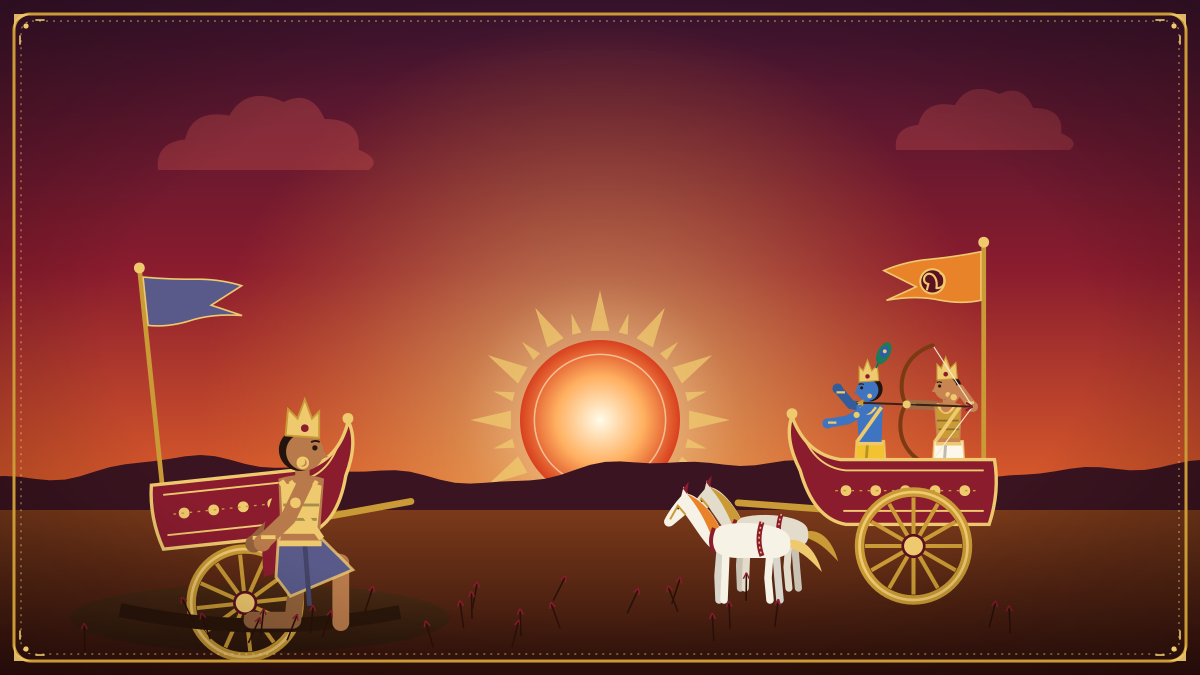
At last Karna and Arjuna faced each other. Karna shot a terrible serpent-arrow at Arjuna’s head, but Krishna pressed the chariot down into the earth, and the arrow only knocked off Arjuna’s crown. Then, just as the brahmin had said, the earth seized the left wheel of Karna’s chariot, and, as Parashurama had said, he could not remember the Brahmastra. Karna jumped down to lift the wheel and asked Arjuna to wait, as the rules of fair fighting required.
Krishna answered him, “Where was your dharma when Draupadi was insulted in the hall, when the Pandavas were cheated at dice, and when young Abhimanyu was surrounded by many?” Karna bowed his head and had no answer. He fought on bravely, but Arjuna’s arrow ended his life. Only after the war, when Kunti told her sons that Karna had been their eldest brother, did the Pandavas learn the truth, and Yudhishthira grieved for him most bitterly of all.
Did you know?
- Karna’s first name was Vasusena; he was also called Radheya, after his foster mother Radha.
- The capital of his kingdom of Anga was Champa, near the river Ganga.
- He received two curses, one from his guru Parashurama and one from a brahmin, and both came true on the day he died.
- Yudhishthira performed Karna’s last rites himself after learning that Karna was his elder brother.
What we learn from Karna
Karna teaches us generosity and gratitude: he gave away even the armour that protected his life, and he never forgot those who had loved and stood by him. But his story also warns us that loyalty to a friend must not make us support what is wrong, as he did in the dice hall. Our birth does not decide our worth; our actions do.
Karna in the story
Read the chapters where Karna plays a part.