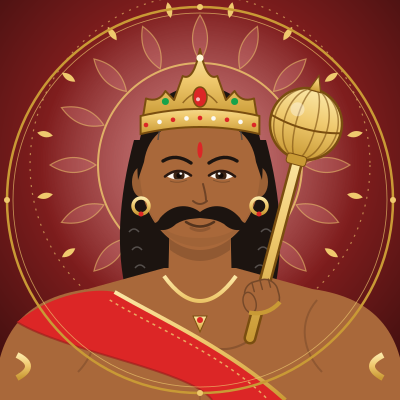
Bhima, also called Bhimasena and Vrikodara, “the one with a wolf’s belly”, was the second of the five Pandava brothers. His mother was Kunti and his father King Pandu; he was born by the blessing of Vayu, the wind god. That made Hanuman, who is also a son of Vayu, his elder brother. Yudhishthira was older than Bhima and Arjuna younger, while the twins Nakula and Sahadeva, sons of Pandu’s second wife Madri, were his younger half-brothers. Bhima was the strongest man of his time and had a famous appetite, yet he had a tender heart for his mother, his brothers and Draupadi. Again and again it was Bhima who carried the family through danger. He freed ordinary people from cruel demons, and in the Kurukshetra war he kept the two fearsome vows he had made in the dice hall.
Birth and a boyhood of rivalry
King Pandu could not father children because of a sage’s curse, so Kunti used the mantra given to her by the sage Durvasa. After Yudhishthira was born, Pandu said, “Kshatriyas value strength above all. Ask for a son of great strength.” Kunti called upon Vayu, and Bhima was born. A voice from the sky declared that he would be the foremost of all strong men. On the very same day, in Hastinapur, Duryodhana was born.
When Bhima was still a baby, a tiger once frightened Kunti on the mountain Shatashringa. She jumped up, and the child slipped from her lap onto a rock. The baby was not hurt at all, but the rock broke into pieces. After Pandu’s death, Kunti brought her sons and Madri’s twins to Hastinapur to live with Pandu’s elder brother Dhritarashtra and his hundred sons.
In the games of childhood Bhima always won. He would pull the Kaurava boys by their hair, duck them under water, or climb the tree they were sitting in and shake it until they fell down with the fruit. He did this out of a boy’s high spirits, not out of hatred, but Duryodhana began to hate him deeply and looked for a way to get rid of him.
During a picnic at Pramanakoti on the bank of the Ganga, Duryodhana mixed poison into Bhima’s food. When Bhima fell unconscious, Duryodhana tied him with creepers and pushed him into the river. Bhima sank down to the land of the Nagas, the serpent people. Their bites drove out the poison, and the old Naga Aryaka, an elder of Kunti’s own family line, recognised him. The Naga king Vasuki had him drink eight bowls of a divine drink, each holding the strength of thousands. Bhima slept for eight days and returned home far stronger.
The princes then studied under Kripacharya and Dronacharya. Bhima and Duryodhana both became masters of the mace, and the two were rivals from then on. At the tournament where the princes showed their skills, their mock fight became so fierce that Drona had to send Ashwatthama to separate them.
Saviour of his family
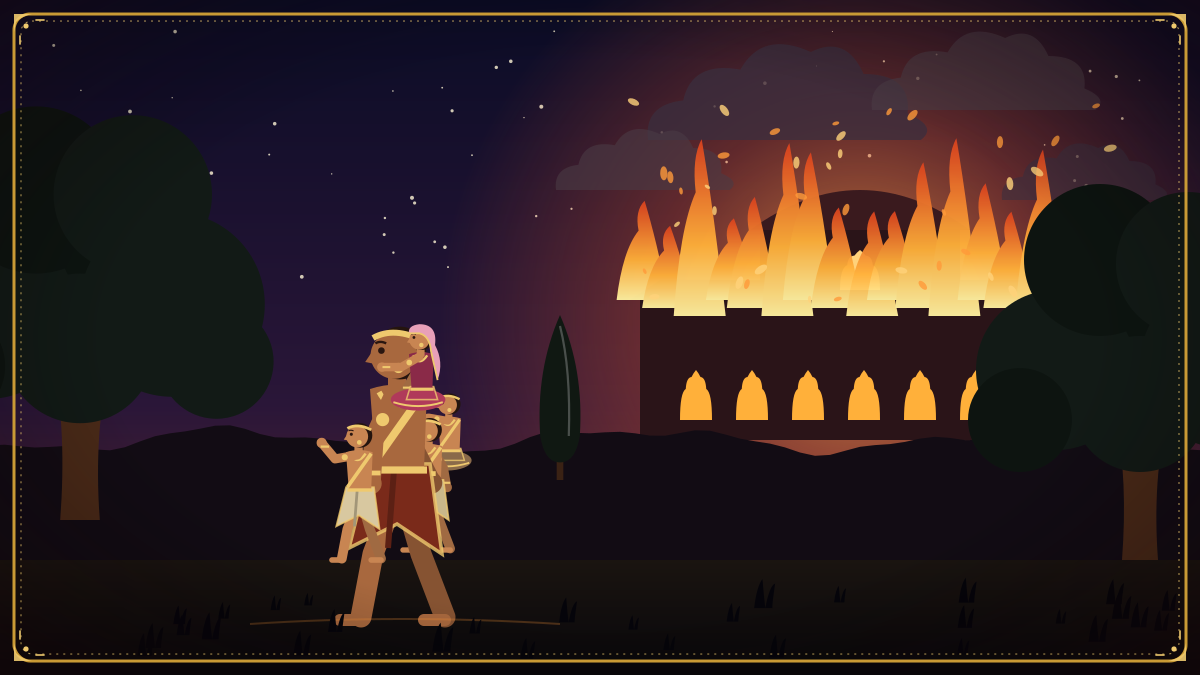
Duryodhana later sent the Pandavas and Kunti to Varanavata to stay in a house made of lac, which would burn in a moment. Warned in secret by Vidura, they dug a tunnel. On the chosen night Bhima himself set the house on fire and led everyone out. When the others grew tired in the dark forest, he lifted his mother onto his shoulders, held the twins on his hips and took Yudhishthira and Arjuna by the hand, and carried them all to safety.
While his family slept under a tree, Bhima kept watch. The rakshasa Hidimba sent his sister Hidimbi to catch them, but she fell in love with Bhima. Hidimba attacked in a rage, and Bhima fought and killed him. With Kunti’s and Yudhishthira’s permission, Bhima married Hidimbi on the condition that he would stay with her only until a son was born. Their son was Ghatotkacha, who promised to come whenever his father needed him.
The Pandavas then lived quietly in the town of Ekachakra, disguised as Brahmins, in the house of a kind Brahmin. A demon named Baka forced the town to send him a cartload of food and one person every week. When it was their host’s turn, Kunti offered to send Bhima in his place. Bhima happily ate the food himself on the way, then fought and killed Baka, and the town lived without fear from that day.
Draupadi, Indraprastha and Jarasandha
At Draupadi’s swayamvara in Panchala, Arjuna won the bride. When the angry kings attacked the “Brahmin” who had won, Bhima pulled up a tree and stood beside his brother, and he defeated the strong King Shalya in a wrestling bout. Krishna, watching, recognised the brothers. Draupadi became the wife of all five Pandavas, and Bhima’s son with her was Sutasoma. Later Bhima also married Valandhara, a princess of Kashi, whom he won at her swayamvara; their son was Sarvaga.
When Yudhishthira wished to perform the Rajasuya sacrifice, Krishna explained that the mighty King Jarasandha of Magadha, who held many kings in prison, must first be removed. Krishna, Bhima and Arjuna went to Magadha dressed as Brahmin students. Jarasandha agreed to a wrestling match and chose Bhima as his opponent.
The two wrestled day and night for thirteen days without rest. On the fourteenth day Jarasandha grew tired, and at Krishna’s signal Bhima overcame and killed him. The imprisoned kings were set free, and Jarasandha’s son, also named Sahadeva, was placed on the throne.
For the Rajasuya, Bhima rode to the east and brought many kingdoms, among them Chedi, Kosala, Kashi, Anga and Vanga, under Yudhishthira’s rule. Maya, the architect who built the wonderful assembly hall of Indraprastha, also brought Bhima a great heavy mace, which became his chief weapon.
The dice hall and the forest years
In the dice game Yudhishthira lost his kingdom, his brothers, himself and finally Draupadi. When Dushasana dragged her into the hall and Duryodhana insulted her by baring his thigh to her, Bhima could not contain his anger. He vowed before everyone that he would break that thigh with his mace in battle, and that he would take a terrible revenge on Dushasana. The elders trembled at his words.
In the twelve years of forest exile Bhima protected the family from many dangers. He killed the demon Kirmira, who blocked their path, and later the rakshasa Jatasura, who tried to carry off Yudhishthira, the twins and Draupadi. Often he urged Yudhishthira to fight at once, but each time he gave in to his elder brother’s wish to keep his word.
One day the wind carried a beautiful Saugandhika flower to Draupadi, and she asked Bhima for more. On the way he found an old monkey lying across the path who asked him to move his tail aside. Bhima could not even lift it. The monkey was Hanuman. He showed Bhima his huge form, embraced him and blessed him, and promised to sit on Arjuna’s banner in the war and add his roar to Bhima’s. Bhima went on to the lake of Kubera and brought back the flowers.
In the forest a giant python once seized Bhima and held him so tightly that he could not move. It was King Nahusha under a curse. Yudhishthira came, answered the python’s questions on dharma, and set both of them free. When King Jayadratha tried to carry Draupadi away, Bhima caught him. For the sake of their cousin Duhshala, Jayadratha’s wife, Yudhishthira spared his life, so Bhima only shaved his head, leaving five tufts, and let him go in shame.
Ballava the cook, and the road to war
In the thirteenth year the Pandavas lived in disguise at the court of King Virata. Bhima became Ballava, the royal cook, and also showed his skill as a wrestler by defeating a famous champion named Jimuta at a festival.
Kichaka, the queen’s powerful brother and commander of Virata’s army, troubled Draupadi, who was living as the maid Sairandhri. Bhima met Kichaka at night in the dance hall and killed him. When Kichaka’s brothers tried to burn Draupadi along with his body, Bhima drove them off as well. Soon after, when King Susharma of Trigarta raided Virata’s cattle and captured Virata himself, Bhima rescued the king and took Susharma prisoner, though Yudhishthira let him go.
When the time of exile ended and Krishna prepared to go to Hastinapur as a peace messenger, Bhima surprised everyone by speaking gently in favour of peace, so that the family would not be destroyed. Krishna teased him for it, and Bhima replied that he was not afraid of war but only wished to avoid the slaughter of their own kin. When the brothers were asked who should lead the army, Bhima suggested Shikhandi.
Keeping his vows in the war
In the Kurukshetra war Bhima was like a storm. On the second day he defeated the king of Kalinga, and from the early days onwards the sons of Dhritarashtra fell before him one after another. On the fourteenth day he cut his way into the Kaurava army to find Arjuna, and many more of Duryodhana’s brothers fell, among them Vikarna, who had once spoken up for Draupadi. Bhima grieved for Vikarna even as he fought him.
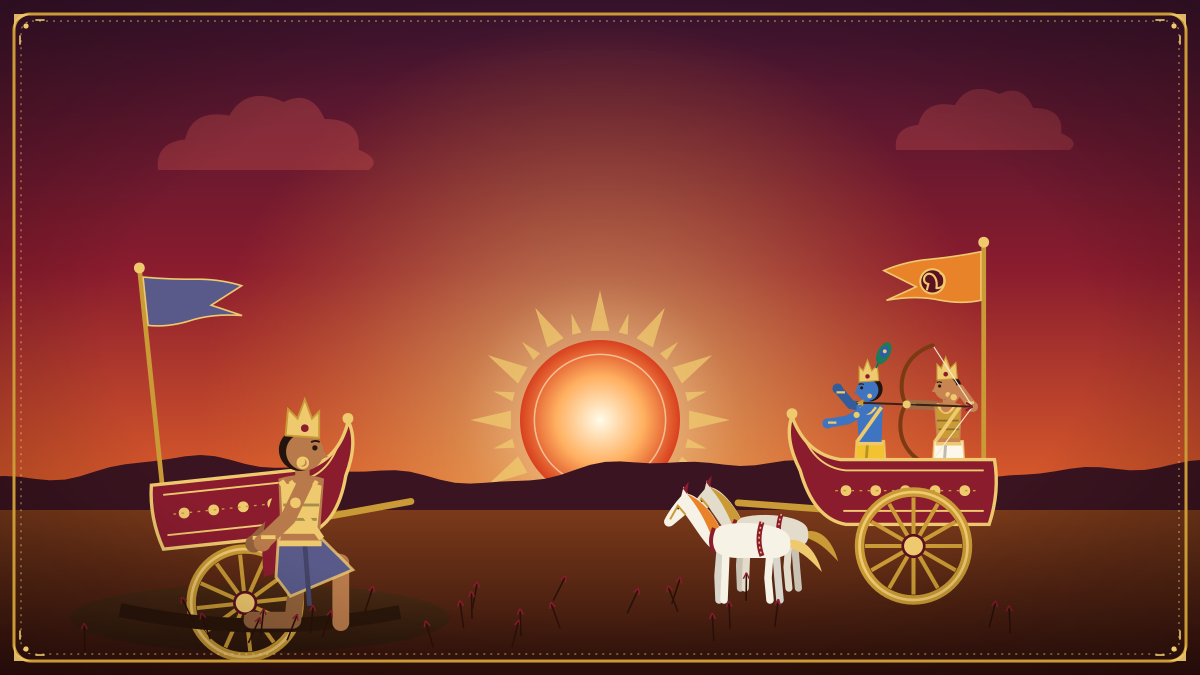
That day Karna defeated Bhima in a long duel but spared his life, because he had promised Kunti that he would kill none of her sons except Arjuna. That same night Bhima’s son Ghatotkacha fought for the Pandavas and was killed by Karna’s divine spear. On the fifteenth day Bhima killed an elephant named Ashwatthama, and the cry “Ashwatthama is dead” was used to make Drona lay down his weapons.
On the seventeenth day Bhima met Dushasana in battle and killed him, fulfilling the fearsome vow he had made for Draupadi thirteen years earlier. On the eighteenth day he killed the last of Duryodhana’s brothers who were still fighting.
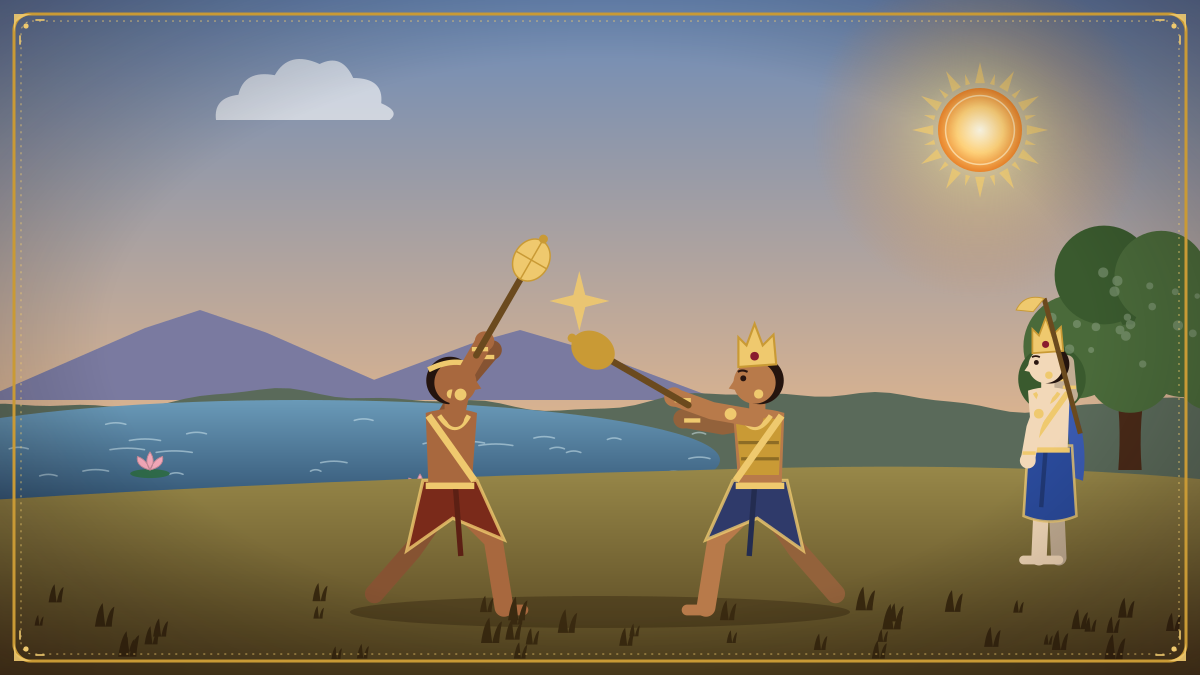
Duryodhana then hid in a lake. Yudhishthira offered him the kingdom if he could defeat any one of the brothers, and Duryodhana chose a mace duel; Bhima stepped forward. It was a long and terrible fight. Krishna said that Duryodhana was the more skilful, and Arjuna reminded Bhima of his vow by striking his own thigh. Bhima struck Duryodhana’s thighs and he fell. Balarama, who had taught both of them the mace, was furious that a blow below the waist had been struck, but Krishna calmed him.
After the war and the last journey
That night Ashwatthama attacked the sleeping Pandava camp, and Draupadi’s five sons, including Bhima’s son Sutasoma, were killed. Bhima set out at once after Ashwatthama. When Ashwatthama was defeated, the jewel on his forehead was taken, and Bhima carried it to Draupadi to comfort her.
When the Pandavas went to meet the grieving Dhritarashtra, the blind king embraced an iron image of Bhima, which Krishna had wisely put forward, and crushed it in his grief and anger. Later his rage melted into tears. When Yudhishthira was crowned, he made Bhima the yuvaraja, the crown prince. During the Ashvamedha sacrifice, Bhima and Nakula guarded the kingdom. Bhima found it hard to forget the past and sometimes spoke sharply to Dhritarashtra, which added to the old king’s sorrow before he left for the forest.
At the end of their lives the Pandavas and Draupadi gave up the kingdom and walked towards the Himalayas. One by one Draupadi, Sahadeva, Nakula and Arjuna fell, and each time Bhima asked Yudhishthira why. At last Bhima himself fell and asked, “If you know, tell me why I have fallen.” Yudhishthira answered, “You ate too much, and you boasted of your strength, thinking little of others.”
Only Yudhishthira reached heaven in his body. There he later found Bhima shining with glory among the Maruts, beside his divine father Vayu.
Did you know?
- Bhima’s name Vrikodara means “wolf-bellied”, because of his huge appetite.
- Bhima and Duryodhana, the two great rivals of the epic, are said to have been born on the same day.
- Hanuman and Bhima are both sons of Vayu, the wind god, so Hanuman is called Bhima’s elder brother.
- After the war, Dhritarashtra crushed an iron statue that Krishna had cleverly placed in front of him in Bhima’s place.
What we learn from Bhima
Bhima teaches that strength is meant for protecting others, especially the weak and the people we love. He went into danger first so that his family could be safe, and he kept his promises however long it took. His fall reminds us that even a hero should eat in moderation, share with others and never boast of his own power.
Bhima in the story
Read the chapters where Bhima plays a part.