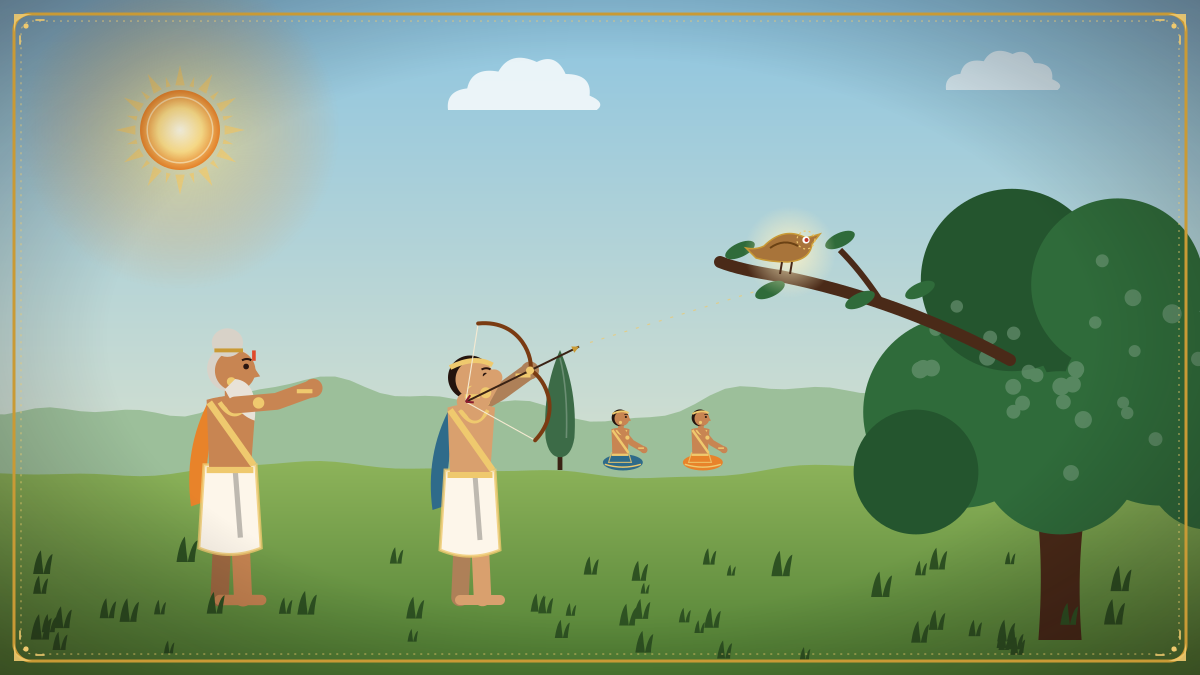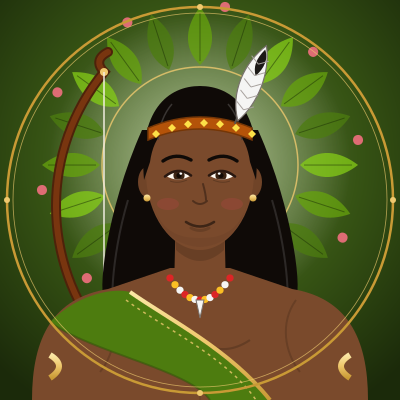
Ekalavya was the son of Hiranyadhanu, king of the Nishadas, a people who lived in the forests. In the Adi Parva of the Mahabharata he comes to Dronacharya, the teacher of the Kuru princes, and asks to learn archery. Drona does not accept him. Ekalavya does not give up. He makes a clay image of Drona in the forest, honours it as his guru and practises day after day, until his speed with the bow is greater even than Arjuna's. When Drona asks for his right thumb as guru-dakshina, he gives it at once, with a cheerful face. The epic says very little else about him, but those few lines have made him one of its most remembered figures — a picture of devotion, and a story that still makes us think about fairness.
A son of the forest
The Mahabharata tells Ekalavya's story in one short chapter of the Adi Parva, but that chapter is full of feeling. He was the son of Hiranyadhanu, whom the epic calls the king of the Nishadas. The Nishadas lived in the forests and hills, and lived by hunting, so Ekalavya grew up with a bow in his hands.
At that time Dronacharya had become the teacher of the young princes of Hastinapur. Bhishma had brought him to train the hundred Kauravas and the five Pandavas in the use of weapons. Drona's fame spread far, and the epic says that princes from many other kingdoms also came to learn from him.
Among all the students, Arjuna stood out for his hard work. Drona loved him dearly. One night, Drona found Arjuna practising archery in the dark. Pleased, he told him, “I will do everything so that no archer in the world is your equal. I tell you this truly.” This promise is important for understanding what later happens to Ekalavya.
Refused at the teacher's door
Hearing of Drona's fame, Ekalavya came to him and asked to be taught archery. The epic says that Drona, who knew dharma well, did not accept him as a student. It also gives the reason plainly: Drona thought of him as the son of a Nishada, and he was thinking of the interests of the Kuru princes whom he had been engaged to teach.
It must have been a hard moment for a young man who had come with so much hope. But Ekalavya did not argue, and he did not turn bitter. He bowed his head at Drona's feet, as a student bows to a teacher, and quietly went back into the forest.
Here we already see the quality that marks his whole story. In his heart he had accepted Drona as his guru, and a refusal from outside could not change what he had decided within.
The clay guru in the forest
In the forest, Ekalavya made an image of Drona out of clay. He treated that image just as a disciple treats a living teacher, with honour and devotion. In front of it he began to practise archery with strict discipline.
There was no one to correct his grip, show him a stance or praise his progress. He had only his faith, his concentration and his daily effort. Yet, the epic says, through that great devotion he became wonderfully skilled in placing the arrow on the string, aiming it and letting it fly with lightning speed.
This is why Ekalavya's name is still spoken in homes and schools. He showed that a student's sincerity can itself become a teacher, and that respect for the guru lives first in the student's own heart.
The dog that stopped barking
One day, with Drona's permission, the Kaurava and Pandava princes set out in their chariots to hunt. A servant followed them carrying their things, and a dog went along with him. Roaming through the forest, the dog came to the place where Ekalavya was practising.
The dog saw a dark young man with matted hair, dressed in black deerskin and covered in forest dust, and it began to bark at him. Ekalavya then shot seven arrows into its mouth, one after another, so fast that they seemed to fly together, and the dog could bark no more. With its mouth full of arrows, it ran back to the princes.
The princes were amazed at such lightness of hand, and the epic says they felt ashamed of their own skill. They searched for the archer and found him shooting arrow after arrow without a pause. When they asked who he was, he replied, “Know me as the son of Hiranyadhanu, king of the Nishadas, and a disciple of Drona, working hard at archery.”
The teacher's fee
The princes went back and told Drona everything. Arjuna kept thinking about Ekalavya. Later, alone with his teacher, he said with affection, “You once embraced me and said that no student of yours would be better than me. Then how is there another student of yours, the son of the Nishada king, who is mightier than me?”
Drona thought for a while. Then he took Arjuna with him and went into the forest. They found Ekalavya with dust on his body, matted hair and rough clothes, bow in hand, shooting arrows without rest. As soon as he saw Drona, Ekalavya came forward, touched his feet, bowed to the ground and honoured him as his teacher. Then he stood before him with folded hands.
Drona said, “If you are my student, then give me my fee.” Ekalavya was overjoyed. “What shall I give, my lord? Only command me. There is nothing I will not give to my teacher.” Drona answered, “Give me the thumb of your right hand.”
These were hard words for any archer to hear. But Ekalavya, true to his word, cut off his right thumb with a cheerful face and an untroubled mind, and gave it to Drona. After that he still shot arrows with his fingers, but he was no longer as quick as before. Arjuna's worry left him, and Drona's promise held true: no one surpassed Arjuna.
What the epic says later
After this, Ekalavya almost disappears from the story. He did not fight at Kurukshetra, because by the time of the great war he was no longer alive. The clearest later mention of him comes in the Drona Parva, in words spoken by Krishna himself.
On the night Ghatotkacha fell, Krishna explained to Arjuna how many dangers had been cleared from his path. He named Jarasandha of Magadha and Shishupala of Chedi, and together with them the mighty Nishada, Ekalavya, and said that they had been slain, one after another and by different means, for Arjuna's good. He also said that, for Arjuna's sake, Drona had taken Ekalavya's thumb by a trick while acting as his teacher, and that Ekalavya, with his thumb and his finger-guards, could not have been defeated in battle even by the gods, demons, rakshasas and serpents together. Krishna ended by saying that he had come into the world to establish dharma.
These words change how we see the earlier story. Ekalavya was not only a devoted pupil; he had grown into a warrior whose strength even Krishna respected. The epic does not hide that his thumb was taken for Arjuna's sake. It records both his devotion and the price he paid, and leaves us to think about them.
Did you know?
- Ekalavya stopped the barking dog with seven arrows in its mouth, without hurting it.
- Ekalavya never studied a single day in Drona’s school, yet he called himself Drona’s student because of his devotion to the clay image.
- During the war, Krishna told Arjuna that Ekalavya, with his thumb, would have been almost impossible to defeat.
- The Government of India runs Eklavya Model Residential Schools for tribal children, named after him.
What we learn from Ekalavya
Ekalavya teaches that real learning grows from faith, focus and steady practice, even when every door seems closed. He kept his word to his teacher without a moment's hesitation, though it cost him dearly. His story also asks us to be fair to every student who comes seeking knowledge, whatever their birth. Devotion is a great virtue, and so is giving others a fair chance.
Ekalavya in the story
Read the chapters where Ekalavya plays a part.