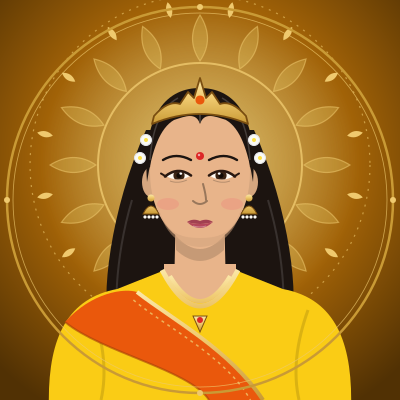
Madri was a princess of Madra, a kingdom in the north-west of India, and the sister of King Shalya. She became the second wife of King Pandu of Hastinapur, after Kunti. Through a mantra that Kunti shared with her, she became the mother of the twin Pandavas, Nakula and Sahadeva. So Nakula and Sahadeva were half-brothers of Yudhishthira, Bhima and Arjuna: the same father, Pandu, but a different mother. Madri's life was short. When Pandu died, she chose to follow him and left her little sons in Kunti's care. Kunti kept that trust all her life. Madri's brother Shalya, the uncle of the twins, later plays an important part in the Kurukshetra war, and her sons became brave and faithful Pandava warriors.
Princess of Madra
Madra was a kingdom famous for its fine horses and brave chariot-warriors. Its princess, Madri, was known everywhere for her beauty and good nature. Her brother Shalya, the king of Madra, was one of the greatest chariot-fighters of the age.
After Pandu had married Kunti, the wise Bhishma, the elder of the Kuru family, wished to find a second queen for him. Hearing of Madri, he travelled to Madra himself with ministers, Brahmins and an army. King Shalya received him with honour and asked why he had come. Bhishma asked for Madri's hand for Pandu.
Shalya replied that in his family there was an old custom: the groom's family gave a price, a rich gift, to the bride's family. Whether people thought it good or bad, he said, he could not break the custom of his ancestors. Bhishma answered that a custom set by the elders is itself a kind of dharma, and he gladly gave gold, jewels, elephants, horses, fine cloth and many other gifts. Shalya then gave his sister to him, and Bhishma brought Madri to Hastinapur, where she married Pandu on an auspicious day.
Queen in Hastinapur and in the forest
Kunti was the elder queen and Madri the younger, and both lived with Pandu in Hastinapur. Pandu went out on a great campaign of conquest and brought back much wealth, which he shared with his family and his elders. Then he went to live in the forest with his two queens, enjoying the beauty of nature and the hunt.
One day Pandu shot a deer that was really a sage named Kindama, who had taken the form of a deer. As he died, the sage cursed Pandu: if he ever came close to his wife with desire, he would die. Pandu was filled with sorrow. He decided to give up his kingdom and live as a hermit.
Kunti and Madri would not leave him. They told him that they too would live simply and pray, as long as they could stay by his side. Pandu sent his royal ornaments back to Hastinapur, and the three of them went to live among the sages on the Shatashringa mountain, the mountain of a hundred peaks. The palace princess Madri now lived in a simple hut with her husband, serving the sages and leading a life of prayer.
Madri's wish for a child
Pandu was sad that he could not have sons. Kunti told him about the mantra the sage Durvasa had given her, and by his wish she became the mother of Yudhishthira, Bhima and Arjuna through the gods Dharma, Vayu and Indra.
Madri watched Kunti's little sons with love, but in her heart she longed to be a mother too. One day she spoke privately to Pandu. She said she was not unhappy at being the younger queen, nor jealous of Kunti's sons. Her only sorrow was that she had no child of her own. Since Kunti was her co-wife, she felt shy to ask her directly. She asked Pandu to speak to Kunti for her.
Pandu gently asked Kunti, and Kunti kindly agreed. She told Madri to think of any god, only once, with the mantra. Madri wisely thought of the Ashvini Kumaras, the twin gods who are the healers of heaven. From that one prayer she was blessed with twin sons.
Later Pandu hoped that Madri could have more sons, but Kunti did not agree. She said that Madri had cleverly called twin gods and received two sons from one prayer, and she did not want to give the mantra again. Even so, there was no bitterness between them, and all five children grew up together as one family.
Nakula and Sahadeva
The sages named the twins Nakula and Sahadeva. Nakula was said to be the most handsome man of his time. He grew up to be a fine swordsman and an expert with horses. Sahadeva was quiet, wise and very learned, and his elder brothers greatly valued his good sense.
The sages of the forest performed the ceremonies for all five boys, and Pandu loved each of them equally. The five Pandavas grew up close together. Yudhishthira, Bhima and Arjuna always treated the twins as their own brothers, and the twins honoured them as elders.
Kunti loved Madri's sons as her own, and Madri loved Kunti's sons as well. These were happy years in the hermitage, with the children playing among the sages and their families.
Madri did not live to see her sons grow up, but they made her name proud. Years later, when Yudhishthira performed the Rajasuya sacrifice, Nakula led the army to the west. When he reached Shakala, the capital of Madra, his uncle Shalya welcomed his sister's son with great affection and gladly accepted Yudhishthira as emperor. At the same sacrifice it was Sahadeva who offered the first honour to Lord Krishna, and he boldly declared that he would stand against anyone who objected to it.
A spring day
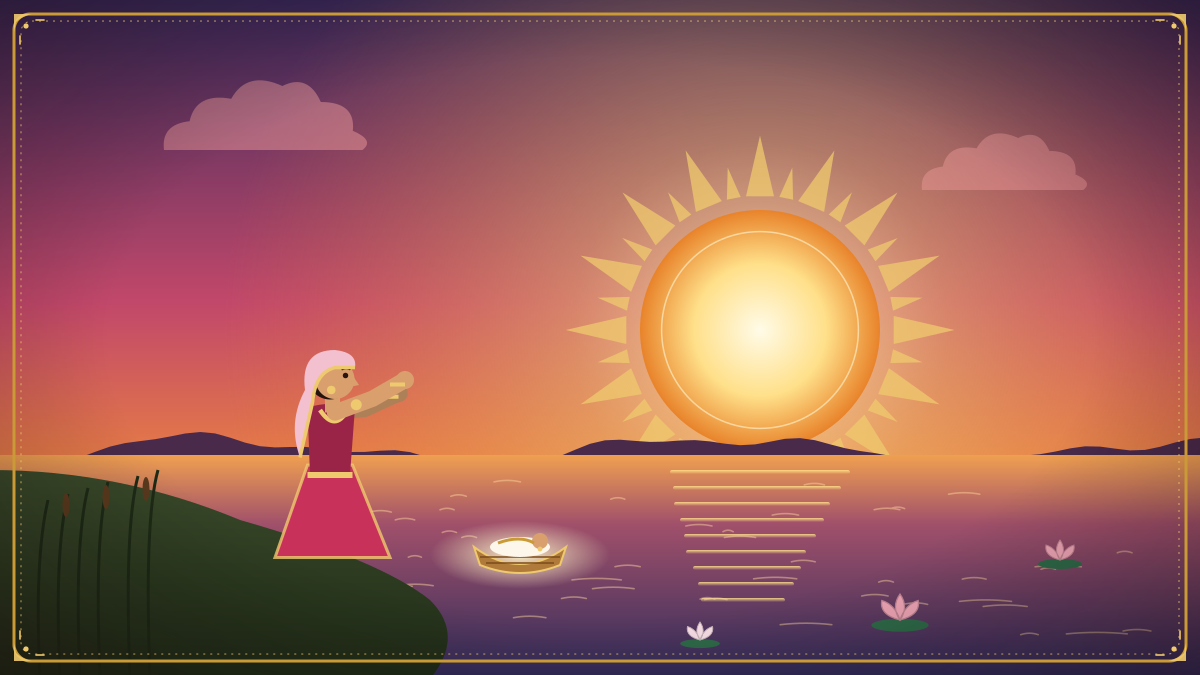
One spring day, the whole forest was in bloom. Pandu was walking in the woods, and Madri followed him alone. Seeing her in the beauty of the season, Pandu forgot the sage's curse. Madri tried to stop him and reminded him of the danger, but he did not listen. He came close to her, and he died at once, just as the sage had said.
Madri cried out in grief, holding her dead husband in her arms. Kunti came running with the children. Madri asked her to keep the children away, and Kunti came alone. Seeing Pandu dead, Kunti wept and said that she, as the elder queen, would follow her husband into death, and Madri should stay and raise the children.
But Madri said that she would go. Pandu had died because of his love for her, so it was right that she should follow him. She also said that she would not be able to treat Kunti's sons exactly as her own, but Kunti would surely raise Madri's sons as if they were hers. She asked Kunti to care for Nakula and Sahadeva.
Then, with the blessings of the sages, Madri gave up her life with her husband and entered his funeral fire. Kunti, a widow now, was left with five little boys.
What she left behind
Seventeen days later, the sages of the forest brought Kunti and the five boys to Hastinapur, along with the remains of Pandu and Madri, and handed the family over to Bhishma, Dhritarashtra and Vidura. The Kuru family performed the last rites for Pandu and Madri together with great honour.
Kunti kept her word to Madri faithfully for the rest of her long life. She raised Nakula and Sahadeva as her own children, and they loved her as their mother. Years later in the forest, a Yaksha offered to bring one of Yudhishthira's dead brothers back to life. Yudhishthira chose Nakula and not his own full brother, saying that both his mothers, Kunti and Madri, should have a living son. Madri was not forgotten.
Madri's brother Shalya set out with a large army to join his nephews before the war. But on the way Duryodhana served him with grand hospitality, and Shalya, feeling grateful, gave his word to fight for the Kauravas. He still met Yudhishthira and promised to help him by weakening Karna's spirit with his words when he drove Karna's chariot. On the last day of the war, Shalya led the Kaurava army and was killed by Yudhishthira.
Madri's sons fought bravely for the Pandavas throughout all eighteen days of the war. Sahadeva killed Shakuni, the uncle of the Kauravas, who had cheated at the game of dice. At the very end of their lives, on the last journey to the Himalayas, the twins walked faithfully beside their brothers until their own time came.
Did you know?
- Nakula and Sahadeva are often called the Madreyas, which means “the sons of Madri”.
- The twins’ divine fathers, the Ashvini Kumaras, are the physicians of the gods.
- At the Yaksha’s lake, Yudhishthira chose to save Nakula so that Madri too would have a living son.
- Madri’s brother Shalya was meant to fight for the Pandavas, but Duryodhana won him over with clever hospitality on the way.
What we learn from Madri
Madri teaches trust and love within a family. Her faith in Kunti, and Kunti's faithfulness to her word, show how two women can support each other instead of competing. Her story also reminds us that a promise made to someone who trusts us must be kept for a lifetime.
Madri in the story
Read the chapters where Madri plays a part.