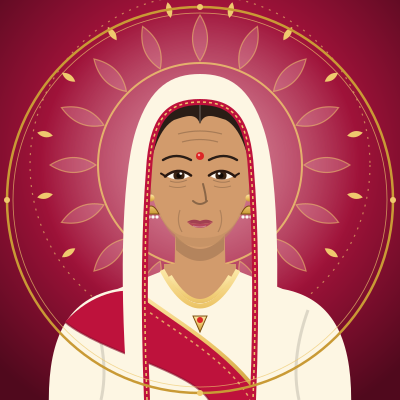
Kunti was born with the name Pritha. Her father was Shura, a king of the Yadava clan, and her brother was Vasudeva, the father of Lord Krishna. So Kunti was Krishna's aunt, his father's sister. As a little girl she was given to King Kuntibhoja, who had no children, and because she grew up as his daughter she came to be called Kunti. She married King Pandu of Hastinapur. Through a mantra given to her by a sage, she became the mother of Yudhishthira, Bhima and Arjuna, and, long before her marriage, of Karna, whom she had to give up. She also raised Madri's twins, Nakula and Sahadeva, as her own. Widowed young, she led her sons through the house of lac, hard years in the forest and a terrible war. At the end she gave up the palace and chose a life of prayer in the forest.
Pritha, the daughter given away
King Shura of the Yadavas had a cousin, King Kuntibhoja, who had no children. Shura had promised him that he would give him his first-born child. Keeping that promise, he gave his little daughter Pritha to Kuntibhoja. The childless king loved her as his own daughter, and from then on she was known as Kunti, the daughter of Kuntibhoja.
In her new home, the king gave young Kunti a special duty: to look after the holy men and guests who came to the palace. One day the great sage Durvasa arrived. He was famous for his short temper, and everyone was afraid of displeasing him. Kunti served him with great patience and care, never getting angry, whatever he asked of her and at whatever hour.
Durvasa was very pleased with her. He saw by his inner sight that hard times would come in her life, and he gave her a special mantra. With it she could call any god she wished, and by that god's grace she would receive a son.
The Sun god and the hidden son
Kunti was still young and unmarried. Out of a girl's curiosity, she wanted to see whether the mantra really worked. Looking at the rising sun, she spoke the mantra and called the Sun god, Surya. At once he stood before her, shining. Kunti was frightened and begged him to go back, saying she had only been testing the mantra. But Surya said that a god who is called by this mantra cannot return without giving its gift. He promised her that she would remain a maiden, and blessed her with a son.
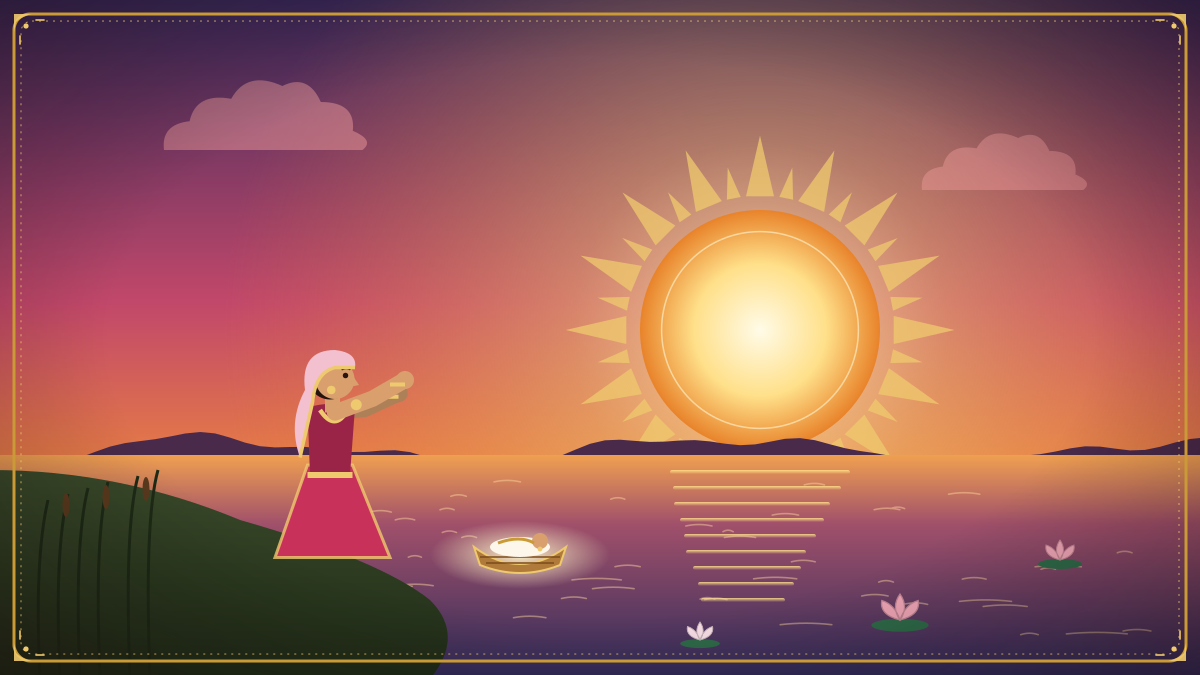
The child was born wearing shining armour and golden earrings that had come with him from birth. Kunti loved him, but she was unmarried and terribly afraid of what the world would say. With tears in her eyes, she laid the baby in a basket, prayed to the gods to protect him, and set the basket floating on the river. It travelled from river to river until it reached the Ganga near the land of Champa.
There a charioteer named Adhiratha and his wife Radha found the basket. They had no children, so they took the baby home as a gift from heaven and raised him with love. This boy grew up to be Karna. Kunti kept her secret and told no one.
Years later, at the great tournament in Hastinapur, a young warrior challenged Arjuna. Kunti recognised him by his armour and earrings as her own first son, and she fainted. Vidura had her revived with sandal water, but she could not say a word.
Queen of Pandu and mother of the Pandavas
When Kunti was grown, King Kuntibhoja held a swayamvara, a ceremony where a princess chooses her own husband. Kunti placed the garland on King Pandu of Hastinapur. Later Bhishma also brought Madri, the princess of Madra, as Pandu's second queen. While hunting, Pandu shot a deer that was really a sage, who cursed him to die if he ever came close to his wife. Pandu gave up the throne to live as a hermit, and both queens went with him to the forest.
Pandu grieved that he would have no sons. Then Kunti told him about Durvasa's mantra. Pandu asked her to call Dharma, the god of righteousness, first, so that their eldest son would love what is right. So Yudhishthira was born from Dharma, Bhima from Vayu the wind god, and Arjuna from Indra, the king of the gods.
Pandu wished for still more sons, but Kunti gently refused, saying that the scriptures did not allow it. When Madri longed to be a mother, Kunti, at Pandu's request, taught her the mantra for one use, and Madri had the twins Nakula and Sahadeva through the Ashvini Kumaras.
One spring day Pandu forgot the curse and died. Madri followed her husband in death and trusted Kunti to raise her sons. The sages of the forest took the widowed Kunti and the five boys to Hastinapur and handed them over to Bhishma, Dhritarashtra and Vidura.
Through fire and forest
In Hastinapur the Pandavas grew up with their hundred cousins, the Kauravas, and Duryodhana, Dhritarashtra's eldest son, became jealous of them. He had a house of lac built for them at Varanavata, planning to burn it with them inside. Vidura secretly warned Yudhishthira and sent a miner to dig a tunnel, and on the night of the fire Kunti and her sons escaped. A forest woman and her sons sleeping there died in the fire, so everyone believed the Pandavas were dead.
Now Kunti lived the hard life of a wanderer, sometimes carried through the forest by the strong Bhima. When the rakshasa woman Hidimbi fell in love with Bhima, it was Kunti who allowed the marriage, and from it was born the brave Ghatotkacha.
Later the family lived in disguise as Brahmins in the town of Ekachakra, in the home of a kind Brahmin. A demon named Baka forced the town to send him a person and a cartload of food every turn, and one day it was this Brahmin family's turn. Hearing them weep, Kunti offered to send her own son Bhima instead. When Yudhishthira was worried, she explained that helping those who have sheltered us is our duty, and that she trusted Bhima's great strength. Bhima went and killed the demon.
The Pandavas then went to the swayamvara of Draupadi, the princess of Panchala, where Arjuna won her. Bhima and Arjuna came back to the hut and called out, “Mother, look, we have brought alms!” From inside, without looking, Kunti answered, “Enjoy it together, all of you.” Seeing Draupadi, she was deeply troubled, for a mother's word should not be false. The sage Vyasa explained that in an earlier life Draupadi had been blessed to have five husbands. So she became the wife of all five brothers, and Kunti welcomed her as a beloved daughter-in-law.
Waiting in Vidura's house
The Pandavas later received half the kingdom and built Indraprastha. But in the game of dice, Yudhishthira lost everything, and the Pandavas and Draupadi had to live twelve years in the forest and a thirteenth year in disguise. As her sons left, Kunti wept and blessed Draupadi. Vidura said that Kunti was old and delicate and should not suffer in the forest, so she stayed in his home in Hastinapur for those thirteen long years.
When the exile was over and Duryodhana still refused to return the kingdom, Krishna came to Hastinapur as a messenger of peace. He went first to see his aunt in Vidura's house. Kunti asked about each of her sons and about Draupadi, and Krishna comforted her.
When Duryodhana rejected peace, Krishna came to Kunti before leaving and asked what message she wanted to send to her sons. She told him the old story of a queen named Vidula. Vidula's son had lost a battle and lay at home, discouraged. His mother scolded him and woke his courage, saying that it is better to blaze brightly for a moment than to smoulder in smoke for a long time. Inspired by his mother, the son rose and won back his kingdom.
Through this story Kunti sent her message: “Tell Yudhishthira that the time for which a Kshatriya mother gives birth to sons has now come.” She asked Krishna to tell Arjuna and Bhima to walk the path Draupadi had shown, and praised Draupadi's courage.
A mother's hardest truth
Before the war began, Kunti went to the bank of the Ganga, where Karna stood praying to the Sun with his face to the east. She waited behind him, in the shade of his upper cloth, until he finished. Karna greeted her politely: “I am Karna, the son of Radha and Adhiratha. What can I do for you?” Kunti told him the truth: he was not Radha's son but her own, born to her from the Sun god. She asked him to join his brothers.
Then a voice came from the Sun itself, saying that Kunti's words were true and that Karna should listen to his mother. But Karna replied that she had abandoned him as a baby and had never cared for him; now it was too late. Duryodhana had given him friendship and honour, and he would not leave him on the eve of war. Still, he made her a promise: he would not kill Yudhishthira, Bhima, Nakula or Sahadeva, even if he had the chance. He would fight only Arjuna. “Either way,” he said, “you will still have five sons.”
Kunti embraced him, trembling, and reminded him of his promise. Karna kept it: in the war, each time one of the four brothers was at his mercy, he let him go. In the end Karna was killed by Arjuna.
After the war, when the Pandavas were offering water to their dead relatives at the Ganga, Kunti, weeping, told them to offer water to Karna as well, for he was their eldest brother. Yudhishthira was overcome with grief, saying that had he known, he would never have fought his own brother. In his sorrow he declared that from then on women would not be able to keep secrets. Then he performed Karna's last rites.
The forest and her end
Yudhishthira became king and treated Dhritarashtra and Gandhari with great respect. After about fifteen years, the old king and queen decided to spend their last years in prayer in the forest, and Kunti chose to go with them and serve them. Her sons begged her to stay, asking why she had urged them to fight for the kingdom only to leave it now.
Kunti answered calmly. She had urged them to war not for her own comfort but so that they would not live by the mercy of others, and so that their dharma and honour would be restored. She had enjoyed the joys of a queen while their father was alive. Now she wished to serve her elders and do austerities, so that she too could reach a good world. Her sons could not change her mind.
They lived with Vidura and Sanjaya in a hermitage near the Ganga at Kurukshetra. When the Pandavas came to visit, the sage Vyasa, by his power, called up the warriors who had died in the war from the waters of the Ganga for one night. Kunti asked Vyasa about Karna, and he comforted her, saying that what had happened was the will of the gods and that she was not to blame. That night she saw her son Karna once again.
Some time later, the sage Narada brought sad news to Yudhishthira. A forest fire had swept through the woods near Gangadwar where the old people were living. Dhritarashtra, Gandhari and Kunti did not run. They sat calmly in meditation, facing east, and gave up their bodies in the fire. Only Sanjaya went on to the Himalayas. Yudhishthira wept for the mother who had borne so much for her sons, and the Pandavas performed the last rites for all three.
Did you know?
- Kunti’s birth name was Pritha, so Arjuna is often called Partha, “son of Pritha”, in the Bhagavad Gita.
- Kunti served the short-tempered sage Durvasa for a whole year before he gave her the mantra.
- At Ekachakra, Kunti offered her own son Bhima to face the demon Bakasura to save the family that had sheltered them.
- Through the sage Vyasa’s blessing, Kunti saw Karna again for one night when the fallen warriors rose from the Ganga.
What we learn from Kunti
Kunti teaches courage and faith in the hardest times, and shows how a mother's strength can hold a family together. She reminded her sons of their duty when it mattered, and at the end she chose service and prayer over comfort. Her secret about Karna also reminds us that hidden truths can bring great pain later.
Kunti in the story
Read the chapters where Kunti plays a part.