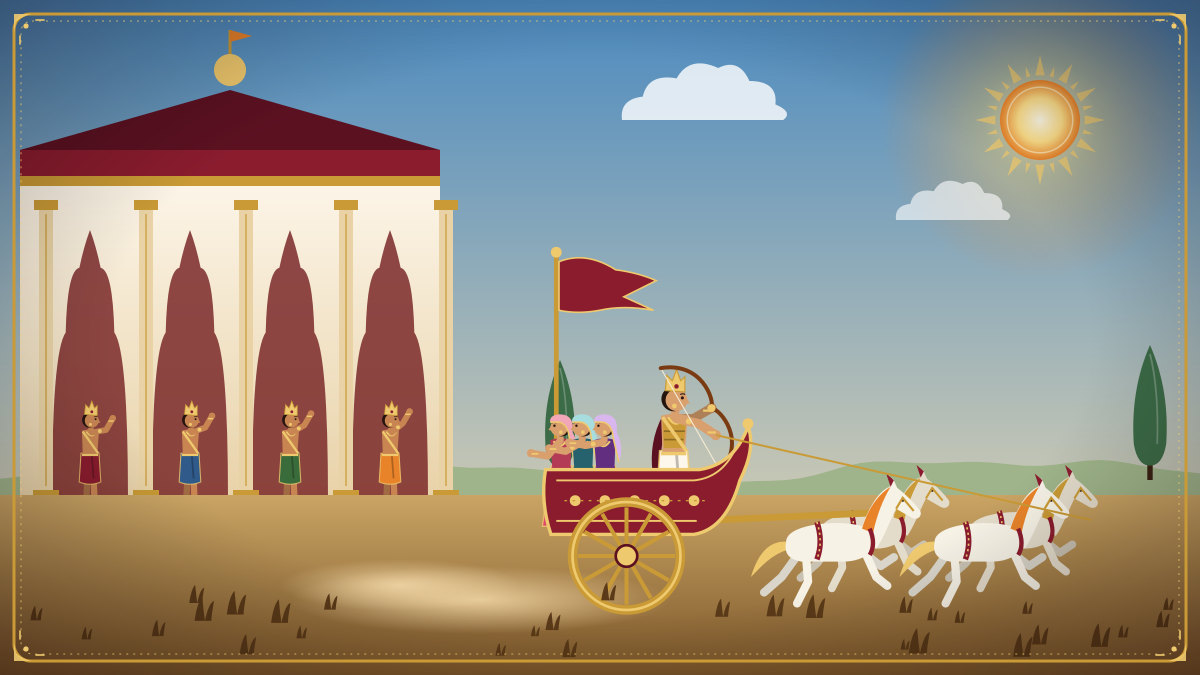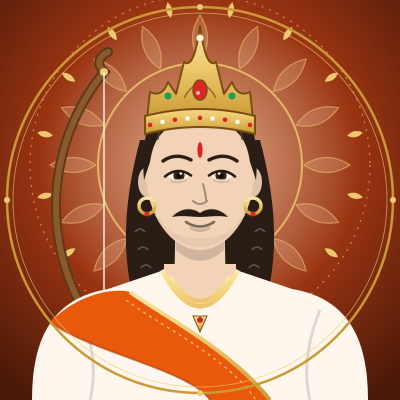
Pandu was the second son of the Kuru family. He was born to Queen Ambalika, the widow of King Vichitravirya, through the blessing of the sage Vyasa. His elder brother was the blind Dhritarashtra, and his half-brother was the wise Vidura. Because Dhritarashtra was blind, Pandu was crowned king of Hastinapur. He was a mighty archer who conquered many kingdoms and filled Hastinapur with wealth and glory. He married Kunti and Madri. But a single careless arrow, shot while hunting, brought upon him the curse of a sage, and he gave up his kingdom to live as a hermit in the forest. There, through the blessings of the gods, his five sons were born, and the brothers are called the Pandavas, the sons of Pandu, after him. His short life and early death shaped the whole future of the Kuru family.
The pale prince
When King Vichitravirya died without children, his mother Satyavati called her first son, the sage Vyasa, to give heirs to the family. When Vyasa came to Queen Ambalika, she turned pale with fear at his fierce appearance. Vyasa said that her son would be pale, and so he was named Pandu, which means pale.
Pandu grew up with his brothers Dhritarashtra and Vidura under the loving care of Bhishma, their father's elder half-brother, whom they honoured as Pitamaha. Bhishma taught them the Vedas, the use of weapons and the duties of a king. Among them Pandu became the finest archer, and no one in the land could match his skill with the bow.
Under Bhishma's rule as protector of the kingdom, Hastinapur was peaceful and prosperous in those years. The fields gave good harvests, the people followed dharma and there was no fear of thieves. Everyone looked forward to the day when the young princes would be ready to take charge.
When the time came to choose a king, the elders decided that the blind Dhritarashtra could not rule well, and that Vidura, son of a palace maid, could not take the throne. So the crown went to Pandu, and he became king of Hastinapur.
Two queens
Kunti, the daughter of King Shura of the Yadavas, had been raised by King Kuntibhoja as his own daughter. She was the sister of Vasudeva and so the aunt of Lord Krishna. At her swayamvara, where a princess chose her own husband, Kunti placed the garland around Pandu's neck.
Bhishma then went to King Shalya of Madra and asked for his sister Madri as Pandu's second queen. According to the custom of the Madra family, Bhishma gave them gold, jewels, elephants and horses, and Madri came to Hastinapur as a bride.
Pandu loved both his queens. Kunti was wise and steady, and Madri was gentle and devoted. Around this time Bhishma also arranged Vidura's marriage, and the three brothers lived happily together in Hastinapur.
The conquering king
Pandu set out with his army to win glory for the Kurus. He defeated the Dasharnas and then marched on Magadha, where he killed the proud king Dirgha in his capital, Rajagriha. He went on to conquer Videha, Kashi, and the lands of Suhma and Pundra.
He returned to Hastinapur with huge treasures: gold, jewels, cattle, horses, elephants and chariots. The people said that the lost glory of the Kurus had come back through Pandu, just as in the days of the great kings of old.
Pandu did not keep this wealth for himself. He gave it to Bhishma, to his grandmother Satyavati and his mother, and to his brothers. With this wealth Dhritarashtra performed great sacrifices and gave generous gifts.
Pandu's victories made the Kuru kingdom strong and respected again among all the kings. Yet he was a gentle ruler at heart, and he did not seek power for its own sake. Once his duty was done, he wished to rest from war and enjoy the beauty of the forests.
The curse of the sage Kindama
After his victories, Pandu went with Kunti and Madri to the beautiful forests on the southern slopes of the Himalayas, where he loved to hunt. Dhritarashtra stayed in Hastinapur, ruled in his place and sent him everything he needed.
One day Pandu saw a deer with its mate and shot them with his arrows. But the deer was really the sage Kindama, who had taken the form of a deer to be with his wife in the forest. Dying, the sage said to Pandu, “Hunting is a king's right, but no noble person would strike a creature at such a moment.”
Then he cursed Pandu: “If you ever come close to your wife with love, you will die at that very moment, and the wife you are with will follow you in death.” With these words the sage left his body.
Pandu was overcome with grief and shame. He decided to give up the life of a king. He sent his jewels and royal clothes back to Hastinapur with the message that Pandu had gone to live as a hermit. Kunti and Madri refused to leave him and chose to live with him in the forest.
Life at Shatashringa and the birth of five sons
Pandu and his wives went to live near the mountain Shatashringa among the sages. Pandu lived simply, did penance and served the holy men, and the sages loved him like a son. Once he wished to travel with them to the high heavenly regions, but they told him that the way was hard and that a man without children could not reach the highest worlds. This saddened Pandu deeply.
Pandu told Kunti about his sorrow and asked her to have sons through the blessing of a holy person. Then Kunti told him a secret. As a girl, she had served the sage Durvasa so well that he had given her a mantra with which she could call any god and receive a son by his blessing. Pandu was filled with joy.
With Pandu's permission Kunti first called Dharma, the god of righteousness, and Yudhishthira was born. A voice from the sky said he would be the best of those who follow dharma. Then she called Vayu, the wind god, and the mighty Bhima was born; once, when Kunti stood up suddenly in fright at a tiger, the baby fell from her lap onto a rock, and it was the rock that broke. Bhima was born on the same day as Duryodhana.
Pandu wished for a son who would be the greatest of warriors. He did penance for a year, standing on one foot, while Kunti kept a vow. Then Kunti called Indra, king of the gods, and Arjuna was born. A heavenly voice foretold his great deeds.
Madri was sad that she had no son, and she asked Pandu to speak to Kunti for her. Kunti gave Madri the mantra once. Madri wisely called the twin gods, the Ashvini Kumaras, and twins were born: Nakula and Sahadeva. When Pandu asked again for Madri, Kunti gently refused, saying Madri had cleverly gained two sons with one call. The five boys grew up happily among the sages, loved by all.
The death of Pandu
Years passed peacefully. Then, one beautiful spring day, the forest was full of flowers and birdsong. Pandu was walking with Madri alone. Carried away by the beauty of the season and forgetting the sage's curse, he came close to her, though she tried to stop him. At that very moment he died, just as Kindama had said.
Madri cried out, and Kunti came running with the children. Kunti wished to follow her husband, but Madri said that Pandu had died because of her, and that she should be the one to go with him. She asked Kunti to love Nakula and Sahadeva as her own sons. Then, as the curse had said, Madri followed Pandu in death.
The sages of Shatashringa decided that Pandu's sons should be taken to their family. They brought Kunti, the five boys, and the remains of Pandu and Madri to Hastinapur. Crowds of people came out to see the holy men and the young princes, and the sages told everyone how the boys had been born. Then they handed the children to Bhishma, Dhritarashtra and Vidura and went back to the forest. The last rites of the king and queen were performed with great honour by the banks of the Ganga, and all of Hastinapur mourned.
Kunti kept her promise to Madri and raised all five boys with equal love. From here the story of the Pandavas and the Kauravas growing up together in Hastinapur begins, a story that would one day lead to Kurukshetra.
Did you know?
- The name Pandu means “pale”; he was named after the pale colour of his skin at birth.
- Pandu was the younger brother, yet he became king, because by the custom of the time a blind prince could not rule.
- People of his time said that no one in the land could match Pandu as an archer.
- According to the sage Narada, Pandu in the world beyond wished his son Yudhishthira to perform the Rajasuya sacrifice.
What we learn from Pandu
Pandu's story teaches that one careless act can change a whole life, so we must act with thought and kindness even towards animals. It also shows that a person can accept his mistakes with humility and still find a meaningful life. Even under a curse, his family found joy through love, faith and the blessings of the gods.
Pandu in the story
Read the chapters where Pandu plays a part.