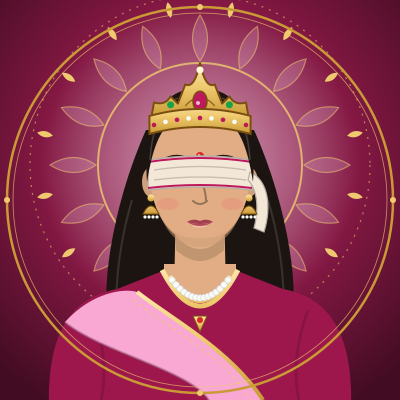
Gandhari was the princess of Gandhara, the daughter of King Subala. Her brother was Shakuni, who later became the cunning adviser of the Kauravas. She married Dhritarashtra, the blind eldest prince of Hastinapur, and when she learned that he could not see, she tied a cloth over her own eyes and never took it off. Through the blessing of the sage Vyasa she became the mother of a hundred sons, led by Duryodhana, and one daughter, Duhshala. Gandhari loved her children deeply, but she was not blind to their faults. More than once she told her own son, before the whole court, that he was wrong. Even during the war, when Duryodhana asked for her blessing, she would only say, “Where there is dharma, there is victory.” After losing all her sons, her grief turned into a curse. Yet in the end she found peace in prayer.
The princess who tied a blindfold
Gandhari grew up in the kingdom of Gandhara, far in the north-west. She was a devotee of Lord Shiva, and by pleasing him she had received the boon that she would have a hundred sons. Bhishma heard of her virtue and of this boon, and he sent a proposal to King Subala for Dhritarashtra.
King Subala hesitated, because the prince was blind. But he thought of the great Kuru family's fame and agreed. When Gandhari learned that her husband-to-be was blind, she did not complain. She took a cloth, folded it many times and tied it over her eyes, deciding that she would never enjoy a sight that her husband could not share.
Her brother Shakuni brought her to Hastinapur with great honour and many gifts. After the wedding, Bhishma honoured him and he returned to Gandhara. In later years, however, Shakuni spent much time at Hastinapur, where he became the close friend and adviser of his nephew Duryodhana, and his schemes brought great harm to the family.
In Hastinapur, Gandhari won everyone's respect by her good conduct and devotion to her husband and elders. Her blindfold became a sign of her strong will and her loyalty.
Vyasa's boon and the hundred sons
One day the sage Vyasa came to Gandhari's palace, tired and hungry. She served him with great care and respect. Pleased with her, he offered her a boon, and she asked for a hundred sons as strong and worthy as her husband. Vyasa granted it.
Gandhari became pregnant, but the months passed and then years, and still no child was born. After two long years she heard that Kunti, living in the forest with Pandu, had already given birth to a son, Yudhishthira. In sorrow and frustration, and without telling her husband, Gandhari struck her womb. A hard lump of flesh was born.
She was about to throw it away when Vyasa arrived. He told her that his words could never be false. On his instruction the lump was sprinkled with cool water and divided into a hundred and one pieces, each the size of a thumb joint. These were placed in pots filled with ghee and kept safely for two more years.
From the first pot came Duryodhana, and the others followed one by one. Gandhari had wished in her heart for a daughter too, and from the hundred and first piece came Duhshala, who later married Jayadratha, king of Sindhu. Duryodhana was born on the same day as Bhima.
A mother who spoke for dharma
Gandhari loved her sons, but she saw clearly where Duryodhana's jealousy was leading. When the Pandavas were cheated in the first game of dice and Draupadi was insulted in the court, it was Gandhari, together with Vidura, who urged Dhritarashtra to act. The king then gave Draupadi boons and freed the Pandavas.
When Duryodhana called the Pandavas back for a second game, Gandhari went to her husband. She reminded him that at Duryodhana's birth the wise had advised giving him up, and she begged the king to give up his wicked son even now, before he destroyed the family. Dhritarashtra loved her, but he could not do it.
Years later, after Krishna's peace mission had failed, Dhritarashtra called Gandhari into the court. Standing before the kings, she spoke firmly to Duryodhana. She told him that a person who cannot control his own anger and greed cannot rule a kingdom. She told him to listen to his elders and give the Pandavas their share, and warned him that war would destroy him and all his friends.
Duryodhana did not listen. He walked out of the court in anger. Gandhari's words remained true, but no one could make her son change his path.
“Where there is dharma, there is victory”
When the war began, Duryodhana came to his mother every day of the eighteen days of battle. Each time he bowed and asked, “Mother, bless me with victory in the war with my enemies.”
Gandhari loved him more than her own life, and her heart longed to bless him. But she would not say anything false. Every day she gave him the same blessing: “Where there is dharma, there is victory.” She knew that dharma was on the side of the Pandavas.
This blessing shows the greatness of her character. A mother's love made her wish for her son's safety, but her truthfulness would not let her ask God to support what was wrong.
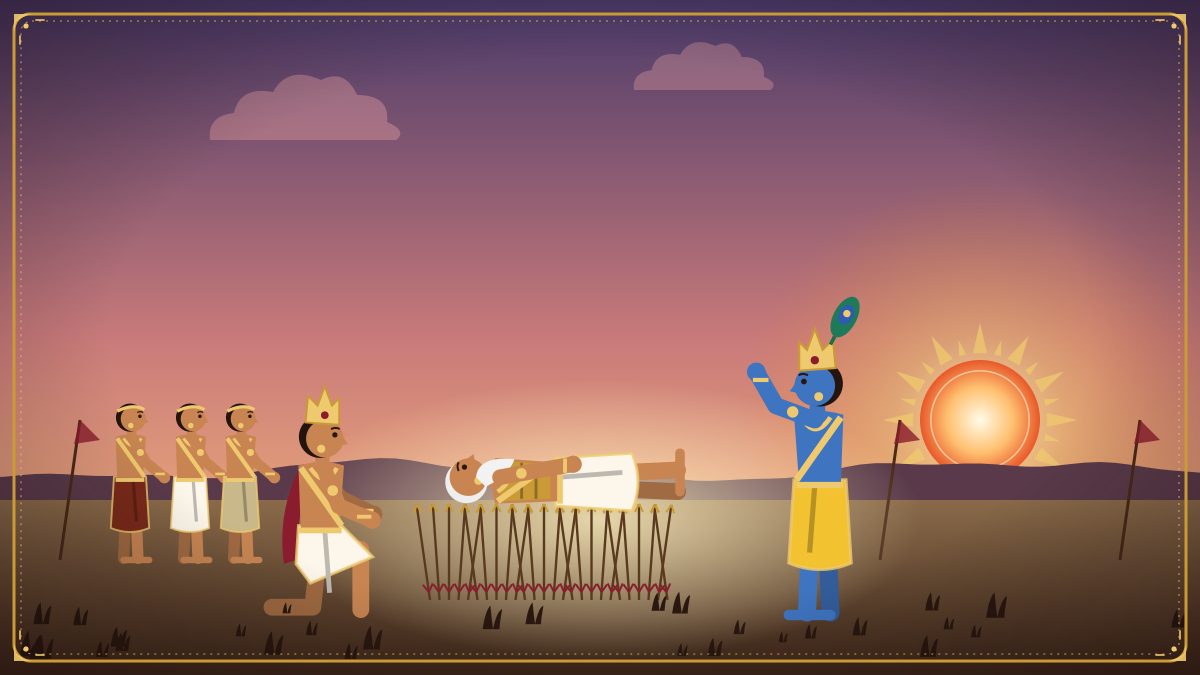
All through those eighteen days she sat in the palace with her husband, listening as Sanjaya told of the battle. One after another she heard that her sons had fallen, Dushasana, Vikarna and many more, and finally Duryodhana himself. Yet she never took back her words, and she never prayed for the wrong side to win.
A mother's grief and her curse
When the war ended, all her hundred sons were dead. Gandhari's sorrow turned to anger against the Pandavas, and she wished to curse them. Vyasa came to her before she could speak and reminded her of her own words: “Where there is dharma, there is victory.” He asked her to let go of her anger. Gandhari replied that she did not wish ill to the Pandavas, but that her heart was broken.
She asked Bhima why he had struck Duryodhana below the waist, against the rules of mace fighting. Bhima answered humbly that he had done it in fear for his life and to keep his old vow, and he begged her forgiveness. Then Yudhishthira came forward with folded hands and said, “I am the cruel killer of your sons. Curse me.” Gandhari's anger was so strong that her glance, falling from under the edge of her blindfold, touched his toes, and the nails turned dark. Seeing this, Arjuna stepped behind Krishna. Then her heart softened, and she spoke to them as a mother.
Through Vyasa's grace, Gandhari could see the whole battlefield from where she stood. She saw the fallen warriors, and the wives and mothers weeping over them: Duryodhana's wife, the wives of her other sons, and her own daughter Duhshala searching for her fallen husband Jayadratha. Gandhari lamented for them all.
Then she turned to Krishna and said that he could have stopped this war and did not. In her pain she cursed him: in thirty-six years his own Yadava clan would destroy itself, and he too would leave the world alone in a forest. Krishna accepted the curse calmly, and said with a gentle smile that he already knew this; no one but he himself could end the Yadavas.
Peace at the end
After the war Gandhari lived in Hastinapur with Dhritarashtra. Yudhishthira and the Pandavas respected them, and Kunti served Gandhari like a sister. Slowly her heart grew calm, and she spent her days in prayer and fasting.
After fifteen years, Dhritarashtra decided to go to the forest. Gandhari went with him, and Kunti went too, leaving her own sons behind. As they set out, Kunti walked in front, Gandhari, still blindfolded, walked with her hand on Kunti's shoulder, and the old king followed with his hand on Gandhari's shoulder.
In the forest, Vyasa asked them what they wished for. Gandhari spoke for her husband and herself: they wished to see their sons once more. On that wonderful night Vyasa called the dead warriors from the Ganga, and Gandhari saw her sons again, shining and at peace.
Some years later a forest fire spread through the woods where they lived. Gandhari sat beside her husband and Kunti in calm meditation, and the three of them left this world together, with their minds fixed on God.
Did you know?
- Gandhara, Gandhari’s homeland, lay in the north-west of ancient India, in the region of present-day Pakistan and Afghanistan.
- Gandhari had only one daughter, Duhshala, who married Jayadratha, the king of Sindhu.
- During the war, she blessed Duryodhana each day only with the words “Where there is dharma, there is victory.”
- The Stri Parva, the eleventh book of the Mahabharata, is largely the lament of Gandhari and the Kuru women after the war.
What we learn from Gandhari
Gandhari teaches loyalty and the courage to tell the truth, even to one's own children. Her blessing “Where there is dharma, there is victory” reminds us that true love never asks God to support what is wrong. Her story also shows that anger, even when born of deep pain, brings more sorrow, while patience and prayer bring peace in the end.
Gandhari in the story
Read the chapters where Gandhari plays a part.