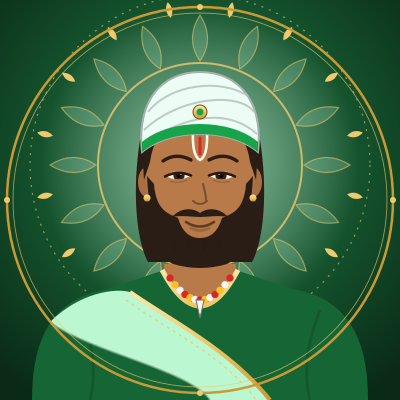
Vidura was the son of the sage Vyasa and a maid who served Queen Ambika. That makes him the half-brother of Dhritarashtra and Pandu, who were also sons of Vyasa, and an uncle of both the Kauravas and the Pandavas. The scriptures say that he was Dharma, the god of righteousness, born on earth as a man because of a sage's curse. Because his mother was a maid, he could not be king, but he became the trusted counsellor of Hastinapur. He is famous for his wisdom, honesty and love of dharma. He spoke the truth even to the king, he saved the Pandavas many times from Duryodhana's plots, and his teachings to Dhritarashtra, called Vidura Niti, are read even today.
The sage on the stake
Long before Vidura was born, there lived a sage named Mandavya. He was doing a great austerity under a tree outside his hermitage, with his arms raised and keeping a vow of silence. One day some thieves, chased by the king's guards, ran into his hermitage and hid their stolen goods there. The guards asked the sage which way the thieves had gone, but because of his vow he said nothing.
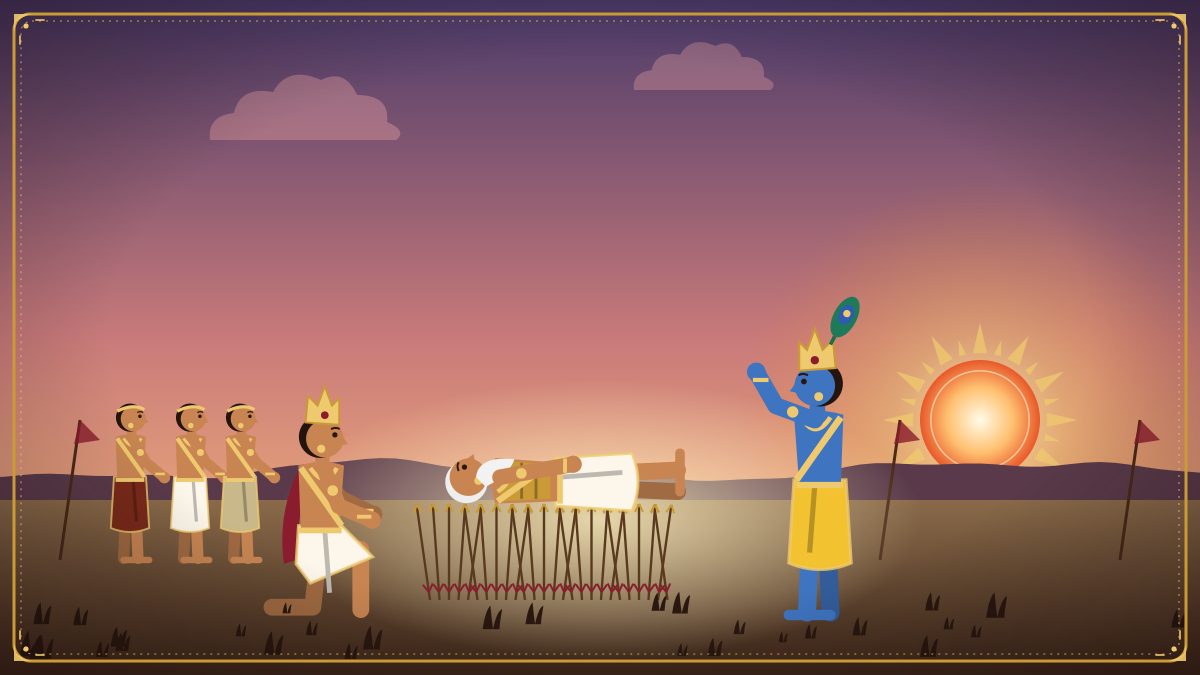
The guards searched the hermitage, found the stolen goods and the thieves, and arrested the sage as well. The king, thinking he was one of the gang, ordered him to be put on a sharp stake as punishment. But the sage did not die. He stayed alive on the stake, deep in meditation, and other sages came to him in grief. When the king learned who he really was, he begged his forgiveness and had him taken down. The tip of the stake could not be pulled out and stayed in his body, so he became known as Animandavya, “Mandavya with the spike”.
Animandavya went to the court of Dharma, the god who judges the deeds of all beings, and asked what sin he had done to deserve such suffering. Dharma replied that as a small child he had pierced a little insect with a blade of grass, and this was the result.
The sage said that the punishment was far too heavy for a child's small mistake. He made a new rule: nothing a child does before the age of fourteen would be counted as a sin. And because Dharma had judged unfairly, he cursed him to be born on earth as a human, from the womb of a maid. In this way Dharma himself was born as Vidura.
Born in the palace
King Vichitravirya of Hastinapur died young and left no sons. To keep the royal line alive, Queen Satyavati asked her son, the sage Vyasa, to bless the two widowed queens with children. Queen Ambika's son Dhritarashtra was born blind, and Queen Ambalika's son Pandu was born pale.
Satyavati asked Ambika to receive the sage once more. But Ambika was afraid of the sage's stern appearance, so she dressed one of her maids in her own clothes and jewels and sent her instead. The maid welcomed Vyasa with respect and served him calmly. The sage was pleased. He freed her from being a servant and blessed her that her son would be righteous and the wisest man on earth. That son was Vidura.
Bhishma raised the three boys, Dhritarashtra, Pandu and Vidura, with equal care. It was said that in all three worlds there was no one equal to Vidura in his knowledge of dharma. Because Dhritarashtra was blind and Vidura was the son of a maid, Pandu became king, and Vidura became the king's counsellor. Bhishma later arranged Vidura's marriage to a daughter of King Devaka.
A voice of warning
When Duryodhana, the eldest son of Dhritarashtra, was born, many bad signs appeared: jackals howled and donkeys brayed. Vidura and the wise Brahmins told Dhritarashtra that this child would bring ruin to the family and that it would be better to give him up for the good of all. But Dhritarashtra loved his son too much and could not do it. Vidura's first warning went unheard.
After Pandu's death, Kunti and the young Pandavas came to Hastinapur, and Vidura cared for them like a father. When Duryodhana poisoned Bhima and threw him into the river, and Bhima came back safely, Vidura advised Kunti to stay quiet and watchful, so that Duryodhana would not try something worse.
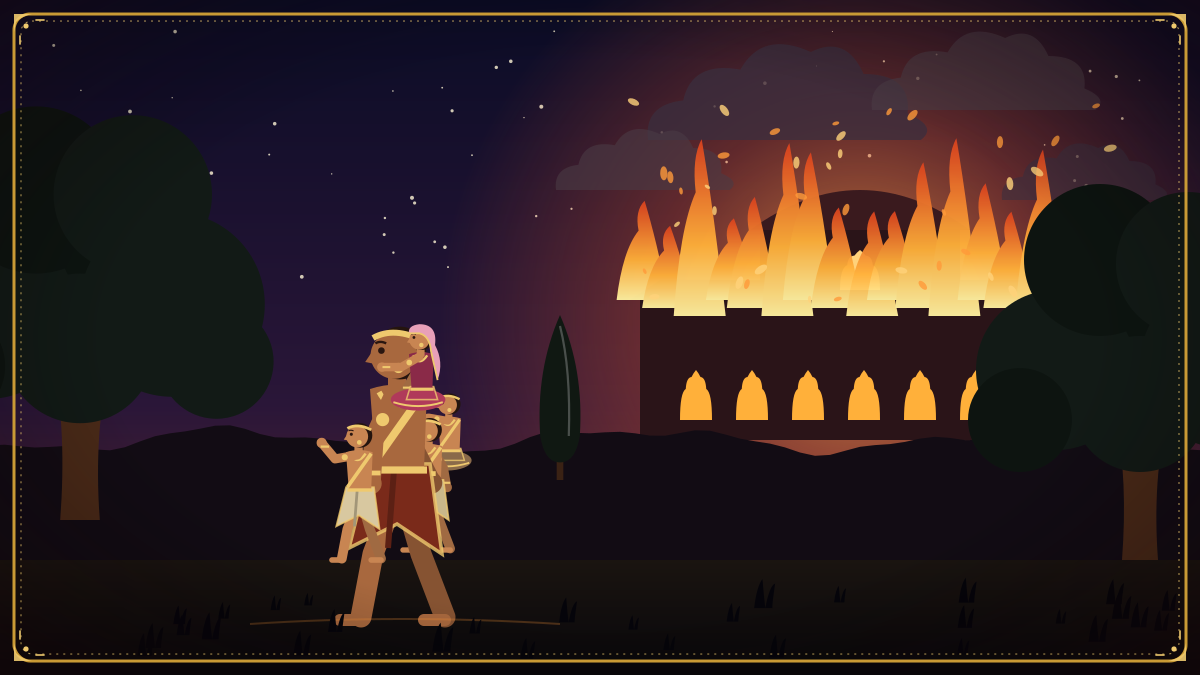
Later Duryodhana sent the Pandavas to stay at Varanavata in a house made of lac, planning to burn it with them inside. As they set out, Vidura spoke to Yudhishthira in a secret language that only the two of them understood. He hinted that fire cannot burn the creature that hides in a hole in the ground. Then he sent a skilled miner to dig a tunnel under the house. When the house was set on fire, the Pandavas and Kunti escaped through the tunnel, and Vidura's boat carried them across the Ganga.
When news came that the Pandavas were alive and had married Draupadi, Vidura told Dhritarashtra and urged him to welcome them back and give them their share. He himself went to the kingdom of Panchala and brought the Pandavas home. Dhritarashtra gave them half the kingdom, and they built Indraprastha.
The dice hall
Duryodhana and his uncle Shakuni planned a game of dice to take away the Pandavas' kingdom. Vidura warned Dhritarashtra clearly that the game would bring quarrels and destruction. But the king was weak towards his son, and he even sent Vidura himself to invite Yudhishthira. Vidura went, and honestly told Yudhishthira that the game was a trap.
In the hall, as Yudhishthira kept losing, Vidura stood up and told Dhritarashtra that the game was a doorway to ruin. He said that for the sake of a family one person may be given up, and for the sake of a village one family; he begged the king to stop Duryodhana. Duryodhana insulted him angrily, saying that Vidura ate the Kauravas' food but always took the side of their enemies.
When Draupadi was dragged into the hall and asked whether Yudhishthira, having already lost himself, had the right to stake her, Vidura urged the elders to answer her truthfully. He told them an old story: the demon king Prahlada was asked to judge a quarrel between his own son Virochana and a Brahmin named Sudhanva. Prahlada spoke the truth, that Sudhanva was the better, even though it went against his own son. One who sees wrong in an assembly and stays silent, Vidura said, shares in the sin.
Soon terrible omens filled the palace. Vidura and Queen Gandhari warned Dhritarashtra, and in fear he granted Draupadi boons, and the Pandavas were freed. But after a second game the Pandavas had to leave for the forest. Vidura said that the old and gentle Kunti should not suffer in the forest, and she stayed in his own house for all the years of exile.
Sent away, called back, and Vidura Niti
While the Pandavas lived in the forest, Vidura again told Dhritarashtra that the only way to save the family was to return the Pandavas' kingdom. The king grew angry and said, “If you love them so much, go to them.” So Vidura went to the Kamyaka forest and stayed with the Pandavas, advising Yudhishthira to be patient and to wait for the right time.
Soon Dhritarashtra was filled with regret. He fainted at the thought of having driven away his wise brother, and he sent Sanjaya to bring him back. Vidura returned without anger, saying that both sides were dear to him equally, but his heart went out to the Pandavas because they were suffering.
When the exile was over, Sanjaya brought back the Pandavas' message from Upaplavya. That night Dhritarashtra could not sleep, and he sent for Vidura. Through the whole night Vidura taught him about wise living and good rule. These teachings are called Vidura Niti. He spoke of who is truly wise and who is a fool, of the six faults a person who wants to rise must give up — too much sleep, drowsiness, fear, anger, laziness and putting things off — and of how a king should protect his people.
Again and again he told the king: give the Pandavas their share, and save your sons and your family. Then, to answer the king's deeper questions about life and death, Vidura called the ancient sage Sanatsujata, who taught Dhritarashtra about the eternal Self.
Host of Krishna, and the years of war
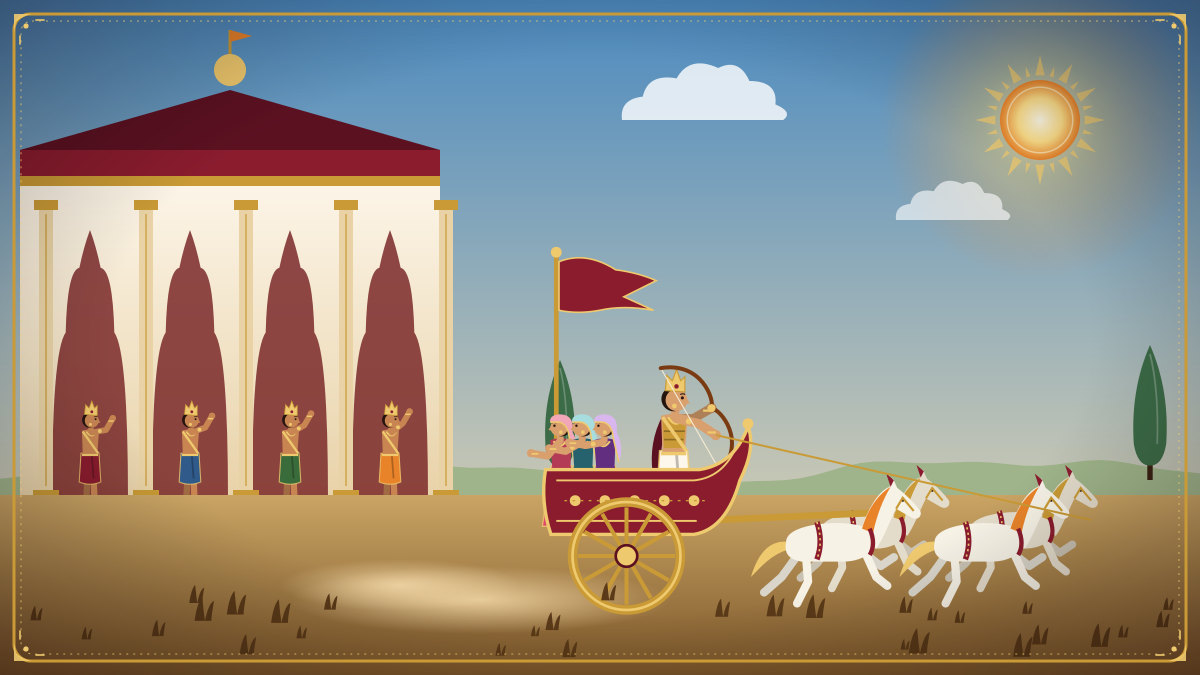
When Krishna came to Hastinapur as a messenger of peace, Duryodhana prepared a royal feast for him. Krishna refused it, saying that one eats another's food either out of love or in times of need, and here there was neither. Instead he went to Vidura's simple home, where his aunt Kunti was staying, and accepted Vidura's food, offered with pure love.
That night Vidura told Krishna honestly that it was not wise for him to come among people bent on wrongdoing, for Duryodhana would never listen. Krishna replied that he had come so that no one could ever say he had not tried for peace. The next day Krishna's efforts failed, and the war could not be stopped.
Vidura did not fight in the war. Through all eighteen days he stayed in Hastinapur at the side of the old king. On the last day, Yuyutsu, the son of Dhritarashtra who had joined the Pandavas, came back to Hastinapur escorting the royal ladies. Vidura welcomed him warmly and praised him for having chosen the side of dharma.
During the eighteen days of war, Vidura stayed beside the grieving king. When Dhritarashtra lost all his sons, it was Vidura who comforted him. He told him a parable: a man fell into a deep well and hung there from a creeper, with a serpent below and an elephant above, yet he kept licking drops of honey that fell near him. So too, Vidura said, people forget death and hold on to small pleasures. The wise accept what cannot be changed and turn to dharma.
Counsellor, hermit, and the end
After the war, Yudhishthira became king and asked Vidura to be his chief counsellor on matters of policy. Vidura served the new king faithfully, and when the brothers discussed what was most important in life, Vidura said that dharma comes first, because wealth and pleasure rest on it.
Years later, when Dhritarashtra and Gandhari went to the forest to spend their last years in prayer, Vidura went with them, along with Kunti and Sanjaya. He lived a life of the strictest austerity. He ate nothing, wore nothing, kept a small pebble in his mouth so that he would not speak, and became so thin that his body looked like a shadow.
When the Pandavas came to visit, Yudhishthira saw Vidura at a distance and followed him deep into the forest. Vidura stopped, leaning against a tree, and looked steadily into Yudhishthira's eyes. By the power of yoga he joined his breath with Yudhishthira's breath and his senses with Yudhishthira's senses, and his spirit entered into Yudhishthira. Both of them were born of Dharma, and now they became one.
Vidura's body remained standing against the tree. Yudhishthira wanted to perform the last rites, but a voice from the sky told him not to burn the body, for Vidura had been a true renunciant and would reach the highest worlds. Yudhishthira felt himself filled with new strength and goodness, and he returned to the hermitage and told the others what had happened.
Did you know?
- Vidura is believed to be Yama, the god of dharma, born as a human because of the sage Mandavya’s curse.
- Vidura Niti teaches that six faults should be given up: too much sleep, drowsiness, fear, anger, laziness and putting things off.
- Though he was against the dice game, Dhritarashtra sent Vidura himself to invite Yudhishthira to it.
- The famous parable of the man in the well, tasting drops of honey while dangers surround him, was told by Vidura.
What we learn from Vidura
Vidura teaches that true greatness comes from wisdom and goodness, not from birth or position. He spoke the truth kindly but clearly, even to the king, and never stopped trying to save his family from wrongdoing. His life shows that a single honest voice is precious, even when the world does not listen.
Vidura in the story
Read the chapters where Vidura plays a part.