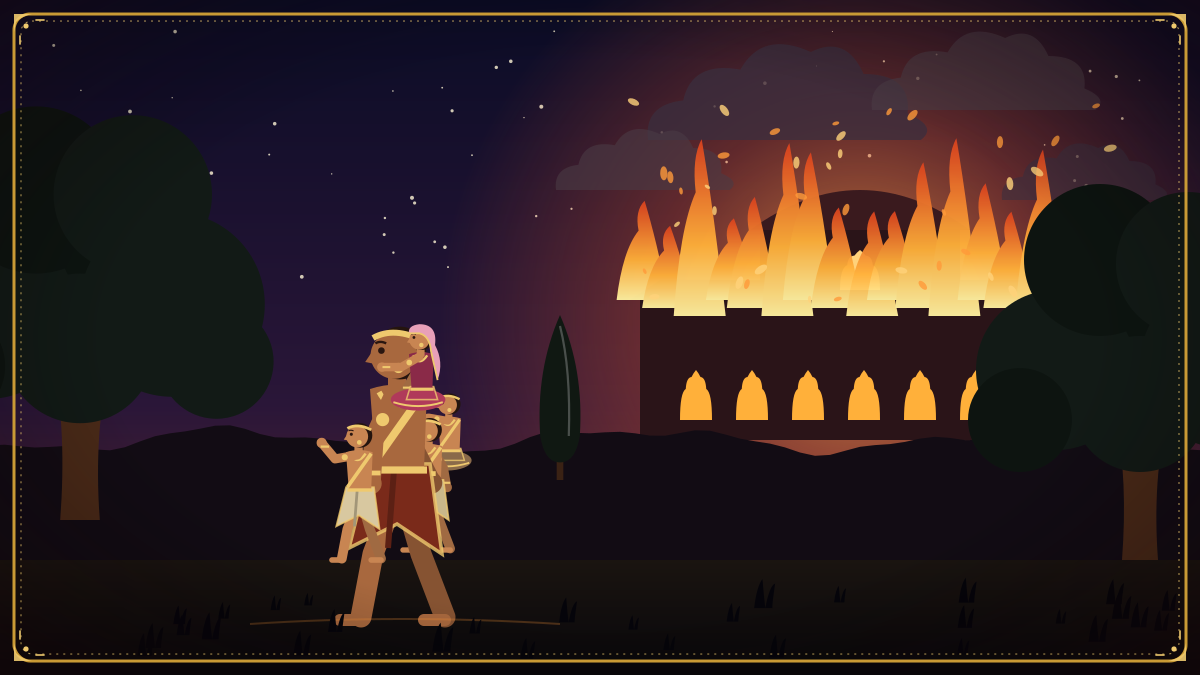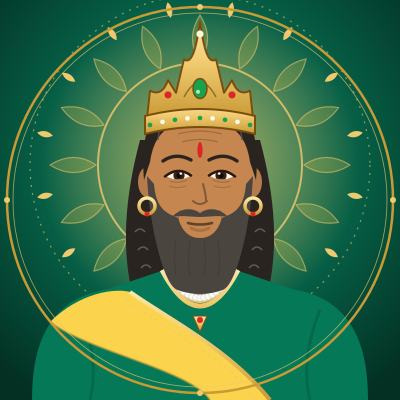
Drupada, also called Yajnasena, was the king of Panchala, a rich kingdom on the banks of the Ganga, not far from Hastinapur. He was the son of King Prishata. As a boy he played and studied with Drona, and he promised to share his kingdom with him one day. When he became king he forgot that promise and turned Drona away, and from that single act of pride grew a long chain of events: his own defeat at Arjuna's hands, a great fire sacrifice, the birth of Dhrishtadyumna and Draupadi, and Panchala's firm friendship with the Pandavas. Through Draupadi he became father-in-law of all five brothers, and in the Kurukshetra war he fought for them as one of their most respected elders until he fell to Drona on the fifteenth day.
A prince and his boyhood friend
King Prishata of Panchala was a dear friend of the great sage Bharadvaja. So the young prince Drupada often went to Bharadvaja's ashram, and there he played and studied with the sage's son, Drona. The two boys grew up together like brothers. One was a prince who would one day wear a crown; the other was the son of a poor sage who owned nothing but his learning.
Drupada loved his friend dearly. One day he said to him, “Drona, I am my father's dearest son. When I am crowned king of Panchala, my kingdom will be yours as well. Its wealth and its joys will be yours to share. This is my promise.” Drona remembered these words all his life.
In time King Prishata passed away, and Drupada became the king of Panchala. Drona, meanwhile, finished his studies, learned the science of weapons, married Kripi, the sister of Kripacharya, and had a son named Ashwatthama. Yet he remained very poor. He went to the sage Parashurama hoping for wealth, but Parashurama had already given everything away, and could give him only his knowledge of divine weapons.
The insult in the royal court
Remembering the old promise, Drona went to Panchala and stood before King Drupada. “O king, I am your friend Drona,” he said with joy. But Drupada was now proud of his throne. He frowned and answered coldly, “Brahmin, your words are foolish. Friendship can only be between equals. A king and a poor man, a learned man and an unlearned one, can never be true friends. Time wears away old friendships. When did I ever promise you anything?”
Then, as if giving alms to a stranger, he added that he could give Drona a meal for one night, if he wished. Drona's heart burned with shame and anger. He did not say a word. He turned around, left Panchala, and swore to himself that one day he would make Drupada feel the same humiliation.
Drona went to Hastinapur, where Bhishma welcomed him with honour and made him the teacher of the Kuru princes: the hundred Kauravas and the five Pandavas. For years he trained them in every weapon, and above all he loved Arjuna, his finest pupil.
Defeated by Arjuna
When the princes had finished their training, Drona asked for his teacher's fee: “Capture King Drupada of Panchala in battle and bring him to me.” The princes marched to Panchala. Duryodhana, Karna and the Kauravas rushed in first, eager for glory, but the Panchala army and the people of the city drove them back.
Then the Pandavas went forward. Bhima fought like the god of death with his mace, and Arjuna, with his arrows, broke through the Panchala army, leapt onto Drupada's chariot and captured the king. Arjuna even stopped Bhima from killing more Panchala soldiers, saying, “This king is a relative of our teacher. Do not destroy his army.”
Drupada was brought before Drona. Drona smiled and said, “Do not fear for your life, O king. We brahmins are forgiving. I still want your friendship. You said only a king can be a king's friend, so I have taken your kingdom. Now I give you back half of it. You rule the land south of the Ganga, and I will rule the north. Now we are equals, so let us be friends.”
Drupada answered politely that he was grateful, and he returned to rule southern Panchala from his city of Kampilya. But in his heart he could not forgive the defeat. He knew that no ordinary warrior could match Drona, and he could not rest. From that day he searched for a way to have a son who could defeat Drona.
The sacrifice of Yaja and Upayaja
Drupada wandered among the ashrams of brahmins along the Ganga and the Yamuna, looking for someone who could perform a sacrifice to give him such a son. At last he found two brothers of the Kashyapa family, Yaja and Upayaja. He first went to the younger brother, Upayaja, and served him humbly for a whole year. Upayaja refused, but finally told him to ask his elder brother Yaja.
Drupada promised Yaja a huge gift of cows if he would perform the sacrifice. Yaja agreed, and Upayaja helped him. When the offering was ready, Yaja called Drupada's queen to come and receive the blessing, but she asked them to wait, for she was not yet ready. Yaja said that the result of the sacrifice would come whether she came or not, and he poured the offering into the fire.
From the flames rose a young prince, shining like fire, with a crown on his head, armour on his body, and a sword and bow in his hands. He roared like a lion, and a voice from the sky declared, “This prince is born to remove the sorrow of the Panchalas and to bring about the death of Drona.” He was named Dhrishtadyumna.
Then from the middle of the altar rose a maiden of wondrous beauty, dark in colour, with eyes like lotus petals. The heavenly voice said that she would be the finest of women and that through her the purpose of the gods would be fulfilled. She was named Krishnaa, and the world knows her as Draupadi. The queen asked Yaja that these two children should know no mother but her, and Yaja granted it. Drupada now had what he wanted, and his joy knew no bounds.
Draupadi's swayamvara
Drupada had always wished in secret to give Draupadi to Arjuna, the hero who had once defeated him. He had heard that the Pandavas had died in the fire of the house of lac at Varanavata, but he kept hoping. So he had a very stiff bow made that almost no one could string, and set a target high in the air behind a revolving device. Whoever strung the bow and hit the target with five arrows would win Draupadi.
Kings and princes came from all over the land. One after another they failed even to string the bow. Then a young man dressed as a brahmin stepped forward, strung the bow in a moment and brought down the target. It was Arjuna. The angry kings attacked, saying a brahmin could not win a princess at a kings' swayamvara, but Arjuna and Bhima drove them back.
Drupada did not yet know who the young brahmin was. His son Dhrishtadyumna secretly followed the brothers to the potter's house where they lived with their mother, and returned saying they spoke like great warriors. Drupada sent his priest to ask, and then invited them to the palace. There Yudhishthira told him the truth: they were the sons of Pandu. Drupada's joy was complete.
But when Yudhishthira said that Draupadi would be the wife of all five brothers, Drupada was troubled, for this seemed against dharma. Then the sage Vyasa arrived and, speaking with Drupada alone, told him of Draupadi's past life and of the divine plan behind it. Satisfied, Drupada gave his daughter in marriage to the five brothers, one by one on successive days, with great celebration and rich gifts.
A steady ally
From that day Panchala stood behind the Pandavas. When Duryodhana's elders learned that the Pandavas were alive and had powerful friends in Drupada and Krishna, Vidura and Bhishma advised Dhritarashtra to call them back and give them half the kingdom. So the Pandavas received Khandavaprastha and built Indraprastha.
After the years of exile, when the Pandavas gathered at Upaplavya for the wedding of Abhimanyu and Uttara, the kings met in council to decide what to do. Balarama spoke gently for peace, while Satyaki spoke angrily. Drupada, the eldest of the allies, said that Duryodhana would not give up the kingdom through soft words alone. He advised that messengers be sent at once to gather allies, and that his own family priest go to Hastinapur as an envoy.
The priest went to the Kuru court and spoke clearly: the Pandavas wanted only their rightful share and did not wish to destroy the family. Bhishma agreed that his words were true, but Karna interrupted angrily, and Bhishma rebuked Karna. Dhritarashtra calmed them and said he would send his own messenger, Sanjaya, to the Pandavas. The talks went on, but in the end Duryodhana would give nothing, and war came.
His last battle
At Kurukshetra the Pandava army was arranged in seven divisions, and Drupada led one of them. His son Dhrishtadyumna was the commander of the whole army. Though old, Drupada fought bravely day after day, often facing Drona himself.
During the five days that Drona led the Kauravas, the Panchalas suffered greatly. In the early hours of the fifteenth day, after a long night of fighting, Drona killed Drupada's three grandsons. Then Drupada and his friend King Virata rushed at Drona together, and Drona brought both of the old kings down with his arrows.
So ended the long quarrel between the two boyhood friends. That same day, Drupada's son Dhrishtadyumna fulfilled the purpose for which he had risen from the sacred fire, and Drona's life came to an end.
Did you know?
- Drupada was also called Yajnasena, and so Draupadi is also known as Yajnaseni.
- Draupadi is called Panchali because she was the princess of Panchala, her father’s kingdom.
- Drupada had a very strong bow made for Draupadi’s swayamvara, secretly hoping that only Arjuna could string it.
- Drupada and his old friend Drona both fell on the same day, the fifteenth day of the Kurukshetra war.
What we learn from Drupada
Drupada's story shows how one moment of pride can break a precious friendship and set off years of enmity, sorrow and war. If he had kept his boyhood promise with humility, much of this suffering might never have happened. Yet he also teaches loyalty: once he had given his daughter to the Pandavas, he stood by them in good times and bad, until the very end.
Drupada in the story
Read the chapters where Drupada plays a part.