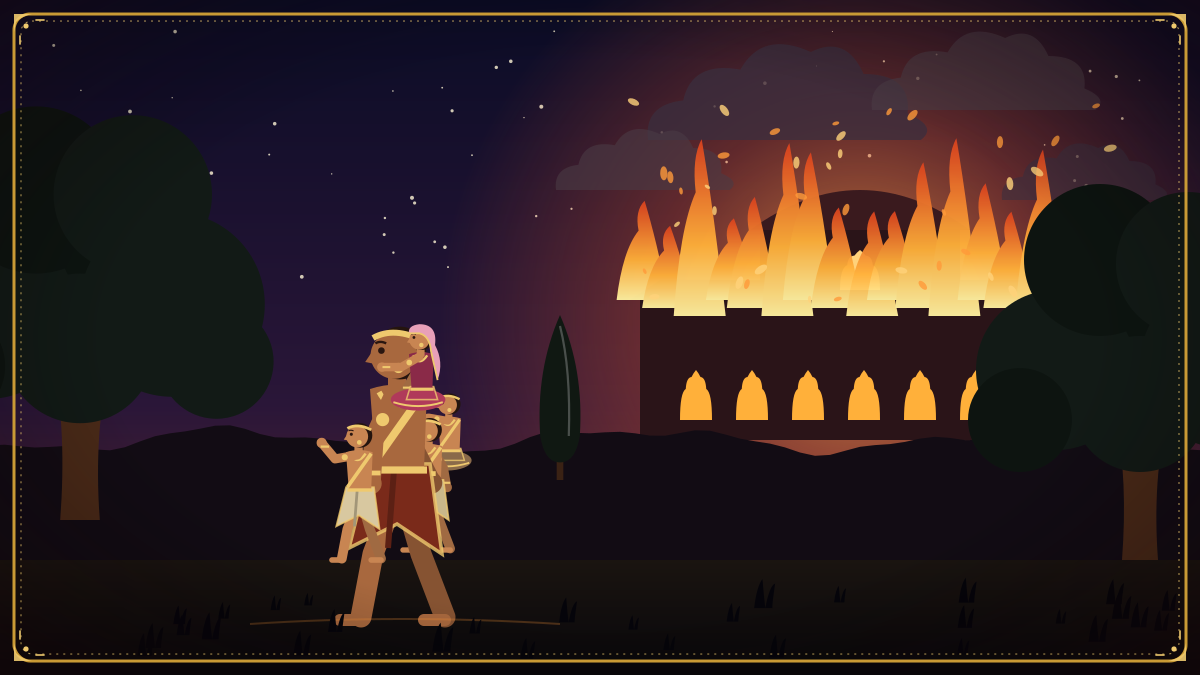
Hidimbi, called Hidimba in the epic, was a rakshasi, a woman of the rakshasa people who lived in the deep forests. Her brother was the fierce rakshasa Hidimba. She enters the story when the Pandavas, having escaped the house of lac, were wandering in the forest with their mother Kunti. She came to harm them, but instead she fell in love with Bhima, the second Pandava, warned him about her brother and asked to become his wife. With the consent of Kunti and Yudhishthira they married, and their son was the mighty Ghatotkacha. So Hidimbi was Bhima’s wife, Kunti’s daughter-in-law and the mother of a hero who later gave his life for the Pandavas. Vyasa tells her story in only a few chapters, but it shows a heart that chose truth.
In the forest of the rakshasas
Duryodhana had tried to burn the Pandavas alive in a house made of lac. Warned by Vidura, they escaped through a tunnel, crossed the Ganga by boat at night and walked into a thick forest. They were so tired and thirsty that Bhima carried his mother and brothers. At last they lay down under a great banyan tree, and Bhima brought water and sat awake to guard them.
Not far away, on a shala tree, sat the rakshasa Hidimba, a fierce man-eater. He smelt humans nearby and said to his sister, “Go and find out who they are, kill them and bring them here. We will feast together.”
Hidimbi went quickly through the trees. She saw the Pandavas sleeping beside their mother, and Bhima, tall and strong, keeping watch over them. As soon as she saw him, her heart changed. She forgot her brother’s order and thought that a woman’s love for her husband is greater than her tie to a brother. She decided that this man would be her husband.
Truth before her brother
Hidimbi took the form of a beautiful woman, adorned with ornaments, and shyly came up to Bhima. She told him the truth: her brother, a terrible rakshasa, had sent her to kill them. “But I have chosen you as my husband,” she said. “Come with me. I can fly through the sky and will carry you to safety.”
Bhima refused. He would not leave his mother and brothers asleep and unprotected for fear of a rakshasa. Hidimbi offered to wake them and carry them all away, but Bhima would not disturb their rest. He said he was not afraid; let her brother come.
Meanwhile Hidimba, tired of waiting, came himself. When he saw his sister in human form, beautifully dressed and speaking kindly to a man, he was furious and threatened to kill her along with the Pandavas. Bhima stepped between them and said, “It is wrong to kill a woman, especially for a fault that is not hers. Fight me instead.”
The fight with Hidimba
Bhima dragged Hidimba some distance away so that the noise would not disturb his family, and the two fought like great elephants, breaking trees as they wrestled. But the roar of the fight woke Kunti and the brothers. They were astonished to see a beautiful young woman standing beside them.
Kunti gently asked who she was. Hidimbi answered honestly: she was the sister of the rakshasa who ruled this forest and had been sent to harm them, but she had seen Bhima and chosen him as her husband. Now her brother was fighting Bhima because of her.
Arjuna offered to help, but Bhima wanted to finish the fight himself. Arjuna reminded him that rakshasas grow stronger at dawn and urged him to end it quickly. Bhima lifted Hidimba, whirled him round and threw him down, and the danger to the family was over.
Kunti’s consent
With Hidimba gone, Bhima turned his anger on Hidimbi as well, saying that rakshasas take revenge through magic. Yudhishthira stopped him at once: “Do not kill a woman, Bhima. Dharma is higher than anger.”
Hidimbi folded her hands before Kunti. She said that she had left her own people for Bhima, and that if he rejected her she could not live. She begged Kunti to be kind to her, and promised that she would carry the family over any difficulty and come to help whenever they remembered her.
Kunti and Yudhishthira saw that her love was true and her words honest. Yudhishthira agreed to the marriage with a condition: during the day she could go with Bhima wherever she wished, but she must bring him back to the family before nightfall. Bhima added his own condition: he would stay with her only until a son was born.
Hidimbi accepted gladly. Taking a lovely form, she flew with Bhima to mountain peaks, flowering forests, clear lakes, river islands and holy places, and each evening she brought him back as she had promised.
Mother of Ghatotkacha
In time Hidimbi gave birth to a son. As rakshasa children do, he grew up almost at once into a strong young man with a huge body and a head round and bald like a pot. His parents named him Ghatotkacha. Vyasa tells us that his birth was willed by Indra, so that one day he could stand against Karna’s divine weapon.
Bhima’s condition was now fulfilled, and the time came to part. Hidimbi kept her word and let him go. Ghatotkacha bowed to his grandmother and to his father’s brothers and promised to come whenever they needed him. Then mother and son went away together to the north.
After this Vyasa tells us little more about Hidimbi. Her story lives on through her son, who carried Draupadi over the mountains during the exile and gave his life for the Pandavas at Kurukshetra. The rakshasi who once came to harm the Pandavas became the mother of one of their bravest defenders.
Did you know?
- Hidimbi’s brother, the rakshasa Hidimba, sent her to bring the sleeping Pandavas to him, but she fell in love with Bhima and warned him instead.
- Her son Ghatotkacha was Bhima’s eldest son, born even before the Pandavas married Draupadi.
- The epic says children of rakshasis grow up very fast, and Ghatotkacha became a young man on the very day he was born.
- Bhima and Hidimbi agreed that he would spend each day with her and return to his family every evening until their son was born.
What we learn from Hidimbi
Hidimbi teaches us that goodness is a choice, not a matter of birth. She told the truth even when it went against her own brother, asked respectfully for what she wanted, and kept her promise when the time came to part. Her honesty and love gave the Pandavas a son who became one of their greatest protectors.
Hidimbi in the story
Read the chapters where Hidimbi plays a part.