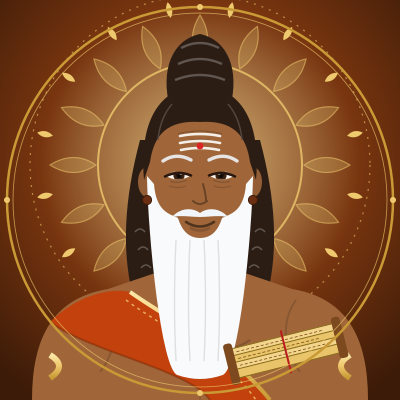
Vyasa, also called Veda Vyasa and Krishna Dvaipayana, is the great sage who composed the Mahabharata. He was the son of the sage Parashara and Satyavati, born long before Satyavati married King Shantanu of Hastinapur. So he was the elder half-brother of Shantanu's sons Chitrangada and Vichitravirya. When the Kuru family was left without heirs, Vyasa came at his mother's call, and through him Dhritarashtra, Pandu and Vidura were born. This makes him the grandfather of both the Kauravas and the Pandavas. Vyasa is unusual in the epic: he is the poet who tells the story and also a person inside it. Again and again he appears at turning points, to warn, to comfort and to show the right path. At the end he gave the whole story to the world, so that people would remember what happens when dharma is forgotten and what happens when it is kept.
Born on an island in the Yamuna
Satyavati was the daughter of a fisherman chief, and as a young girl she ferried travellers across the river Yamuna. One day the great sage Parashara crossed the river in her boat. He blessed her, and from that blessing a son was born on a small island in the middle of the river. Parashara also blessed Satyavati that she would remain pure in every way and that her body would always carry a sweet fragrance.
The child was dark in colour, so he was called Krishna, the dark one. Because he was born on an island, he was also called Dvaipayana, the island-born. As soon as he was born he grew strong and set his mind on prayer and learning. He took leave of his mother to live as a hermit in the forest.
Before he left, he made her a promise: “Whenever you need me and think of me, I will come.” This promise would one day save the Kuru family. Satyavati later married King Shantanu and became queen of Hastinapur, but for many years she told no one about the son she had given birth to on the island.
Arranging the Vedas, and his son Shukadeva
In those days the Vedas were one huge body of sacred knowledge, too vast for most people to learn. Vyasa arranged them into four parts, so that each could be studied and protected. Because of this great work he became known as Veda Vyasa, the one who arranged the Vedas.
He taught the Vedas, along with the Mahabharata as a kind of fifth Veda, to his disciples Sumantu, Jaimini, Paila and Vaishampayana, and to his own son Shuka. Through these disciples the knowledge spread across the land. Vyasa is also revered as the one who gave the world the Puranas, the great books of stories about God and the ages of the world.
His son Shukadeva was born through the power of his long penance, without a mother, from the sacred fire-sticks used to kindle the holy fire. From birth Shuka was free from worldly desire. Vyasa taught him himself and then sent him to the wise King Janaka of Mithila, who tested him and found him perfect.
In time Shuka gave up his body and became one with the Supreme. Vyasa, filled with a father's love, followed him calling, “Son! Son!” It is said that the trees and the hills answered him in Shuka's place. Even a great sage, the story shows, has a loving father's heart.
Saving the Kuru family
King Vichitravirya, Satyavati's younger son, died young and left no children. His two widows were the princesses Ambika and Ambalika. Bhishma had vowed never to marry or rule, so the great Kuru line was about to end. In her distress Satyavati told Bhishma about her first son and then remembered Vyasa. He came at once, as he had promised.
Satyavati asked him to give sons to the widowed queens by niyoga, an old custom in which a respected person gave an heir on behalf of a man who had died. Vyasa agreed. When he came to Queen Ambika, she was frightened by his dark face, matted hair and fiery eyes, and shut her eyes tight. Vyasa told Satyavati that the son would be wise and as strong as ten thousand elephants, but would be born blind. That son was Dhritarashtra.
Queen Ambalika turned pale with fear, so her son Pandu was born pale. When Satyavati asked Ambika to go to the sage once more, she was still afraid and sent her maid instead. The maid welcomed the sage with respect and calm, and her son Vidura was born wise and devoted to dharma. Vyasa blessed the maid and freed her from service.
Vyasa kept watching over the family. Years later he came to Gandhari's palace tired and hungry, and she served him with care. Pleased, he blessed her with a hundred sons. When she later gave birth to a hard lump of flesh instead of a baby, Vyasa came again, had it divided into a hundred and one pieces and placed in pots of ghee. From these came the hundred Kaurava brothers and their sister Duhshala.
A guide to the Pandavas
After the Pandavas escaped the burning house of lac, they wandered in the forests with their mother Kunti. Vyasa appeared before them and comforted them. He led them to the town of Ekachakra, told them to live quietly in a Brahmin's house dressed as Brahmins, and said, “Wait here until I come again.”
Later, while they were still in Ekachakra, Vyasa came again and told them that Princess Draupadi was to be born for them. He told the story of her past life, in which a young woman had asked Lord Shiva five times for a good husband. He then sent them to Panchala, where Arjuna won Draupadi at her swayamvara.
When King Drupada was troubled that his daughter would be the wife of all five brothers, Vyasa came to his court. He explained the divine reason behind it and, for a moment, gave Drupada divine sight so that he could see the brothers in their heavenly forms. Only then did Drupada agree to the marriage.
At Yudhishthira's great Rajasuya sacrifice, Vyasa himself sat as one of the chief priests. When it ended, he quietly warned Yudhishthira that in thirteen years a great destruction of kings would come, and that Yudhishthira would be its cause. Hearing this, Yudhishthira vowed never to speak harshly to anyone and never to quarrel with his brothers or relatives.
When the Pandavas were sent to the forest after the dice game, Vyasa first went to Dhritarashtra and urged him to stop Duryodhana's hatred. Then he visited the Pandavas in the forest. He taught Yudhishthira a special knowledge to pass on to Arjuna, so that Arjuna could go to the mountains and win divine weapons from Lord Shiva and Indra.
Witness to the war
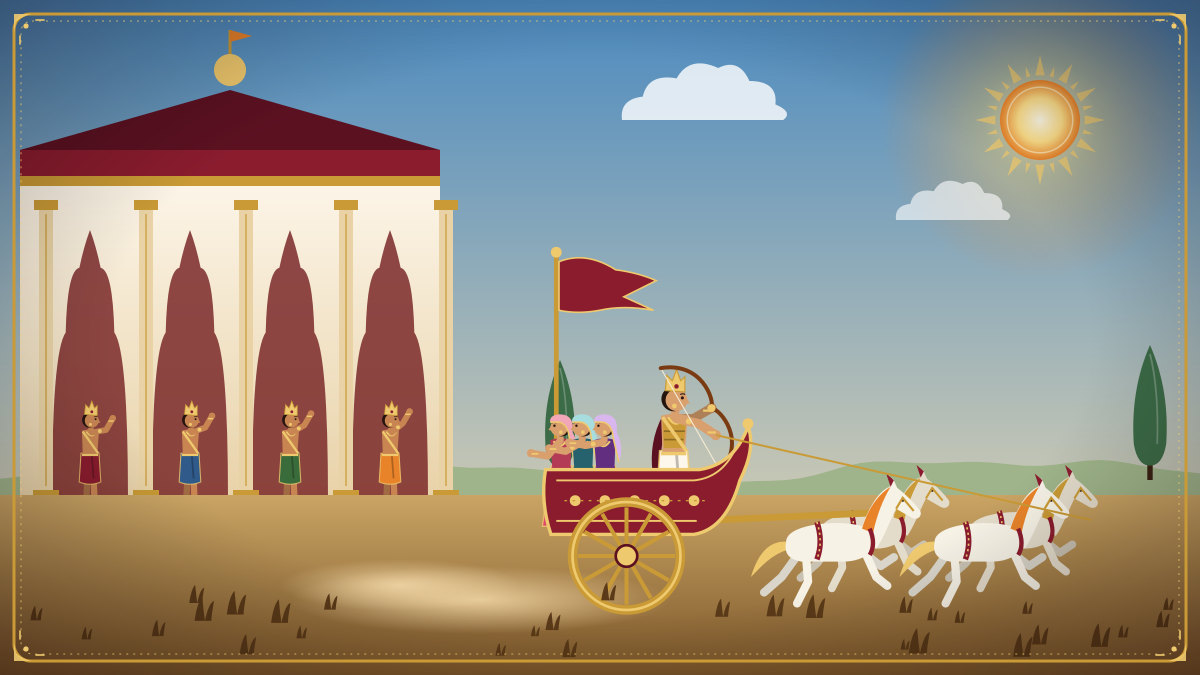
Before the war began, Vyasa came to the blind King Dhritarashtra and offered him sight to watch the battle. The king refused; he did not wish to see his own family die. So Vyasa gave divine vision to Sanjaya, the king's charioteer and adviser. Sanjaya could now see everything on the battlefield, even people's thoughts, and he described the whole war to the king, including the Bhagavad Gita that Krishna spoke to Arjuna.
During the war Vyasa came to comfort the grieving. When young Abhimanyu was killed, he consoled Yudhishthira with stories of how death came into the world and how even great kings must leave it. After Drona's fall, he told Arjuna that Lord Shiva himself had been going ahead of his chariot.
When the war was over, Ashwatthama and Arjuna released the terrible Brahmashira weapon against each other. To save the world, Vyasa and the sage Narada stood between the two blazing weapons. Arjuna, pure in his discipline, was able to call his weapon back. Ashwatthama could not, and he turned it towards the unborn child of Uttara. Krishna protected the child, Parikshit, and Vyasa stood with Krishna as Ashwatthama was punished.
Vyasa also stopped Gandhari from cursing the Pandavas in her grief, and later he helped Yudhishthira, who was heartbroken and wanted to give up the throne. He urged him to rule well, sent him to learn from Bhishma, and advised him to perform the Ashvamedha sacrifice to cleanse his heart.
The night of the dead
Years later, Dhritarashtra, Gandhari and Kunti went to live in the forest. Vyasa came to their hermitage on the bank of the Ganga and asked what they wished for. Gandhari said that the old king longed to see his sons once more, and Kunti asked to see her son Karna.
That night Vyasa stood in the Ganga and called out. The warriors who had died at Kurukshetra rose from the water, shining and calm, free from anger and envy. Fathers met sons, wives met husbands, and friends met friends. Vyasa gave the blind king divine sight for that one night, so that he too could see his children. At dawn the warriors returned to the river and to their worlds.
Later still, after the Yadava family had destroyed itself and Krishna had left the world, a sorrowful Arjuna came to Vyasa's hermitage. Vyasa told him gently that his weapons had served their purpose and that the time had come for the Pandavas to leave this world too.
The great epic is written
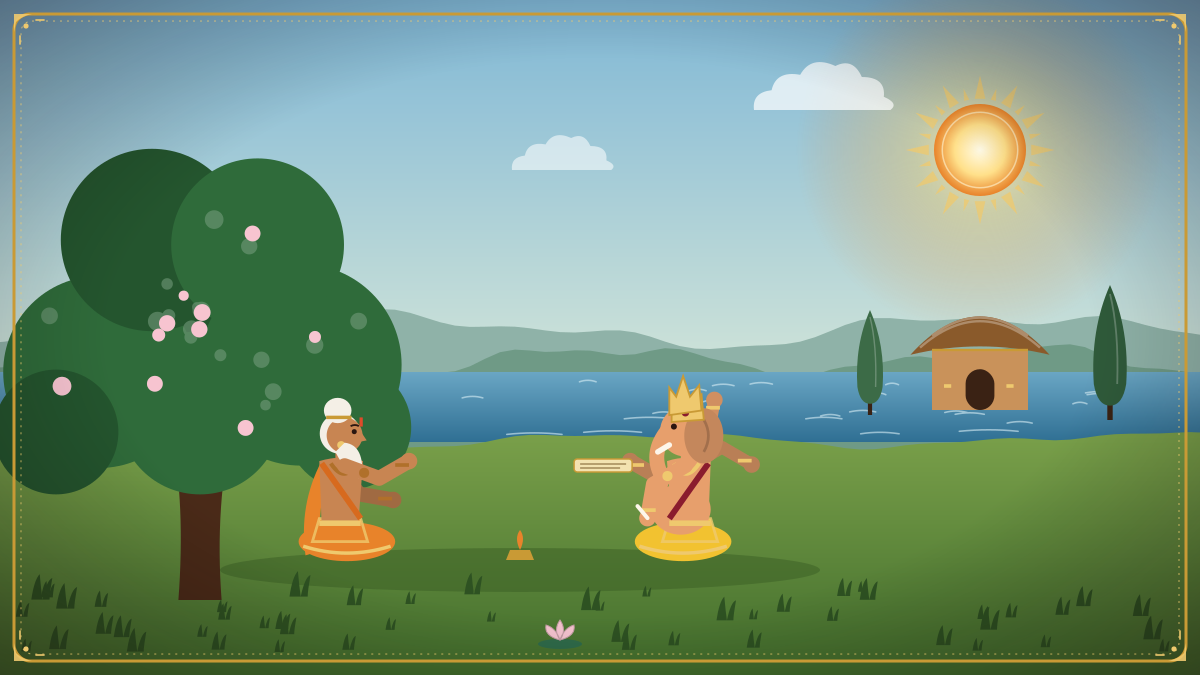
After all these events Vyasa composed the whole story in his mind, a great poem of about one hundred thousand verses. According to the Mahabharata itself, Lord Brahma advised him to ask Lord Ganesha to write it down. Ganesha agreed on one condition: his pen must never stop. Vyasa added his own condition: Ganesha must understand every verse before writing it.
Whenever Vyasa needed time, he spoke a verse full of deep meaning, and while Ganesha paused to understand it, Vyasa composed the next verses. Vyasa is said to have worked on the epic for three years. He taught it first to his son Shuka and then to his other disciples.
At Vyasa's command, his disciple Vaishampayana recited the Mahabharata to King Janamejaya, the great-grandson of Arjuna, at his great snake sacrifice, with Vyasa himself present. Later the storyteller Ugrashravas recited it again to the sages of the Naimisha forest, and so it reached the whole world. Even today, on Guru Purnima, also called Vyasa Purnima, devotees honour him as the first guru.
Did you know?
- Vyasa taught the Vedas and the Mahabharata to five disciples: Sumantu, Jaimini, Paila, Vaishampayana and his own son Shuka.
- The Mahabharata has about one hundred thousand verses, which makes it one of the longest poems ever composed.
- Through Vyasa’s power, the warriors who died at Kurukshetra rose from the Ganga for one night to meet their families.
- Guru Purnima, the full moon of the month of Ashadha, is also called Vyasa Purnima in his honour.
What we learn from Vyasa
Vyasa teaches that knowledge is meant to be shared in a way everyone can understand. He appeared whenever his family stood at a crossroads, yet he never forced anyone; he only showed the path and let them choose. A true teacher guides with patience, tells the truth even when it is hard, and stays close to those who are suffering.
Vyasa in the story
Read the chapters where Vyasa plays a part.