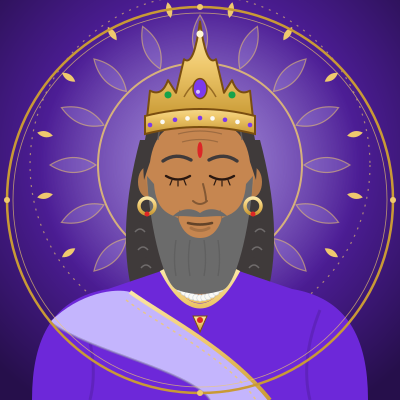
Dhritarashtra was the eldest son of the Kuru family. He was born to Queen Ambika, the widow of King Vichitravirya, through the blessing of the sage Vyasa. He was born blind. His younger brother was Pandu, son of Queen Ambalika, and his half-brother was the wise Vidura, son of a palace maid. All three were raised by Bhishma, whom they honoured as Pitamaha, the grand elder. Dhritarashtra married Gandhari, princess of Gandhara, and became the father of the hundred Kauravas, led by Duryodhana. He was strong, learned and often knew what was right, and many times even said it aloud. But his love for his son was stronger than his sense of justice, and again and again he let Duryodhana have his way. His story is the story of a good mind ruled by a weak heart, and of a father who lost everything because he could not say no.
The blind prince who lost the throne
When Vyasa came to Queen Ambika, she was frightened by his fierce appearance and shut her eyes. Vyasa told Satyavati that the child would be learned and as strong as ten thousand elephants, but would be born blind because of his mother's fear. So Dhritarashtra came into the world unable to see.
Bhishma raised the three princes with great love. Dhritarashtra became famous for his strength, Pandu for his archery and Vidura for his wisdom and knowledge of dharma. The people of Hastinapur were happy, and the kingdom prospered.
As the eldest son, Dhritarashtra should have been king. But the elders decided that a blind man could not rule well, and the crown was given to his younger brother Pandu. Dhritarashtra accepted it, but the hurt of losing his rightful place stayed in his heart all his life, and later it turned into a fierce wish to see his own son on the throne.
Gandhari and the hundred sons
Bhishma arranged Dhritarashtra's marriage with Gandhari, daughter of King Subala of Gandhara. When she learned that her husband was blind, she tied a cloth over her own eyes for life. Pandu, meanwhile, married Kunti and Madri, conquered many lands and then went to live in the forest. While Pandu was away, Dhritarashtra ruled Hastinapur in his place and sent his brother everything he needed.
Through Vyasa's blessing, Gandhari became the mother of a hundred sons and a daughter, Duhshala. Dhritarashtra also had a son named Yuyutsu by a Vaishya woman who served in the palace. The eldest of Gandhari's sons was Duryodhana.
At the moment of Duryodhana's birth, the child cried out like a donkey, and jackals and crows made fearful sounds. Vidura and the learned Brahmins warned the king that this child would bring ruin to the family, and that for the good of all he should be given up. But Dhritarashtra could not bear to part with his firstborn. This was the first of many times he chose his son over the warnings of the wise.
Jealousy grows
When Pandu died in the forest, the sages brought Kunti and the five young Pandavas to Hastinapur. Dhritarashtra received them kindly and they grew up with his own sons. But as the Pandavas grew in skill and goodness, and the people began to love Yudhishthira, the king's heart grew uneasy.
After Yudhishthira was named crown prince, the people openly said that he should be king. Duryodhana came to his father burning with jealousy. A cunning minister named Kanika also advised the king to weaken the Pandavas. Torn between fairness and fear for his son, Dhritarashtra agreed to send the Pandavas and Kunti to the town of Varanavata. There Duryodhana had secretly built a house of lac to burn them alive. Thanks to Vidura's warning, they escaped.
When news came that Draupadi had chosen a husband at her swayamvara, Vidura said happily, “The Kurus have been blessed!” Dhritarashtra thought Duryodhana had won her and was overjoyed. When he learned that the bride had gone to the Pandavas, and that they were alive, he quickly hid his disappointment. His words were sweet, but his heart was divided.
On the advice of Bhishma, Drona and Vidura, he called the Pandavas back and gave them half the kingdom. But he gave them Khandavaprastha, a wild and empty land. The Pandavas worked hard, cleared it and built the beautiful city of Indraprastha.
The game of dice
Yudhishthira performed the grand Rajasuya sacrifice, and Duryodhana returned home sick with envy at the Pandavas' wealth. With his uncle Shakuni he planned to win everything from them in a game of dice. At first Dhritarashtra hesitated and asked Vidura. Vidura warned him plainly that the game would destroy the family. Still the king gave in to his son, and sent Vidura himself to invite the Pandavas.
In the hall, Shakuni won Yudhishthira's wealth, kingdom, brothers, himself and finally Draupadi. Draupadi was dragged into the court and insulted, but Lord Krishna protected her honour. Through all this, the blind king stayed silent for far too long, even asking eagerly what had been won.
Then fearful omens were heard, jackals howled and donkeys brayed, and Gandhari and Vidura urged the king to act. At last Dhritarashtra came to his senses. He praised Draupadi and offered her boons. With them she freed Yudhishthira and his brothers, and the king returned everything that had been lost.
But as soon as the Pandavas left, Duryodhana persuaded his father to call them back for one more game. Gandhari begged her husband to give up their wicked son. Dhritarashtra replied that if the family was to end, let it end; he could not stop his sons. The Pandavas lost again and were sent to the forest for twelve years, and a thirteenth year in hiding.
Warned again and again
While the Pandavas lived in the forest, Vidura kept telling the king to call them back and make peace. Once, angered by his advice, Dhritarashtra told him to leave. Vidura went to the Pandavas in the forest. But soon the king missed his brother so much that he fainted, and he sent Sanjaya to bring Vidura home and begged his forgiveness.
When the thirteen years were over, the Pandavas asked for their kingdom back. Dhritarashtra sent Sanjaya to them with words of peace, but no promise of land. That night, unable to sleep, he asked Vidura for counsel, and Vidura spoke at length about right conduct; these teachings are known as Vidura Niti. The sage Sanatsujata also taught him about the soul and death.
Krishna came himself to Hastinapur as a messenger of peace and asked for only five villages for the Pandavas. Bhishma, Drona, Vidura and Gandhari all begged the king to accept. Dhritarashtra agreed with them and pleaded with Duryodhana, but he would not act firmly against his son. Duryodhana even tried to capture Krishna, and the last chance for peace was lost.
Hearing the war through Sanjaya
Before the battle, Vyasa offered Dhritarashtra sight so that he could watch the war. The king refused, saying he could not bear to see his own family killed. So Vyasa gave divine vision to Sanjaya, who sat beside the king in Hastinapur and saw everything happening at Kurukshetra.
The Bhagavad Gita begins with Dhritarashtra's question: “What did my sons and the sons of Pandu do, gathered at Kurukshetra, the field of dharma?” Through Sanjaya, the blind king heard Krishna's teaching to Arjuna and even heard of Krishna's universal form.
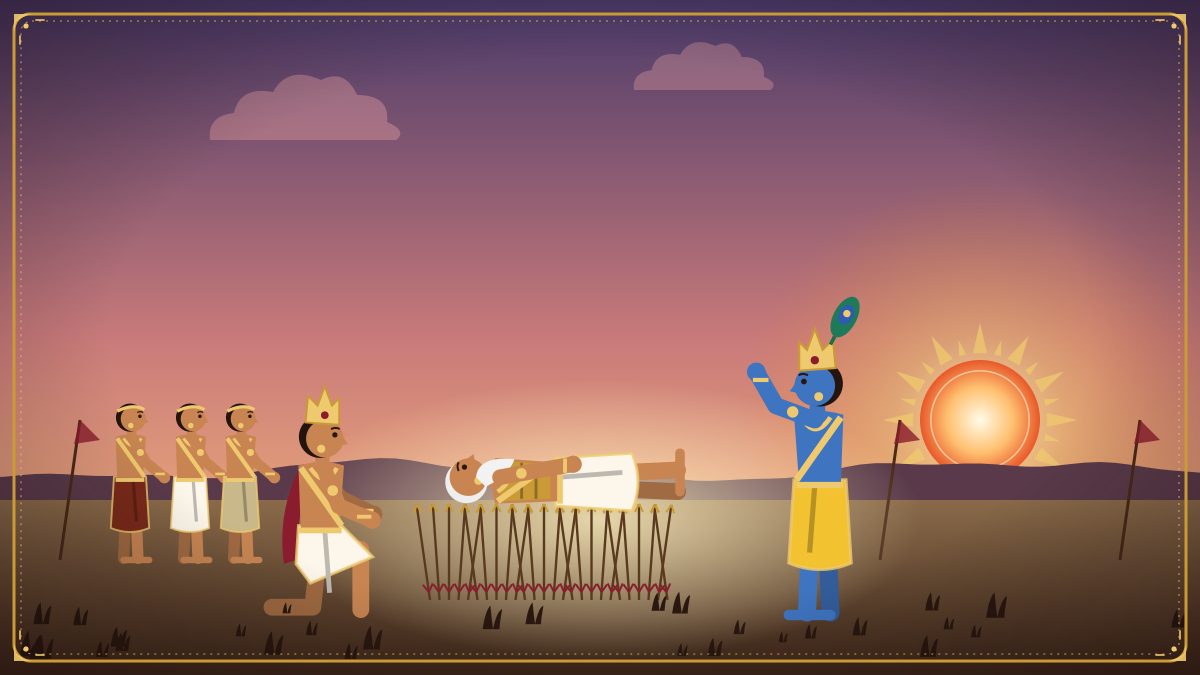
Day after day Sanjaya brought him news of the battle: the fall of Bhishma, then Drona, then Karna, then Shalya. Each time the king wept and blamed fate, and each time Sanjaya reminded him that he could have stopped this long ago. One by one he heard that his sons had fallen.
On the eighteenth day Duryodhana fell to Bhima's mace. All hundred of Gandhari's sons were gone. Only Yuyutsu survived, because before the battle began he had crossed over to the Pandava side, choosing what he believed was right.
Grief, the iron statue and the forest
When the war was over, Dhritarashtra went to the battlefield with the women of the family. The Pandavas came to bow to him. He embraced Yudhishthira, then asked for Bhima. In his heart burned anger against the man who had killed Duryodhana. Krishna understood this and quickly pushed forward an iron statue of Bhima that Duryodhana had used for practice. The king crushed it to pieces in his embrace and fell to the ground.
Then he wept, thinking he had killed Bhima. Krishna told him gently that Bhima was alive, and reminded him that the destruction had come from his own weakness and his son's wrongs. Dhritarashtra's anger melted. He embraced Bhima and the other Pandavas with true affection.
For fifteen years he lived in Hastinapur under King Yudhishthira, who treated him like a father and let him give gifts and perform rites for his dead sons. But sometimes Bhima spoke bitter words that hurt him, and the old king quietly kept fasts and grew weary of palace life.
With Vyasa's support, he took Yudhishthira's permission to go to the forest. Gandhari, Kunti, Vidura and Sanjaya went with him. They lived as hermits on the banks of the Ganga, and there, on the night of the dead, Vyasa gave him sight for one night so that he could see his sons, calm and shining.
Some years later a great forest fire swept through the woods where they lived. Dhritarashtra told Sanjaya to save himself. Then the old king, with Gandhari and Kunti, sat facing east in calm meditation, and they left this world together. Sanjaya escaped and went to the Himalayas, and Yudhishthira later performed their last rites with deep sorrow.
Did you know?
- The very first verse of the Bhagavad Gita is a question asked by Dhritarashtra to Sanjaya.
- When Krishna showed his universal form in the Kuru court, he gave the blind Dhritarashtra sight for a short time so that he could see it.
- When Duryodhana was born, jackals howled, and Vidura advised the king to give up the child for the family’s good.
- Of all Dhritarashtra’s sons, only Yuyutsu survived the war, because he fought on the side of the Pandavas.
What we learn from Dhritarashtra
Dhritarashtra teaches that love without wisdom harms the very people we love. He often knew what was right, yet knowing is not enough if we lack the courage to act on it. A good parent says no to a child's wrong wishes, and anyone who holds power must use it for justice. His calm end in the forest also shows that it is never too late to let go of anger.
Dhritarashtra in the story
Read the chapters where Dhritarashtra plays a part.