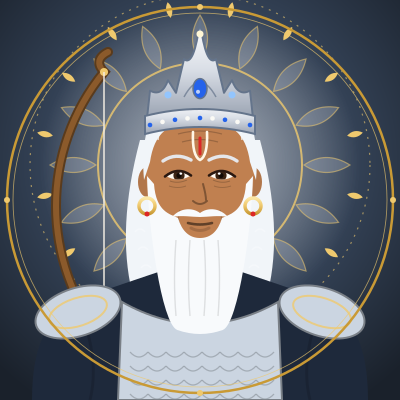
Bhishma, born as Devavrata, was the eighth son of King Shantanu and the river goddess Ganga. He was the half-brother of Vichitravirya, and so the great-uncle of both the Kauravas and the Pandavas; everyone called him Pitamah, the grandsire. For his father's happiness he gave up the throne and promised never to marry. For the rest of his very long life he served the throne of Hastinapur, guided the family through four generations and loved its children. He was the greatest warrior of his age, undefeated even by his teacher Parashurama. Yet his vow also bound him, and he sat silent when he should perhaps have spoken. Lying on a bed of arrows, he gave the world some of its deepest teachings on dharma. His story is one of sacrifice, loyalty and a promise kept to the very end.
Devavrata, son of Ganga
Bhishma was once Dyau, one of the eight Vasus, the heavenly beings cursed by the sage Vasishtha to be born as humans. Ganga, his mother on earth, set his seven brothers free by releasing them into her waters, but he, the eighth, had to live a long human life. He was named Devavrata, and also Gangeya, the son of Ganga.
Ganga took the child with her when she left King Shantanu, and saw that he received the finest education. He learned the Vedas from the sage Vasishtha, all the arts of weapons including those of Parashurama, and the wisdom of statecraft known to Brihaspati, guru of the gods, and Shukracharya, guru of the asuras.
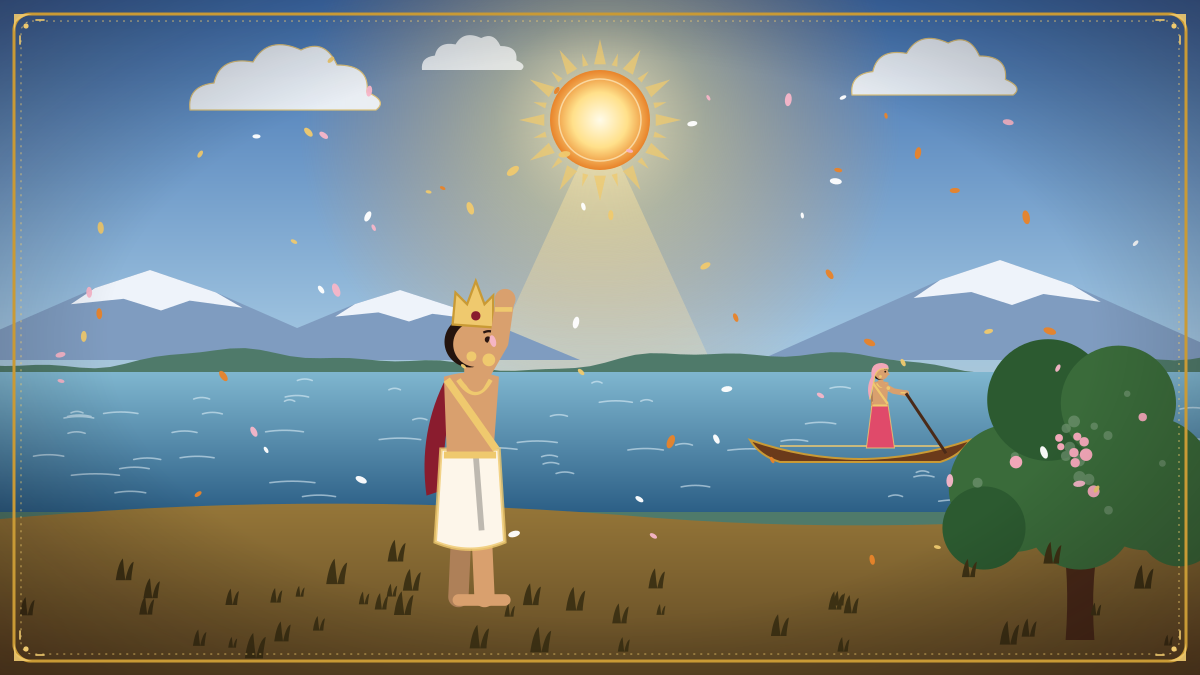
When he was a young man, Shantanu found him on the bank of the Ganga holding back the river with a wall of arrows. Ganga then returned him to his father. Shantanu made him crown prince, and for four years Hastinapur rejoiced in its brave, learned and gentle prince.
The terrible vow
Then Shantanu fell in love with Satyavati, the fisherman chief's daughter. Her father agreed to the marriage only if Satyavati's son would be king. Shantanu would not take the throne away from Devavrata, and he grew silent and sad.
Devavrata learned the truth from an old minister. He went to the fisherman chief with the elders of the court and said, “I give up the throne. Satyavati's son will be king.” The chief, a careful man, said, “I believe you. But what about your sons? They may fight for the throne.”
Then Devavrata made the vow that changed his life. “From today I will live as a brahmachari and never marry. Even without a son, I will reach the eternal worlds.” As he spoke, flowers fell from the sky, and the gods and sages cried, “This is Bhishma!”, the one of the terrible vow. He took Satyavati to the palace, calling her mother.
Shantanu was overwhelmed by his son's sacrifice. He gave Bhishma the boon of choosing his own death: “As long as you wish to live, death will not touch you.” This boon would shape the end of Bhishma's story.
The princesses of Kashi, Amba and Parashurama
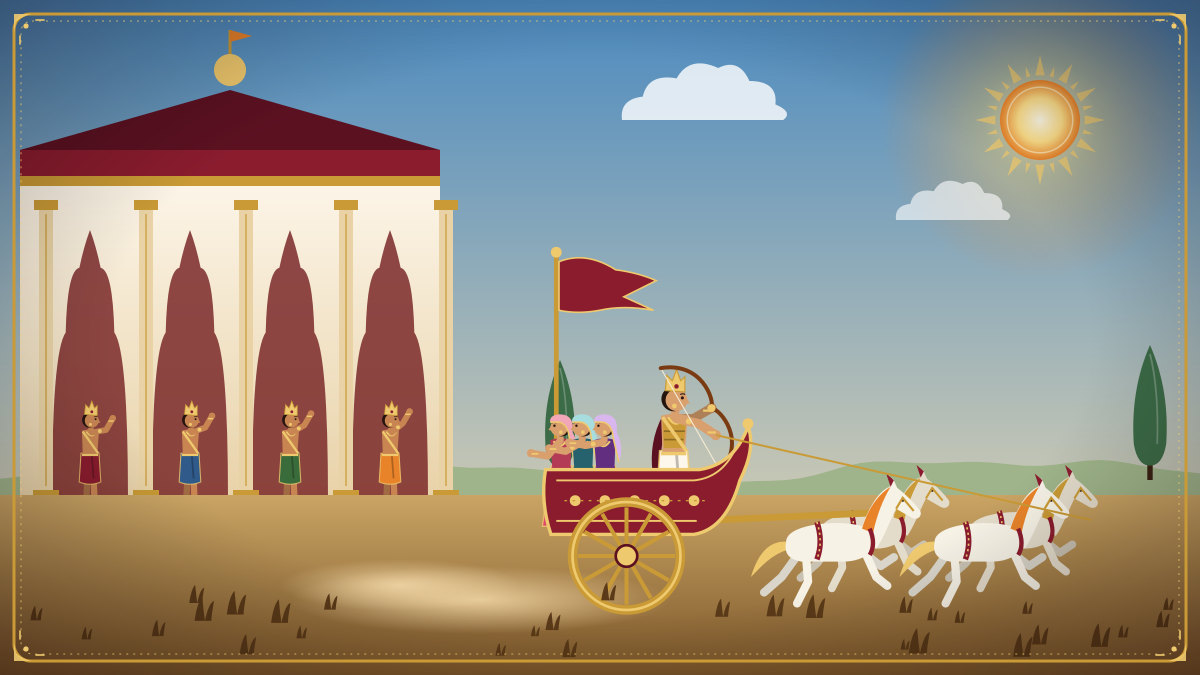
After Shantanu's death, Bhishma crowned Chitrangada, who was soon killed by a Gandharva. He then crowned the boy Vichitravirya and ruled for him as regent. When the king of Kashi held a swayamvara for his three daughters, Amba, Ambika and Ambalika, Bhishma went alone in his chariot, took the three princesses for his brother, and defeated all the kings who opposed him, including King Shalva.
In Hastinapur, the eldest, Amba, told Bhishma that in her heart she had already chosen Shalva. Bhishma, after consulting learned brahmins, let her go with honour. But Shalva refused her, saying she had been won by another man. Ambika and Ambalika married Vichitravirya.
Amba, rejected by all, blamed Bhishma for her sorrow. She went to the forest ascetics, and her grandfather Hotravahana brought her to Parashurama, Bhishma's own teacher. Parashurama ordered Bhishma to take her back. Bhishma bowed to his guru but refused: he would not break his vow, and his brother would not marry a woman whose heart belonged to another.
So teacher and pupil fought on the field of Kurukshetra for twenty-three days. Ganga begged both of them to stop, but neither would give up. At last, when Bhishma was about to use a sleep-weapon given to him by the Vasus in a dream, the sage Narada and the gods stopped him, and the ancestors told Parashurama to lay down his arms. Parashurama admitted that he could not defeat Bhishma, and they parted with respect.
Amba then performed fierce penance, and Lord Shiva granted that in her next birth she would cause Bhishma's death. She entered a fire and was reborn as Shikhandini, daughter of King Drupada, who later became the man Shikhandi. Bhishma knew this story well, which is why he later refused to fight Shikhandi.
Pillar of the Kuru family
Vichitravirya died young, without children. Satyavati begged Bhishma to marry or take the throne, but he answered that he could give up the three worlds, but never his vow. He suggested inviting a great sage to bless the queens. Satyavati called her son Vyasa, and Dhritarashtra, Pandu and Vidura were born.
Bhishma raised the three boys as a father, and while they grew he ruled the kingdom wisely. The epic says the land of the Kurus flourished then, with good rains, full harvests and happy people. Because Dhritarashtra was blind and Vidura was born of a maid, Pandu was crowned king.
Bhishma arranged their marriages: Gandhari of Gandhara for Dhritarashtra, Madri of Madra for Pandu (Kunti had already chosen Pandu at her swayamvara), and a good bride for Vidura. Later he brought Kripacharya and then Dronacharya to teach the young Kauravas and Pandavas.
He loved all the children, but he saw that the Pandavas walked the path of dharma. When news came that they had died in the house of lac, he wept. When they returned alive and married to Draupadi, he advised Dhritarashtra to give them half the kingdom, and they built Indraprastha.
At Yudhishthira's Rajasuya sacrifice, Bhishma proposed that the first honour be given to Krishna. When King Shishupala insulted Krishna and Bhishma, Bhishma calmly spoke of Krishna's greatness, and soon Krishna himself ended Shishupala's life.
Silence in the dice hall
The saddest moment of Bhishma's life came in the dice hall of Hastinapur. Yudhishthira lost everything in a game with Shakuni, then lost himself, and then Draupadi. Draupadi was dragged into the hall, and she asked the elders a question: “Yudhishthira lost himself first. Did he still have the right to stake me?”
Bhishma answered, “Dharma is subtle, and I cannot decide this question rightly. One who has lost himself cannot stake what is not his, yet a wife is under her husband's word. Yudhishthira himself should answer.” His answer helped no one, and the insult went on. Only Krishna's grace protected Draupadi.
Why did the greatest warrior of the age stay silent? The epic gives his own explanation. On the first day of the war he told Yudhishthira, “A person is the servant of wealth, but wealth is no one's servant. I am bound to the Kauravas by the wealth I have received from them.” His vow to serve the throne of Hastinapur, and his loyalty to the king who fed him, tied his hands.
Again and again Bhishma tried to bring peace. He told Duryodhana to make peace when the Pandavas returned from exile, and he supported Krishna's peace mission in the Kuru court. Duryodhana would not listen.
Before the war, while counting the great warriors, Bhishma called Karna only half a chariot-warrior. Karna was so hurt that he vowed not to fight while Bhishma stood. Later Bhishma revealed that he had spoken harshly only to curb Karna's pride and prevent quarrels.
Ten days as commander
When the war could not be avoided, Duryodhana made Bhishma commander of the Kaurava army. Bhishma accepted, but warned him: “I will not kill the sons of Pandu. But every day I will destroy ten thousand warriors.”
Before the battle began, Yudhishthira walked unarmed to Bhishma to seek his blessing. Bhishma was deeply moved and blessed him: “Victory will be yours.” He promised that he would one day tell Yudhishthira how he himself could be defeated.
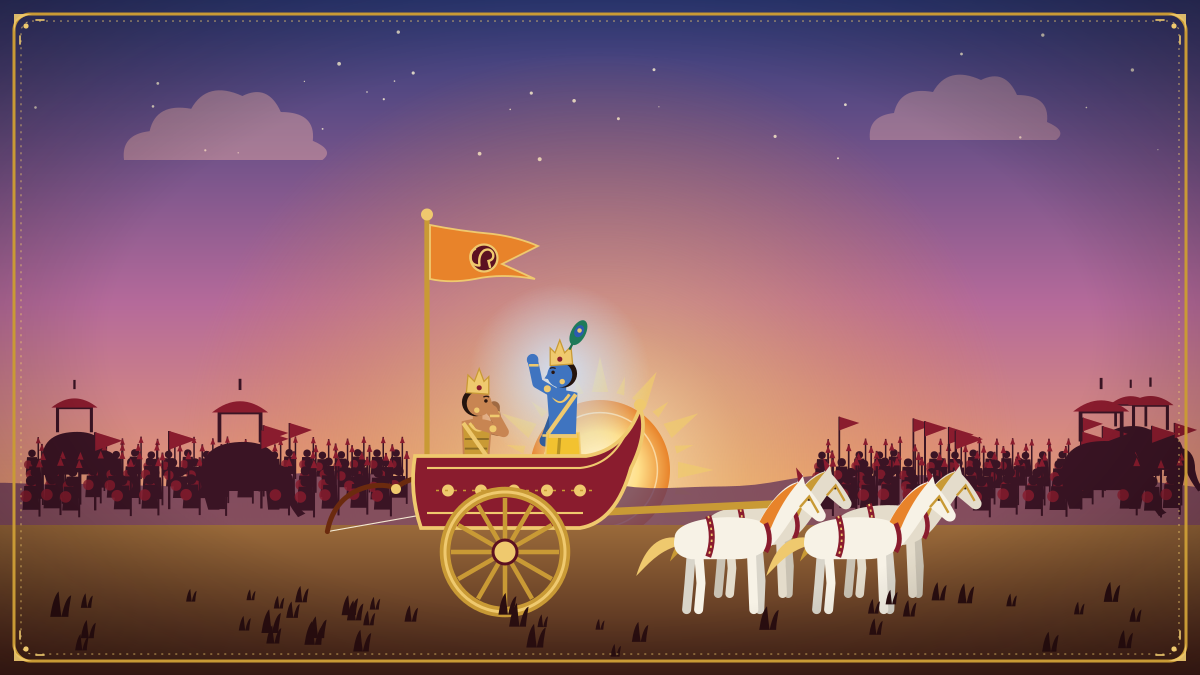
For ten days Bhishma fought, his white umbrella and palm-tree banner always in the thick of battle. The Pandava army could not stand before him. Twice, seeing Arjuna fight too gently against his beloved grandsire, Krishna jumped down from the chariot and ran at Bhishma, once with his discus. Bhishma lowered his bow and welcomed him: “Come, Lord, I bow to you. To be killed by you would be my honour.” Arjuna ran after Krishna, held him back, and promised to fight in earnest.
On the ninth night the Pandavas went to Bhishma's tent and asked how he could be defeated. Bhishma told them, “I will not fight Shikhandi, who was born a woman. Let Arjuna attack me with Shikhandi in front of him.”
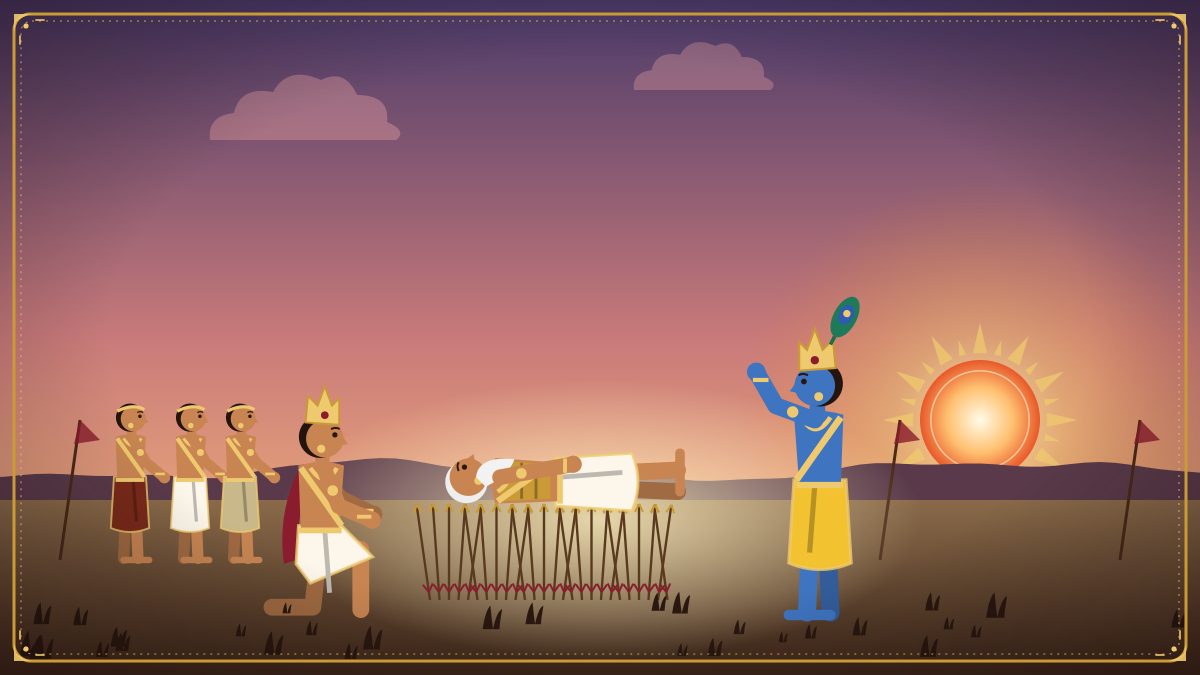
On the tenth day it happened so. With Shikhandi before him, Arjuna's arrows covered Bhishma. Feeling them, Bhishma said, “These arrows that cut like lightning are Arjuna's, not Shikhandi's.” Near sunset he fell from his chariot, so pierced with arrows that his body did not touch the ground.
The bed of arrows and the final journey
Both armies stopped fighting and gathered around him. The sun was then on its southern path, and Bhishma decided to wait for Uttarayana, the sun's northward journey. His head hung down, so he asked for a pillow; Arjuna placed three arrows under it. When he was thirsty, Arjuna shot an arrow into the earth and a stream of pure, cool water rose to his lips. Bhishma begged Duryodhana once more to make peace, but in vain. That night Karna came to him, and Bhishma told him gently that he was Kunti's son and the Pandavas' brother.
After the war, Krishna brought the grieving Yudhishthira to Bhishma. Bhishma was in great pain, but Krishna blessed him so that his pain would leave him and his mind would be clear. Over many days, Bhishma taught Yudhishthira about the duties of a king, about right action in hard times, and about freedom of the soul. These teachings fill the Shanti Parva and Anushasana Parva of the epic.
It was in this teaching that Yudhishthira asked which god is the highest, and Bhishma answered by reciting the Vishnu Sahasranama, the thousand names of Lord Vishnu, which devotees chant to this day.
When the sun began its northward journey, in the bright half of the month of Magha, Bhishma said he had lain on the arrows for fifty-eight nights. He blessed Yudhishthira and took leave of Dhritarashtra, Krishna and everyone around him. Then, by the power of yoga, he drew his life breath upward and it left through the crown of his head. The arrows fell from his body, and flowers fell from the sky.
The Pandavas performed his last rites on the bank of the Ganga, and the goddess rose from the river to weep for her son, until Krishna told her that he had returned to the Vasus. The epic remembers Bhishma as the noblest of the Kurus, whose sacrifice was great and whose vow was never broken.
Did you know?
- Bhishma’s birth name was Devavrata. “Bhishma” means “the terrible one”, a title the gods gave him because his vow was so hard to keep.
- Bhishma fought a long duel with his own guru Parashurama over Princess Amba, and neither could defeat the other.
- Bhishma lay on the bed of arrows for about fifty-eight nights before he chose to leave his body in Uttarayana.
- The Vishnu Sahasranama, the thousand names of Lord Vishnu still recited daily in many homes, was taught by Bhishma to Yudhishthira.
What we learn from Bhishma
Bhishma teaches the beauty of sacrifice and keeping one's word. Yet his silence in the dice hall also teaches that a promise or a debt of loyalty should never stop us from standing up for what is right. His last days show that true wisdom is something to share until one's final breath.
Bhishma in the story
Read the chapters where Bhishma plays a part.