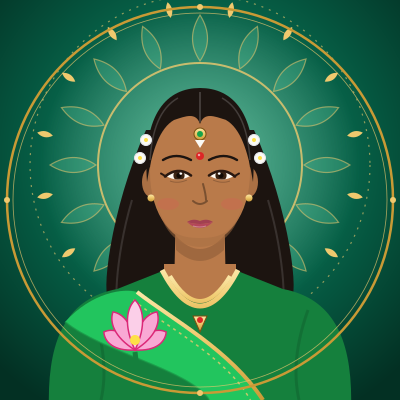
Satyavati is one of the most important women in the Mahabharata, though she appears only in its early part. Born in a wondrous way and raised by a fisherman chief, she rowed a ferry on the river Yamuna. She became the mother of the great sage Vyasa, and later the queen of King Shantanu of Hastinapur. Her father's demand that her son should be king led Prince Devavrata to take the vow that made him Bhishma. When both her sons by Shantanu died without children, it was Satyavati who found a way to save the Kuru family, by calling Vyasa. Through him she became the grandmother of Dhritarashtra, Pandu and Vidura, and the great-grandmother of both the Kauravas and the Pandavas.
A wondrous birth
Satyavati's story begins with King Uparichara Vasu of Chedi, a righteous king who was a friend of Indra. Indra gave him a crystal chariot that could fly through the sky, which is why he was called Uparichara, the one who moves above.
One spring, the king went hunting while his heart was full of thoughts of his beloved queen Girika. His seed fell, and not wanting it to be wasted, he placed it on a leaf and asked a hawk to carry it swiftly to the queen. On the way another hawk attacked the first, and the seed fell into the river Yamuna.
In the Yamuna lived Adrika, an apsara, a heavenly dancer, who because of a curse was living as a fish. She swallowed the seed. In the tenth month, fishermen caught the fish, and when they opened it they found two human babies inside, a boy and a girl. At that moment Adrika was freed from her curse and went back to heaven.
The fishermen took the twins to King Uparichara Vasu. The king kept the boy, who grew up to be a righteous king named Matsya. The girl he gave to the chief of the fishermen, saying, “Let her be your daughter.”
The fisherman's daughter
The fisherman chief raised the girl lovingly as his own. She was named Satyavati, the truthful one. She was beautiful and good, but because she had been born from a fish, her body had the smell of fish. So people also called her Matsyagandha, the one who smells of fish.
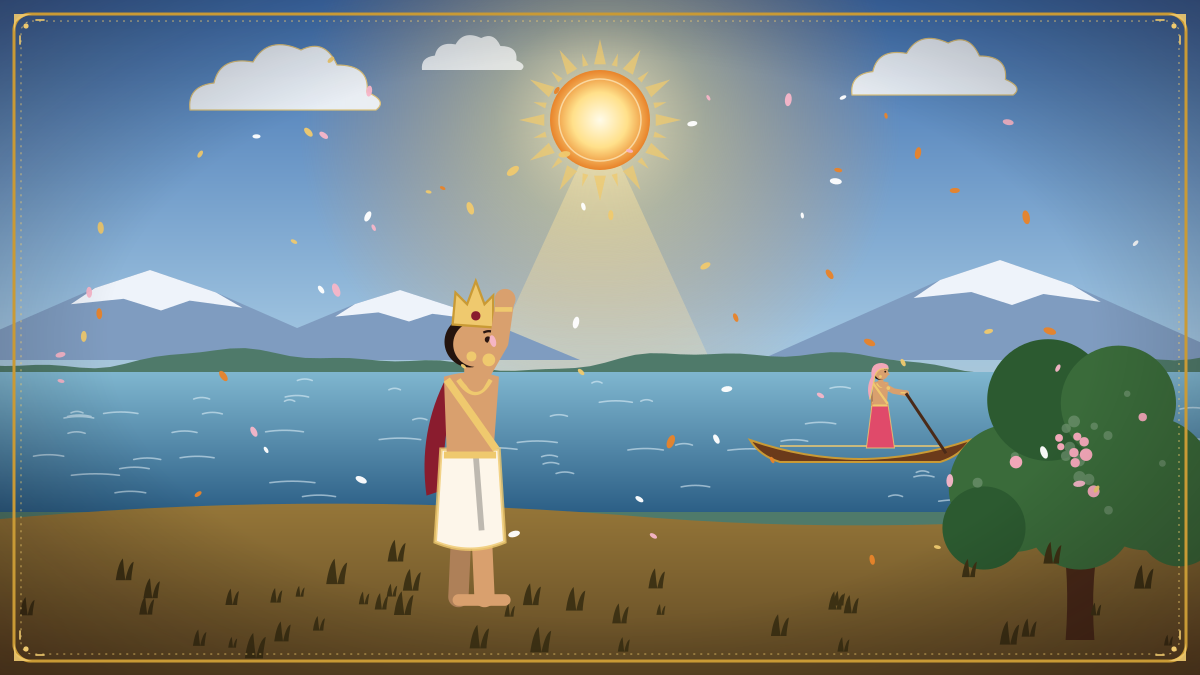
To serve her father, Satyavati rowed a ferry boat across the Yamuna, carrying travellers from one bank to the other. It was humble work, but she did it with devotion.
Her foster father was the chief of the fisherfolk who lived along the Yamuna. He loved her dearly and was proud of her. He was a shrewd and careful man, and his protective love for his daughter would later show itself in the famous condition he set before King Shantanu.
Even in these simple beginnings, the epic shows her as clever, thoughtful and aware of what was right. These qualities would later make her a wise queen.
The sage Parashara and the birth of Vyasa
One day the great sage Parashara, travelling on pilgrimage, came to cross the Yamuna in her boat. Seeing her beauty, he wished to have a child with her. Satyavati was hesitant. She pointed out that other sages were standing on the bank, and that she was an unmarried girl under her father's care.
Parashara, by his power, covered the whole place in a thick mist so that no one could see. He promised her that she would remain a maiden even after the child was born. He also granted her wish: from then on her body gave out a sweet fragrance that could be smelled from a yojana away. So she came to be called Gandhavati and Yojanagandha, the fragrant one.
On an island in the Yamuna, Satyavati gave birth to a son. He was dark in colour, so he was named Krishna, and because he was born on an island (dvipa) he was called Dvaipayana. This child, Krishna Dvaipayana, grew up at once by his yogic power and later became the great sage Vyasa, who divided the Vedas and composed the Mahabharata.
Before going to the forest for penance, the boy said to his mother, “Whenever you need me, just remember me, and I will come.” Satyavati kept this promise in her heart for many years.
Queen of Hastinapur
Some time later, King Shantanu of Hastinapur, wandering near the Yamuna, was drawn by Satyavati's wonderful fragrance. He found her and wished to marry her, and he went to her father.
The fisherman chief agreed on one condition: the son born of Satyavati must become king after Shantanu. Shantanu would not set aside his worthy son Devavrata, and he went home in sorrow.
When Devavrata learned the reason, he went to the chief himself. He gave up his right to the throne and then vowed that he would never marry, so that no children of his would ever claim it. This was the vow that made him Bhishma. Devavrata then brought Satyavati to the palace, calling her mother.
Satyavati married Shantanu and became queen. They had two sons, Chitrangada and Vichitravirya. Her father's condition had made her son the heir, but it had also taken away the future of another son. This would weigh on the family for generations.
Sorrow upon sorrow
Shantanu died while Vichitravirya was still a boy. Bhishma, honouring Satyavati's wishes, crowned Chitrangada king. But Chitrangada was proud of his strength, and a Gandharva king who had the same name challenged him. They fought for three years on the field of Kurukshetra, and Chitrangada was killed.
Bhishma then crowned young Vichitravirya, and ruled for him as Satyavati advised. When the prince grew up, Bhishma won the princesses Ambika and Ambalika of Kashi as his brides. But after seven years of married life, Vichitravirya fell ill with a wasting disease and died, leaving no children.
Satyavati's grief was very deep. Her husband and both her sons were gone, and the great Kuru line, for whose sake her father had once asked so much, now had no heir at all.
In her sorrow she turned to Bhishma. “You know the law,” she said. “Take the throne and marry, or give sons to your brother's widows by the ancient custom, so that the family does not end.” Bhishma answered with great respect but firmly: he could give up the three worlds, but never his vow. He suggested instead that a worthy sage be invited to bless the queens with sons.
Calling Vyasa
Then, with some shyness, Satyavati told Bhishma the secret of her youth: the sage Parashara and the son born on the island, Krishna Dvaipayana. Bhishma agreed that Vyasa was the right person to help.
Satyavati remembered her son, and Vyasa appeared at once. By the ancient custom of niyoga, he agreed to give sons to Vichitravirya's widows. He asked that the queens first keep a vow for a year to make themselves pure, but Satyavati, worried for the kingdom without a king, asked him to act quickly.
Queen Ambika closed her eyes in fear of the sage's stern appearance, so her son Dhritarashtra was born blind. Queen Ambalika turned pale, so her son Pandu was born pale. Satyavati asked Ambika to go to the sage again, but Ambika sent a maid in her place. The maid welcomed the sage calmly and respectfully, and her son Vidura was born wise and righteous.
In this way, through Satyavati's courage, the Kuru line continued. Dhritarashtra became the father of the hundred Kauravas, and Pandu the father of the five Pandavas. All of them were Satyavati's great-grandsons.
The last journey to the forest
Satyavati lived to see her grandsons grown, and to see the Pandavas brought back to Hastinapur by the sages after Pandu's death in the forest.
After Pandu's last rites, Vyasa came to his mother and said, “The happy days are past, and hard and cruel times are coming. The earth has lost her youth. Do not stay to see the destruction of your family. Go to the forest and spend your days in yoga and prayer.”
Satyavati agreed. She went to Ambika and told her that her grandson's sins would soon destroy the Bharatas. Then, with Bhishma's permission, she went to the forest with her two daughters-in-law, Ambika and Ambalika. There the three queens practised hard penance, and in time they left their bodies and reached the higher worlds. Satyavati did not live to see the dice game or the war.
The epic remembers Satyavati as a woman of great strength. She rose from a ferry boat to the throne of Hastinapur, faced the deaths of her husband and both her sons, and still found a way to save the family. Her firstborn, Vyasa, would compose the whole story of her descendants, so her name stands at the very root of the Mahabharata.
Did you know?
- Satyavati had many names: Matsyagandha (smelling of fish), Yojanagandha (whose fragrance travelled for miles), Kali (the dark one) and Satyavati (the truthful one).
- Her twin brother was kept by their father, King Uparichara Vasu, and grew up to become a king named Matsya.
- Satyavati was the mother of Vyasa, the author of the Mahabharata, so the poet of the epic was also a member of its royal family.
- She left Hastinapur for the forest on her son Vyasa’s advice, so she did not live to see the dice game or the war.
What we learn from Satyavati
Satyavati shows that a person's beginnings do not limit their future: a ferry girl became the mother of Vyasa and the queen mother of the Kurus. Her story also reminds us that wishes made for our own children can have effects far into the future. And her wise decision to leave for the forest teaches us to know when to step away with grace.
Satyavati in the story
Read the chapters where Satyavati plays a part.