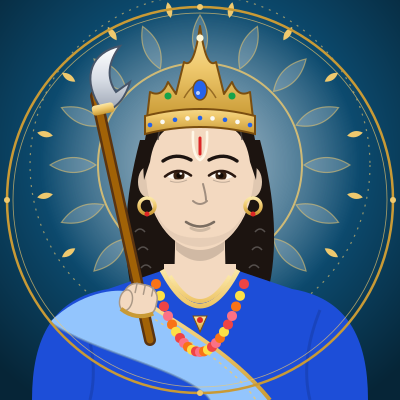
Balarama was the elder brother of Shri Krishna, the son of Vasudeva and his wife Rohini, so the two brothers shared the same father. Fair as a white cloud and dressed in blue, he was famous for his enormous strength and for the plough he carried as a weapon, which is why he is called Haladhara and Halayudha. The Mahabharata says that he was born from a portion of Shesha, the divine serpent on whom Lord Vishnu rests. In the epic he is the great master of the mace, the teacher of both Bhima and Duryodhana, and the one Yadava hero who refused to take sides in the war. Honest and quick to anger, but just as quick to forgive, he loved both the Pandavas and the Kauravas as his own.
A wonderful birth and a happy childhood
The Harivamsha tells that Balarama’s birth was a miracle. The cruel King Kansa had imprisoned Devaki and Vasudeva and was killing their children one by one. When Devaki was expecting her seventh child, the goddess Yoganidra, by Lord Vishnu’s wish, gently moved the baby from Devaki’s womb to the womb of Rohini, Vasudeva’s other wife, who was living safely in Gokul. Because he was drawn from one womb into another, he was also called Sankarshana.
Balarama grew up in Gokul and Vrindavan with his little brother Krishna, in the home of the cowherd chief Nanda. The two boys grazed cows together, played together and protected the cowherds together. With his bare strength Balarama destroyed demons such as Dhenuka and Pralamba.
When the brothers were grown, they went to Mathura, where Kansa met his end. Later, when Jarasandha attacked Mathura again and again, Balarama went with Krishna and the Yadavas to the new city of Dwaraka. There he married Revati, the daughter of King Raivata.
The master of the mace
No one in his time could match Balarama with the mace. Both Bhima, the second Pandava, and Duryodhana, the eldest Kaurava, learned mace fighting from him. Balarama was fond of both his students. He admired Duryodhana’s skill and graceful style, and he loved Bhima’s great strength.
Balarama came with Krishna and the Yadavas to Draupadi’s swayamvara. When Krishna recognised the Pandavas in their brahmin disguise and pointed them out to him, Balarama was overjoyed that his cousins had escaped the fire of the lac house alive.
Balarama was simple and honest, and he spoke his mind openly, even before kings. In the epic he is called by many names: Rama, Baladeva, Sankarshana, Haladhara, and Halayudha, “the one whose weapon is the plough”. The Yadavas loved him dearly, and they also stood a little in awe of his temper.
Subhadra’s marriage
When Arjuna carried away Subhadra, the sister of Krishna and Balarama, the Yadava assembly was in an uproar. Balarama was furious. “Arjuna ate at our table and then stole our sister,” he said. “I will wipe the Kurus from the earth.”
Krishna calmly explained that Arjuna had done no wrong. He was a noble hero of a great family, a worthy husband for Subhadra, and carrying away a bride in this way was an accepted custom among Kshatriyas. It would be wiser to bring him back with honour as a friend. Balarama listened, and his anger cooled.
Arjuna was brought back to Dwaraka and married Subhadra there. Later Balarama went with Krishna and the Yadavas to Indraprastha, bringing rich wedding gifts for the couple, and he was welcomed there with great love.
Standing apart from the war
When the Pandavas’ thirteen years were over, Balarama came with Krishna to Upaplavya for the wedding of Abhimanyu and Uttara. Afterwards the kings gathered there to decide what to do. Balarama advised that a gentle messenger should be sent to Duryodhana. He said that Yudhishthira had gambled knowingly against a skilled player, so the Pandavas should ask for their share politely. Satyaki was angered by these words, but Balarama spoke from his wish for peace.
When both sides began gathering allies, Duryodhana came to Dwaraka and asked Balarama for help. Balarama reminded him that he had always spoken in his favour, but said that since Krishna was with the Pandavas, he would fight for neither side.
Just before the war, Balarama visited the Pandava camp, dressed in blue and shining like a white mountain. Yudhishthira and the others rose to greet him with great respect. He said, “I told Krishna again and again to treat the Kurus as he treats you, for they are our relatives too. But out of his love for Arjuna he would not listen.”
Then he added, “The Pandavas and the Kauravas are equally dear to me, and Bhima and Duryodhana are both my students. I cannot bear to stand by and watch the Kurus destroyed.” He embraced the Pandavas and took his leave.
The pilgrimage along the Sarasvati
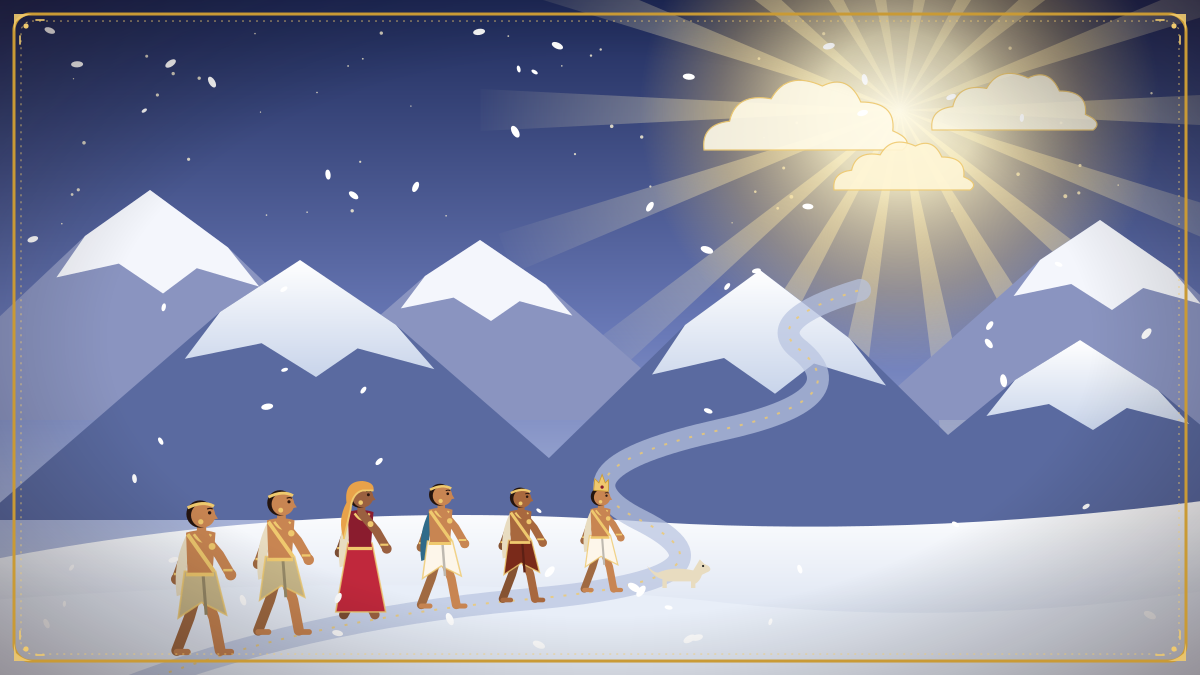
Instead of fighting, Balarama set out on a long pilgrimage to the holy places along the river Sarasvati, taking brahmins, priests and attendants with him. The Shalya Parva describes this journey in great detail.
He began at Prabhasa on the western sea and travelled from one sacred bathing place to the next. Among them were Udapana, Vinashana, where the Sarasvati disappears into the sand, and the Naimisha forest. He went as far as Plaksha in the Himalayas, where the river begins. At every holy place he bathed, gave cows, gold, clothes and food to brahmins, and listened to the ancient stories told about it.
At Kurukshetra the sages told him why that land is so holy. Long ago King Kuru had ploughed it, and Indra had granted that whoever gave up his life there, in penance or in battle, would reach heaven.
The pilgrimage lasted forty-two days. All that time the great battle was raging at Kurukshetra, and Balarama had no part in it.
The last mace fight
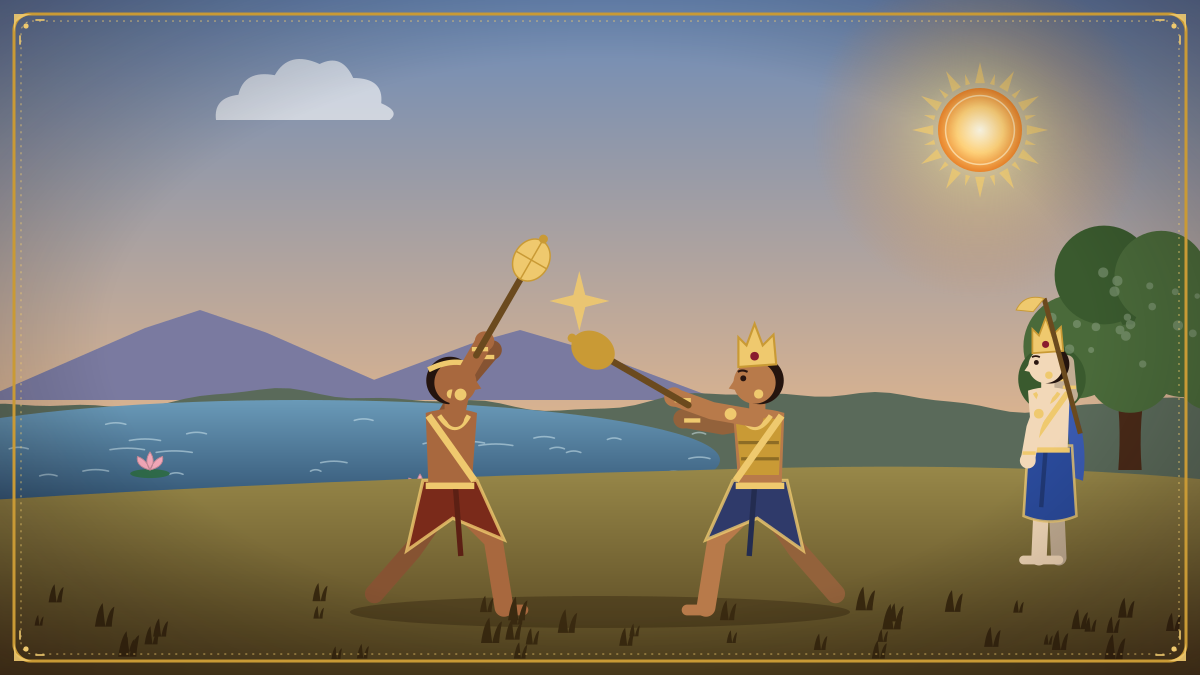
On the eighteenth day, when Duryodhana alone was left and was about to fight Bhima with the mace, the sage Narada brought Balarama the news, and he hurried back to see his two students fight. Both Bhima and Duryodhana welcomed their teacher with respect.
Balarama told them, “Forty-two days have passed since I set out under the star Pushya, and I have come back under the star Shravana. I wish to see my two students fight with the mace.” Then he sat down among the kings to watch.
At Balarama’s suggestion, the duel was moved to the holy ground of Samantapanchaka. The two great warriors fought long and hard. Then, at Krishna’s hint passed on by Arjuna, Bhima struck Duryodhana on the thigh, a blow that was against the rules of mace fighting.
Seeing this, Balarama raised his plough and ran at Bhima in a fury. Krishna caught him in his arms and calmed him. He reminded Balarama of the vow Bhima had made in the dice hall to break Duryodhana’s thigh, and of the many wrongs the Kauravas had done to the Pandavas.
Balarama was not satisfied. He declared that Bhima would be known as an unfair fighter, while Duryodhana, who had fought honestly to the end, would go to heaven. Then, still angry, he mounted his chariot and returned to Dwaraka.
His departure at Prabhasa
Thirty-six years after the war, some Yadava youths played a trick on visiting sages, and the sages laid a curse on the clan. To protect their people, King Ugrasena, Balarama and Krishna had it announced throughout Dwaraka that no one was to make or drink wine any more.
Yet bad omens kept appearing in the city, and the Yadavas went on a pilgrimage to Prabhasa, by the sea. There they drank, quarrelled over the old deeds of the war, and destroyed one another.
Krishna found Balarama sitting alone in deep meditation beneath a tree in a quiet place. As Krishna watched, a great white serpent with a thousand heads came out of Balarama’s mouth and went into the ocean.
The ocean and the great serpents came to welcome him with honour. In this way Shesha returned to his divine home, and Balarama left the world, just before Krishna himself departed.
When Arjuna reached Dwaraka and found what had happened, he had the bodies of Balarama and Krishna found and their last rites performed with honour, and then he led the surviving Yadava families away.
Did you know?
- Balarama was Krishna’s elder brother, born to Rohini, another wife of their father Vasudeva.
- Balarama would not fight at Kurukshetra, because both Bhima and Duryodhana had learned the mace from him and he could not take one pupil’s side.
- Balarama spent the Kurukshetra war on a pilgrimage along the Sarasvati river and came back just in time for the last mace duel.
- At the end, Balarama left his body sitting in yoga by the sea, and a great white serpent came out of his mouth and went into the ocean.
What we learn from Balarama
Balarama teaches us to stand for fairness and to love people on both sides of a quarrel. His strength was great, but he refused to use it in a war between members of his own family. He was quick to anger yet open to good advice, and he always spoke honestly, even when his words were not welcome.
Balarama in the story
Read the chapters where Balarama plays a part.