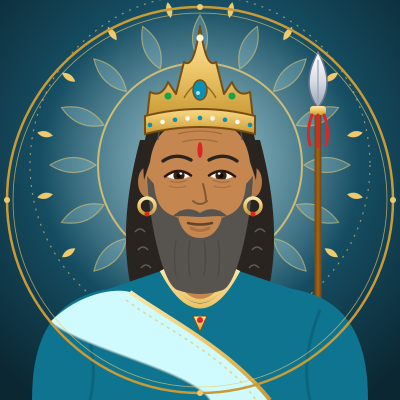
Shalya was the king of Madra, a kingdom in the north-west. His sister Madri was the second wife of King Pandu, so Shalya was the maternal uncle of the twin Pandavas, Nakula and Sahadeva. He was a mighty warrior and a charioteer said to be equal to Krishna himself. When the war came, he set out with a large army to join his nephews, but on the way Duryodhana won him over with clever hospitality, and Shalya, bound by his word, fought for the Kauravas. Even so, he kept a promise he had made to Yudhishthira: as Karna's charioteer he spoke words that shook Karna's confidence. On the eighteenth and last day he became the commander of the Kaurava army, and he fell to Yudhishthira himself.
The king of Madra and Madri's brother
When Prince Pandu had married Kunti, Bhishma wished to find him a second bride. He had heard of Madri, the beautiful sister of King Shalya of Madra, famous for her good qualities. So Bhishma went to Madra with ministers, brahmins and an army.
Shalya welcomed him with great respect and listened to his request. Then he said politely, “Our family has a custom handed down by our ancestors. Whether others think it good or bad, I cannot break it. You know it well.” The custom was that the bride's family received gifts for a bride.
Bhishma said that this custom was established long ago and was no fault. He gave Shalya gold, jewels, fine cloth, horses, elephants and many other gifts. Shalya was pleased and gave his sister Madri, richly adorned, to Bhishma, who brought her to Hastinapur, where she married Pandu.
Uncle of the twins
Pandu, under a curse, could not have children in the usual way. Kunti had received a mantra from the sage Durvasa to call any god, and she shared it once with Madri. Madri called the twin Ashvini gods, and so Nakula and Sahadeva were born. After Pandu's death, Madri gave up her life with him, and Kunti raised the twins as her own. Shalya was their mother's brother, their mama.
At Draupadi's swayamvara, when the angry kings attacked the disguised Pandavas, Shalya fought Bhima. Bhima lifted him and threw him to the ground, but laughingly did him no real harm. Neither knew that they were uncle and nephew, and the watching kings were amazed at the strength of the young brahmin.
Later, when Yudhishthira performed the Rajasuya sacrifice and his brothers went out to win the four directions, Nakula went west and reached Shakala, Shalya's capital. Shalya accepted his nephew with love and gave him rich gifts for the sacrifice.
Won over by Duryodhana
After the exile, when war became certain, Shalya set out with a large army and his heroic sons to join the Pandavas. His army was so large that it filled the road for a great distance.
Duryodhana heard of this and quickly made a plan. He had beautiful rest houses built all along the way, filled with food, drink, comfort and entertainment for Shalya and his soldiers. Shalya was delighted and thought Yudhishthira had arranged them. He said to the servants, “Where are the men who made these? I wish to reward them. Tell Yudhishthira I am pleased.”
Then Duryodhana, who had been hiding nearby, stepped forward and greeted him. Shalya, full of good will, said, “Ask what you wish.” Duryodhana said, “Let your word be true. Be the leader of my army.” Shalya had given his word, and a kshatriya does not take it back. He said, “So be it.”
A promise to Yudhishthira
With Duryodhana's permission, Shalya went on to Upaplavya to meet the Pandavas. They welcomed him with love, and he told Yudhishthira honestly what had happened. Yudhishthira did not complain. He said, “You kept your word, uncle, and that is right. But please grant me one favour. When Arjuna and Karna face each other, you will surely be made Karna's charioteer. Then, for our sake, weaken Karna's spirit with your words and protect Arjuna.”
Shalya agreed. “It is not right, but I will do it,” he said. “When I am Karna's charioteer, I will speak to him in a way that takes away his pride and his strength.”
Shalya also comforted Yudhishthira and Draupadi, who had suffered so much. He told them the long story of how even Indra, the king of the gods, had faced great troubles, losing his throne for a time after killing Vritra, and how in the end he won it back. “Sorrow comes even to the great,” he said, “and good times will return to you too.”
On the battlefield
Once the war began, Shalya fought for the Kauravas with all his strength. On the very first day, young Prince Uttara, son of King Virata, charged at him on an elephant. The elephant killed Shalya's horses, and Shalya hurled a spear that took Uttara's life.
It was a sad sight: again and again Shalya found himself fighting against his own nephews, Yudhishthira, Nakula and Sahadeva. Uncle and nephews faced each other with arrows and spears, each one doing what he believed was his duty.
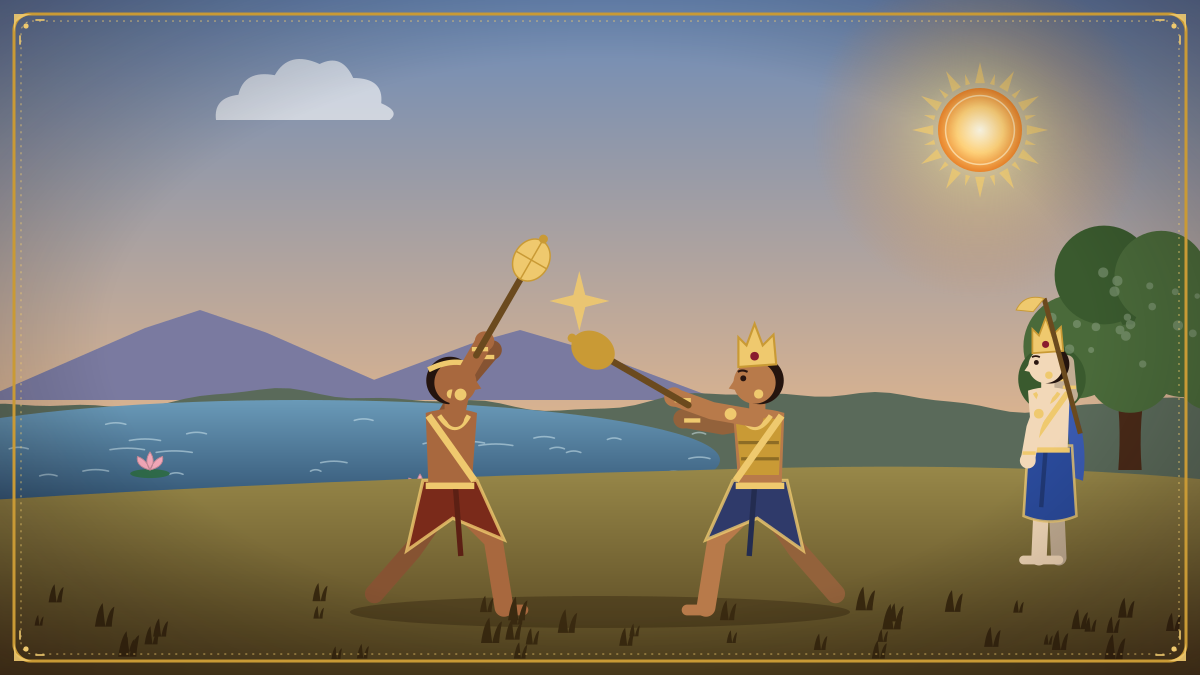
On many days Shalya faced the Pandava heroes. Once he and Bhima fought a fierce duel with maces, striking until both fell to the ground, and Kritavarma carried Shalya away. On the thirteenth day, inside Drona's great circular formation, the young Abhimanyu fought Shalya bravely, and Shalya's son Rukmaratha fell in that battle.
Karna's charioteer
After Drona fell, Karna became the Kaurava commander. Karna told Duryodhana that Arjuna had Krishna as his charioteer; if Shalya, who was as skilled as Krishna, drove for him, he could win. When Duryodhana asked him, Shalya was deeply offended. “I am a crowned king. Shall I drive the chariot of a charioteer's son?” he said.
Duryodhana flattered him and told him how Brahma himself had once driven Lord Shiva's chariot to destroy the three cities of the demons. At last Shalya agreed, on one condition: “I will say whatever I please in Karna's presence.” Karna and Duryodhana accepted.
On the seventeenth day, as they rode out, Karna boasted that he would kill Arjuna, and Shalya mocked him. He told the story of a crow who was fed by a merchant's sons on their leftover food and grew so proud that he challenged the swans to a race. The swan flew calmly over the sea, while the crow, after showing off many tricks, grew tired and fell into the water, and had to be saved by the swan. “You are that crow,” Shalya said, “fed on the leftovers of Dhritarashtra's sons. Arjuna is the swan.” Karna answered with harsh words about Shalya and his people, and they quarrelled all the way.
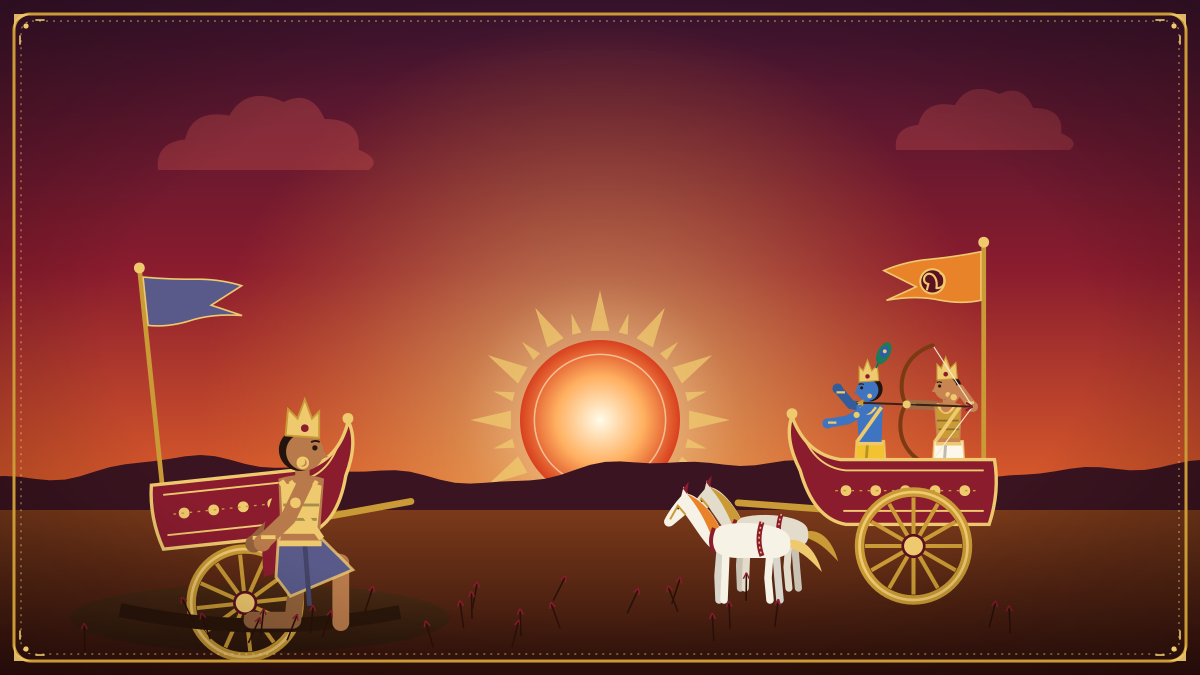
Still, Shalya gave honest advice as a charioteer. When Karna aimed his snake-arrow at Arjuna's head, Shalya told him to aim at the chest instead. Karna proudly refused, saying he never aimed twice. Krishna pressed Arjuna's chariot into the ground, and the arrow only knocked off Arjuna's crown. Later that day Karna's chariot wheel sank into the earth, and while he was trying to free it, Arjuna's arrow ended his life.
Commander on the last day
That night Duryodhana's army was full of grief. On Ashwatthama's advice, Duryodhana made Shalya the commander of what remained of the Kaurava army for the eighteenth day.
Krishna told Yudhishthira that no one but he could defeat Shalya. The gentle Yudhishthira, usually so calm, now fought with great fierceness. Shalya fought bravely too, and when his chariot was broken, he rushed forward with sword and shield.
At midday, Yudhishthira hurled a mighty golden spear, and Shalya fell lifeless to the ground. Yudhishthira also struck down Shalya's younger brother, who came to avenge him. With their commander gone, the Kaurava army broke apart and fled.
Did you know?
- Shalya was considered such a skilled charioteer that Duryodhana compared him to Krishna himself.
- On the very first day of the war, Shalya struck down Prince Uttar of Matsya, the brother of Uttara.
- Yudhishthira, the gentlest of the Pandavas, was the one who defeated Shalya on the last day of the war.
- Before the war, Shalya comforted Yudhishthira by telling him how the god Indra also suffered and then won back his glory.
What we learn from Shalya
Shalya teaches us to be careful before giving our word, because a promise once given must be kept even when it leads us to the wrong side. He also shows that a person can try to keep faith with everyone, and that honesty still has a place even among enemies. Finally, his crow-and-swan story reminds us that pride built on borrowed strength cannot carry us across the sea.
Shalya in the story
Read the chapters where Shalya plays a part.