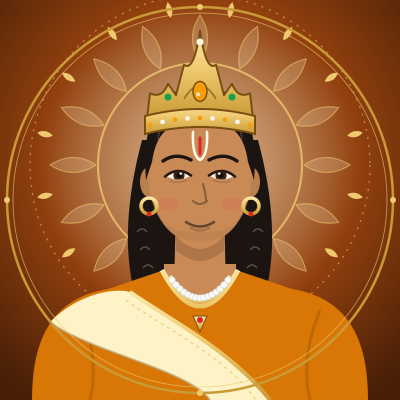
Parikshit was the son of Abhimanyu and Uttara. That made him the grandson of Arjuna and Subhadra, and the great-grandson of Pandu and Kunti. He was struck by Ashwatthama's weapon even before he was born, and came into the world lifeless — but Krishna brought him back to life. When the Pandavas set out on their last journey, Parikshit became king of Hastinapur, and he ruled with justice. His death came through a curse: an angry moment with a silent sage led to a young ascetic's curse, and the serpent Takshaka took his life. His son Janamejaya then held a great snake sacrifice, and it was there that Vyasa's disciple Vaishampayana first told the whole Mahabharata. In a way, the epic exists because of Parikshit's story.
A weapon aimed at the womb
When the war ended, the Kuru family had been almost wiped out. All the sons of the Pandavas were dead — Abhimanyu in the battle, and the five sons of Draupadi in Ashwatthama's night attack. The only hope left for the family was the child Uttara was carrying.
Ashwatthama, hunted by the Pandavas, released the fearsome Brahmashira weapon. When the sages asked him to withdraw it, he could not. So he turned it toward the wombs of the Pandava women, to end their line forever.
Krishna answered calmly. He said that Uttara's child would indeed be born dead from the weapon's power, but that he himself would give the child life again. He also recalled that a brahmin had once told Uttara at Upaplavya that, when the Kuru family had dwindled, she would have a son who would be named Parikshit.
Born lifeless, revived by Krishna
Some months later, while Yudhishthira was preparing for the Ashvamedha sacrifice, Krishna came to Hastinapur. Soon after, Uttara gave birth to a son. But the baby lay still, without breath or movement. The weapon had done its work.
Cries of grief rose in the palace. Kunti, Subhadra and Draupadi turned to Krishna. Subhadra reminded him that this was the child of Abhimanyu, her own son. Uttara held her baby and begged him to wake up and bow to Krishna, and said she would give up her life if he did not.
Krishna went into the birth chamber, which had been prepared with care and holy rites. He touched water and withdrew the power of the weapon. Then he made a solemn vow before everyone: “I have never spoken a lie. I have never turned back from battle. I have never quarrelled with Arjuna. By the power of this truth, may this child live.”
The baby began to move, slowly at first, and then came fully to life. The whole palace rejoiced. Krishna himself named him. Because he was born when the Kuru family had dwindled away — parikshina — he would be called Parikshit.
King after the Pandavas
When the Pandavas returned with wealth for the sacrifice, they were overjoyed to find the baby alive. Parikshit grew up in Hastinapur, surrounded by the love of his elders, the last bright hope of a family that had lost so much.
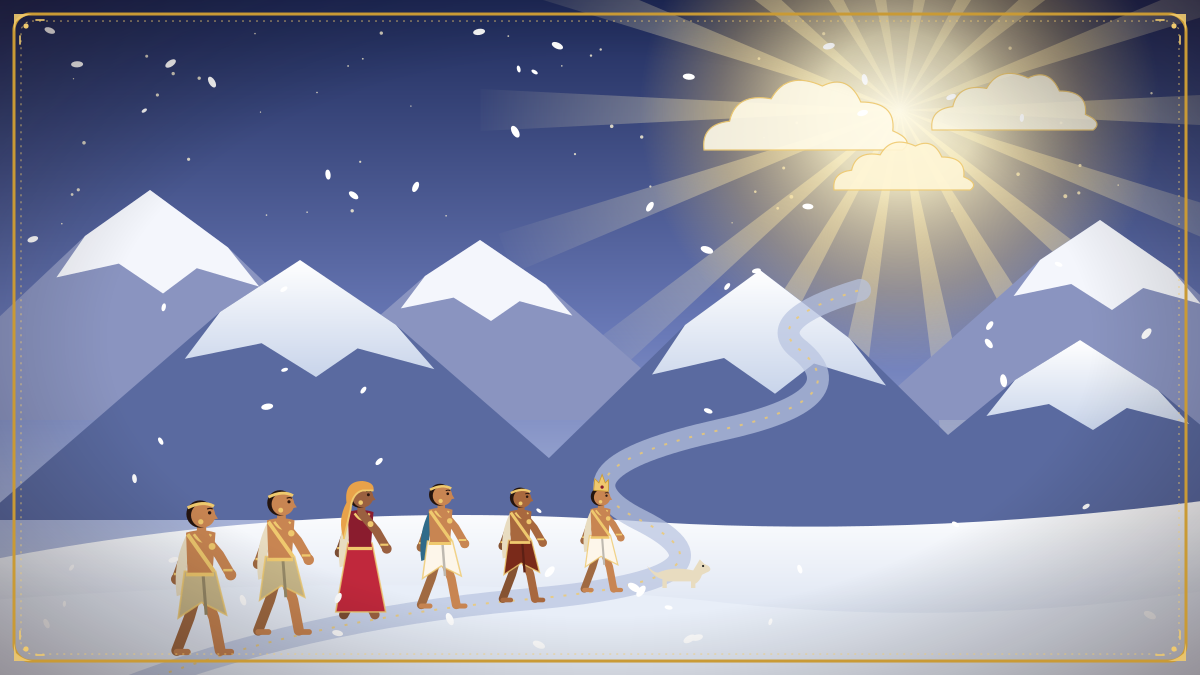
Many years later, news came that Krishna had left the world and that the Yadavas had destroyed one another. The Pandavas decided to give up their kingdom and set out on their final journey. Yudhishthira crowned Parikshit as king of Hastinapur, and crowned Krishna's great-grandson Vajra at Indraprastha.
Yudhishthira did not leave the young king alone. He gave Yuyutsu, Dhritarashtra's son, the charge of the kingdom's affairs, made Kripacharya Parikshit's teacher, and asked Subhadra to watch over her grandson.
Later, the ministers of the kingdom would remember Parikshit as a righteous and generous king who protected all his people like a father, as his ancestors had done. He had learned archery from Kripa and, like his great-grandfather Pandu, he loved to hunt.
The silent sage
One day Parikshit went hunting in the forest. He shot a deer with an arrow, but it ran away, and he followed it far into the woods, alone. Tired and hungry, he came upon an old sage named Shamika, who was sitting near a cowshed.
The king asked him, “O brahmin, I am King Parikshit, son of Abhimanyu. I shot a deer. Did you see where it went?” But Shamika had taken a vow of silence, and he said nothing.
Hunger and tiredness turned into anger. With the tip of his bow, the king lifted a dead snake from the ground and placed it on the sage's shoulder. Shamika still said nothing and did not even show displeasure. The king went back to his city.
Shringi's curse
Shamika had a son named Shringi, a young ascetic with great spiritual power and a very quick temper. Another young ascetic, Krisha, mocked him: “Do not be so proud. Your father is sitting with a dead snake on his shoulder.”
Shringi burned with anger. He touched water and pronounced a curse: “Within seven nights, the serpent Takshaka, filled with fiery poison, will burn to death the wicked man who placed a dead snake on my old father.”
When Shamika heard this, he was deeply unhappy. He told his son that they lived in the king's land under his protection, that the king had been hungry and tired and had not known about his vow, and that the curse was wrong. He sent his disciple Gauramukha to warn the king.
Parikshit was filled with regret — the epic says he grieved more for having insulted the sage than for his own coming death. With his ministers he made plans. A palace was built on a single pillar, guarded day and night, with physicians, brahmins skilled in mantras, and healing herbs ready.
The seventh day
A brahmin named Kashyapa, who could cure snake poison, set out to save the king. On the road he met Takshaka, disguised as an old brahmin. To test him, Takshaka bit a great banyan tree and turned it to ashes, and Kashyapa brought it back to life. Takshaka then gave Kashyapa more wealth than he could hope for from the king, and Kashyapa, seeing by his inner vision that the king's life was ending, turned back.
Takshaka sent some of his serpents, disguised as ascetics, to the king with fruit, kusha grass and water as gifts. It was the evening of the seventh day. The king shared the fruit with his ministers. In his own fruit he found a tiny insect, coppery in colour with black eyes.
The sun was setting, and the king thought the danger had passed. Smiling, he said, “The sun is going down, and I have no fear of poison now. But let the sage's word not be false. Let this insect become Takshaka and bite me.” He placed it on his neck. At once it became Takshaka, who wrapped himself around the king. The ministers fled, and Parikshit fell, struck by the serpent's fiery poison.
According to the Bhagavata Purana, Parikshit spent his last seven days hearing the sage Shukadeva; that account is not part of the Mahabharata.
Janamejaya and the telling of the Mahabharata
The ministers crowned Parikshit's young son Janamejaya as king. When he grew up, the sage Uttanka, who had his own quarrel with Takshaka, came to him and told him how his father had died. Janamejaya asked his ministers for the whole story, and they described his father's goodness and his death.
Filled with grief and anger, Janamejaya held a great snake sacrifice. Through the power of the mantras, serpents fell into the sacred fire by the thousands. Takshaka hid with Indra, but even he was being drawn toward the fire. Then a young sage named Astika, whose mother was the sister of the serpent king Vasuki, came to the sacrifice. He pleased the king with his wisdom, and when Janamejaya offered him a boon, he asked that the sacrifice be stopped. The king kept his word, and Takshaka was saved.
At that same sacrifice, Vyasa himself was present. Janamejaya asked him to tell the story of his ancestors, the Kauravas and the Pandavas, and why they had quarrelled. Vyasa asked his disciple Vaishampayana to tell it. Vaishampayana then told the king the full Mahabharata.
So the story we are reading reached the world because of Parikshit. A king's moment of anger, a sage's curse and a son's grief led to the first full telling of the great epic of his family.
Did you know?
- Parikshit was cursed by Shringi, the young son of the sage Shamika, after he placed a dead snake on the silent sage’s shoulder.
- The Mahabharata says Takshaka reached Parikshit by hiding as a tiny worm inside a fruit.
- In the Mahabharata, the name Parikshit is linked to his birth at a time when the Kuru family had almost come to an end.
- The Mahabharata was first told aloud in full at the snake sacrifice of Parikshit’s son, Janamejaya.
What we learn from Parikshit
Parikshit's life began with a miracle of grace: Krishna gave him life when all hope seemed gone. Yet one moment of anger toward a silent sage brought a heavy result. He accepted it with true regret, and faced his end with calm courage. His story reminds us to control our anger, to respect the holy, and to remember that even our mistakes can become part of a larger plan.
Parikshit in the story
Read the chapters where Parikshit plays a part.