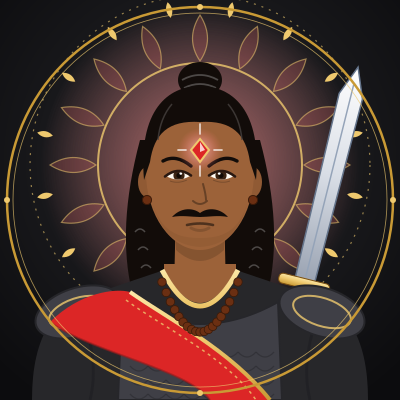
Ashwatthama was the only son of Dronacharya and his wife Kripi, which made Kripacharya his uncle. At his birth he cried out like a horse, and so he was named Ashwatthama. A gem was born with him on his forehead, protecting him from weapons, sickness and hunger. He learned the divine weapons from his father, grew up with the Kuru princes, and became a close friend of Duryodhana. In the war he was one of the mightiest Kaurava warriors. When his father was killed through a trick, his grief turned into fury. After the war he attacked the sleeping Pandava camp at night and then released the dreadful Brahmashira weapon. For this, Krishna cursed him to wander the earth alone for three thousand years.
The child who neighed like a horse
Drona and Kripi had one son. As soon as he was born, he cried out with a sound like the neighing of Uchchaihshravas, the celestial horse. A voice from the sky declared, “Because this child's cry rang out like a horse (ashva), he shall be called Ashwatthama.”
On his forehead was a gem that was born with him. Later in life Ashwatthama himself said that this gem protected him from weapons, disease and hunger, and from fear of gods, demons and serpents.
Yet his family was very poor. Once little Ashwatthama saw the sons of rich families drinking milk and cried for milk himself. His father searched everywhere for a cow and found none. Some boys mixed flour in water and gave it to him, and he drank it and danced with joy, saying, “I have drunk milk!” People laughed at Drona's poverty. This sorrow sent Drona to his old friend Drupada and, after Drupada's insult, to Hastinapur, where the family first lived quietly in the house of Ashwatthama's uncle Kripa.
Growing up among the princes
At Hastinapur Ashwatthama studied side by side with the Pandavas and the Kauravas. The epic says he excelled in the secret arts of the weapons. Drona loved him dearly. Sending the pupils to fetch water, Drona gave his son a wide-mouthed pot so that he would return first and get extra teaching. Arjuna saw this, filled his own narrow pot quickly with the Varuna weapon, and came back in time to learn just as much.
Drona also gave Ashwatthama the terrible Brahmashira weapon, though unwillingly, knowing his son's restless nature. He warned him never to use it against human beings, even in great danger.
Ashwatthama grew close to Duryodhana, and that friendship decided his side. Krishna later told Yudhishthira how Ashwatthama once came to Dwarka and asked for the Sudarshana discus, offering the Brahmashira in exchange. Krishna told him to take it, but Ashwatthama could not even move it, and went away ashamed.
Before the war
When the Kauravas raided King Virata's cattle, Karna boasted that he alone would defeat Arjuna and insulted Drona. Ashwatthama answered sharply that real heroes do not praise themselves, and that the Kauravas had won the Pandavas' kingdom by cheating at dice, not by bravery.
Still, when the war came, Ashwatthama stood with Duryodhana and his own father on the Kaurava side. His friendship with Duryodhana and his loyalty to his father outweighed his doubts.
Before the battle Bhishma counted the warriors of the Kaurava army. Of Ashwatthama he said, “He is a great chariot-warrior, a master of every weapon, whose arrows fly one after another without a gap. But he loves his own life too much; otherwise no one would equal him.” Like his father, he knew the most powerful divine weapons, and the Pandava soldiers feared him.
His father's death and the Narayanastra
Ashwatthama fought bravely day after day, facing Bhima, Satyaki, Dhrishtadyumna and even Arjuna. On the thirteenth day he was among the warriors who surrounded Abhimanyu in the Chakravyuha. On the fourteenth night, when Karna insulted his uncle Kripa, he drew his sword in anger, and Duryodhana had to calm him. In the great night battle that followed, he fought the rakshasa warriors of Ghatotkacha and killed Ghatotkacha's son Anjanaparva.
On the fifteenth day he was fighting in another part of the field when his father was killed. He learned how Drona had laid down his weapons after hearing the false news of his son's death, and how Dhrishtadyumna had struck him while he sat in yoga. Ashwatthama was filled with grief and fury.
He released the Narayanastra, a weapon Lord Narayana had once given to Drona, and Drona to him. Countless blazing missiles filled the sky. Krishna told the whole Pandava army, “Get down from your chariots and lay down your weapons. This weapon spares those who do not resist.” Everyone obeyed except Bhima, who kept fighting until Krishna and Arjuna pulled him down from his chariot. Then the weapon grew calm, and the army was saved. Duryodhana begged Ashwatthama to use it again, but he replied that the Narayanastra could be used only once; used a second time, it would turn on the one who released it.
Ashwatthama then released the fiery Agneya weapon at Arjuna, but Krishna and Arjuna came out unharmed. Puzzled and downcast, Ashwatthama dropped his bow and left the chariot. Then Vyasa appeared and explained to him that Krishna and Arjuna were Narayana and Nara, the ancient divine sages, and that no weapon could harm them. Ashwatthama bowed to Lord Shiva in his heart, honoured Krishna, and led his troops back to camp.
The last days of the war
On the seventeenth day Bhima killed Dushasana. Shaken, Ashwatthama took Duryodhana's hand and pleaded, “Make peace with the Pandavas. Arjuna will listen to me, and Krishna does not want war. Stop now, for the good of the world.” Duryodhana refused.
Karna fell later that same day, and Shalya on the next. On the eighteenth day Duryodhana hid in a lake. Ashwatthama, Kripa and Kritavarma went to him and promised to fight on, but the Pandavas found him, and Bhima broke his thighs in a mace fight.
When Ashwatthama saw his friend lying on the ground, he swore, “I will send all the Panchalas to the house of death this very night.” Duryodhana told Kripa to bring water, and Ashwatthama was anointed as the last commander of the Kaurava army. He embraced his friend and set out into the night with Kripa and Kritavarma, roaring like a lion.
The night raid
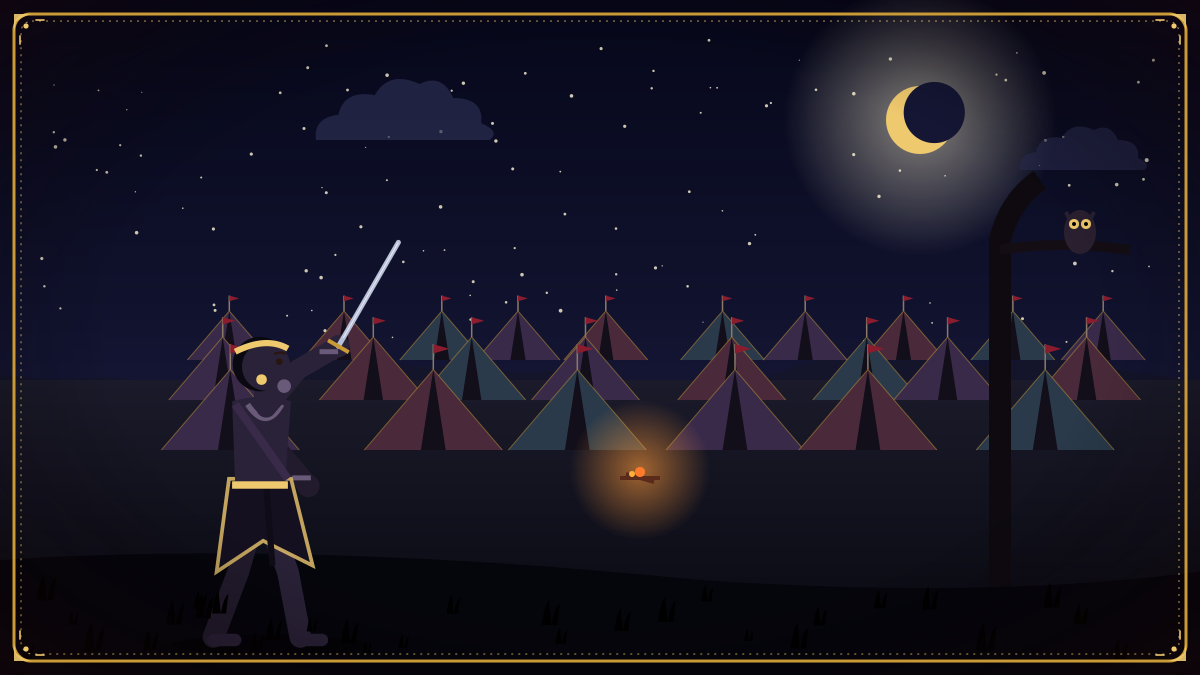
That night the three rested under a large banyan tree in the forest. Kripa and Kritavarma slept, but Ashwatthama lay awake with anger. Then he saw an owl swoop down and kill many crows sleeping in the tree. A dark thought came to him: “This bird has shown me the way. I will attack my enemies while they sleep.”
Kripa pleaded with him to wait until morning and to ask the elders first, saying that killing sleeping men was against dharma. Ashwatthama replied that the Pandavas had already broken dharma by killing Bhishma, Drona, Karna and Duryodhana through tricks, and he went on.
At the gate of the camp a huge and terrible being blocked his way, and his weapons could not harm it. Ashwatthama then prayed to Lord Shiva and offered himself. Shiva gave him a shining sword and entered him with his power.
Inside the camp, Ashwatthama killed Dhrishtadyumna, the slayer of his father, without letting him die by a weapon. He then killed Uttamaujas, Yudhamanyu, Shikhandi and the five young sons of Draupadi, along with many sleeping warriors. Kripa and Kritavarma stood at the gate. The five Pandavas, Krishna and Satyaki were not in the camp that night, so they were saved. Only Dhrishtadyumna's charioteer escaped to carry the news to Yudhishthira. Before dawn Ashwatthama told the dying Duryodhana, who died content.
The Brahmashira and Krishna's curse
Draupadi fell into deep grief and refused to eat until Ashwatthama was punished and she received the gem from his head. Bhima set out after him, and Krishna, Arjuna and Yudhishthira followed, for Krishna knew that Ashwatthama carried the Brahmashira.
They found him on the bank of the Ganga near Vyasa and other sages. In fear and hatred, Ashwatthama took up a blade of grass, charged it with the Brahmashira and released it with the words, “For the destruction of the Pandavas!” At Krishna's word, Arjuna released his own Brahmashira to stop it, wishing well to all. The two weapons blazed as if to burn the worlds. Then the sages Narada and Vyasa stood between them and asked both warriors to withdraw their weapons.
Arjuna, pure in conduct, withdrew his weapon at once. Ashwatthama could not. He turned it towards the wombs of the Pandava women, and it struck the unborn child of Uttara. Krishna said, “The child will be born lifeless, but I will give him life, and he will rule for sixty years.”
Then Krishna said to Ashwatthama, “You will wander the earth for three thousand years, alone, sick and with no one to speak to.” Vyasa agreed with this punishment. Ashwatthama said to Vyasa, “Holy one, I will live among men, with you.” Then he gave up the gem from his forehead to the Pandavas and went away into the forest. Draupadi, who said she would not seek the death of their guru's son, accepted the gem, and Yudhishthira wore it on his head.
Did you know?
- Ashwatthama’s name means “the one with the voice of a horse”, because he neighed like a horse when he was born.
- Ashwatthama once asked Krishna for his Sudarshana chakra, but he could not even lift it.
- The gem taken from Ashwatthama’s forehead was given to Draupadi, who gave it to Yudhishthira to wear on his crown.
- For attacking the unborn Parikshit, Krishna told Ashwatthama that he would wander the earth alone for three thousand years.
What we learn from Ashwatthama
Ashwatthama was gifted, brave and loved, and he even pleaded for peace in the middle of the war. But when grief turned into rage, he let revenge rule his mind and did what no warrior should do. His story warns us that unchecked anger can destroy all the good a person has built. True strength is the strength to stop, as Arjuna did when he withdrew his weapon at the word of the sages, even in the heat of anger.
Ashwatthama in the story
Read the chapters where Ashwatthama plays a part.