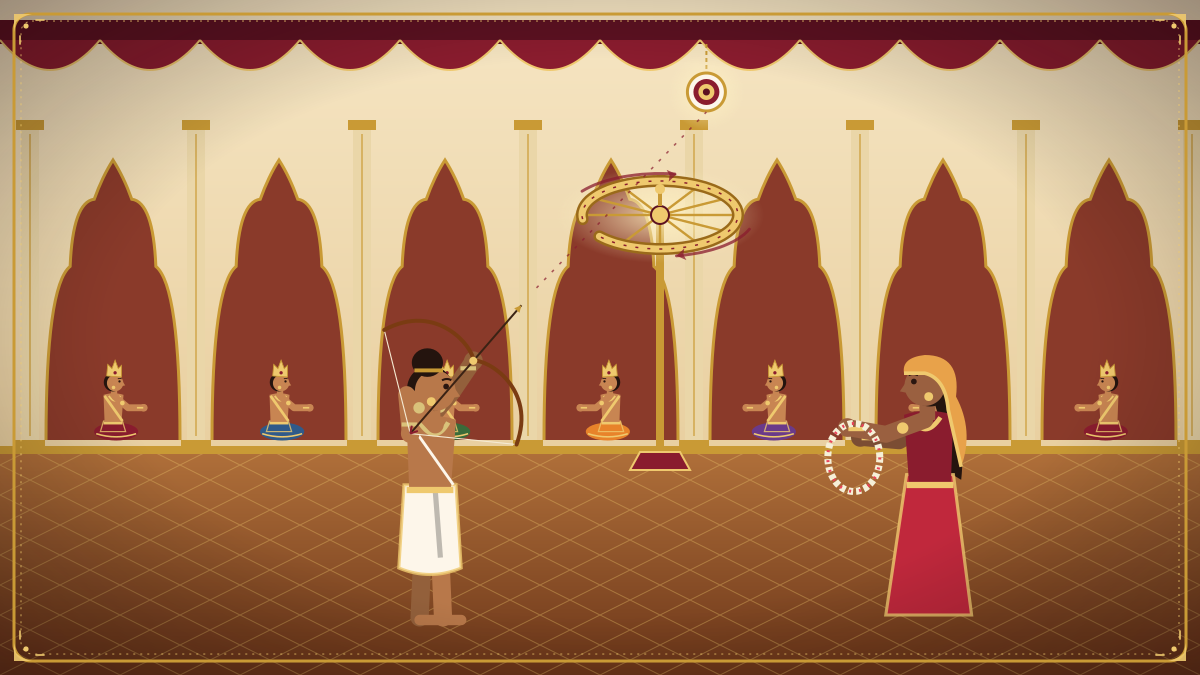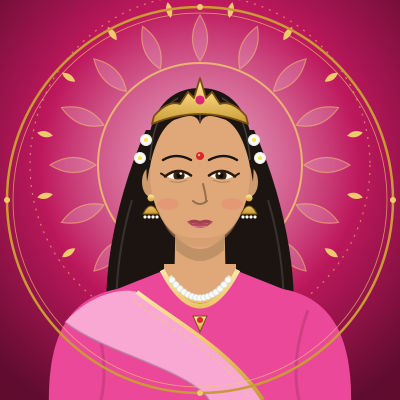
Subhadra is the younger sister of Shri Krishna and Balarama, a daughter of Vasudeva of the Yadava clan of Dwarka. The Mahabharata gives her only a few chapters, but each of them matters. She married Arjuna, the third Pandava, in a famous wedding that began with Arjuna carrying her away in a chariot, with Krishna's own blessing. At Indraprastha she won Draupadi's heart through humility, and she became the mother of the brave Abhimanyu. She lost that son in the great war, yet she lived to see her grandson Parikshit saved by Krishna and crowned king of Hastinapur. Through Subhadra, the family of Krishna and the family of the Pandavas were joined forever. She is remembered as gentle, modest and deeply loved by her brothers.
A princess of the Yadavas
Subhadra grew up in Dwarka, the sea city of the Yadava clans, the Vrishnis and the Andhakas. Her father was the respected elder Vasudeva. When Arjuna later asked who she was, Krishna told him, “She is my sister Subhadra, the daughter of Vasudeva and the full sister of Sarana. She is very dear to our father.”
The epic says little about her childhood. Her story really begins when Arjuna comes to the land of the Yadavas.
Arjuna had left Indraprastha for twelve years. To save a poor brahmin's stolen cows, he had entered the room where Yudhishthira sat with Draupadi, breaking a rule the brothers had made. Though Yudhishthira forgave him, Arjuna kept the rule and went on a long journey to holy places.
Arjuna sees Subhadra on Raivataka hill
Near the end of his journey Arjuna reached Prabhasa on the western sea. Krishna came at once to meet his dear friend and brought him to Dwarka as an honoured guest.
Soon there was a great festival on the Raivataka hill, with music, singing and dancing. Among the young women Arjuna saw Subhadra, adorned with ornaments and surrounded by her friends, and his heart was won.
Krishna noticed his gaze and smiled. “How is it that the heart of a wanderer in the forest is stirred by love?” he teased. Then he told Arjuna who she was and asked what he wished to do. Arjuna replied that he could think of no one better as his wife, and asked Krishna how she could be won.
Krishna said, “A swayamvara is uncertain, for no one can tell whom a girl will choose. For a kshatriya, carrying away a bride by force is praised by those who know dharma. So carry away my sister.” Arjuna and Krishna sent swift messengers to Yudhishthira at Indraprastha, and Yudhishthira gave his consent.
Carried away, and Balarama calmed
One day Subhadra went to worship the Raivataka mountain and to receive the blessings of the brahmins. As she was returning to Dwarka, Arjuna, in armour and riding Krishna's own golden chariot, came up to her, lifted her into the chariot and drove off towards his city.
The guards ran to Sudharma, the assembly hall of the Yadavas, and told what had happened. A war drum was sounded, and the Yadava heroes gathered, ready to chase Arjuna. Balarama, red-eyed with anger, said to Krishna, “Why do you sit silent? Arjuna ate our food and was honoured as our guest, and now he has insulted us. I alone will rid the earth of the Kurus!”
Krishna answered calmly, “Arjuna has not insulted our family. He has honoured it. He knew we would never sell a daughter for wealth, and that a swayamvara is uncertain, so he chose the warrior's way. He is of the noble Bharata line, the son of our aunt Kunti, and no one can defeat him in battle. Let us go quickly and bring him back with friendship.”
The Yadavas agreed. Arjuna was brought back, and the wedding of Arjuna and Subhadra was celebrated in Dwarka. Arjuna stayed there with her for a little more than a year, spent the rest of his time away at Pushkara, and then returned home to Indraprastha.
A cowherd's dress at Indraprastha
When Arjuna reached Indraprastha, he went to Draupadi. She spoke with loving hurt: “Go to where the Yadava girl is. A second knot always loosens the first, however tightly it was tied.” Arjuna comforted her again and again and asked her forgiveness.
Then he sent Subhadra to the palace. She did not come as a proud princess. She put on the simple red dress of a cowherd woman and went first to Kunti and bowed at her feet. Kunti embraced her new daughter-in-law with great love and blessed her.
Then Subhadra went to Draupadi, bowed before her and said, “I am your servant.” Draupadi rose and embraced her, saying, “May your husband never have an enemy.” From that day the two lived together in friendship, and the whole household was glad.
Soon Krishna and Balarama came to Indraprastha with the Yadava heroes, bringing rich wedding gifts for their sister. Balarama returned after the celebrations, while Krishna stayed on with Arjuna for a long time.
Mother of Abhimanyu
In time Subhadra gave birth to a shining son. Because he was fearless (abhi) and full of fiery spirit (manyu), he was named Abhimanyu. Krishna loved him dearly, and Arjuna himself taught him the use of weapons. Abhimanyu grew up with Draupadi's five sons, one born to each Pandava.
When the Pandavas lost everything in the game of dice and had to live in the forest, Krishna came to visit them. When he returned, he took Subhadra and young Abhimanyu with him to Dwarka, while Dhrishtadyumna took Draupadi's sons to Panchala. So Abhimanyu spent his boyhood among the Yadavas.
At the end of the thirteen years, Abhimanyu was married to Uttara, the daughter of King Virata. Krishna and Balarama brought Subhadra and Abhimanyu to the wedding at Upaplavya with many Yadava heroes, and it was a day of great joy.
In the war, Abhimanyu himself told Yudhishthira that his father had taught him how to break into the Chakravyuha formation, but not how to come out of it if trouble arose. He knew the danger, yet he went in for the sake of his elders.
The grief of a mother
On the thirteenth day of the war, while Arjuna and Krishna were fighting far away, Abhimanyu broke into the Chakravyuha, fought many great warriors alone, and fell like a hero. That evening Arjuna, mad with sorrow, vowed to kill Jayadratha, who had stopped the other Pandavas at the entrance of the formation.
That night Arjuna asked Krishna to go and comfort Subhadra and Uttara. Krishna went to his sister and said, “Do not grieve, Subhadra. Your son has gone by the path of heroes, the path every warrior wishes for. Tomorrow Arjuna will fulfil his vow.”
Subhadra wept aloud for her son, and Draupadi and Uttara wept with her. Krishna gently consoled them all. The next day Arjuna kept his vow before sunset.
Parikshit and the last years
After the war Ashwatthama turned his terrible weapon towards the unborn child of Uttara. Krishna promised that he would give life to the child. Some months later Uttara's son was born without breath. Kunti, Draupadi and Subhadra wept bitterly, and Subhadra cried to her brother, “Krishna, remember your promise! This is Abhimanyu's son. Bring him to life.”
Krishna entered the room and, by the power of his truth, brought the child to life. Because he was born when the Kuru family had almost come to an end (parikshina), he was named Parikshit.
Many years later, after Krishna had left the world, Yudhishthira crowned Parikshit king of Hastinapur. He spoke to Subhadra: “This son of your son will be king of the Kurus, and Vajra, who is left of the Yadavas, has been made king at Indraprastha. Protect them, and never set your mind on wrong.” Then the Pandavas left on their last journey, and Subhadra stayed behind to watch over the next generation.
Did you know?
- Arjuna married Subhadra with Krishna’s blessing during his twelve-year pilgrimage, and Balarama was angry at first until Krishna calmed him.
- When the Pandavas left on their last journey, Yudhishthira asked Subhadra to watch over the young king Parikshit and the kingdom.
- Subhadra’s great-grandson Janamejaya was the king who first heard the whole Mahabharata, recited by Vaishampayana, a disciple of Vyasa.
- Subhadra was the Pandavas’ cousin even before her marriage, because their mother Kunti was the sister of her father Vasudeva.
What we learn from Subhadra
Subhadra shows that humility can win a heart that pride would only harden: she came to Draupadi not as a rival but as a sister. She bore the loss of her son with tears, yet she did not lose faith, and she called on Krishna for her grandson's life. Her life teaches us to love quietly, to trust the Lord in sorrow, and to care for the next generation.
Subhadra in the story
Read the chapters where Subhadra plays a part.