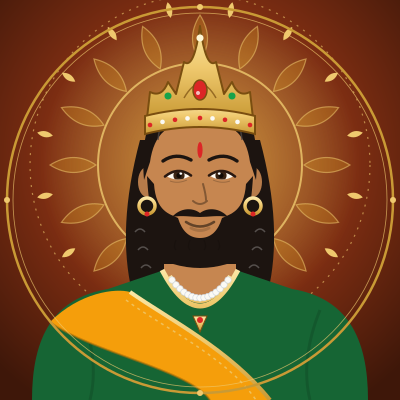
Shantanu was a king of Hastinapur in the great Kuru family, the son of King Pratipa. The family story of the Mahabharata truly begins with him. His first wife was the river goddess Ganga, who gave him a son named Devavrata, later famous as Bhishma. His second wife was Satyavati, the daughter of a fisherman chief, who gave him two more sons, Chitrangada and Vichitravirya. Every king and prince of the epic, the Kauravas and the Pandavas alike, belongs to the family that Shantanu headed. His life is a gentle one, full of love and longing, yet two promises made in it, one by Shantanu to Ganga and one by his son for his sake, shaped the fate of the whole Kuru line.
A king from heaven: Mahabhisha
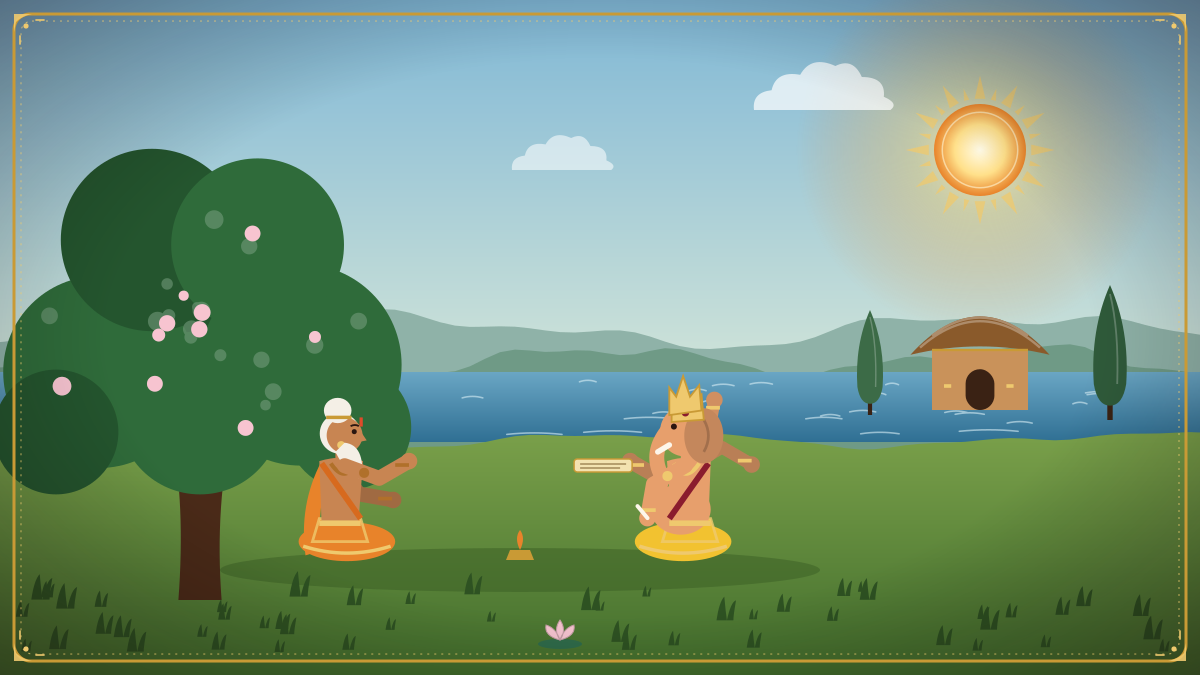
The Mahabharata says that in an earlier life Shantanu was a king named Mahabhisha, born in the line of Ikshvaku. He was so devoted to truth and to sacred rituals that, after his life on earth, he was welcomed into heaven and sat among the gods.
One day the gods and the great sages had gathered in the court of Lord Brahma. The holy river Ganga came there too. Just then a breeze lifted her shining white garment. At once all the gods lowered their eyes out of respect. Only Mahabhisha kept looking at her, without shame.
Brahma was displeased and said, “You will be born among human beings. And this Ganga, who has stolen your heart, will do things on earth that hurt you. When you become angry with her, you will be free from this curse.” Mahabhisha accepted his fate calmly and chose to be born as the son of the good King Pratipa.
Son of King Pratipa
King Pratipa of the Kuru dynasty and his queen Sunanda, a princess of the Shibi people, had three sons: Devapi, Shantanu and Bahlika. Devapi, the eldest, gave up worldly life and went to the forest for penance, and Bahlika went to live with his mother's family. So the throne came to Shantanu. Bahlika lived to a great old age, and his family later fought in the Kurukshetra war on the Kaurava side.
Before Shantanu was born, something wonderful happened. King Pratipa was praying on the bank of the Ganga when a lovely woman rose from the water and sat on his right thigh. She asked him to marry her. Pratipa gently said no, for the right thigh is the seat of a daughter or a daughter-in-law; a wife sits on the left. “Become the wife of my future son,” he said. She agreed and disappeared. That woman was the goddess Ganga herself.
Pratipa and his queen prayed for a son, and in their old age Shantanu was born. The epic gives two lovely meanings for his name. He was born when his father had become calm and peaceful (shanta). And it is also said that any old person he touched with his hands felt happy and young again, so people called him Shantanu, the one whose touch brings peace.
When Shantanu grew up, Pratipa told him, “A heavenly woman once asked to marry you. If she comes to you, accept her. Do not ask who she is, and do not question anything she does.” Then Pratipa crowned Shantanu king and went to the forest to spend his last years in prayer.
The promise to Ganga
Shantanu was a just and generous king who loved hunting. Wandering along the bank of the Ganga one day, he saw a woman of such beauty that she seemed to glow like the goddess Lakshmi. He asked her to be his queen. She replied, “I will be your wife. But whatever I do, good or bad, you must never stop me or speak a harsh word to me. The day you do, I will leave you.” Remembering his father's words, Shantanu promised.
They lived happily, and the queen pleased the king in every way. Then their first son was born. To Shantanu's horror, she carried the baby to the river, said, “I do this for your good,” and let him go into the water. The same thing happened with the second son, and the third, until seven sons were gone.
Shantanu's heart was breaking, but he stayed silent, afraid that she would leave him. When the eighth son was born and she again walked towards the river, he could bear it no longer. “Do not kill him!” he cried. “Who are you, and why do you destroy your own children?”
She answered, “I will not harm this child. But our time together is over, because you have broken your promise. I am Ganga, daughter of the sage Jahnu.” Then she explained that the eight babies were the Vasus, heavenly beings who had been cursed by the sage Vasishtha to be born as humans. They had begged her to be their mother and free them quickly. Seven were now free. The eighth would live a long and noble life on earth. Saying this, she took the boy and vanished.
The son who stopped a river
Shantanu went back to ruling his kingdom. The epic describes his reign as a golden time, when the people of Hastinapur lived without fear, and he was honoured by kings everywhere as a protector of dharma.
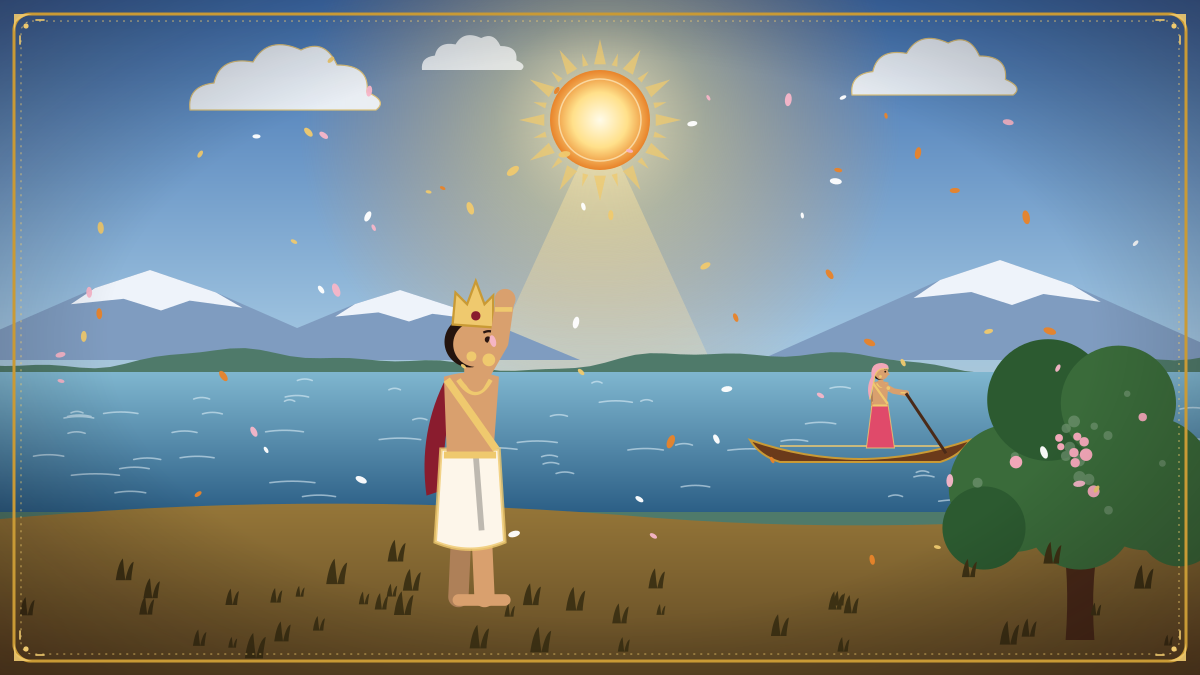
Many years later, while hunting along the Ganga, he noticed that the great river had become shallow. Following the bank, he found a tall, handsome young man who had stopped the flow of the river with a wall of arrows, showing a skill like that of Indra himself. The youth looked at the king and then disappeared by his power.
Shantanu guessed that this might be his own lost son and called out to Ganga. She appeared, holding the young man's hand. “This is your eighth son, Devavrata,” she said. “He has learned the Vedas from Vasishtha, all the arts of weapons, including those of Parashurama, and the wisdom of Brihaspati and Shukracharya. Take him home.” Overjoyed, Shantanu brought him to Hastinapur and made him crown prince, and for four years the whole kingdom rejoiced in him.
Satyavati and Devavrata's vow
One day, near the river Yamuna, Shantanu noticed a wonderful fragrance in the air. Following it, he found a beautiful young woman named Satyavati, the daughter of the fisherman chief. He went to her father to ask for her hand.
The chief agreed on one condition: the son born of Satyavati must be the next king. Shantanu could not take the throne away from Devavrata, his worthy eldest son, so he refused and returned home. But he could not forget Satyavati, and he became quiet and sad.
Devavrata saw that his father had grown pale and silent, and asked him what was wrong. Shantanu did not tell him directly. Instead he said, “You are my only son, and you are a great warrior. The wise say that having one son is like having none. If anything happened to you in battle, our family would come to an end. That is my worry.” But Devavrata understood that there was something more.
Devavrata noticed his father's grief and learned the reason from an old minister. Taking some elder Kshatriyas with him, he went to the fisherman chief and gave up his claim to the throne. When the chief worried that Devavrata's future children might still fight for it, the prince made a second vow: he would never marry at all. Flowers fell from the sky, and voices called him Bhishma, the one of the terrible vow.
Devavrata brought Satyavati home himself, calling her mother. Shantanu was deeply moved by his son's sacrifice. He gave him a rare boon: “Death will not come to you as long as you wish to live. It will come only with your permission.”
Last years and legacy
Shantanu married Satyavati, and they had two sons, Chitrangada and Vichitravirya. Shantanu died before Vichitravirya had grown up. Bhishma, following Satyavati's wishes, crowned Chitrangada and later Vichitravirya, and guarded the kingdom for them.
Through Vichitravirya's line came Dhritarashtra and Pandu, and through them the hundred Kauravas and the five Pandavas. So every great figure of the Kurukshetra war is a descendant of Shantanu, or, like Bhishma, his son.
Satyavati and Bhishma performed Shantanu's last rites with great honour. Bhishma never once regretted the vow he had made for his father. For the rest of his long life he served the throne of Hastinapur faithfully, and that whole life of service was, in a way, his gift to his father's memory.
The epic remembers Shantanu as a righteous and kind king, but also as a man whose two deep loves set great events in motion. His silence for seven sons freed the Vasus, and his longing for Satyavati led to the vow that kept Bhishma bound to the throne of Hastinapur for the rest of his life.
Did you know?
- Shantanu was not the eldest son of King Pratipa. His elder brother Devapi became a hermit, and so the throne came to Shantanu.
- Ganga once sat on the right thigh of Shantanu’s father, Pratipa. Since that is the seat for a daughter-in-law, Pratipa said she should marry his son.
- Shantanu met his grown-up son Devavrata when the young man had stopped the flow of the Ganga with a wall of arrows.
- Satyavati was called Yojanagandha because her fragrance could be felt from a yojana, several miles, away — and it was this fragrance that led Shantanu to her.
What we learn from Shantanu
Shantanu's story shows how one promise, and one wish of the heart, can shape many generations. A promise should be made with care, because keeping it may be very hard. It also teaches that a parent should honour a child's sacrifice and bless it with love.
Shantanu in the story
Read the chapters where Shantanu plays a part.