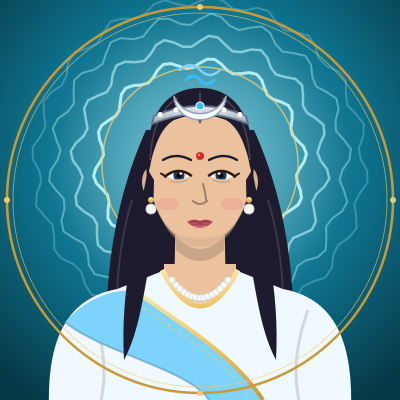
Ganga is the holy river goddess, worshipped across India as Ganga Maiya, the mother whose waters wash away sins. The Mahabharata tells how King Bhagiratha brought her down from heaven and how Lord Shiva received her on his head. In the epic's family story she takes a human form and becomes the first wife of King Shantanu of Hastinapur. She is the mother of Devavrata, who grew up to be the great Bhishma. Her story explains a mystery at the very start of the epic: why a loving mother would let her own babies go into the river, and why Bhishma lived such a long life without children. Though she leaves the palace early, she remains a mother to the very end, watching over her son and weeping for him when he leaves the world.
The river that came from heaven
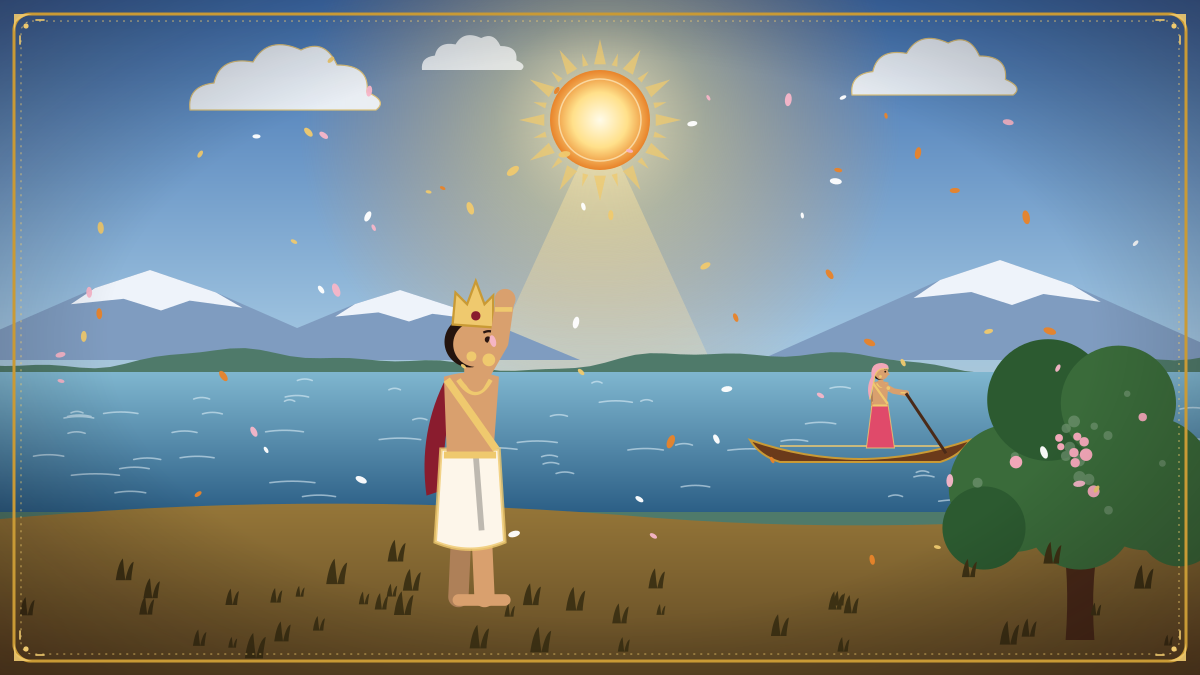
The Mahabharata tells that Ganga once flowed only in heaven. King Bhagiratha of the Ikshvaku line performed long and hard penance so that she would come down to earth and purify the ashes of his ancestors, the sixty thousand sons of King Sagara. Ganga agreed, but her fall would have been too powerful for the earth to bear. So Lord Shiva received her on his head, and from there she flowed gently down. Because Bhagiratha brought her, she is called Bhagirathi.
She is also called Jahnavi, the daughter of the sage Jahnu, and when she introduces herself to King Shantanu she uses this name. For the people of the epic she is not just water but a living mother. Kings bathe in her before great deeds, and the dead are honoured on her banks.
The epic describes many holy places along her banks, such as Gangadvara, where she comes down from the mountains into the plains. It was at such a spot, on the bank of the Ganga, that the story of the Kuru family and the river goddess began, when King Pratipa sat there in prayer.
One day Ganga came to the court of Lord Brahma, where the gods and sages had gathered. A breeze lifted her bright garment. All the gods lowered their eyes, but a king named Mahabhisha, who had reached heaven through his good deeds, kept looking at her. Brahma said that Mahabhisha would be born among humans, and that Ganga would go to earth too and do things that would pain him.
The Vasus and their curse
As Ganga was going down to earth, she met the eight Vasus, shining heavenly beings, who looked very sad. They told her what had happened.
The sage Vasishtha had an ashram on the slopes of Mount Meru, and there he kept a wonderful cow named Nandini, who could give anything one wished for. One day the Vasus came to that forest with their wives. The wife of the Vasu named Dyau (also known as Prabhasa) saw Nandini and wanted her for a friend on earth, a princess named Jitavati. To please his wife, Dyau, helped by his brothers, took the cow away.
When Vasishtha returned and found Nandini gone, he cursed all eight Vasus to be born as human beings. They begged for mercy. The sage softened the curse: seven of them would be freed within a year of their birth, but Dyau, who had taken the cow, would live a long life on earth. He would be wise and righteous, devoted to his father, but he would never marry or have children.
The Vasus begged Ganga, “Please become our mother on earth, and throw each of us into your waters as soon as we are born, so that we are freed at once.” Ganga agreed, but asked that one son should stay, so that her union with the king would not be without fruit. Each Vasu gave an eighth part of his power to that son, who would be born from Dyau.
Pratipa, Shantanu and the condition
Ganga first appeared before King Pratipa, Mahabhisha's chosen father on earth, while he was praying at the river. She sat on his right thigh and asked him to marry her. Pratipa replied that the right thigh belongs to a daughter or daughter-in-law, and asked her to become the wife of his future son. Ganga agreed.
Years later, the young King Shantanu met her on the river bank and fell deeply in love. Ganga agreed to marry him on one condition: he must never stop her or speak harshly to her, whatever she did. If he did, she would leave him. Shantanu, remembering his father's advice, accepted.
Ganga lived as his queen and made him very happy. The epic describes her as a perfect companion, graceful, loving and wise, who made the king forget the passing of the years.
For Ganga this marriage had a deeper purpose. Brahma's word had sent her to earth, and her promise to the Vasus would be fulfilled through it. Yet she was not cold. She cared for Shantanu and knew how much her actions would hurt him, which is why she asked for his promise before anything else.
Seven sons set free, the eighth stays
When their first son was born, Ganga carried him to the river and released him into the water, saying, “I do this for your good.” She did the same with the next six sons. To the watching king it looked terrible, but to Ganga each was a loving act, because each baby was a Vasu going home to heaven, free from the curse.
Shantanu suffered silently, bound by his promise. When the eighth son was born, he finally stopped her and asked who she was and why she was doing this. Ganga said she would not harm this child, but since the king had broken his word, she must now leave.
Before going, she told him the whole story of the Vasus and Vasishtha's curse. She explained that this last child was Dyau, who would live long on earth. Then she took the baby with her and disappeared, leaving the king alone with his grief.
The boy was named Devavrata, and was also called Gangeya, the son of Ganga. She kept him with her and saw that he received the best education in the world: the Vedas from Vasishtha, all the arts of weapons including those of Parashurama, and the wisdom of Brihaspati and Shukracharya.
Giving the son back, and watching over him
Years later, Shantanu found a young warrior who had stopped the flow of the Ganga with his arrows. When he called upon Ganga, she appeared holding the young man's hand and told him, “This is your eighth son. Take him home.” Having fulfilled her duty, she returned to her river.
Ganga never stopped caring for her son. When Bhishma later had to fight his own teacher Parashurama because of the princess Amba, Ganga appeared before him and begged him not to fight his guru. She also went to Parashurama and pleaded with him not to fight her son. Neither warrior would give up, but her love was plain for all to see.
Amba, still filled with anger against Bhishma, began severe penance and wandered from one holy river to another. Ganga appeared to her and warned her that this crooked purpose would not succeed, and that she would become a crooked river. Half of Amba's being became the river Amba in the land of Vatsa, a stream that flows only in the rainy season. The other half was later reborn as Shikhandi.
When Bhishma lay on the bed of arrows during the war, Arjuna pierced the earth with a divine weapon and a stream of pure, cool, fragrant water rose up to quench his thirst. Those who saw it were filled with wonder. In this way, even on the battlefield, the earth and its waters seemed to serve the son of Ganga.
A mother's lament
Bhishma left his body after the war, at the time he had chosen. The Pandavas, with Vidura and the elders of the family, carried his body to the bank of the Ganga, performed his last rites and offered water to him there.
Then Ganga rose from her waters in her divine form and wept. “My son was wise and pure in conduct,” she cried. “He honoured his elders and kept his vow all his life. Even Parashurama could not defeat him, and he won the princesses of Kashi alone against all the kings. How can my son have been killed by Shikhandi?”
Lord Krishna comforted her. “Do not grieve, mother,” he said. “Your son was not killed by Shikhandi; Arjuna brought him down, as the gods themselves had arranged. He left his body by his own wish, and he has returned to his place among the Vasus. Even the gods could not have defeated him in battle.” Hearing this, Ganga was comforted and returned to her waters.
The story of Ganga begins and ends with her son. She came to earth to free the Vasus, gave the world its greatest example of a kept vow, and at the end received her son back into heaven. To this day, those who bathe in the Ganga remember her as the mother who never truly lets go.
Did you know?
- King Bhagiratha’s penance brought Ganga from heaven to earth, which is why she is also called Bhagirathi.
- Each of the eight Vasus gave an eighth of his strength to the son who stayed on earth — this is why Bhishma was so mighty.
- Bhishma is often called Gangaputra or Gangeya, which both mean “son of Ganga”.
- Ganga left Shantanu because he broke his promise never to question her, when he stopped her from giving their eighth son to the river.
What we learn from Ganga
Ganga teaches that true love sometimes means doing what is best for another's soul, even when others cannot understand it. She kept her word to the Vasus and her condition with Shantanu. And her lament shows that a mother's care never ends, whether her child is a baby or a great old warrior.
Ganga in the story
Read the chapters where Ganga plays a part.