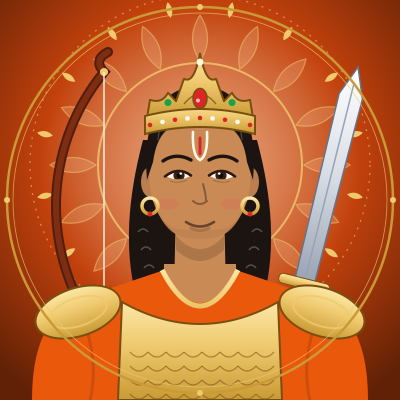
Abhimanyu was the son of Arjuna, the third Pandava, and Subhadra, the sister of Shri Krishna and Balarama. So Krishna was his maternal uncle, and Yudhishthira, Bhima, Nakula and Sahadeva were his father’s brothers. Draupadi’s five sons were his brothers and childhood companions. He married Uttara, the princess of the Matsya kingdom, and their son Parikshit later became king of Hastinapur and carried the family line forward. Abhimanyu was only about sixteen at the time of the war, yet great warriors said he was equal to his father in skill. On the thirteenth day he broke into Drona’s Chakravyuha and fought alone against many great warriors. His short life and great courage make his story one of the most moving in the whole epic.
The son of Arjuna and Subhadra
During his twelve years away from Indraprastha, Arjuna came to Dwarka and, with Krishna’s help, married Subhadra. They returned to Indraprastha, and there Subhadra gave birth to a son. He was named Abhimanyu, because he was fearless and full of fiery spirit, and the name itself means a hero of great courage. Brahmins were given gifts, and Indraprastha celebrated the birth of the new prince.
Vyasa tells a deeper story about his birth. When the gods took birth on earth to lighten its burden, the Moon god Soma sent his dear son Varchas to be born as Abhimanyu. But Soma could not bear to be separated from him for long, so he made a condition: his son would live on earth for only sixteen years and then return to him. That is why Abhimanyu’s life was so short, and so bright.
Krishna loved this nephew dearly, and the whole family delighted in him. Around the same time Draupadi gave birth to her five sons, and Abhimanyu grew up with them in Indraprastha, like brothers in one house.
Learning the art of war
Arjuna himself taught Abhimanyu archery. He gave him knowledge of all kinds of weapons, both human and divine, and of how to use them in every kind of battle. The boy learnt quickly, and people admired his strength, his skill and his sharp mind.
When the Pandavas lost the dice game and went to the forest, Subhadra took Abhimanyu to her brother’s city of Dwarka. There his training went on. Krishna’s son Pradyumna, himself a great warrior, taught him along with the young princes of the Yadava clan.
Abhimanyu grew up among the Yadava heroes, in the care of Krishna and Balarama. When Krishna visited the Pandavas in the forest, he gave them news of their sons and told them how eagerly the boys were learning the use of weapons. By the time the thirteen years of exile were over, Abhimanyu had become a skilled young chariot-warrior whom people compared with Arjuna himself.
Marriage to Uttara
In the last year of exile, Arjuna lived in King Virata’s palace disguised as Brihannala, teaching dance and music to the princess Uttara. When the Pandavas revealed who they were, the grateful Virata offered Uttara to Arjuna as his bride.
Arjuna declined. He said that for a whole year he had lived among the women of the palace and Uttara had trusted him like a father. To protect her good name and his own, he would accept her not as his wife but as his daughter-in-law, the wife of his son Abhimanyu, a youth worthy of her in every way.
Krishna and Balarama came to the city of Upaplavya with Subhadra and Abhimanyu, and the wedding was celebrated with great joy. Soon afterwards the peace talks failed. When the war began, Uttara was expecting their child.
The first twelve days of the war
Abhimanyu rode out with the Pandava army from the very first day. On that day he boldly faced the grandsire Bhishma himself, the oldest and greatest warrior of the Kauravas, and cut down his palm-tree banner, earning praise from both sides of the field.
Day after day he fought beside his uncles and his cousins, the sons of Draupadi, against famous warriors, among them Duryodhana’s son Lakshmana and King Shalya of Madra. He often came to the help of the Pandava army when it was hard pressed, and the young prince became one of the warriors the Kauravas feared most.
When Bhishma fell and Drona became commander, the Kauravas planned to capture Yudhishthira alive. To make this possible, the Trigarta warriors, called the Samshaptakas, swore to fight Arjuna to the death, and on the thirteenth day they drew him far away to another part of the field.
Into the Chakravyuha
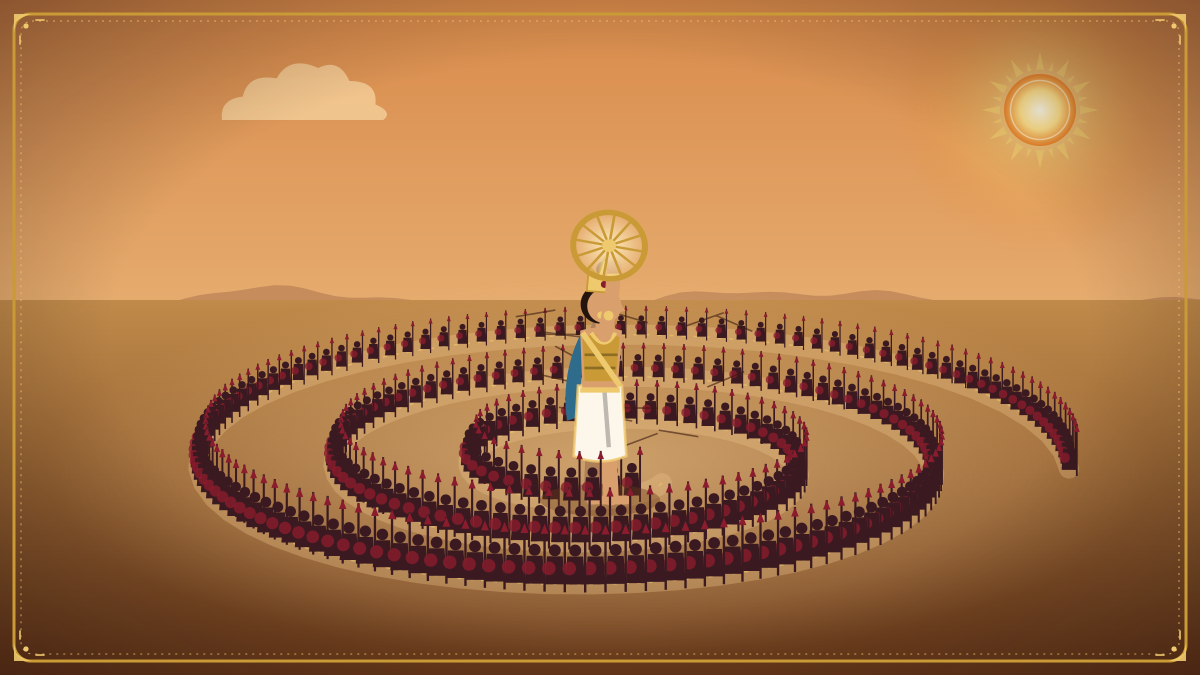
That day Drona arranged his army in the Chakravyuha, a great circular formation shaped like a wheel, with ring upon ring of warriors. Yudhishthira knew that only Arjuna, Krishna, Pradyumna and Abhimanyu could break into it. With Arjuna away, he turned to Abhimanyu and asked him to open the way.
Abhimanyu answered honestly: “My father taught me how to break into this formation, but if danger comes, I do not know how to come out.” Yudhishthira and Bhima promised to follow close behind him through the opening with the whole army. His charioteer Sumitra warned him that the task was too heavy for one so young, but Abhimanyu told him to drive on.
He broke through the front lines and entered. But Jayadratha, the king of Sindhu, rushed to the gap. Years before, after his attempt to carry off Draupadi, he had pleased Lord Shiva with penance and received a boon that for one day he could hold back all the Pandavas except Arjuna. Now he used it, and Yudhishthira, Bhima, Nakula, Sahadeva and the others could not get through. Abhimanyu was alone inside.
Alone, he fought like a fire in dry grass. He wounded Shalya, made Dushasana faint in his chariot so that his charioteer had to carry him away, and drove back Karna himself. He killed Duryodhana’s young son Lakshmana, King Brihadbala of Kosala and many others, and the Kaurava ranks began to scatter. Drona himself praised him openly, saying that no archer could equal him. Then Drona told Karna that the boy’s armour could not be pierced and he could not be defeated face to face, so his bow must be cut from behind and his horses and charioteer struck down.
So several great warriors, among them Drona, Karna, Kripa, Ashwatthama and Kritavarma, attacked him together. Karna cut his bow, and others struck down his horses and charioteer. Without a chariot, Abhimanyu fought on with sword and shield, and when these were broken he lifted a chariot wheel, and then a mace. At last, in a mace fight with Dushasana’s son, both fell to the ground. Dushasana’s son rose first and struck Abhimanyu as he was getting up, and the young hero fell. Voices were heard saying that this was not right, for many had fought against one.
Aftermath and Parikshit
That evening the Pandava camp was silent with grief. Yudhishthira wept, blaming himself for sending the boy into danger and for failing to follow him. Vyasa came and comforted him with the ancient story of how Death was created, explaining that every being born must one day die, and that Abhimanyu, who fell facing the enemy, had gone to the shining worlds of heroes.
When Arjuna returned from fighting the Samshaptakas, he saw the camp without its usual joy and sensed that something terrible had happened. On hearing how his son had died, and how Jayadratha had blocked the way, his grief turned into a vow: he would kill Jayadratha before sunset the next day, or enter the fire himself. On the fourteenth day, with Krishna’s help, he kept his word.
Subhadra and Uttara were heartbroken, and Krishna consoled his sister and the young widow. After the war Ashwatthama turned a terrible weapon against the unborn heirs of the Pandavas, and Uttara’s child was born without life. Krishna kept his promise and brought the baby back to life.
The child was named Parikshit, because he was born when the Kuru family had almost been destroyed. He became king of Hastinapur after the Pandavas, and through him the line of Arjuna and Abhimanyu continued. At the end of the epic, Yudhishthira learns in heaven that Abhimanyu has returned to the Moon god, just as had been promised.
Did you know?
- Abhimanyu was only about sixteen years old when he fought and fell in the Kurukshetra war.
- The epic says Abhimanyu was a part of Varchas, the son of the Moon god, who sent his son to earth only for a short time.
- King Virata first offered Uttara to Arjuna, but Arjuna, as her dance teacher, asked that she marry his son Abhimanyu instead.
- Abhimanyu’s son Parikshit became king of Hastinapur, and Parikshit’s son Janamejaya is the king who heard the Mahabharata recited.
What we learn from Abhimanyu
Abhimanyu teaches us that courage and duty do not depend on age. He was honest about what he did not know, yet he did not step back when his family needed him. His story also reminds us to learn a thing completely, and that a life is measured by its goodness, not its length.
Abhimanyu in the story
Read the chapters where Abhimanyu plays a part.