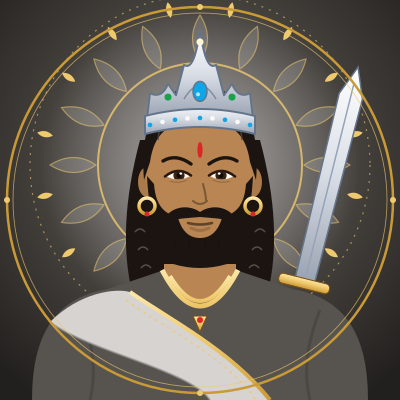
Jayadratha was the king of Sindhu, a kingdom along the river Indus, and the son of King Vriddhakshatra. He married Duhshala, the only daughter of Dhritarashtra and Gandhari, so he was the brother-in-law of Duryodhana and all the hundred Kauravas. Through Duhshala he was family to the Pandavas too, for they loved her as their sister. Jayadratha is remembered for two great wrongs: trying to carry Draupadi away during the forest exile, and holding the Pandavas back at the gate of the Chakravyuha on the day young Abhimanyu was killed. His story ends with Arjuna’s famous vow, and with a strange curse that his own father had spoken long before.
The prince of Sindhu
When Jayadratha was born, a voice from the sky announced that he would become a famous king, but that one day a great warrior would cut off his head in battle. His father, King Vriddhakshatra, was filled with fear for his son.
Using all the power of his long years of penance, Vriddhakshatra declared before everyone, “Whoever makes my son’s head fall to the ground in battle, that man’s own head will burst into a hundred pieces.” When Jayadratha grew up, his father placed him on the throne of Sindhu and went away to the forest near Kurukshetra to live as a hermit.
Jayadratha married Duhshala and became a close ally of Duryodhana. As the son-in-law of the Kuru house, he was respected at Hastinapur, and the Pandavas, for their sister’s sake, treated him as family.
Draupadi carried away
During their forest exile, the Pandavas were living in the Kamyaka forest. One day the five brothers went out hunting, leaving Draupadi at the ashram with their priest Dhaumya. Just then Jayadratha passed by with his army, on his way to seek a bride. Seeing Draupadi standing at the door of the hermitage, he was struck by her beauty and sent a companion to ask who she was.
Draupadi told them who she was and, as a good hostess, welcomed Jayadratha as a relative, saying the Pandavas would soon return and honour him. But Jayadratha told her to leave the Pandavas, who had lost their kingdom, and become his queen. Draupadi refused him firmly and warned him of the Pandavas’ anger.
Jayadratha would not listen. He seized Draupadi and forced her into his chariot. Dhaumya followed on foot behind the chariot, calling on him to stop and reminding him of the law of kings. Jayadratha drove away fast.
Punishment and Shiva’s boon
When the Pandavas returned and heard what had happened, they rushed after him. They scattered his army, and Jayadratha jumped down from his chariot and ran away to save his life, leaving Draupadi behind. Before Bhima and Arjuna went after him, Yudhishthira said, “Do not kill him. Think of our sister Duhshala and of mother Gandhari.”
Bhima caught Jayadratha and, to shame him, shaved his head leaving five tufts of hair, and made him say aloud that he was the servant of the Pandavas. Then he brought him bound before Yudhishthira. Yudhishthira kindly set him free and told him never to do such a thing again.
Burning with humiliation, Jayadratha did not go home. He went to Gangadwara and prayed to Lord Shiva with severe penance. Pleased, Shiva offered him a boon. Jayadratha asked to defeat all the Pandavas. Shiva said, “For one day in battle you will be able to hold back four of the Pandavas, but not Arjuna, who is protected by Narayana himself.”
At the gate of the Chakravyuha
On the thirteenth day of the Kurukshetra war, Drona arranged his army in the Chakravyuha, the wheel formation. Arjuna had been drawn away to another part of the field. Young Abhimanyu, who knew how to break into the formation but not how to come out, cut his way in, and Yudhishthira, Bhima and the other heroes followed close behind to protect him.
But Jayadratha stood at the opening that Abhimanyu had made. That day the boon of Shiva gave him strength, and one by one he held back all the Pandava warriors. No one could get past him. Abhimanyu was left alone inside, surrounded by many great warriors, and he fell fighting bravely.
When Arjuna came back that evening and learned how his son had died, he was overwhelmed with grief and anger. He made a terrible vow: “If I do not kill Jayadratha before the sun sets tomorrow, I will enter the fire myself.”
The fourteenth day and his end
Hearing the vow, Jayadratha was so frightened that he wanted to run home to Sindhu. Duryodhana and Drona persuaded him to stay, and Drona promised to protect him. On the fourteenth day Drona built a huge formation and placed Jayadratha far behind it, guarded by the greatest Kaurava warriors.
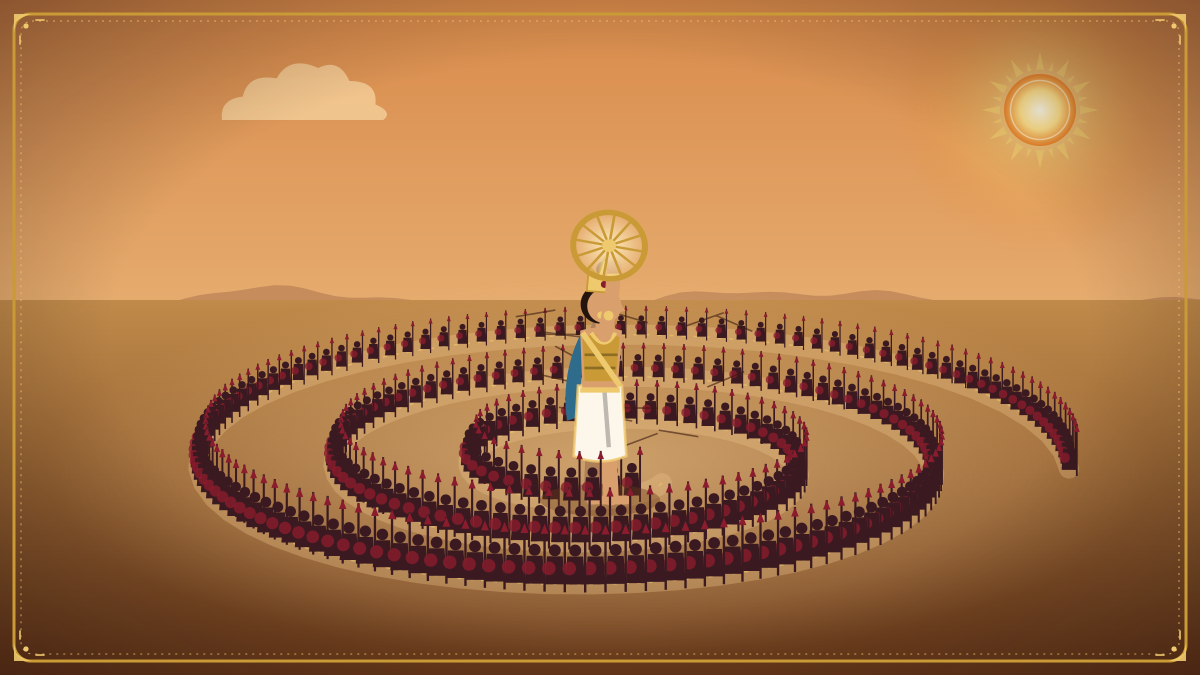
All day Arjuna fought his way forward with Krishna driving his chariot. He broke through line after line, but the sun was sinking fast. Then Krishna, by his yogic power, spread a darkness that hid the sun. The Kauravas thought the sun had set and Arjuna’s vow had failed. Jayadratha came out joyfully and looked up at the sky. At that moment the sun shone again, and Krishna told Arjuna, “Strike now.”
Krishna also reminded Arjuna of Vriddhakshatra’s curse. So Arjuna shot his arrows in such a way that Jayadratha’s head was carried far away and dropped into the lap of his father, who was sitting in evening prayer. When the old king rose, unaware, the head fell to the ground, and by the power of his own words Vriddhakshatra’s life ended too.
Years after the war, when Arjuna came to Sindhu following the horse of Yudhishthira’s Ashvamedha sacrifice, Jayadratha’s son Suratha died of fear on hearing of his arrival. Duhshala came out with her little grandson and begged Arjuna for peace. Arjuna gently comforted his sister, blessed the child and went on his way.
Did you know?
- Duhshala, Jayadratha’s wife, was the only daughter among the hundred and one children of Dhritarashtra and Gandhari.
- Bhima shaved Jayadratha’s head leaving five tufts, one for each Pandava.
- Shiva’s boon let Jayadratha hold back four Pandavas for one day, but never Arjuna.
- Jayadratha’s father had vowed that whoever made his son’s head fall to the ground would die, and in the end the vow fell on himself.
What we learn from Jayadratha
Jayadratha teaches us that a boon or power gained through prayer must be used for good. He was forgiven once, but instead of changing his ways he nursed his anger and sought revenge. His story reminds us that pride and grudges lead only to ruin, both for ourselves and for those who love us.
Jayadratha in the story
Read the chapters where Jayadratha plays a part.