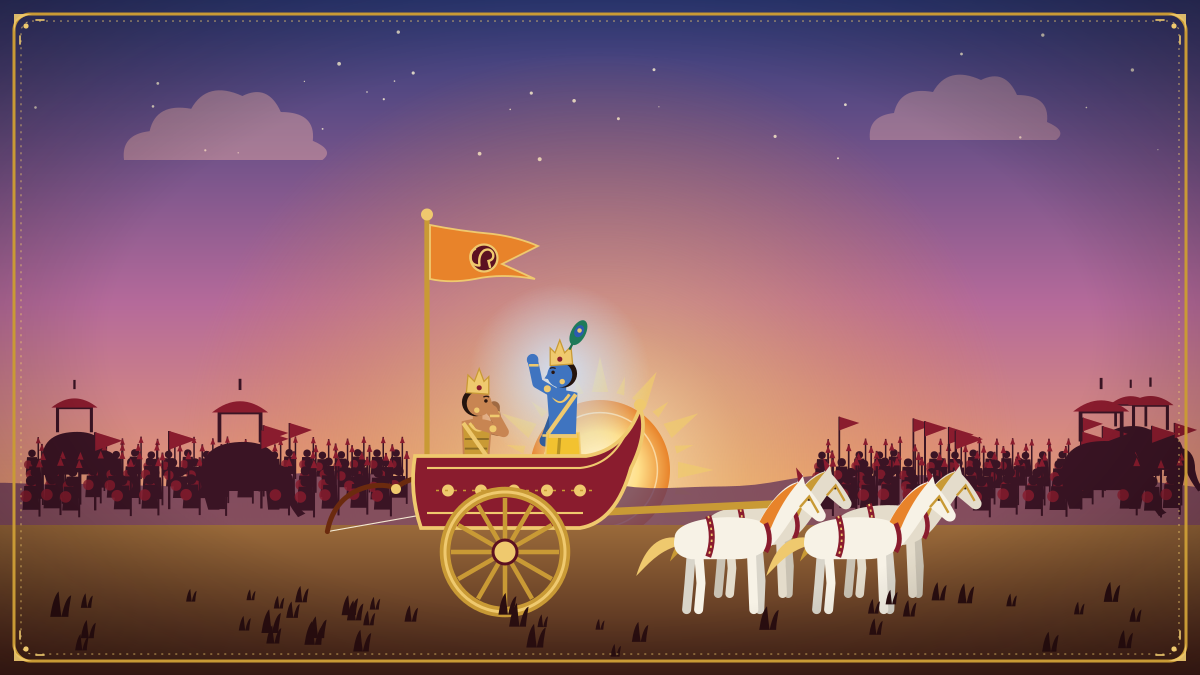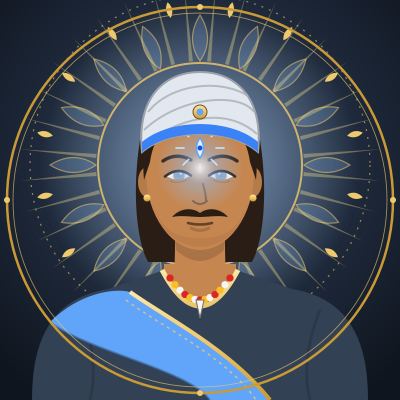
Sanjaya, the son of Gavalgana, was the charioteer and trusted counsellor of Dhritarashtra, the blind king of Hastinapur. He belonged to the suta community, whose people drove chariots and served kings as advisers and storytellers. Sanjaya was gentle, wise and honest. Again and again he told the king the truth, even when it was bitter. Before the war he went as Dhritarashtra's messenger to the Pandavas. When the armies gathered at Kurukshetra, the sage Vyasa gave him divine sight, so that he could see everything that happened on the battlefield and tell it to the king. It is through Sanjaya's words that we hear the story of the war and the holy Bhagavad Gita. He stayed by the old king's side through every sorrow, right up to the end.
The king's eyes and ears
Dhritarashtra was born blind, so all his life he depended on others to see for him. Of all those around him, Sanjaya was the closest. He drove the king's chariot, sat with him in council and carried his messages. The epic often calls him Gavalgani, “the son of Gavalgana”.
Sanjaya respected both the Kauravas and the Pandavas. He could see clearly that Duryodhana's greed and jealousy were leading the family toward ruin, and he did not hide this from the king. Many times he told Dhritarashtra that he should control his son and give the Pandavas their rightful share.
In fact, the Mahabharata itself opens with Sanjaya at the king's side. In the Adi Parva, the grieving Dhritarashtra recalls, one by one, every piece of news that took away his hope of victory, and it is to Sanjaya that he pours out his heart.
Messenger to the Pandavas
When the Pandavas' thirteen years of exile were over, they asked for their kingdom back. Dhritarashtra did not want war, but he also did not want to take anything away from Duryodhana. So he sent Sanjaya to the Pandavas at Upaplavya, in the kingdom of Matsya.
Yudhishthira welcomed Sanjaya warmly and asked about the well-being of everyone in Hastinapur. Sanjaya delivered the king's message: war would destroy both families, and peace was the best path. He even said that it would be better for the Pandavas to live on alms than to win a kingdom by killing their own relatives.
Yudhishthira replied that he did not want war either, but he would not give up what was rightfully his. Then he made a very small request. He asked Sanjaya to tell Duryodhana: “Give us just five villages — Avisthala, Vrikasthala, Makandi, Varanavata, and any one more as the fifth — and let there be peace.” Krishna too spoke to Sanjaya, saying he would go to Hastinapur himself to try for peace.
Sanjaya returned late at night. Before leaving the king, he spoke sharply and told him that he would be blamed for the coming destruction. He said he would give the full message in the assembly the next day. That night, Dhritarashtra could not sleep and sent for Vidura. In the morning, Sanjaya reported everything in the royal court, but Duryodhana would not agree to peace.
Telling the king who Krishna is
Before the war, in the presence of Vyasa and Gandhari, Dhritarashtra asked Sanjaya about Krishna. Sanjaya spoke of him not just as a great hero, but as the Lord himself, who holds the whole world in his hands.
Dhritarashtra asked how Sanjaya knew this when he himself did not. Sanjaya answered that he did not follow illusion, that his heart had been made pure by devotion, and that he knew Krishna through the scriptures.
Then he explained the meanings of Krishna's names. He is Vasudeva because all beings dwell in him, Vishnu because he pervades everything, and Krishna because his name joins two sounds meaning “existence” and “bliss”. Sanjaya gently urged the king to take refuge in Krishna.
The gift of divine sight
When the two armies stood ready at Kurukshetra, Vyasa came to his son Dhritarashtra. He offered to give him sight so that he could watch the battle. The king refused. He said he did not wish to see his own family being killed, but he wanted to hear about everything.
So Vyasa gave his gift to Sanjaya instead. He said, “Sanjaya will tell you about this war. Nothing will be hidden from him — whether it happens in the open or in secret, by day or by night, even what people only think in their minds. Weapons will not wound him and he will not grow tired. The son of Gavalgana will come out of this war alive.”
With this sight, Sanjaya first described to the king the shape of the earth and its lands. He also went among the armies himself. On the tenth day he returned from the battlefield with terrible news: “I am Sanjaya. Bhishma, grandfather of the Bharatas, has fallen.” Then, at the king's request, he began to tell the whole war from the beginning.
The voice of the Bhagavad Gita
The Bhagavad Gita is part of Sanjaya's telling. It begins with Dhritarashtra's question: “O Sanjaya, gathered at Kurukshetra, the field of dharma, eager to fight, what did my sons and the sons of Pandu do?” Sanjaya then described how Arjuna lost heart on seeing his own family in both armies, and how Krishna taught him.
Sanjaya also described the Vishwarupa, Krishna's universal form, which he saw through Vyasa's gift. He said that if the light of a thousand suns were to rise in the sky at once, it might be like the brilliance of that great being. In that form the whole universe, with all its many divisions, could be seen together.
At the end of the Gita, Sanjaya spoke from his own heart. He said that by the grace of Vyasa he had heard this supreme and secret teaching straight from Krishna, the Lord of yoga. Remembering that wonderful conversation and that wonderful form of Hari again and again, he was filled with amazement and joy, again and again.
His very last words in the Gita are among its best known: “Wherever there is Krishna, the Lord of yoga, and wherever there is Arjuna, the archer, there, I believe, are fortune, victory, prosperity and lasting righteousness.”
Bearer of hard news
As the war went on, Sanjaya had to bring the king one painful message after another: the fall of Bhishma, then of Drona, of Karna and of Shalya. Each time Dhritarashtra wept and asked how it had happened, and each time Sanjaya told him honestly. Often he reminded the king that this suffering was the result of his own wrong choices.
On the eighteenth day, near the end of the fighting, Satyaki captured Sanjaya. Dhrishtadyumna said that he should be killed, and Satyaki raised his sword. Just then Vyasa appeared and said that Sanjaya must be set free and not harmed. Satyaki bowed, folded his hands and released him.
On his way back, Sanjaya found Duryodhana alone, wounded, mace in hand. Duryodhana asked him to tell his father that he had entered the lake to rest. Sanjaya then met Kripacharya, Ashwatthama and Kritavarma, the last surviving Kaurava warriors, and told them where the king was.
When Duryodhana finally died, the divine sight that Vyasa had given to Sanjaya left him. His special task was over.
Consoler and companion to the end
With all his hundred sons gone, Dhritarashtra was broken with grief. Sanjaya sat beside him and spoke gently. He reminded him that grief cannot bring back the dead, and that even the greatest kings of old, mighty, generous and famous, had all one day left this world. He told the king to be steady and do what had to be done for the departed.
Years later, when Dhritarashtra, Gandhari and Kunti left Hastinapur to live in the forest as hermits, Sanjaya went with them. Vidura went too. Sanjaya served the old king in the forest just as he had served him in the palace.
When the Pandavas came to visit them in the forest, the hermits there did not know who was who. Sanjaya introduced each of the brothers and their wives to the hermits, one by one.
Some time later, the sage Narada brought sad news to Yudhishthira. A forest fire had reached the hermitage, and Dhritarashtra, Gandhari and Kunti had calmly given up their bodies to it. Dhritarashtra had told Sanjaya to go to safety, and Sanjaya escaped the fire. After telling the hermits what had happened, he went away to the Himalayas.
Did you know?
- The first verse of the Bhagavad Gita is Dhritarashtra’s question to Sanjaya, and the last verse is spoken by Sanjaya himself.
- Vyasa promised Sanjaya that no weapon would harm him and that he would not grow tired while watching the war.
- Sanjaya first told the king that Bhishma had fallen, and only then narrated the first ten days of the war from the beginning.
- It was through Sanjaya that Yudhishthira sent his famous request for just five villages to avoid war.
What we learn from Sanjaya
Sanjaya teaches us to speak the truth clearly but kindly, even to the most powerful person in the room. He served faithfully through good times and bad, never leaving the old king even in his darkest days. Through his clear eyes and humble heart, the words of Krishna reached the whole world. A faithful servant who loves the truth can become a channel for great blessings.
Sanjaya in the story
Read the chapters where Sanjaya plays a part.